First-Time Manager Journeys
From individual contributor to confident people leader
Build the judgment, people leadership and confidence to move from individual contributor to manager.
Why it matters
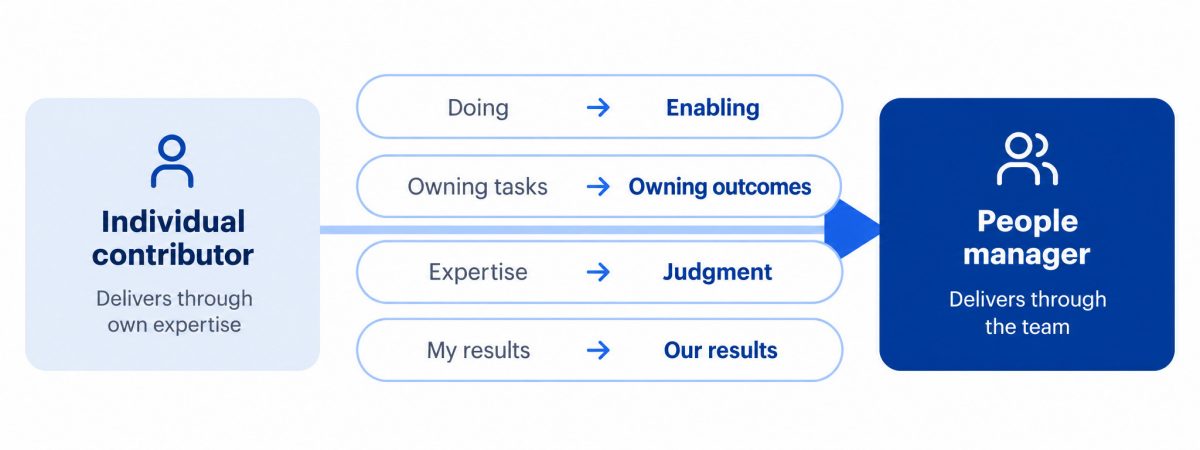
Your best performers were promoted for what they do. Now they are measured on what their team does.
The first management role is one of the most consequential transitions in a career. Technical credibility now has to be matched by people judgment, and individual results give way to results delivered through others. Left to chance, this shift costs teams momentum and creates avoidable people risk.
Signs you need this

Uneven people leadership
Feedback, performance conversations and team management vary widely across teams and locations.

Slow transitions
Strong individual performers take too long to start delivering through their teams.

Avoidable people risk
New managers mishandle difficult conversations, conflict or performance issues.

A thin pipeline
Too few managers are ready for the next leadership role.
The shift every new manager has to make
The journey is built around four shifts that define the move into people leadership.
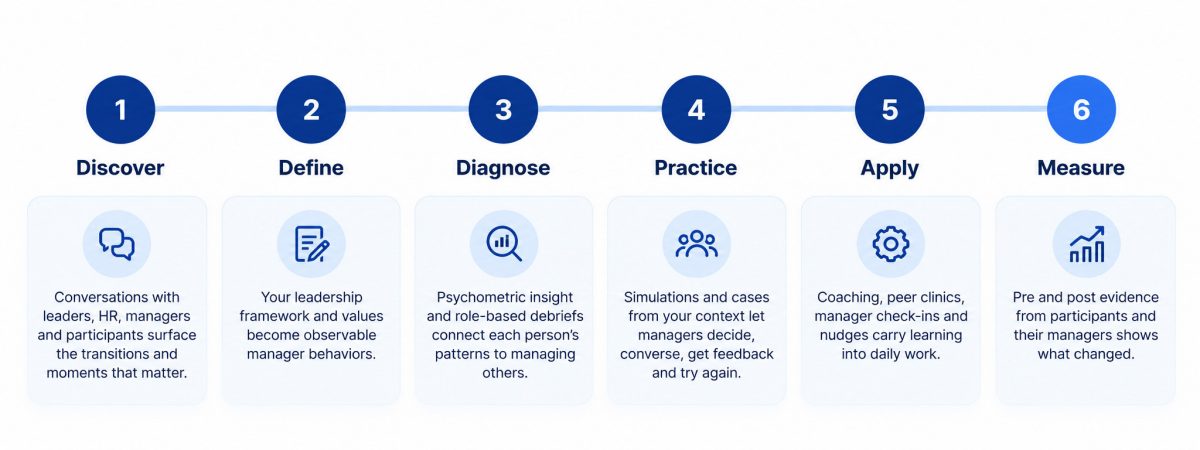
How it works
What changes for your organization

Faster time to impact
New managers start delivering through their teams sooner.

One standard of people leadership
Feedback, performance and team practices become consistent across teams and sites.

Fewer people escalations
Managers handle sensitive situations with confidence and judgment.

A stronger leadership bench
A pipeline of managers ready for larger roles.
What you receive
✓ An individual development plan for every manager
✓ Practical tools, conversation guides and job aids
✓ Pre and post evidence of behavior change
✓ A cohort view of strengths and development themes
Why SHRM

Built on your reality
Designed around how management works in your organization.

Practice over theory
Every framework is tied to a situation managers genuinely face.

Diagnostics that develop
Assessments shape each manager’s development plan.

Seasoned practitioners
Facilitators, coaches and assessors with deep HR and leadership experience.
Who it is for
• Managers in their first one to two years of leading a team
• Organizations moving technical experts into people roles
• HR and L&D teams building a consistent standard of people leadership
Ways to engage
Foundation journey | Manager simulation lab | Psychometric debrief and development planning | Manager-as-Coach pathway | Manager excellence academy
Give your new managers a stronger start.
Talk to us about a first-time manager journey built around your organization.
Leadership Development
SHRM’s Leadership Development solutions are designed around a fully customized, business-aligned approach - from understanding organizational priorities and leadership challenges to creating content, experiences, and interventions tailored to the specific needs of the organization.
We develop leaders across the entire leadership pipeline, from first-time managers and emerging leaders to senior leaders and CXO-level executives. Our offerings span critical areas such as Inclusion & Diversity (I&D), Sales Force Effectiveness, AI Skilling for HR, and Hi-Potential Leadership Journeys, enabling organizations to build the capabilities required for both current performance and future growth.
Our online learning journey platform creates a highly engaging pre-, during-, and post-program development experience, extending learning beyond the classroom and encouraging continuous application. Complementing this is our AI-powered skill practice bot, which provides leaders with a safe, simulated environment to practice critical leadership conversations and behaviours, while receiving nuanced, personalized feedback to strengthen their effectiveness.
We also focus on demonstrating impact-not just participation. Through pre - and post-program assessments, we evaluate behavioural change and measure Kirkpatrick Level 3 impact, helping organizations understand whether learning has translated into observable changes in workplace behaviour.
From customized content to immersive learning, AI-enabled practice, and measurable behavioural impact, SHRM helps organizations build leaders who are ready to lead today and prepared for tomorrow.
SHRM Coaching Practice
At SHRM, our coaching practice is designed to empower leaders and professionals to reach their full potential through personalized, impactful development. With a deep understanding of workplace dynamics and leadership challenges, we offer coaching that goes beyond traditional models rooted in real-world business insights and delivered by experienced practitioners who understand the nuances of human capital. Our approach is practical, forward-looking, and tailored to each individual, helping organizations build stronger, more agile leaders capable of navigating today’s complex workforce landscape.
Why Coaching?
Coaching is a powerful development tool that goes far beyond addressing performance issues. While it can be used reactively to support individuals facing specific challenges, it is equally valuable as a proactive strategy to accelerate growth, enhance leadership effectiveness, and prepare high-potential talent for future roles. Whether navigating a new leadership position, driving strategic change, or building influence across teams, coaching provides a focused, confidential space for reflection, skill-building, and sustained performance.
Benefits of Coaching:
When done well, coaching delivers transformative benefits across individuals, teams, and the organization.
For individuals, it helps navigate uncertainty, enhances self-awareness, and builds critical behavioral skills that drive high performance. It provides focused support during career transitions and prepares leaders to meet evolving expectations with confidence and clarity.
At the team level, coaching fosters the creation of sensitized and aligned groups that operate with shared values and collective goals. It encourages empowerment by unlocking potential and promoting effective collaboration.
On an organizational scale, a strong coaching culture leads to reduced turnover, improved performance, and increased revenue. It contributes to a more positive work environment, nurtures a healthier culture, stimulates innovation, and encourages open dialogue and inquiry creating a workplace where people and business thrive together.
Why Coaching Fails?
- Undefined goals lead to lack of focus
- Alignment with personal and organizational goals is critical
- Executive may resist feedback due to ego or fear of change
- Openness is essential for growth
- Lack of trust hinders honest discussions
- Strong rapport boosts engagement
- Minimal effort leads to limited progress
- Coaching should be viewed as a growth opportunity
- Immediate fixes overlook long-term growth
- Balance between short- and long-term goals is needed
- Lack of metrics makes tracking progress difficult
- Measurable milestones maintain momentum
Executive Coaching
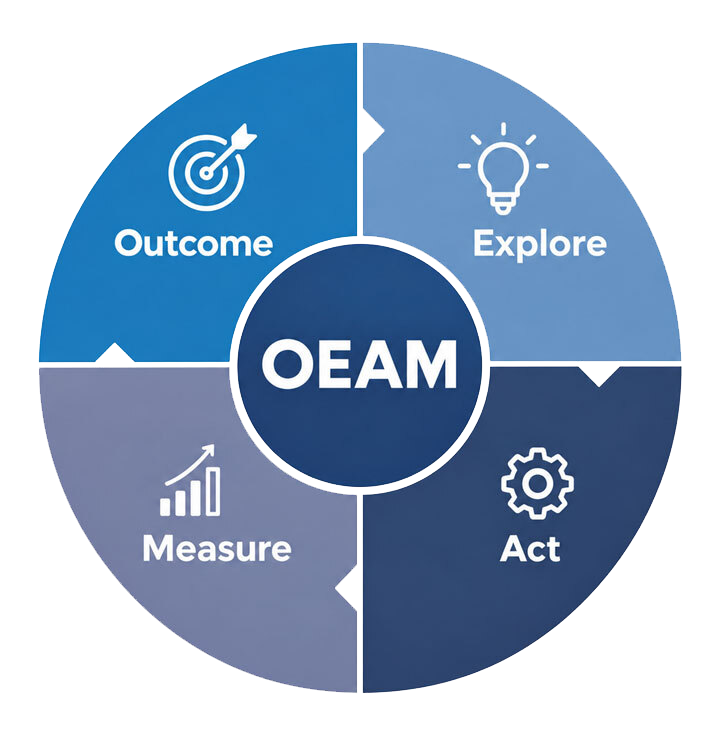
The SHRM OEAM Coaching Model provides a structured yet flexible framework designed to drive meaningful development and measurable outcomes. It guides the coaching journey through four key stages: Outcome, Explore Options, Act on the Plan, and Measure the Results. This model ensures that coaching conversations are focused, actionable, and aligned with both individual aspirations and organizational goals. By clearly defining desired outcomes, exploring realistic pathways, driving accountability through action, and regularly assessing progress, the OEAM model empowers individuals to take ownership of their growth while enabling organizations to see tangible impact from their coaching investments.
Outcome you want to Achieve?
- It all starts with the Why of Coaching? If Why is strongly defined, the What’s and How’s become easy.
- Identifies and clarifies the outcome; The End Game
- Clarifies the desired result from the session
Explore Options
- Understand & Explore the Motivations, Aspirations, Wants & Desires
- Explore different perspectives
Act on the Plan
- Basis the end outcomes and motivations, a detailed action plan is laid down
- Provides understanding of what has been learned and what can be changed to achieve the initial goals
- Using SMART objective define each element of the plan and timelines
- Provides understanding of internal / external obstacles and blocks currently preventing progression
Measure the Results
- Creates a summary and plan of action for implementation of the identified steps
- Highlights how accountability and achievement of the goals will be ensured.
Transition Coaching
The SHRM Transition Coaching Model is thoughtfully designed to support individuals navigating critical shifts in their careers, such as taking on new leadership roles, moving across functions, or adapting to organizational change. This model focuses on building clarity, confidence, and capability during moments of transition, helping leaders align quickly with new expectations and environments.
Through a structured approach that blends strategic insight with empathetic guidance, combining self-reflection, targeted skill-building, and forward-looking strategies, the SHRM Transition Coaching Model ensures that individuals are not only prepared for change but positioned to thrive within it accelerating their impact and reducing the time it takes to become fully effective in their new roles.
What is Transition Coaching?
Transition coaching focuses on helping individuals identify and manage the challenges associated with life transitions. These transitions can include career changes, relocation, relationship shifts, retirement, or any other significant life event that requires adjustment. The coach acts as a guide, providing support, tools, and strategies to help clients navigate these changes effectively.
Benefits of Transition Coaching
- Clarity and Focus: Transition coaching helps individuals clarify their goals and priorities during times of change, allowing them to focus on what truly matters.
- Emotional Support: Life transitions can be emotionally taxing. A transition coach provides a safe space for clients to express their feelings and concerns, fostering emotional resilience.
- Skill Development: Coaches equip clients with essential skills such as decision-making, problem-solving, and stress management, which are crucial during transitions.
- Accountability: Regular coaching sessions create a structure for accountability, encouraging clients to take actionable steps towards their goals.
- Personal Growth: Transition coaching promotes self-discovery and personal development, enabling individuals to emerge from transitions with a stronger sense of self.
The Coaching Process
The transition coaching process typically involves several key steps:
- Assessment: The coach conducts an initial assessment to understand the client's current situation, challenges, and aspirations.
- Goal Setting: Together, the coach and client establish clear, achievable goals related to the transition.
- Action Planning: The coach helps the client develop a strategic action plan, outlining the steps needed to achieve their goals.
- Support and Guidance: Throughout the coaching relationship, the coach provides ongoing support, encouragement, and feedback
- Reflection and Adjustment: Clients are encouraged to reflect on their progress and make adjustments to their plans as needed.
Transition coaching is a valuable resource for individuals facing significant life changes. By providing clarity, emotional support, and practical strategies, transition coaches empower clients to navigate their transitions with confidence and resilience. Whether you are experiencing a career shift, a personal transformation, or any other major life event, transition coaching can help you embrace change and emerge stronger on the other side.
Women’s Leadership Journeys
Build the capability and presence to lead at the next level
Journeys that build the capability, presence and visibility women need to step into senior roles.
Why it matters
Many programs for women leaders create goodwill. The senior leadership team still looks the same.
Three things usually explain the gap. Programs build skills and leave leadership identity untouched. They run once, leaving no alumni or role models. And participants return to the same managers and talent processes that shaped the gap. Our journeys are designed to address all three.
Signs you need this

Thin representation at the top
Reasonable numbers at entry level, very few in the senior operating line.

Capable women who are not seen
Strong performers whose visibility stays within their own function.

Generic development
The same programs as everyone else, with no attention to leadership identity.

One-off programs
A single cohort that is never repeated, leaving no momentum.
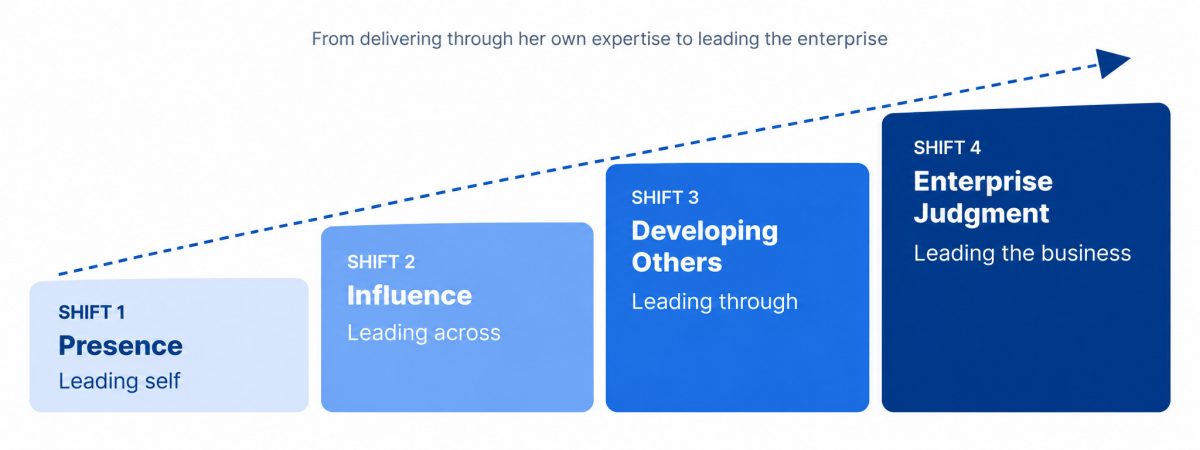
The Four Shifts
SHRM’s women’s leadership lens: four shifts that together describe readiness for the next level. Each cohort’s baseline decides where the journey concentrates.
How it works
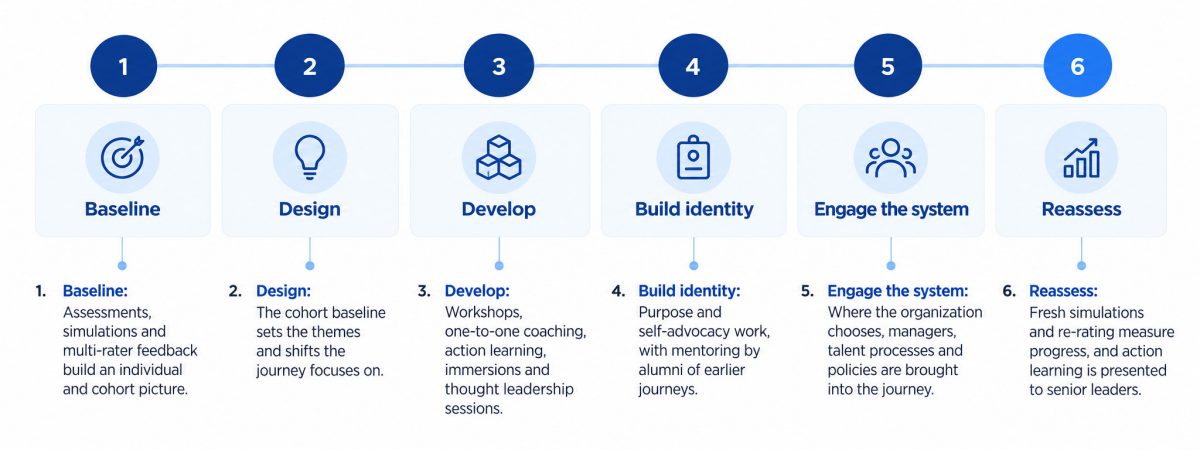
What changes for your organization

More women ready for senior roles
A visible, assessed pool of women prepared for the next level.

Greater visibility in talent decisions
Women leaders known beyond their function and present in succession conversations.

A self-sustaining network
Alumni who mentor and model the way for each new cohort.

Evidence of progress
Baseline and reassessment data that shows real movement.
What you receive
✓ A capability baseline per participant and a cohort picture
✓ An individual development plan reviewed with each participant’s manager
✓ Action learning output presented to senior leadership
✓ Reassessment evidence at individual and cohort level
✓ An alumni group that mentors the next cohort
Why SHRM

Capability and identity together
Skills work matched by deliberate work on how women see themselves as leaders.

Built to repeat
Alumni become mentors, turning a program into an institution.

One platform for the journey
Coaching, materials and gamified tasks run in sequence on SHRM’s platform.

Measured at both ends
Reassessment held to the same rigor as the baseline.
Who it is for
• Emerging women leaders in middle management
• Senior women preparing for enterprise and board roles
• Organizations committed to building a lasting women’s leadership pipeline
Journey at a glance
Four to eight months | 20 to 30 women per cohort | Around 120 contact hours | Virtual, in person or blended
Build a women’s leadership pipeline that lasts.
Talk to us about a journey designed to run beyond one cohort.