Analytics with Benefits
Harness the Power of Next-Gen Data Tools to Rein in Health Spending and Optimize Employee Care

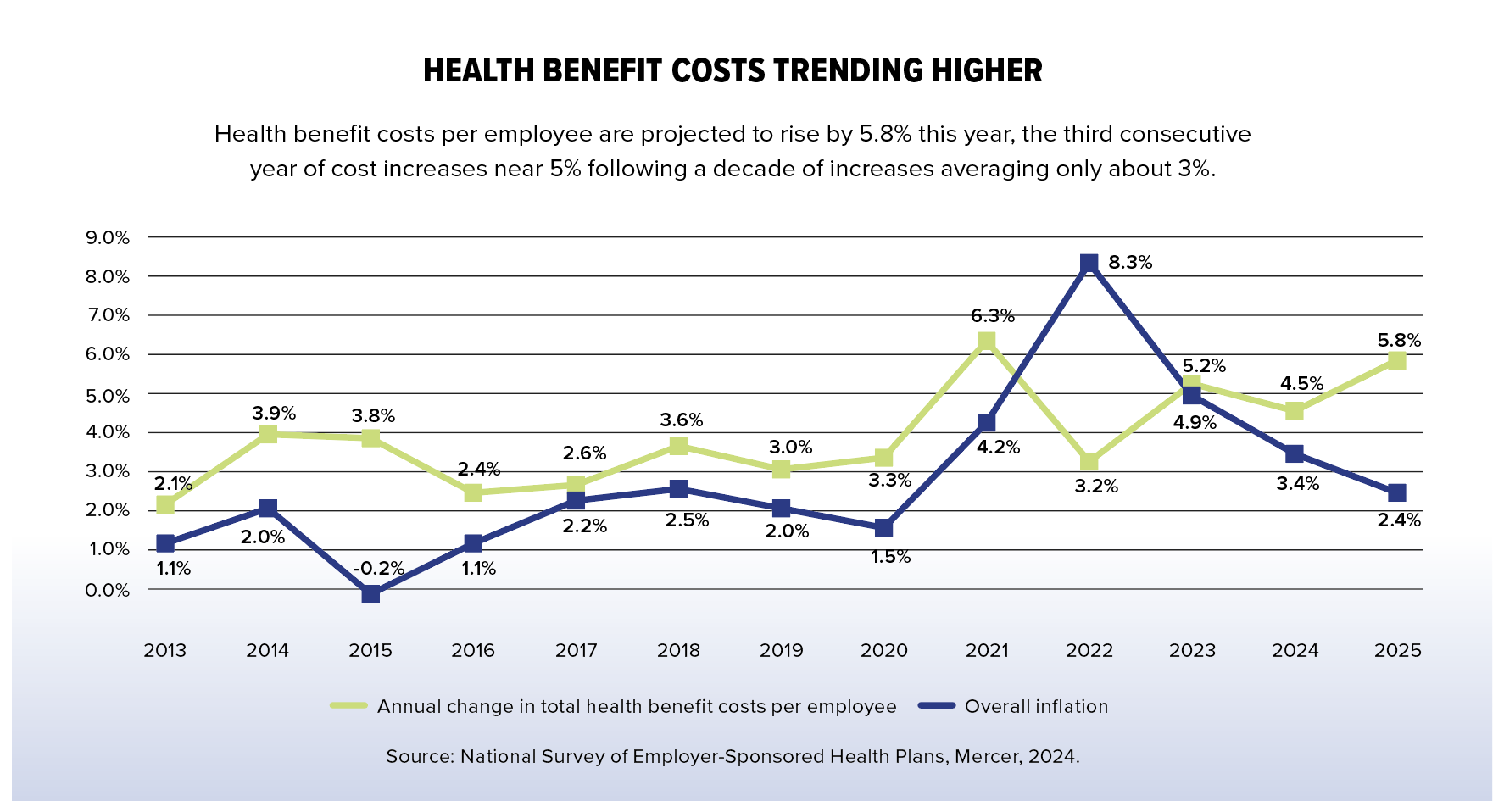
Rising health care costs have long been a thorn in the side of employers. In 2025, health benefit cost increases are expected to run near or above 5% for the third consecutive year after a decade of average increases near 3%. However, new technologies are helping organizations tilt the cost battle back in employers’ favor.
Powered by predictive analytics and machine learning, a new wave of digital tools is helping organizations fine-tune their benefits plans and curb unnecessary spending. It’s not just about cutting costs — it’s about getting smarter and delivering more personalized care to employees.
CHROs have labored for decades to design benefits plans that attract and retain top talent but don’t fan the flames of rising health care expenses. Historically they’ve sought to achieve that balance by using cost-containment strategies such as increasing benefit plan deductibles or directing employees to high-performance networks that promise more cost-effective care. But the reality is that many of the levers that HR executives have pulled in the past to rein in health care costs have also undermined a key component of their employee value propositions: using benefits as a top job perk.
Studies show workers (particularly those in Generation Z) are increasingly willing to switch jobs for better health care benefits. And health care continues to be the most-valued benefit among employers, with 88% rating it “very important” or “extremely important,” according to the 2025 SHRM Employee Benefits Survey.
To future-proof their organizations against spiraling health care costs, more CHROs are turning to next-generation technologies and artificial intelligence. Tools such as predictive analytics software, “nudge tech” systems, and fast-evolving machine learning can help CHROs better analyze their benefits data to detect cost trends, predict future health care use patterns, incentivize employees toward desired behaviors, and slash administrative labor costs for benefits programs.
So far, the headline-grabbing uses of AI in HR have focused on improving tasks such as writing job descriptions and screening candidates. But behind the scenes, evolving software and digital tools can bring direct bottom-line value in the benefits arena by giving CHROs improved insights into benefits usage patterns and identifying employees at risk of developing chronic (and costly) conditions.
Capitalizing on the benefits of those tools requires that CHROs re-evaluate and modernize their HR technology stacks. A recent industry study found, for example, that 8 in 10 employers still rely solely on spreadsheets to analyze their employee benefits data. Spreadsheets are inexpensive and easy to use. But they have limitations, including an inability to provide real-time analytics, integrate disparate benefits data, and create adequate data security protections.
Analysts say more advanced, specialized software can provide the sophisticated and scalable capabilities needed by CHROs to tackle the complex benefits cost containment challenge.
A Shift Toward Cost Control
Health benefit costs per employee are projected to rise 5.8% this year, even after cost-reduction efforts taken by organizations, according to a Mercer study. A handful of factors are driving the escalation in costs, including:
- An increase in cancer-related costs due to more employees being diagnosed at advanced stages of the disease.
- The expense of increasingly popular drugs such as GLP-1s for weight loss, which can cost up to $1,500 per employee per month.
- Health care providers raising prices due to factors such as staffing shortages or to regain revenue lost during the pandemic.
- Growing behavioral health costs associated with a rise in employee anxiety and depression.
Escalating cost increases — and the prospect of continuing health care price inflation in 2026 — have caused CHROs and their C-suite colleagues to rethink benefits strategies. The Mercer survey found that more than half of employers (53%) planned to make cost-cutting changes to their benefit plans in 2025, up from 44% in 2024. The spike in employers focused on cost control represents a shift from the past few years, when the competitive labor market caused more companies to expand their benefits offerings.
In this period following the pandemic, enhancing benefits to attract and retain talent was the top priority of respondents to the Mercer survey. In 2025, however, expanding benefits fell to third place. The top two strategies in the survey now both address the need to contain expenses: “Managing high-cost claimants” and “Managing cost for specialty drugs.”
“In recent years, many employers have avoided making these types of changes, but this becomes more difficult in a period of sustained higher cost growth,” the authors of the Mercer study wrote.
Technology as an Expense-Control Lever
Against that backdrop, CHROs are increasingly looking to technology as a means to achieve new cost efficiencies and stronger ROI from benefits offerings. New tools allow benefits teams to analyze vast datasets to better predict and manage future health care costs.
“The ability for employers to use machine learning to anticipate future benefit costs and future risk is significant,” said Elodie Olsen, a senior director in consulting firm WTW’s health and benefits group. “New technology can help HR leaders move the needle on managing health care costs in ways they haven’t been able to before.”
These exponentially powerful technologies can detect emerging patterns in benefits data that elude human data analysts. For example, AI can identify employees with potentially undiagnosed conditions, as well as those reluctant to take preventive tests that can help reduce the long-term costs tied to chronic illness.
Greg Vert, human capital applied AI leader at Deloitte Consulting, said next-generation technology is a valuable but often-underused tool to help CHROs control health care costs in ways that don’t undermine the power of benefits packages to attract and retain top talent.
“AI and machine learning capabilities are continuing to mature and can help organizations analyze and make sense of large structured and unstructured datasets related to benefits and health care,” he said. “When provided with the right internal and external data input, AI can automatically detect patterns and identify drivers of health care costs, such as chronic diseases or high-cost treatments, enabling a more targeted cost-reduction approach.”
Organizations can now tap into huge amounts of data on employees and their benefits usage that can help proactively detect (and address) expensive health conditions before they become more serious, such as type 2 diabetes and cardiovascular conditions (see box below).
The high cost of popular GLP-1 drugs such as Ozempic, Wegovy, and Zepbound — medications that have proven effective in managing type 2 diabetes, obesity, sleep apnea, and other chronic conditions — also has become a major driver of rising health care costs. These drugs, now frequently used for weight loss, can cost more than $10,000 per patient annually.
Olsen said the use of new technology can help better manage and anticipate the cost of such drugs, as well as estimate the future costs of other high-cost claimants.
“The good news is that companies can now use tools like AI to look at data based on expected health conditions in an employee population and project which of these specialty drugs might be prescribed to certain employees,” she said. “That helps them to plan for that future cost exposure.”
Data vs. Diabetes: How Analytics Tools Can Save Lives and Money
Organizations are sitting on a wealth of untapped employee benefits data that new technologies can unlock to proactively identify and address many costly health conditions and enable early detection.
“Companies can do that by consolidating data such as medical claims, biometric screenings, and wearable device data to uncover patterns and risk factors that can indicate the presence of undiagnosed or poorly managed health conditions,” said Greg Vert, human capital applied AI leader at Deloitte Consulting.
Next-generation predictive analytics tools can help identify employees who may be at higher risk of certain health conditions with the goal of intervening earlier to help them avoid developing more serious illnesses.
“One example is potentially undiagnosed diabetics,” said Elodie Olsen, a senior director in consulting firm WTW’s health and benefits group. “You can use machine learning to comb through many data points to help recognize patterns in things like medical claims to be able to say, ‘We think in XYZ population there may be 20 people with undiagnosed [type 2] diabetes.’ That creates the opportunity to intervene with those people before they become diabetics.”
Technology can be used in similar ways to identify emerging cardiovascular or orthopedic conditions, as well as chronic obstructive pulmonary disease. With hypertension, for example, benefits teams can now use machine learning to analyze claims, pharmacy records, and blood pressure screening data to identify potentially high-risk employees and offer targeted well-being and lifestyle modification programs to reduce the frequency of heart disease and stroke, Vert said.
More Digital Innovations from Health Care Providers
New tools from third-party providers are helping employers analyze past benefits usage to better forecast and manage future health care spending.
For example, Blue Cross and Blue Shield (BCBS) of Minnesota unveiled a new digital platform, Blue Care Advisor, to help organizations close critical gaps in their member health care and guide employees toward healthier behaviors.
“We use AI and machine learning to place member-employees into one of 140 different clinically validated segments, which helps determine their risk profiles,” said Matt Hunt, vice president of customer experience and digital products for BCBS of Minnesota. “That allows us to personalize the health care experience for those segments, which are built on members’ claims data, individual health assessments, and more to help us identify their health priorities and any obstacles to achieving them.”
Blue Care Advisor also uses AI to identify patterns such as emergency room overutilization and employee adherence to prescribed medications. In addition, the platform uses embedded claims data along with AI to make it easier for employees to use cost as a criterion when searching for the right medical professional for their needs.
“As they search for doctors online, there is a price attached to [the doctors’] services,” Hunt said. “Members can see what the cost might be given their specific benefits plan, as well as get information on quality of care to help make the best decision. They also can receive cost estimates on ordering medications from different pharmacies in their area. It helps employees better understand what they’re getting into before they ever step into a doctor’s office.”
‘Nudge Tech’ Can Improve Employees’ Habits and Guide Their Care Choices
Blue Care Advisor also uses digital tools that can encourage employees toward positive health behaviors. With this “nudge tech,” machine learning is used to analyze multiple data points and then serve up personalized health recommendations for individual employees, such as next steps for them to take after visiting a primary care provider. Those suggestions are delivered through a mobile app, email, or portal.
For example, when Blue Care Advisor reviews patient claims or lab results, it can identify when employees have high blood sugar levels. “If we see that result multiple times, it can set off an alert to recommend to that member a preventative diabetes program they can access,” Hunt said. “The idea is to give people early stepping stones and to personalize recommendations to help them avoid developing more serious conditions down the road.”
Sending employees suggestions for the next steps to improve their health or well-being is one thing, but getting them to follow through is often another. To address that adoption challenge, the platform includes an incentive and rewards program that employers can use to encourage employees to stay committed to improvement.
“Organizations can build their own incentives directly into the tool. So when an employee is sent a next best action to take, the employer provides a reward for taking that action in form of points that can be redeemed for merchandise,” Hunt said.
Metrics indicate the platform is already paying dividends for client organizations. Employees who register to use Blue Care Advisor are two times more likely to get key preventive exams than those who don’t register. Such exams can detect conditions such as cancer and cardiovascular issues before they become more chronic and costly.
Workday is another industry provider using evolving technology to help HR executives make more informed benefits and wellness decisions. The company’s new Workday Wellness program capitalizes on improvements in API (application programming interface) technologies that allow different software systems to communicate with each other. This gives executives faster access to benefits data stored by insurance providers.
API connections between Workday’s human capital management system and those providers allow a real-time data exchange that resolves a common problem. In the past, HR leaders would have to ask those insurance companies for information, such as plan participation rates, claims data, utilization, and more. This process often led to delays of weeks or more in receiving that data. Now HR can access that information instantly via API connections between disparate systems.
“Timeliness is a big factor, and the program provides more real-time insight for HR executives about what’s happening with their benefit and wellness offerings,” said Cristina Goldt, general manager of talent optimization at Workday. “Receiving up-to-date data on things like program usage can allow executives to optimize costs and return on investment of their programs.”

Companies need to take into account the delicate balancing act of leveraging employee benefits data and the privacy of that data. Many HR teams accomplish that by not getting to the specific employee level in using that data and avoiding any claims of discriminatory treatment because of what may be in an individual employee’s DNA.”
Pay Attention to Data Privacy, Legal Risks
Using technologies such as AI in the benefits space doesn’t come without regulatory and ethical risks. Employing machine learning tools to analyze sensitive health data, for example, can raise data privacy issues that CHROs and chief information officers must tread carefully around.
“Companies need to take into account the delicate balancing act of leveraging employee benefits data and the privacy of that data,” said Ron Hanscome, a research vice president with Gartner specializing in HR technology. “Many HR teams accomplish that by not getting to the specific employee level in using that data and avoiding any claims of discriminatory treatment because of what may be in an individual employee’s DNA.”
Vert said organizations need a comprehensive approach to mitigate AI-related legal and regulatory risks when mining benefits data. “That should include proactive and secure data management techniques, ongoing monitoring and governance, and recurring compliance audits,” he said. “In addition, the regulatory environment is likely to create a moving target for organizations to navigate for years to come.”
Best practices should include removing all personally identifiable information and aggregating benefits data to analyze trends for groups, rather than focusing on individual employees, Vert said.
“Organizations also are starting to offer ‘opt in/opt out’ choices to give employees more control over where and how their benefits data is used,” he said. “Typically, employees will choose to opt in if they have a clear benefit or incentive to participate.”
Dave Zielinski is a business journalist who covers the impact of emerging technologies on the workforce. He is a frequent contributor to SHRM publications.
Next-Gen Enrollment
New Digital Tools Help Workers and HR Execs Make Smarter Benefit Decisions
What truly drives employee decisions when selecting benefit plans? HR leaders like to think their workers make educated decisions after much fact-based analysis. But a report from HR software company Justworks found that more than half of Generation Z and Millennial workers (51%) admit to having blindly chosen a health insurance plan because they didn’t understand the complicated terms and definitions. That’s double the number of Gen X and older workers who said the same (25%).
Such a “throw up your hands” approach not only can drive up benefits costs for employees — it can inflate those costs for employers as well.
But all is not lost. New digital tools can remove much of the frustration from the benefit selection process by making it easier for workers to compare and contrast benefit plans during open enrollment. Fast-evolving AI, for example, has added new capabilities to decision-support tools on benefits administration platforms. These tools can be a lifeline for anxious employees when busy HR professionals aren’t available to field emails or calls about benefits-related questions.
“AI has added a lot of strength to chatbots that once offered only canned, decision-tree-based answers to employees,” said Evelyn McMullen, a research manager with Miami-based Nucleus Research, who specializes in recruiting and benefits technologies.
These digital benefit assistants can now pull from a broader set of data within the context of the individual employee communicating with them, which provides a more tailored experience and targeted recommendations during open enrollment.
“For example, new chatbots can look at a family’s claims history as well as any life changes to better predict what an employee can realistically expect as far as health care needs in a given year,” McMullen said. “That can help employees sign up for the most appropriate health care plans without having to spend hours trying to figure out what’s best for them.”
Personalize Benefits for Each Generation
The benefit needs of your Gen Z employees can be radically different than those of your Gen X and Boomer staff. New technologies can help HR teams identify benefit preferences among different generations in the workforce. These tech-assisted insights also help HR sidestep the problem of “survey fatigue,” where employees become reluctant to fill out benefits-related surveys because they already feel overloaded with regular engagement surveys.
“The good news about AI and natural language processing is that HR leaders can use these tools to quickly and effectively analyze data to understand what different cohorts want and need in more personalized benefits options. And that doesn’t necessarily mean sending another survey,” said Rebecca Wettemann, CEO and principal analyst at Valoir, a technology advisory firm in Arlington, Va.
For example, Wettemann said using AI to analyze the type of benefits questions employees are asking on a self-service benefits portal can be an effective way to gain insights into which offerings may be missing from your current benefits lineup.
Related Articles

Transform HR with mobile technology to streamline workflows, enhance communication, and boost employee engagement across distributed teams.

A new study found that talent development practitioners believe performance-based assessments are more effective at measuring employee learning outcomes than knowledge tests.

As AI makes deeper inroads into organizations, employee concerns about the technology continue to grow. Here's how HR leaders can address the fear of AI among their own staff, as well as in the wider organization.