The Atomic Model
Getting top-notch skills is no longer an employment game. More companies are bringing in fractional teams of workers that move fast and add expertise and agility.

It's rare to see the smallest companies and the largest companies talking about the same thing. But whether you're in a board meeting of a seed stage startup or a Silicon Valley giant, the word of the day is efficiency. It means do not spend too much ahead of revenue. You can invest in new initiatives, but you have to divest if there's no return.
The hard part is innovating with an efficiency-driven structure. So how do these more compact organizations innovate? They bring in fractional teams that move fast and add expertise and agility.
Instead of hiring full-time employees one at a time, they hire a team of contingent workers for strategic help or an injection of niche expertise, or perhaps an entire product team to facilitate transformation. This way, the company can flexibly scale their hours up and down according to the needs of the initiative.
Case Study: McGraw Hill
McGraw Hill, the century-old textbook publisher, wanted to make studying fun for the digital generation. Instead of spending a year staffing in-house or going the traditional route with consultancies, McGraw Hill decided to bring a "rented" team in-house. A high-performing, multidisciplinary product team came on board for over two years to build an app that would create the kind of study experience that students crave.
By sourcing a team with an ideal talent profile using A.Team's TeamGraph AI technology, McGraw Hill was able to scale quickly and bring in top talent it would struggle to recruit otherwise.
"Traditionally, we'd get a tiger team together from different parts of the organization, with each person spending 10 percent of their time on innovation," Justin Singh, McGraw Hill's chief transformation and strategy officer, explained at the Collision 2023 conference. "But we realized there was a big cost in terms of time and distraction. And the outputs tended to be very similar to what we had today. Then we tried bringing in third parties. The issue was you start to lose accountability. The third party wasn't leveraging what makes our company great. And so we realized we had to think about this completely differently.
"That's when we reached out to A.Team. We told them: Don't do a business case. All I want you to do is make a mockup that delights the student. And if you can do that, everything else will sort itself out. That's how we rethought innovation," Singh says.
The Benefits of Fractional Talent
At A.Team, we've had a front-row seat on the unfolding future of work. We've seen small companies and Fortune 500 companies deploying fractional teams of specialized expertise to keep up with the pace of technological change. This is the future of work: smaller companies, prioritizing speed, relentlessly focused on creating value.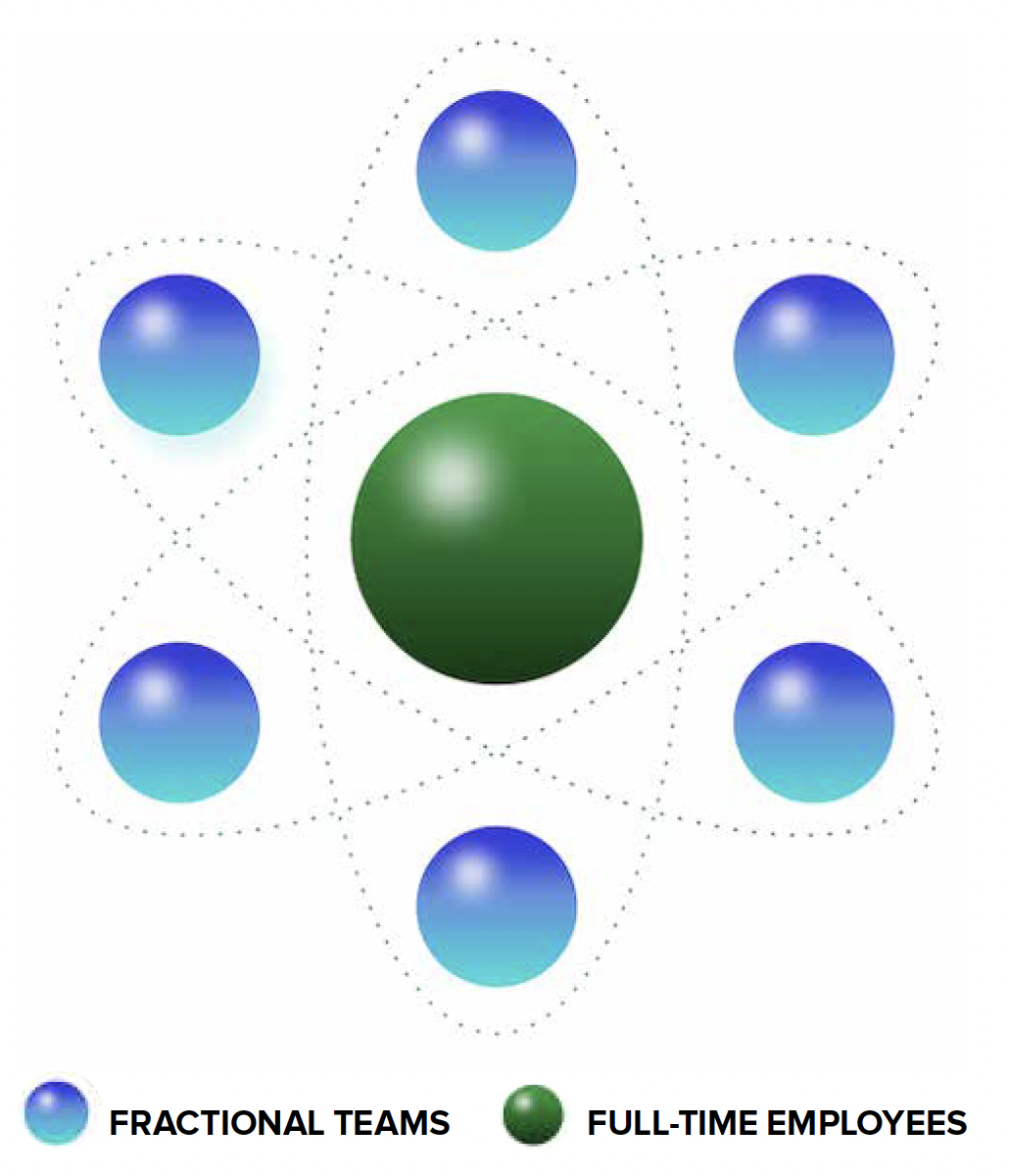
What does this mean for the future of work? Consider the dynamic structure of an atom: At the core of this model are full-time employees with deep institutional knowledge. Those are the neutrons and protons. Surrounding them are fractional teams, the electrons.
This model has only recently become possible, enabled by the surge in independent talent—as the workforce shifts to remote and prioritizes flexibility—plus the ability to bring this talent together as teams on platforms like ours.
The result for McGraw Hill? A new mobile learning app called Sharpen. It went viral, with hundreds of thousands of students declaring it was as if "TikTok and DuoLingo had a baby." It earned coverage in outlets including Forbes, and it gave a transformative new identity to the company as its digital business grew 28 percent quarter-over-quarter.
In a recent survey of 581 U.S. tech founders and execs, 71 percent said fractional talent gives their business greater agility during times of economic uncertainty, and 73 percent are already using blended teams of fractional talent and full-time employees. It's an attractive alternative to the traditional hiring process, which 67 percent said is too time-consuming and expensive.
Whether they know it or not, companies have already begun adopting the atomic model, for several compelling reasons:
- Flexibility. The ability to rapidly scale up or down to meet project needs and deadlines allows for efficient resource utilization. This adaptability is particularly advantageous during times of economic uncertainty.
- Scarce specialized expertise. Fractional teams bring diverse, specialized skill sets on board, facilitating problem-solving and innovation.
- Cost-effectiveness. By eliminating lengthy and expensive hiring processes, fractional hiring saves time and reduces financial costs.
- Efficiency. There's that word again. With fractional teams, fast-tracking product development to meet market demands or seize time-sensitive opportunities becomes achievable.
Apprentice, the pharma manufacturing platform, is another good example. In early 2021, it had an opportunity to play a pivotal role in the distribution of the COVID-19 vaccine. But to do this, Apprentice needed to launch an entirely new version of its product within 45 days—a product that spanned multiple technological stacks and incorporated augmented reality headsets. The task seemed monumental, if not impossible.
Apprentice brought in a specialized engineering team that quickly scaled to meet the product's evolving needs. Angelo Stracquatanio, Apprentice's CEO, says the rebuild would have been "literally impossible" without fractional talent.
On-Demand Expertise
Fractional teams—the electrons—introduce a new possibility for the future of work, one in which independent contractors can increase their value by operating as high-impact units that supercharge the core neutron and proton team.
Instead of orienting work around companies as employers, we're starting to see the most high-value product builders are reorienting work around teams. By forming fractional teams that can come in and solve key problems for organizations, independent product builders can simultaneously increase their earning power while also gaining greater stability.
This fractional talent trend is likely to continue. Because here's the thing: The era in which hard work and perseverance guaranteed a climb up the corporate ladder is over.
For the past 15 years, giants such as Google, Apple and Facebook intentionally hired more than they needed to, scooping up talent simply to prevent competitors from doing so. This dubious strategy—talent hoarding—will be remembered as a ZIRP, a zero interest rate phenomenon.
The market downturn provided a reality check. Large tech companies laid off 12 percent to 15 percent of their workforces, breaking the promise of employment stability that some had begun to take for granted.
More than 200,000 tech employees have been laid off in 2023—many in callous and unceremonious fashion. In the wake of this Great Betrayal, the attitudes and perspectives of these highly skilled workers are shifting rapidly.
Eighty-three percent of surveyed workers have lost trust in the stability and security of full-time employment amid layoffs—leading many to pursue fractional opportunities instead. Over two-thirds of independent workers say this model gives them greater job satisfaction and work/life balance than a full-time gig.
The Impact on Hiring
Even the way we read resumes is changing. It's not just about what title someone reached at which prestigious firm. Now hiring managers want to see the real-world results, the teams a candidate has effectively worked with and the unique skills they've applied. What matters isn't pedigree. What matters is your answer to a more relevant question: "What have you built?"
As Adam Grant, the bestselling author and A.Team advisor, put it, "Instead of selling your soul to one company, you can rent your skills to the highest bidder or the highest purpose."
The world's top product and engineer talent doesn't want to sit around a giant company to rest and vest. They want meaningful work, with the autonomy to choose where and when it's done, and to do it alongside the people with whom they most want to collaborate.
"I've been anticipating for years that the future of work would have more opportunities," Grant says. "Especially for people in the knowledge and creator economies, to be freelance but have a structure behind that freelance."
In a survey of top independent builders, we found that there are four primary drivers behind their interest in independent work:
- Autonomy. The opportunity to control their work schedule and environment appeals to many tech workers' desire for work/life balance.
- Professional growth. Working on different projects with different teams offers an enriching professional experience and broadens skill sets.
- Meaningful work. The ability to choose projects based on personal interest leads to more fulfilling work.
- Financial opportunities. Fractional work often comes with competitive pay, making it an attractive option.
"Freelancing unlocked something big," says Anthony Spadafino, a product manager on the A.Team network and founder of Lingostar.ai. "Now I have the ability to make my own schedule and shift my energy to where it's most needed on any given day. I get both the financial cushion and increased flexibility."
Fractional talent presents us with a unique opportunity—to redefine how we think about the way companies are structured. Instead of seeing work as headcount in departments, we begin with the desired outcomes and the ideal team composition to achieve them.
That means a workforce can plug in new expertise quickly. Companies such as Lyft, HCA and PepsiCo have tapped our company for this precise reason—not just executing on specific initiatives, but building tech capabilities in their organization so that, over time, they can experiment and iterate.
Now you can start new initiatives with smaller proton and neutron teams that can add electrons as needed to scale based on the learnings on the ground and the changes in the market—and do so at speed.
This journey with A.Team has revealed to me a future where companies are leaner and faster, focused not on the number of people, but on the collective skills, experiences and diversity they bring to the table. And where the next generation of product builders can choose their work with autonomy and build meaningful careers.
 | Raphael Ouzan is founder and CEO of A.Team, a team formation platform that enables tech leaders to assemble and manage cloud-based teams. |
Was this resource helpful?

Validate your HR expertise
Earning your SHRM-CP credential makes you a recognized expert and leader in the HR field.
Related Content

Transform HR with mobile technology to streamline workflows, enhance communication, and boost employee engagement across distributed teams.

A new study found that talent development practitioners believe performance-based assessments are more effective at measuring employee learning outcomes than knowledge tests.

As AI makes deeper inroads into organizations, employee concerns about the technology continue to grow. Here's how HR leaders can address the fear of AI among their own staff, as well as in the wider organization.