The CHRO & the Board: Expanding the Seat of Influence
The former CEO of Nutrisystem outlines four key areas every CHRO should master to become an indispensable voice in the boardroom.

A lot has changed over the past decade when it comes to the talent equation, including the pandemic, work-from-home and return-to-work orders, executive burnout, quiet quitting, the war for talent, social media, geopolitics, and now artificial intelligence. Post-pandemic, we witnessed a shifting power dynamic between employers and employees, and now, we are seeing the pendulum once again modulating. We have four generations in the workplace with increasingly different expectations and views around the “employer-employee contract.” The talent landscape has become complicated and less predictable.
If you’re working at a company where HR is viewed largely as an administrative function, it’s woefully behind the times and at a competitive disadvantage. Today, the best CHROs focus on business outcomes, not HR processes, and they’re earning a seat at the table as strategic thought partners to the CEO and, increasingly, the board of directors.
Talent and Culture Take Center Stage
Back when I was conducting due diligence — before accepting the CEO role at Nutrisystem — I remember being surprised to discover that the head of HR at the company reported to the CFO. I believed that could be a negative indicator of the corporate culture and how talent is prioritized. When I took the Nutrisystem CEO job, elevating the CHRO to become a direct report of mine was a change I made on day one. To this day, when I’m assessing CEOs, companies, and corporate cultures, it still serves as a potential red flag for me if I see that the CHRO does not report to the CEO.
Pre-pandemic, CHROs’ interactions with their boards were primarily focused on compensation plans and perhaps once-a-year discussions around leadership talent, with a couple of hiring and retention statistics thrown in for good measure. The CHRO attended the compensation committee meetings and maybe some portion of the regular board meeting, depending on whether they were part of the CEO’s inner circle.
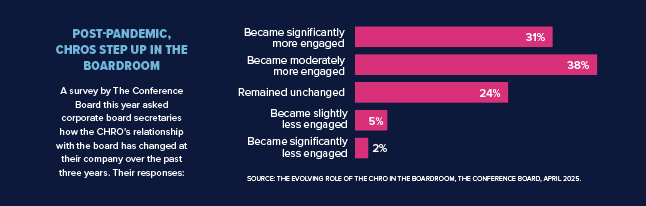
But in the post-pandemic years, CHROs have taken a far more strategic and vocal seat at the board table. According to a 2025 survey by The Conference Board, nearly 70% of companies reported increased CHRO engagement with the board over the past three years (see chart, page 22). The report said the corporate world’s response to the pandemic helped spark this new CHRO influence because it forced companies to rethink digital collaboration, workplace flexibility, mental health, and other people strategies.
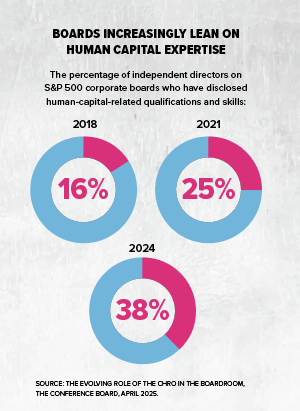
Board composition is also changing to reflect a more in-depth understanding around talent and culture. Boards are making a more concerted effort to appoint directors with expertise relating to human capital. In 2024, a full 38% of independent directors of S&P 500 companies checked the skills box (found within the proxy statement) stating that they had human capital qualifications or skills. That’s more than double the 16% that had such skills in 2018, according to The Conference Board’s analysis (see chart).
Today, across every industry, boards of directors are sharpening their focus on enterprise risk, strategy, and shareholder value. One of the most critical levels of organizational effectiveness — the workforce — historically had been glossed over or discussed in transactional terms. This limited lens often reduced the CHRO to a functional administrator. But boards are now paying more attention to talent and culture as they’re forced to face post- pandemic realities that have reshaped work permanently. One small example: In many cases, compensation committees have been renamed compensation and human capital committees or talent committees as their agendas have become more encompassing and robust.
Companies that prioritize organizational resilience are progressing to the point where the CHRO often has a dual-reporting obligation, similar to that of the general counsel or head of internal audit. They report directly to the CEO but also are a trusted neutral board resource whose insights may, at times, be solicited independently from the CEO.
A 4-Part Approach to Building Strategic Partnerships with the Board
For CHROs to earn their seat around the board table, they must demonstrate both business and financial acumen. They must translate people data into business outcomes, linking retention to customer satisfaction or leadership capability to market expansion, for example. These are table stakes for any strategic conversation at the board level.
Additionally, there are four primary areas that CHROs should be focusing on to drive both resilience throughout the organization and strategic partnership with the board:
1. Speak Hard Truths and Keep a Finger on the Culture’s Pulse
Culture is the bedrock of an organization’s success or failure. As a CEO, I regarded my CHRO as someone who helped me drive (and stay true to) the corporate culture that we intentionally put forward. I dubbed my CHRO the “Chief Truth Teller,” responsible for candidly assessing what was working and not working from an organizational and cultural perspective. We’d then work together to address gaps and strengthen alignment. Likewise, boards must also hear the unvarnished truth. An effective CHRO will provide accurate and unbiased readouts of employee sentiment, leadership behaviors, cultural friction points, and the overall health of the organization.
CHROs have to be constantly checking the pulse of the company and looking for things that might be eroding the culture or corporate trust. That can be done formally, through engagement and pulse surveys, and less formally, through trust and relationship building.
CHROs need to watch out for these common factors that can quickly derail trust:
Perceptions that management is not “walking the talk.”
Toxic behavior within the organization that is not addressed.
Poor communication and lack of transparency between management and employees.
Unclear goals, responsibilities, or reward measures.
Lack of alignment between management and the board.
Focusing solely on the “what” and disregarding the “how.”
Importantly, HR leaders need to strike a difficult balance of neutrality. They have to build trust with employees and maintain confidence while keeping the CEO and board informed of undercurrents. CHROs must represent the voice of the employee and be willing to tell the CEO, leadership, and the board things they need to know but might not want to hear.
Boards must understand that culture is not “soft.” It is a hard performance infrastructure deeply ingrained into the organization. Boards that treat it that way outperform their peers. Boards that don’t prioritize culture often find themselves in the crosshairs of unwanted headlines and the erosion of their company’s values.
2. Align Compensation, Performance, and Generational Needs
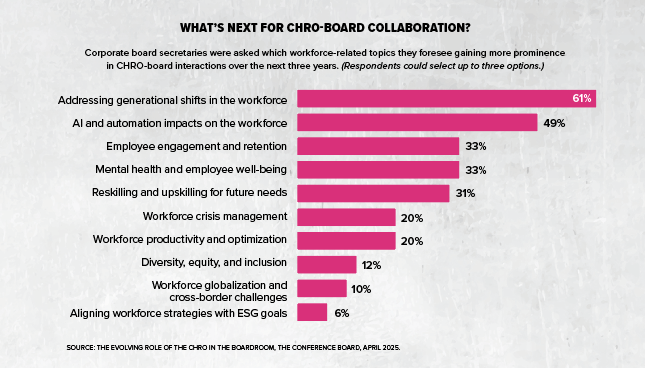
The employee contract changed permanently in the wake of the pandemic. The war for talent will continue, and organizations must acknowledge that the leaders of today are often motivated by factors that the leaders of tomorrow (aka the current workforce) may not find motivating. CHROs are well positioned to understand what makes the workforce tick and where gaps exist. Organizations are still evolving as new ways of working collide with old ways, and the pendulum will continue to shift.
Compensation and benefits are strategic levers to acquire and retain talent. Millennials and Generation Z value different things than their Boomer and Generation X counterparts. They are often more tech-savvy, which allows them to work smarter and quicker than their older counterparts and put a higher value on flexibility and balance. They tend to be less loyal and will walk out more quickly if they perceive inequity. They want to feel connected to the company’s mission and products.
HR leaders need to partner with the CEO and the compensation and human capital committees to come up with talent acquisition and retention plans that marry performance, compensation, and generational needs to ensure that their organizations have engaged, invested workforces rather than transactional ones. A one-size-fits-all talent approach is not likely to garner the same results as it did in the past.
3. Guide the Board Through AI-Driven Workforce Change
CHROs must become well versed in the effects of technology, namely AI, and how it will shape the future of work. In fact, 87% of CHROs expect AI to be a critical factor in boosting productivity in their workforce, according to SHRM’s 2025 CHRO Priorities and Perspectives report.
Be a student. Partner with IT, finance, and others. Decide if the company is better positioned to be an industry leader or a fast follower, understanding that laggards will lose.
CHROs need to create a talent strategy and future-of-work plan and then share those with the board. They need to champion the culture change that AI will bring to ensure that AI is not viewed as something that only “takes away” from the workforce but as something that is additive, too. AI shouldn’t be regarded solely as an efficiency move; it is also a growth and productivity play.
The CHRO will need to encourage AI curiosity and create training forums that teach teams how to embrace AI to increase productivity. In some cases, AI may replace tasks that humans do now, but it can also open the door to more rewarding work as people learn to use AI as virtual assistants and brainstorming partners.
Training and development will take on renewed importance, with retooling and upskilling talent becoming a critical investment that companies must make to retain their top performers. Because AI is uncharted territory for many directors, educating the board on these initiatives will be essential.
4. Partner with the Board on CEO Succession and Transition
CEO turnover is at a historical high, and boards are finding themselves in the difficult and unwanted position of having to replace CEOs for many different reasons at an increased cadence.
Through the first half of the year, 1,358 CEOs left their posts, up 9% from the same period of 2024 and the highest year-to-date total since Challenger, Gray & Christmas began tracking CEO exits in 2022. The main reasons, according to the group: Boards are demanding fresh perspectives as companies navigate economic uncertainty, rapid tech change, and shifting organizational priorities.
If you’re a CHRO, that means you may likely experience a planned or unplanned CEO transition. To be a key part of the discussion around succession, it’s vital for CHROs to have a solid, trusting relationship with the board.
Whether it’s planned or unplanned, a CEO change is highly disruptive to the organization and introduces uncertainty and stress for employees. Working with the board chair, head of the nominating committee, and the compensation chair, the CHRO will be relied on to play a critical role in helping manage the transition, offboarding the outgoing CEO, onboarding the incoming CEO, communicating to the employee base, and keeping the workforce motivated and focused.
The bottom line: If CHROs can communicate as business operators, be chief truth-tellers, create an AI-enabled workforce, effectively compete in the war for talent, and partner with the board on succession and transition, they will more than earn their place as valued, strategic partners to the board. They will also help ensure organizational resiliency through a focus on talent and culture tied to business outcomes as boards and management teams continue to grapple with a heightened pace of change and disruption.

Dawn Zier is a former CEO of Nutrisystem and current director on the boards of Hain Celestial Group, Prestige Consumer Healthcare, and Acorns.
Related Articles

Transform HR with mobile technology to streamline workflows, enhance communication, and boost employee engagement across distributed teams.

A new study found that talent development practitioners believe performance-based assessments are more effective at measuring employee learning outcomes than knowledge tests.

As AI makes deeper inroads into organizations, employee concerns about the technology continue to grow. Here's how HR leaders can address the fear of AI among their own staff, as well as in the wider organization.