The CHRO & CIO: Reinventing Work for the AI Era
AI is blurring the lines between HR and IT, making collaboration between these two functions essential for aligning talent, technology, and business outcomes.

If a CHRO’s work calendar can be seen as a window into their strategic priorities, a review of Maryjo Charbonnier’s schedule would reveal a pattern historically uncommon for many HR executives: Recently, Charbonnier has been spending a lot more time meeting and collaborating with her organization’s chief information officer (CIO), Kim Basile.
Charbonnier, CHRO of Kyndryl, a New York City-based provider of IT infrastructure services that was spun off from IBM in 2020, recognizes that the rise of technologies such as artificial intelligence is transforming organizational culture and talent management — and requires a deeper partnership with her CIO colleague. In the past, the CHRO-CIO relationship traditionally had been characterized by infrequent collaboration on matters like new-hire onboarding or cybersecurity training. Today, however, disruptive technologies such as agentic AI are reshaping job roles, work processes, leadership development models, and employee reskilling needs, making a stronger alliance between the two C-suite leaders essential.
“I spend a lot of time now talking with our CIO about where our business is heading and what we need to be working jointly on together to improve organizational success,” Charbonnier said. “One area of growing collaboration is around the impacts of AI.”
Charbonnier also believed having the ear and trust of her CIO would help as she led a cultural transformation and an overhaul of HR technology strategy at Kyndryl.
“So much of the culture of an organization is expressed in a digital way now,” Charbonnier said. “We’ve learned that if you want to change the culture, the technology platforms in your organization are a driving force that either helps cement or prevent that.”
From Basile’s side of the relationship, she also sees significant value in creating a strong partnership with her CHRO colleague.
“The CIO and CHRO need to be connected at the hip around AI, in particular,” Basile said. “We can’t go down different paths. Otherwise, employees will get mixed signals, the employee experience will become disjointed, and it won’t serve the organization well.”

So much of the culture of an organization is expressed in a digital way now. We’ve learned that if you want to change the culture, the technology platforms in your organization are a driving force that either helps cement or prevent that.”
Kyndryl
The Rise of Agentic AI and Digital Staff Requires a Unified Alliance
Historically, much of the focus on CHROs building stronger relationships with their C-suite peers has been on strengthening ties with CFOs or COOs with the goal of enhancing HR’s business savvy and bottom-line impact. While those partnerships remain critical, experts say the CHRO-CIO alliance has taken on new importance in the age of AI, amid persistent technical talent shortages, and in the face of more sophisticated cybersecurity threats.
“If you think about the daily interactions employees have with their organizations, the vast majority of them now flow through technology,” said Katy Tynan, vice president and principal analyst in Forrester’s employee experience and future of work group. “Part of the reason CHROs and CIOs need to get closer is because the employee experience has become increasingly dependent upon workers’ interactions with digital tools like AI.”
The arrival of AI doesn’t mark the first time a digital transformation has demanded closer collaboration between CHROs and CIOs. But experts say agentic AI, in particular, presents fundamentally different challenges to those two executives than past transformations, such as the adoption of cloud or mobile technologies in the workplace.
Agentic AI introduces autonomous AI agents with capabilities including the ability to make plans, reason through complex scenarios, execute multistep processes, and collaborate with other agents. For HR, the implications are profound: re-engineering job descriptions to accommodate new AI-driven tasks, reskilling employees to partner with and supervise these AI agents, training managers to lead hybrid AI-human work teams, and embedding strong change management practices in every stage of adoption.
If CHROs aren’t in the room when the CIO and other C-suite leaders make decisions about adopting agentic AI tools, those key people issues are likely to get overlooked. As a result, the organization’s return on AI investments will suffer.
While agentic AI has yet to go mainstream, many experts believe fully autonomous agents will be common across industries in the next one to two years. The technology’s impact won’t just be felt in back-end automation, but throughout functional groups such as marketing, finance, HR, customer service, supply chain, and more.
“With agentic AI, the IT group isn’t just introducing technology tools to augment work and assist humans, they’re actually introducing new digital workers,” said Paul Jeruchimowitz, a senior managing director in Accenture’s strategy and consulting group. “These are essentially digital colleagues who work alongside humans and can handle end-to-end work tasks, and this is far more advanced than previous transformations that required HR and IT collaboration.”
AI possesses another feature that sets it apart from previous digital transformations: how rapidly the technology is changing.
“The speed at which AI is evolving and that new capabilities are being introduced to the market by vendors requires that CHROs and CIOs work differently together than they ever have in the past,” said Kyle Forrest, U.S. future of HR leader for Deloitte Consulting.
Breathing New ‘AIR’ into HR: Kyndryl’s HR Tech Makeover
As agentic AI makes deeper inroads into organizations, the traditional responsibilities of HR and IT functions will become blurred, creating new questions and challenges for both CHROs and CIOs.
Earlier this year, Jensen Huang, CEO of technology giant NVIDIA, made headlines at the Consumer Electronics Show for his comments regarding how he anticipates AI agents will affect oversight responsibilities in organizations. Huang suggested the IT function will serve as the “HR department of AI agents in the future,” meaning IT will be responsible for traditionally HR-managed duties such as onboarding, training, and providing performance feedback to AI agents.
Some organizations have taken this connection a step further by actually merging their HR and IT departments to acknowledge how technology innovations are reshaping functional roles.
Earlier this year, biotech firm Moderna announced it was combining its HR and IT groups into a single function and creating a new role to oversee the reconfigured group — chief people and digital technology officer. According to The Wall Street Journal, Moderna’s HR head, Tracey Franklin, was promoted into that new role with the mission of redesigning teams across the company based on what work is best done by humans versus what can be automated with technology.
While Kyndryl hasn’t taken the step of merging its IT and HR groups, CHRO Charbonnier and CIO Basile are now working hand-in-glove around the organization’s technology strategies — most notably, the growing use of AI to boost employee productivity, efficiency, and client service.
That includes one-on-one meetings as well as work that both executives do on an AI governance board. Those dual efforts focus on improving the quality and security of data used in AI platforms, creating ethical and compliant AI policies, evaluating new AI use case proposals, and assessing how the workforce needs to be reskilled or redeployed as AI tools are implemented.
“We know that soon, AI will be all around us like air and in the comprehensive way it impacts our workforce,” Charbonnier said. “So, we chose to use the acronym AIR for how we manage that change within HR. The acronym encompasses all of the things I work on with our CIO to help structure our underlying enterprise technology systems, prepare our data, and educate our people to maximize the use of AI.”
The “A” stands for anticipating how the two executives will have to work together to understand how job descriptions, work processes, and employee training needs will change as a result of generative AI or agentic AI. “We’ve found here that pieces of jobs change before entire jobs change when you introduce AI tools,” Charbonnier said. “So, one big question we’re dealing with is: ‘How do you redeploy the productivity that’s being replaced by AI?’ ”
The “I” stands for integrating and inventorying HR technology systems — including AI platforms — and employee skills in ways that better serve Kyndryl’s clients. “Our HR team worked with the CIO’s team to move all of our human capital data into one consolidated platform that also holds information on the work we need to do for customers,” Charbonnier said. “That allows us to have a side-by-side inventory of the client projects we need to do and the skills needed by our employees to accomplish that work. That helps us quickly identify any gaps in needed skills or capabilities.”
The “R” is for reskilling and redeploying employees as AI-powered platforms are adopted. The CHRO and CIO work jointly on creating targeted learning programs to build needed AI skills in the workforce.
One Kyndryl initiative that has benefitted from using the AIR framework is the company’s Bridge program. As part of the program, employees had to learn to use new AI tools to more efficiently analyze datasets with the goal of delivering actionable insights for Kyndryl customers.
The switch from manual to AI-powered data analysis meant Kyndryl had to determine what to do with employees who no longer fit the transformed work process.
“We didn’t want to displace workers because of AI, we wanted to move them into other opportunities,” Basile said. “So, we were able to provide them with new training and redeploy them in the organization.”
A Leadership Opportunity for CHROs
Experts say the scaling of agentic AI will create an opportunity for CHROs to take leading roles as they partner with IT around technology implementation. AI agents, for example, will not only need to execute business processes, they’ll also need to understand the organization’s cultural norms and strategic objectives, incorporate feedback on their performance, and get retrained as needed through adjustments to algorithms and underlying datasets.
“CHROs and CIOs will need to work together on issues like how to continuously reskill AI agents or even replace them with different agents if needed,” Jeruchimowitz said. “Those are questions we used to only ask about people. It will require that CHROs develop their technology acumen around how agentic AI works, what it can enable, and how humans best work alongside it.”
Sean Cavaliere, the chief technology officer at talent optimization platform The Predictive Index, said that when HR and technology executives work closely together, they can ensure AI amplifies the human elements of work.
“AI agents are continually improving their ability to work independently, not just following instructions but tackling more complex, less well-defined problems,” Cavaliere said. “Leadership, coaching, and performance evaluation must all evolve as we pair a human’s judgment with an AI agent’s speed of execution.”
Recent surveys have found that it’s rare for CIOs alone to consider the effects of AI tools on issues such as job design or employee reskilling needs. Those are areas where CHROs have opportunities to assert themselves to take a bigger role in AI implementations.
“For example, anytime a potential new AI use case is discussed, an HR leader could be asking, ‘How might job roles and workflows need to change on work teams to get the most out of the AI investment we’ll be making?’ ” said Emily Rose McRae, a senior director analyst with Gartner who advises CHROs on the future of work.
McRae said if the answer to that question is that roles or work processes don’t need to change, the company may need to revise its expectations for AI’s impact. “If job roles and workflows aren’t changing, chances are the impact of the AI tools won’t be substantive,” she said. “The influence will only be at the margins.”
Karalee Close, global lead in Accenture’s talent and organization practice, said CHROs’ expertise uniquely positions them to work not only with CIOs but also with business unit leaders on talent issues tied to AI implementations.
“Unless companies are fundamentally redesigning work and the way tasks are done, they won’t fully capitalize on the benefits of AI,” Close said. “It’s in the redesign of work as part of AI use where the people function needs to step up.”

The two departments tend to be skeptical of each other, use their own unique jargon, and have their own distinct cultures. But the arrival of AI is one more opportunity for CHROs and CIOs to work together more collaboratively, and the urgency has never been higher.”
Approach Change Management from a Human-Centered Perspective
CHROs and CIOs also need to be on the same page when it comes to change management strategies brought on by AI. For example, getting employees to accept suddenly working alongside AI agents as new “teammates” — some of whom may replace their human co-workers or assume work tasks they once took pride in doing — requires attention not just to technical issues but to emotional ones, as well.
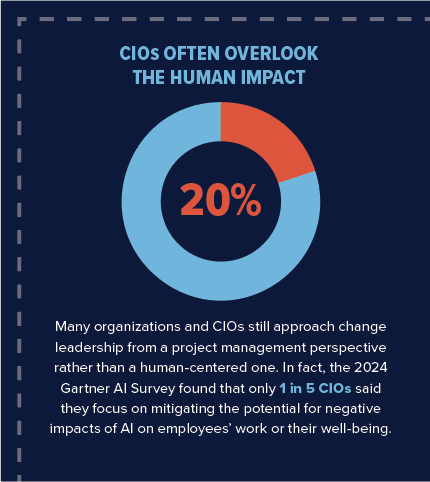
Too many organizations and CIOs, however, still approach change leadership from a project management perspective rather than a human-centered one. In fact, Gartner’s 2024 AI Survey found that just 1 in 5 CIOs said they focus on mitigating the potential for negative impacts of AI on employees’ work or their well-being.
Some companies and CIOs “focus primarily on tactical issues like deadlines, milestones, Gantt charts, and KPIs tied to AI implementation. But they don’t fully consider the human elements of change,” Tynan said. Failing to address issues such as the fear of AI agents eventually taking employee jobs, build trust in the outputs generated by AI, and give workers the training needed to manage or work alongside AI can impair adoption and undermine the return on investment of AI implementations.
When Charbonnier makes a decision to phase out, add, or integrate major HR technology platforms, she collaborates with her CIO on change management strategies tied to those moves.
“Before we roll out change, we talk jointly together to our HR and IT teams about why we’ve made the decision, how processes are going to change as a result, training that will be available to learn new ways of working, and more,” Charbonnier said.
Building a trusted partnership also can help overcome long- standing challenges in the CHRO-CIO relationship, such as who “owns” the HR technology budget or has the final say in technology decisions.
“There isn’t a day now that Maryjo and I aren’t engaging on something together,” said Basile. “I no longer view it as my role only being the technical piece and her role as CHRO being the people piece. There is a constant collaboration that’s needed, and I think our two teams see that and it benefits them as well as the broader organization.”
Overcoming Barriers to an Alliance
Despite a perceived need for more collaborative CHRO-CIO relationships, some experts say such an alliance remains the exception rather than the rule. They cite previous digital transformations — such as the migration from on-premises tech infrastructure to cloud and mobile technologies — that didn’t always lead to closer ties between the two executives.
A 2025 study from technology provider iCIMS found that 89% of CIOs believe the collaboration between HR and IT is essential for attracting top talent to their organizations. But alignment isn’t seamless. CIOs said the top factors holding back the HR-IT partnership include:
Strategic disconnect between both sides (55%).
Limited budgets and resources (48%).
A lack of shared understanding around tech capabilities (48%).
Resistance to change from HR (42%).
Tynan of Forrester said while she hopes AI becomes the catalyst that creates closer connections between CHROs and CIOs, she’s not confident it will happen without fundamental change.
“A closer relationship is long overdue, but the two functions will need to overcome challenges in communicating and other areas to make it happen,” said Tynan, who’s worked in both IT and HR capacities in her career. “The two departments tend to be skeptical of each other, use their own unique jargon, and have their own distinct cultures. But the arrival of AI is one more opportunity for CHROs and CIOs to work together more collaboratively, and the urgency has never been higher.”
Charbonnier echoed the importance of the two C-suite leaders moving beyond stereotypes to gain a better understanding of their respective challenges, strengths, and vulnerabilities.
“It’s so important today for HR and IT to sort out how they can work together in a more integrated way,” Charbonnier said. “It’s vital to collaborate in a more agile manner to support business goals and drive a better employee experience.”
Dave Zielinski is a Minneapolis-based business journalist and a frequent contributor to SHRM publications.
Related Articles

Transform HR with mobile technology to streamline workflows, enhance communication, and boost employee engagement across distributed teams.

A new study found that talent development practitioners believe performance-based assessments are more effective at measuring employee learning outcomes than knowledge tests.

As AI makes deeper inroads into organizations, employee concerns about the technology continue to grow. Here's how HR leaders can address the fear of AI among their own staff, as well as in the wider organization.