The Pixelated Workforce Has Arrived ... Are We Ready?
Recent disruptions are blowing up the traditional model of full-time, long-term employees. Now every job or project can be filled with a wide variety of people, each working in different employment arrangements. How should your organization respond?

In the past few years, it seems like everything at work has changed. We work from home, we use online tools for video and document-sharing, and our relationships with employers are weaker and more tenuous than ever. Just last year, almost a third of workers changed employers, and nearly 45 percent of them changed industries in the process, according to a McKinsey & Company report. And this highlights a key insight: The relationship between worker and employer has changed, leading us to a new world we call the Pixelated Workforce.
Consider what employment was like in the 1950s and 1960s. Most companies hired employees for long careers. Employers provided health care and insurance, training and development, career growth, and retirement annuities as benefits. In exchange for these rewards, employees were loyal, they felt committed to their employer, and job hopping was considered bad practice.
As the internet started to disrupt business models and we suddenly had more information at our fingertips, all this started to change. No longer was it difficult to find a new job. Tools such as Monster, LinkedIn and Indeed suddenly made it easy to find and apply for positions. So employees started looking around. And as people felt freer to move to new positions, everything started to change.
Think about companies such as General Electric, IBM or AT&T in the 1960s and 1970s. They had enormous competitive advantages, and their products, business processes and innovations were long-lasting and unique. But as people started to change companies, they took their ideas and innovations with them. The result was a whole new economy, one in which ideas flow quickly from company to company, key employees are recruited away and new ideas are quickly copied by competitors.
This shift, from what we call the "industrial scale" model of business to that of "innovation, IP and services," forced companies to move to a new model of hiring. No longer do we look for people who want to build a long-term career. We look for skills, flexibility, agility and productivity. So employers have become more pragmatic in their hiring, now looking for "the right person for the project" and no longer expecting a worker to stay their whole career.
To accelerate this process, new tools and employment models were created. CareerBuilder (the first major online jobs site) was founded in 1995, followed by Monster in 1999 and LinkedIn in 2002. These companies democratized the job market, giving workers (and later employers) tools, information and transparency they never had before. Prior to these systems, it was very difficult to even know if you were underpaid or falling behind in your career. Suddenly, everyone could see what jobs, careers and opportunities were trending every minute.
While this transparency and mobility was growing, something more profound started to happen. Workers and employers started to experiment with new working arrangements. Starbucks famously decided to offer health care, educational benefits and career growth to its hourly employees. Sodexo, Aramark and other foodservice companies created a variety of flexible work models to enable hourly workers to swap shifts and find times to work (now powered by AI). And staffing companies Manpower and Robert Half—and later Adecco and others—shifted from being staffing agencies for temporary accountants or administrators to acting as full-service hiring, recruitment and outplacement firms.
In fact, there has been such a scramble for contingent and skills-based hiring that many of these staffing firms also got involved in training. Hundreds of reskilling vendors—from Coursera to Skillsoft to Pluralsight—created online education offerings to help job changers learn new skills and transition from role to role.
For less educated workers, community colleges and many government-funded transition programs opened their doors to train people to work in nursing, IT, cybersecurity, accounting and more. Institutions such as Capella, Southern New Hampshire University and others became billion-dollar enterprises, all built in support of this newly created "highly mobile" workforce, filled with people who wanted better opportunities or new careers in this transparent, opportunity-rich environment.
But something else was going on. The traditional idea of an "employee" was breaking down. As people moved around more, companies such as Uber (founded in 2006) realized there were many people who wanted more flexibility and a new arrangement. If you didn't speak English well, you had kids or aging parents at home, or you lacked direct business skills, you could now drive for Uber and supplement your income easily. Uber exploded, giving rise to other "uber-work" ideas that have been copied by companies such as Lyft and gig work sites including Upwork, Fiverr and hundreds more.
And it's getting even more complicated. In the last five years, every social network has built a revenue model for "influencers," so young people who are good at video production or entertainment can now supplement income as a TikTok, YouTube or other online star. And this "creator economy" now lets you sell your ideas, your writing and even your leadership skills (through online coaching networks) without any formal employment relationship at all.
Where does that leave us? We now live in this Pixelated Workforce, where every job, project and opportunity can be filled with a wide variety of people, each working in different employment arrangements. You as an employer have many new choices, and our old "prehire to retire" model is just not enough to handle them all.
Our newest research found that the average U.S. corporation now has 47.5 percent of its "workers" employed in a contract, contingent or other nonemployee relationship. More than 37 percent of U.S. workers operate in this model. And we also found that 62 percent of full-time workers also do "side hustles" to supplement income.
It's no longer sufficient to think about full-time employees as your workforce. We live in a world where high-performing companies operate with a "workforce ecosystem" strategy to grow.
How to Manage the Pixelated Workforce
We've done research on this problem for almost five years, and as you'd expect, we find companies at different levels of maturity. In general, only about a third of companies have any kind of integrated strategy for all these work arrangements. The "contract employees" are often hired by business managers, and these "contracts" are stored in vendor management systems, not in the company's HR database. That means there's little to no opportunity to train and develop contractors, move them to new roles easily or recruit them to join full time.
And employers are often nervous about changing this model. Since many states penalize employers for failing to pay benefits for contractors who work full time, companies deliberately treat these workers with a hands-off model, often using employment agencies as intermediaries to reduce risk. But the downside hurts performance and the workers. We can't always train, move and engage these people like we want. And in a world where the unemployment rate is well below 4 percent, employers need these people more than ever.
In the health care industry, where nurses and other clinical professionals are in short supply, companies fill roles by engaging with "traveling nurses" (essentially gig workers who are accredited and highly trained), high-pay contract nurses and part-time staff. Despite these efforts, CHROs tell us they are constantly trying to engage these staff to become long-term employees, simply because they need people so badly.
Think about your IT department. Most companies outsource cloud services, cybersecurity needs and many of their application development projects to contractors. Gone are the days when every company had an IT department that did all its work in-house. Where do these people come from? This creates demand for highly skilled technical professionals, large and small IT contractors, and gig workers who specialize in things such as AI who can move from company to company with ease.
Hourly workers have been pixelated as well. While Starbucks, Verizon and most retailers built long-term relationships with their hourly staff, the pandemic disrupted this model. People were laid off or furloughed, forcing them to find multiple jobs and other opportunities. Now employers are creating job networks where they "share hourly workers" with other companies to give workers more flexibility. They are raising wages while building AI-based scheduling systems so workers can find a shift that meets their needs.
Uber, DoorDash and hundreds of other gig-work companies have also thrived. In the first quarter of 2023, Uber generated $8.3 billion of revenue, growing at nearly 30 percent. We are witnessing the "uberization" of many roles, from designers to gardeners to retail workers.
What Should Companies Do?
As our research points out, it's time to rethink the way we define and manage our workforce. We can't simply let the purchasing department manage all the contingent hiring. We need hiring managers and recruiters to work together to decide when to hire, when to outsource and when to possibly train and recruit internally. The vast array of hiring options creates confusion, and while it's easy to terminate or lay off contingent workers, they provide less strategic value during growth.
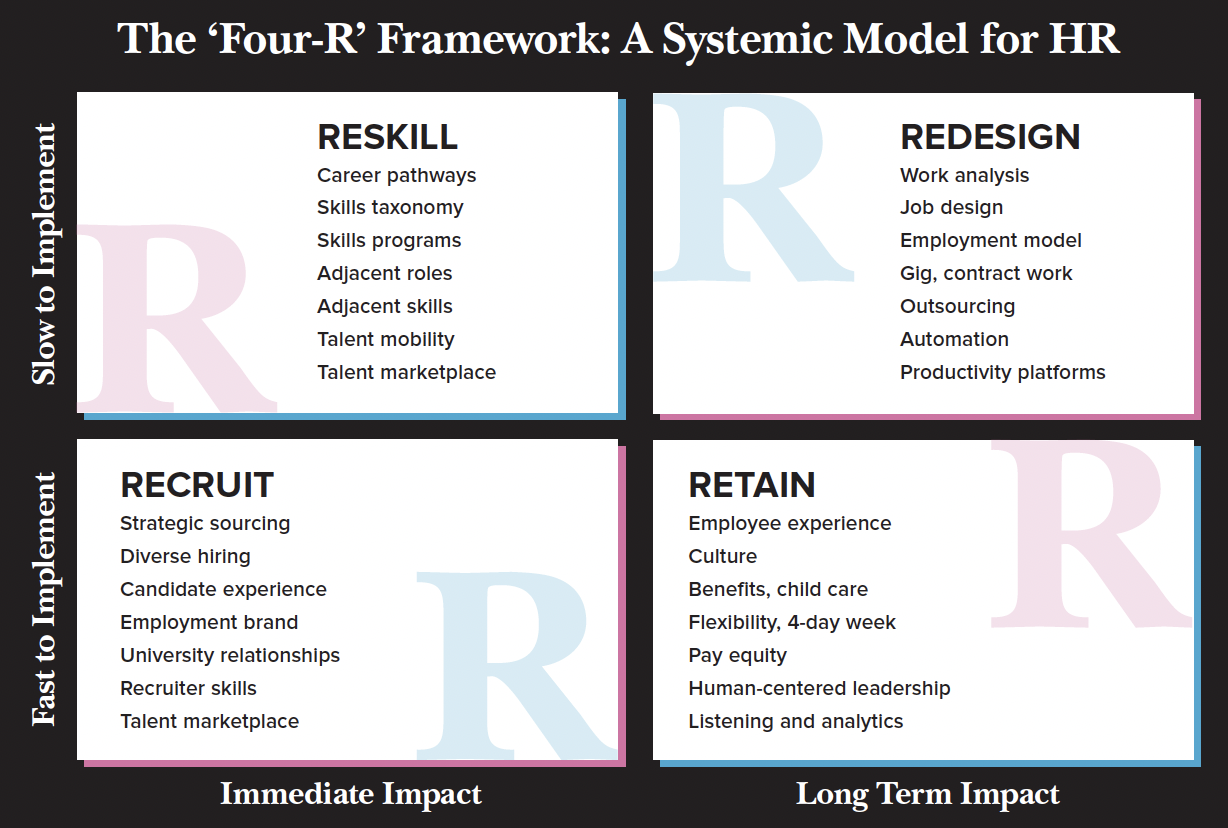
We developed the Four-R model (Reskill, Redesign, Recruit, Retain) to help HR departments address this issue (see chart at left). Whenever you want to "hire someone" to grow a team or a function, it's important to think holistically about "why we need to hire." Are we hiring because of a retention problem? Can we source someone internally (reskill)? Or should we redesign the work and outsource it to a contractor?
This type of model helps hiring managers (and HR teams) rethink the need to "open a requisition and hire someone" just to fill a job. And these kinds of models are badly needed as the workforce becomes more fragmented.
One thing we definitely know: Hiring is going to get even tougher over time. Most estimates of birth rates show flat to declining working populations in almost every developed country. So while the pixelation of work has been positive for workers and many companies, it's time to build a more strategic focus for the future.
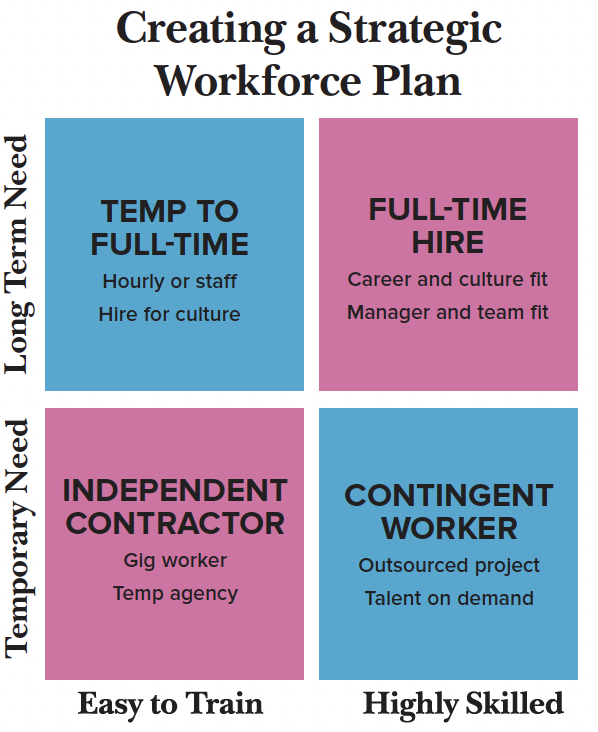
Imagine a world in which every hiring manager participates in a strategic discussion and the team decides if this position is a full-time job, a part-time job, a contract job or an outsourced project. That type of framework brings many of these complex decisions together and lets the company think about speed, time to hire, and skills balanced against long-term growth, corporate culture and team development.
At right is an example of a simple tool for this discussion that we've often used with clients:
Novartis recently discovered it was managing around 100,000 full-time employees and more than 50,000 contractors, many of whom became full time. To manage this complex web of staff, it set up a global cross-functional steering committee to start to understand and manage the ecosystem. It's now building staffing consultants to help business units create consistent practices to decide when to hire, when to outsource and when to use a contractor.
The Pixelated Workforce is here to stay. It's time to learn to manage this ecosystem for your company's competitive advantage, and to bring productivity, growth and employee energy into companies in a world of rapid change.
 | Josh Bersin is the CEO and global industry analyst of the Josh Bersin Company. He is also the author of three books, including Irresistible: The Seven Secrets of the World’s Most Enduring, Employee-Focused Organizations. |
Was this resource helpful?

Validate your HR expertise
Earning your SHRM-CP credential makes you a recognized expert and leader in the HR field.
Related Content

Learn how Marsh McLennan successfully boosts staff well-being with digital tools, improving productivity and work satisfaction for more than 20,000 employees.

The proliferation of artificial intelligence in the workplace, and the ensuing expected increase in productivity and efficiency, could help usher in the four-day workweek, some experts predict.

As artificial intelligence technology continues to develop, the demand for workers with the ability to work alongside and manage AI systems will increase. This means that workers who are not able to adapt and learn these new skills will be left behind in the job market.