HR's Guide to the First 100 Days of the Trump Administration
How the second Trump administration is reshaping the employer agenda — and what HR leaders are doing to balance compliance, culture, and business needs.

The first 100 days of President Donald Trump’s second term delivered a tidal wave of change that altered the employment landscape and sent shockwaves through corporate boardrooms. From crackdowns on immigration and inclusion and diversity (I&D) programs to tariff turmoil and a dramatic downsizing of the federal workforce, these opening months have created a climate of heightened uncertainty for HR leaders — both in terms of what’s legally required and what’s strategically smart.
“The first 100 days of any new administration carry tons of change. What makes this 100 days different is the whirlwind of executive orders,” said SHRM Chief of Staff, Head of Government Affairs, and Corporate Secretary Emily M. Dickens, J.D. While only five pieces of legislation have passed Congress so far this year, Trump has so far issued a record-breaking 137 executive orders (EOs), several of which affect workplace policy.
“The EOs have impacted employers in a number of ways, and because there’s been so many, it has felt like whiplash,” Dickens said during a recent episode of the People + Strategy podcast. “What you need to focus on are the ones that have the most impact on your organization and that you have the most control over.”
In this environment, staying compliant is only part of the equation. HR leaders must also weigh how to protect company culture and manage employee concerns amid major policy shifts and political polarization. This is also a leadership moment for HR, as your C-suite and board are looking for clear guidance on how these changes will affect your organization’s workforce planning and talent strategy.
With April 29 marking the 100th day of the second Trump administration, now is a good time to take stock of what has changed and how HR leaders should be responding. Here are the five most impactful workforce changes so far, along with guidance on how leaders can balance compliance, culture, and business needs in this new environment.
* * * * *
INCLUSION & DIVERSITY: Staying Compliant and Committed
In January, the Trump administration unveiled a series of EOs aimed at dismantling diversity, equity, and inclusion (DEI) programs within the federal government and among federal contractors, while also calling for increased scrutiny of such programs in the private sector.
One key shift came with the rescinding of a 60-year-old EO that required companies holding contracts with the federal government to practice affirmative action based on race and sex. Under Trump’s order, federal contractors must also certify that they don't operate DEI programs that violate federal anti-discrimination laws.
In February, the White House directed the Department of Justice to investigate private-sector companies for what it called “illegal” DEI activities. As intended, this action has created a chilling effect on private employers, causing many to scale back or shut down their I&D initiatives.
These EOs don’t change existing law regarding discrimination in employment — it’s still unlawful to make hiring or firing decisions based on a person’s race, national origin, sex, or religion. However, these orders do signal that the Trump administration may view certain DEI programs themselves as unlawful, particularly those based on “illegal preferences, mandates [and] policies” and programs aimed at “workforce balancing” based on race, sex, etc.
For employers, the message — which is not necessarily new — is to make sure your I&D practices are tailored to comply with existing anti-discrimination laws, and to avoid giving advantages to one person or group. SHRM recommends organizations not abandon their I&D efforts but rather evolve them to fit the new landscape. Audit your I&D initiatives to prioritize merit-based practices and leverage SHRM’s five-step Belonging Enhanced by Access through Merit (BEAM) Framework to ensure your efforts remain compliant with the new EOs.
* * * * *
IMMIGRATION: Policy Shifts and Talent Uncertainty
From Day 1, the new administration has pushed dramatic actions to reshape the country’s immigration landscape, with important implications for HR leaders and workforce planning. A series of EOs and policy shifts prioritize a more restrictive, enforcement-heavy approach at the border and in U.S. workplaces.
Organizations looking to hire foreign workers face stricter eligibility criteria for temporary work visas and employment-based green cards. Employers also face an increased risk of worksite immigration raids and heighted scrutiny of their Form I-9 work authorization documents. SHRM advises employers to have a step-by-step plan to prepare for a visit from U.S. Immigration and Customs Enforcement (ICE) and offers a detailed checklist for what to do when ICE arrives at your door.
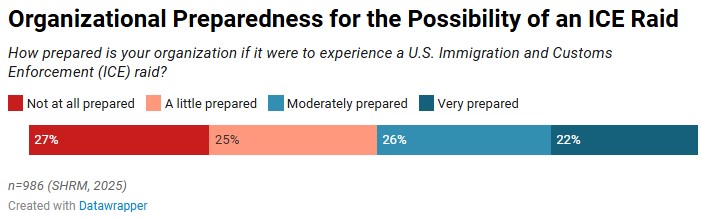
“Staying ahead of workplace immigration issues starts with ensuring that your I-9 processes are compliant. Don’t wait for ICE to arrive at your door,” Dickens said. In a February survey, more than half of HR professionals said their organizations are not at all prepared or only a little prepared for the possibility of an ICE raid at their workplace.
This tightening of immigration policy comes at a time when the U.S. labor market faces a persistent worker shortage. Since mid-2021, the number of available jobs in the U.S. has consistently outnumbered the number of job seekers. Tighter immigration policies will have a direct impact on future talent pipelines and business competitiveness.
“Given the current trends of an aging workforce and low birth rates, immigration may be the most powerful policy lever available for increasing the labor supply over a longer time horizon,” said SHRM Senior Labor Economist Justin Ladner. SHRM research finds that nearly 3 in 4 employers agree that increased immigration encourages economic growth and makes the U.S. more globally competitive.
* * * * *
TARIFF THREATS: New Pressure on Economy, Labor Market
The Trump administration’s announcement of large-scale tariffs on U.S. trading partners — and then a partial 90-day delay for most — shook up the stock market and could damage the U.S. labor market as the year rolls on. Experts say a tariff-inspired trade war could trigger higher inflation and stagnant economic growth, a combination called stagflation. In response, HR leaders must be prepared to assess their workforce and compensation strategies in response.
“The labor market has continued its remarkable run of health and resilience through March. However, there is ample and growing reason to believe this favorable picture could transform quickly as we move into the second quarter,” Ladner said. “Economic conditions are now changing rapidly, leading to escalating fear that the labor market and broader economy will deteriorate rapidly in the months ahead.”
These developments have all contributed to an environment of uncertainty, which is itself economically damaging. Surveys show that concerns of rising inflation and even a potential recession have increased among business leaders in recent months.
“So many employers have told me over the years that they can face almost any challenge, but what they can’t face is lack of predictability,” former Rep. Susan Wild, D-Pa., said in a recent SHRM webinar. “What is happening right now makes it so hard for [employers] to plan ahead. … And that is going to very much affect the workforce, because if you don’t know what you’re planning for, it is very hard to either hire or retain.”
HR leaders need to step up to help guide their organizations through the tariff-related challenges of rising operational costs, wage pressures, and supply-chain disruptions.
“CHROs must help their CEOs and boards understand how tariffs impact the workforce and how these workforce issues impact the broader strategy,” said SHRM CHRO Jim Link, SHRM-SCP. “Your CEO and board may or may not understand the talent implications of the current headlines. It’s your job to make sure you’re course-correcting before the organization starts to veer off-target.”
* * * * *
FEDERAL LAYOFFS: Skilled Workers on the Move
The Trump administration’s effort to shrink the federal workforce will have ripple effects in the U.S. labor market for years to come. At the same time, private-sector layoffs have also surged. Nationwide, layoffs in the first two months of 2025 reached the highest number for the first two months of any year since the 2009 global financial crisis.
Trump isn’t the first president to prioritize shrinking the size of the U.S. government. Most recently, the Clinton administration’s Reinventing Government campaign led to the elimination of about 300,000 federal positions between 1993 and 2000.
This year’s rapid, large-scale federal layoffs will largely hit workers concentrated in business, finance, health care, science, and administrative roles. Federal workers are often well-educated, mid- to late-career professionals. Layoffs could reach much of the country, but Washington, D.C.; Virginia; Maryland; California; and Texas may be more affected because they have the most federal workers.
For employers, especially those in heavily affected areas, this represents a potential shift in the talent supply. CHROs are evaluating their recruiting strategies to tap into this new influx of skilled workers, particularly for roles aligned with government-acquired skills, such as project management, logistics, data analysis, and some health and science roles. Employers who place high value on prior work experience or educational attainment may see their pool of qualified job applicants expand the most.
Another, more negative impact of the shrinking federal workforce is that your organization may have a harder time getting answers and assistance when reaching out to federal agencies, such as the U.S. Department of Labor or Small Business Administration.
“That can directly impact your business because if certain people are not at agencies, who do you call when you have a struggle with the federal government? That’s all in flux,” former Rep. Larry Bucshon, R-Ind., a senior policy advisor at Holland & Knight, said in a SHRM webinar.
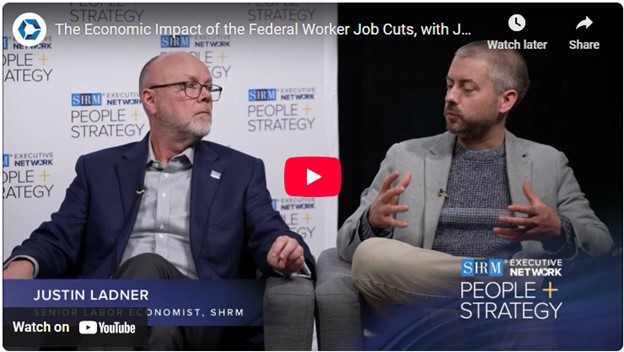
PEOPLE + STRATEGY PODCAST: The Economic Impact of the Federal Worker Job Cuts:
* * * * *
RETURN TO OFFICE: A Nudge Toward Stricter Policies
In January, Trump issued a “Return to In-Person Work” executive order that directed executive branch leaders to end remote-work arrangements and require most employees to return to in-person, full-time work. This order directly affects only federal employees, but it will have ripple effects. In fact, it could help local businesses (restaurants, dry cleaners, etc.) that benefit from more in-person federal workers.
Will this EO spur more private-sector companies to bring workers back to the office five days a week? Most private-sector employers have already settled into their own post-pandemic workplace schedules by now, but some employers may see this federal action as an incentive to tighten the reins on flexibility in terms of where and when employees work.
CHROs need to balance their need for in-office collaboration with their legal requirements to accommodate workers with disabilities and with employees’ expectations of flexibility and work/life balance.
As one recent study noted, many companies experience “abnormally high” employee turnover and a longer time-to-hire after implementing return-to-office mandates. And the Q1 Civility Index from SHRM found that workers whose employers enacted a return-to-office mandate were significantly more likely to report encountering uncivil acts in their workplaces.
* * * * *
Other Key Actions from the First 100 Days
Beyond the headline‑grabbing policy shifts, several lower‑profile executive actions carry consequences for HR compliance and strategy:
- Disparate-impact liability. On April 23, Trump issued an EO that called disparate-impact liability — a common basis for lawsuits under anti-discrimination laws — unlawful. This current legal theory says employers’ seemingly neutral practices (such as job applicant tests) can be unlawful if they have discriminatory effect, even absent any discriminatory intent. This could cause a reduction in lawsuits against employers. Expect it to be challenged in court.
- Gridlock at the NLRB and EEOC. Trump’s removal of certain members of the National Labor Relations Board and Equal Employment Opportunity Commission have left the agencies without a quorum at times this year, effectively halting their ability to issue decisions or launch new initiatives, many of which are relevant to the workplace.
- English as the official language. On March 1, Trump issued an executive order designating English the official language of the U.S. While this doesn’t change employers’ obligations with regard to employment laws, it could have other implications in the workplace.
- Federal contractor minimum wage. On March 14, Executive Order 14026 rescinded a Biden-era order that required the minimum wage for employees of federal contractors be raised to $15 per hour. Most experts agree that this drops the wage floor back to the $13.30 level set during the Obama administration. Some states, however, do set their wage floors for all employees at $15 per hour or more.
- Collective bargaining agreements. On March 27, Trump signed an executive order effectively ending federal collective bargaining agreements across a wide range of government agencies. The move is being challenged by unions in court.
- OSHA deregulation. Under new leadership and with shrinking resources, the Occupational Safety and Health Administration is moving to pause some rulemaking and compliance efforts. This could lead to less OSHA enforcement, causing state safety agencies to attempt to fill the gaps.
* * * * *
Don’t Overlook Action at the State Level
While the legislative gears in Washington have been stuck in neutral this year, state and local lawmakers are moving forward. As a result, HR leaders also need to keep a close eye on the legislative and regulatory movements in states where they have operations.
“Unlike Congress, state and local legislatures are working,” Dickens said. “States are tired of waiting on Congress to do anything, so they’re getting active on all sorts of workplace issues.”
SHRM advances workplace policy in state legislatures and works with its affiliates to advance policy solutions that benefit work, workers, and the workplace. This year, SHRM is paying special attention to state-level issues such as artificial intelligence regulations, pay transparency laws, skills-based hiring, flexible work arrangements, mental health, and paid leave.
* * * * *
SHRM’s Federal Legislative Priorities
The executive branch provided most of the fireworks during President Donald Trump’s first 100 days, but Congress could assert its voice in the months to come. This year, SHRM is urging Congress to update several key pieces of legislation related to these three workplace needs:
- Closing the workforce participation gap. With U.S. businesses facing a long-term talent shortage worsened by demographic shifts, SHRM has identified six policy pillars that provide solutions.
- Shaping the future of work. SHRM advocates for policies addressing the rapidly changing landscape of work, including responsible AI regulation and policies to support workers who serve as caregivers.
- Modernizing pivotal policies. Outdated federal labor laws are not keeping up with modern workplace needs. SHRM is pushing for legislative fixes to the Fair Labor Standards Act, the Family and Medical Leave Act, and the Immigration and Nationality Act.
Related Articles

Transform HR with mobile technology to streamline workflows, enhance communication, and boost employee engagement across distributed teams.

A new study found that talent development practitioners believe performance-based assessments are more effective at measuring employee learning outcomes than knowledge tests.

As AI makes deeper inroads into organizations, employee concerns about the technology continue to grow. Here's how HR leaders can address the fear of AI among their own staff, as well as in the wider organization.