Striking the Balance Between Profits and Purpose
From the Met to BlackRock to Harvard: Deborah Winshel discusses her journey to a more balanced approach to ESG.

Deborah Winshel, a senior lecturer at Harvard Business School and former managing director at BlackRock, would ideally like to see those three letters—ESG—eventually disappear. She argues that putting a separate label on a set of expectations that should be firmly embedded in every organization undermines a more holistic, long-term approach to social responsibility. And that separate label has allowed ESG to become the lighting rod that has sparked the "woke capitalism" backlash we're seeing today. Adam Bryant, articles editor of People + Strategy, sat down with Winshel to discuss her experience in the ESG space and where she sees the debate going from here.
People + Strategy: You led both impact investing and social impact for BlackRock for more than six years. What prepared you for those roles, given that these were still relatively new fields?
Deborah Winshel: When I joined BlackRock in 2015, I didn't have direct experience in what was emerging in the industry as sustainable investing or ESG. But I did have experience in thinking about the fact that organizations have more than one bottom line—and multiple responsibilities beyond short-term financial objectives. I first explored that idea when I was the chief financial officer of the Metropolitan Museum of Art. I came to understand that the organization had a double bottom line—that while the Met was deeply committed to its mission, equally it needed to be financially sustainable over the long run to accomplish that mission. The Met had a very experienced board, and it allowed us to reframe the way we operated with a broader lens of balancing mission and financial goals. You can't sustain one without the other, and that requires thinking about different perspectives and constituents at the same time.
There was a similar dual focus when I served as president of the Robin Hood Foundation, a venture philanthropy with a dual lens on creating social impact and a return on investment. Organizations are often challenged to find leaders or stakeholders who understand that balance. They may focus on a social mission and not be quite as attuned to the practicalities and other demands of the organization. Or they rely on a financial perspective, and the other strategic and operating priorities are essentially layered on top, not considered in a more integrated way.
P+S: And so what was your approach to your roles at BlackRock?
Winshel: My role was to create a sustainable impact investing platform. ESG were three increasingly popular letters at the time, although not nearly as recognized as they are today. Early on, when I spoke with clients and at conferences, I often mentioned that ideally those three letters would disappear. I said that because creating an acronym or label around what was considered a new set of expectations for companies was misleading in many ways. It created a segregated way of thinking about issues that for decades were implicitly embedded in many CEOs' visions of their responsibilities.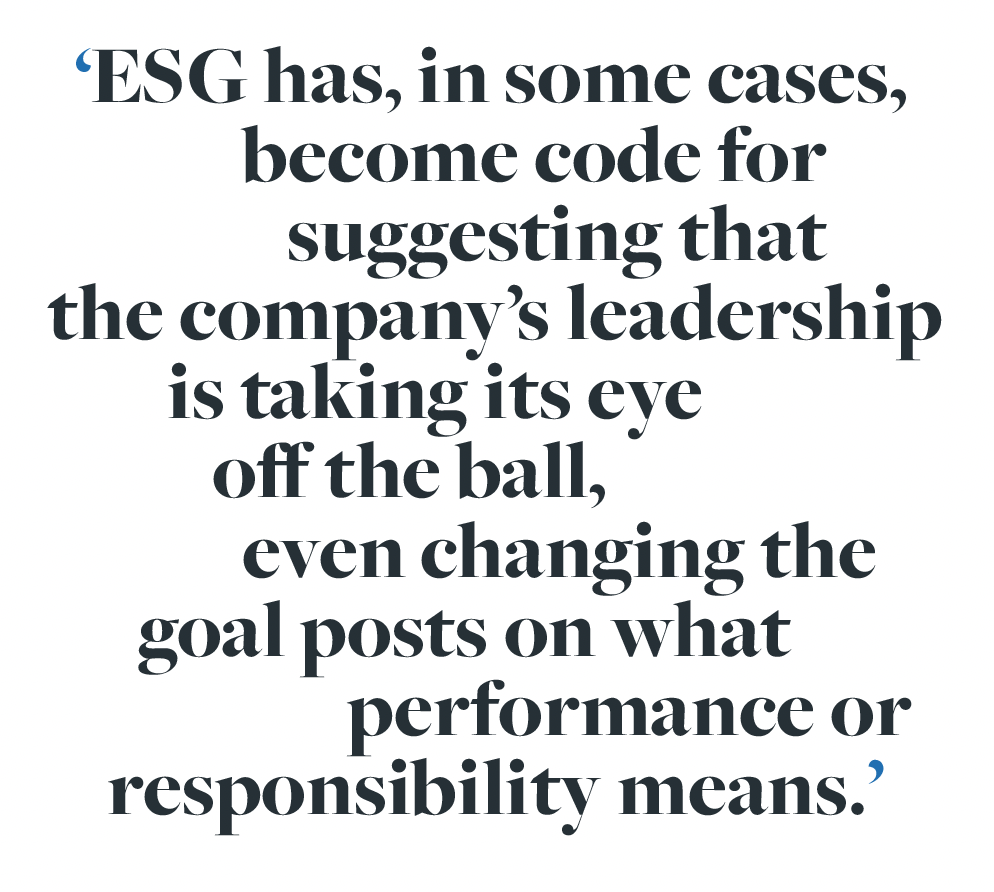
In a way, one could argue that creating this separate approach to ESG undermined a more integrated, holistic and long-term way of thinking about core responsibilities as a leader and as an organization. That's been a lightning rod that has sparked the backlash we're seeing now. ESG—and responsibility to a broad set of stakeholders—has been isolated as an independent, standalone objective no longer embedded in the context of a company's long-term operating health.
P+S: Companies are getting pressured from so many different stakeholders now, often with conflicting demands and expectations.
Winshel: It can be challenging for companies to balance what are often competing priorities. And in difficult economies or challenging markets, objectives that support long-term financial sustainability can take a backseat. But successful companies focus on how best to satisfy their customers, how best to ensure that their employees feel committed and how best to support the communities and environment in which they operate.
The role of the CEO is to be the long-term visionary and to create a sustainable company for years to come. Many companies think deeply about how to make sure they have the right balance among all their stakeholders.
As is frequently raised in these debates, when you have a sharp focus on quarterly earnings, it's difficult to sustain a two-level perspective of worrying about what you're trying to deliver at the end of a quarter and also trying to figure out what makes sense for the company over the next five to 10 years.
P+S: The CEO role has always been difficult, but it feels like leadership has become five to 10 times harder in the last three years.
Winshel: We put CEOs in an almost untenable position as they try to strike a balance. There are investors, such as pension funds, that are in it for the long-term, alongside activist investors who are often focused on a more immediate return. How do you create that balance? ESG has, in some cases, become code for suggesting that the company's leadership is taking its eye off the ball, even changing the goal posts on what performance or responsibility means. I argue, instead, that for a well-managed company, all those considerations are deeply embedded in the strategy and operations.
A number of companies have invested deeply in thinking about how to be more environmentally conscious because it's efficient for their operations. It's just smart business. And when companies can express what they are doing in a way that specifically relates to the advancement and progress and success of their company—rather than something they are promoting in isolation—that's when the debate can settle down. It's about getting back to the fundamental purpose of companies. Why do you exist? It's usually to deliver something to a customer. And if you build your purpose from that, other "ESG" issues will surface, but they're in context. This is about going back to the basics of how you have a smart, efficient, responsible company that generates good long-term returns.
Was this resource helpful?

Validate your HR expertise
Earning your SHRM-CP credential makes you a recognized expert and leader in the HR field.
Related Content

Transform HR with mobile technology to streamline workflows, enhance communication, and boost employee engagement across distributed teams.

A new study found that talent development practitioners believe performance-based assessments are more effective at measuring employee learning outcomes than knowledge tests.

As AI makes deeper inroads into organizations, employee concerns about the technology continue to grow. Here's how HR leaders can address the fear of AI among their own staff, as well as in the wider organization.