Negativity Grows in the Workplace
A sense of pessimism grips many U.S. workers today. What can employers do?

Let’s say you oversee a team of restaurant workers—waiters, hostesses, dishwashers, cooks. Many seem lethargic lately. Disinterested in their jobs. Some are quitting with little notice. Others complain about their working conditions.
You’ve tried everything: Pep talks. Modest raises. Free passes to the gym next door. Happy hours on the company dime. But things don’t seem to be improving.
You’re not alone. It seems that pessimism has gripped many employees in the U.S. And companies across the nation are struggling to keep workers happy—or keep them at all.
“Workers feel their hard work will not get them any closer to a better life for themselves or their family,” says Laura Putnam, a workplace well-being expert and author of Workplace Wellness that Works (Wiley, 2015). “It’s the sense of feeling left out of the American Dream and never fully receiving the fruits of one’s labors. Persistent pessimism, especially at work, can ultimately add up to an overriding sense of despair.”
Workers feel their hard work will not get them any closer to a better life for themselves or their family.”
Laura Putnam
Studies, surveys and polls reveal a stark truth: Approximately half to three-quarters of U.S. workers are pessimistic about their jobs and their work futures.
So, what can a company’s leaders do?
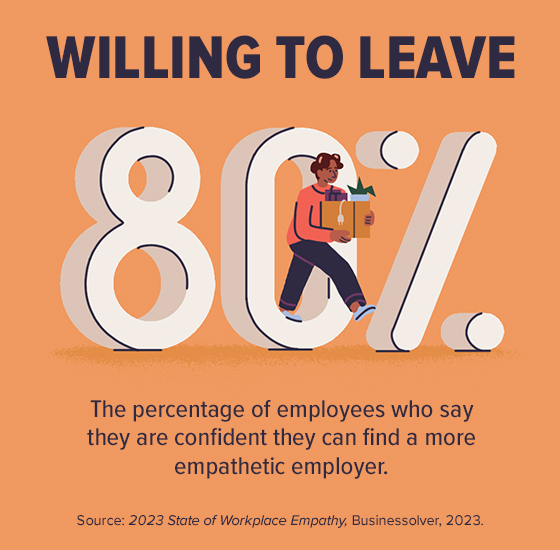
“There is little doubt in my mind that the best way to address the growing concerns about employee burnout, mental health and wellness overall is to address the work itself,” wrote Amy Edmondson, Novartis Professor of Leadership and Management at Harvard Business School, in a foreword to 2023 research from Businessolver. Those reports found that 51 percent of employees reported having experienced a mental health issue last year, and 80 percent said they’re willing to leave their companies for a more empathetic employer—and are confident they can find one.
The research underscores how much employees value a healthy work environment—perhaps more than gym memberships or happy hours.
“What matters is creating a positive, learning-oriented culture that supports people [so they can] deliver value, creating conditions for meaningful interactions that build energizing relationships, and ensuring every employee has the resources needed to do their job,” Edmondson wrote. “Notice what isn’t on this list: all the fun perks that are unrelated to making work ‘work’ as it should. It’s not about being tough or uninterested in employees’ lives. It’s about enabling individuals and teams to make work ‘work.’ ”
[Join SHRM’s Initiative: 1M Civil Conversations at Work and Beyond]
What Is Pessimism?
Experts say pessimism is a lack of hope or confidence about the future. “When someone is feeling pessimistic, they expect that things are more likely to be worse for them in the future than they are currently,” says Jessica Grossmeier, a workplace well-being expert and author of Reimagining Workplace Well-Being: Fostering a Culture of Purpose, Connection, and Transcendence (Modern Wisdom Press, 2022).
It’s actually healthy to have a somewhat pessimistic view of things, says Russell Robinson, founder of Amplified Research + Consulting LLC, which researches, analyzes and consults on employee engagement and work culture.
“This pessimism can help fuel change or provide clarity,” says Robinson, who is also director of the Key Undergraduate Leadership Development at American University’s School of Public Affairs. “However, like fear, an unhealthy amount of pessimism can do damage to a person in their personal and work lives. As a professor, I have seen how too much pessimism impacts the performance and wellness of my students.”
Nicole Mixdorf, founder and chief wellness officer at wellness company Balance by Nature, is no stranger to what a stressful work environment can do to a person.
After years of climbing the corporate ladder in a global firm, she became physically and mentally exhausted and felt so ill that she had to take a leave of absence.
Like fear, an unhealthy amount of pessimism can do damage to a person in their personal and work lives.”
Russell Robinson
In recent years, she’s not the only one.
A November 2023 report from meQuilibrium, which predicts workforce risk for burnout, turnover and mental health problems, found that three-quarters of the 4,466 U.S. employees surveyed (75 percent) are experiencing pessimism about their country. Other stressors negatively impacting employees include money (46 percent), work (39 percent) and relationships (28 percent).
When it comes to employees’ desire to quit, the report found that mental demands (identified by 35 percent of respondents), compensation (33 percent) and opportunity for growth (31 percent) were the top turnover triggers.
During Mixdorf’s time away from the corporate world, she decided to launch Los Angeles-based Balance by Nature, which helps companies create cultures that increase employee engagement, reduce attrition, and improve mental and physical health. When employees can bring into balance all aspects of their lives—including careers, finances, health, relationships and family—they will feel complete and will be able to do their best work, Mixdorf says.
What Led to This Rise in Pessimism?
The increase in pessimism was not sudden. “The rise is one that has been long in the making—especially for working class Americans,” Putnam says.
In 2019, income inequality in the U.S. reached its highest level in 50 years, she says, citing U.S. Census Bureau data. This divide only increased during the pandemic, according to a Federal Reserve survey. More recently, layoffs in the tech industry have led to increased pessimism among employees in that sector, Putnam says.
As measured in the meQuilibrium report, pessimism is on the rise due to financial insecurities, political tensions and the workplace itself. The fall 2023 report showed increases in job stress and decreases in positivity. It linked respondents’ pessimism about the state of the country with pessimism about their work. In other words, thinking about the state of the country influenced how employees felt about their jobs.
Interestingly, this report found that employees felt more optimistic about their own personal work situation than they did for the country as a whole; they expect things will improve for them but not for the majority of the country.
Robinson thinks it’s only normal to be somewhat pessimistic given the chaotic events of recent years, including the COVID-19 pandemic, social justice challenges in the U.S. and world conflicts. And now, Robinson says, we are asking: “ ‘What is work in a work-from-home and return-to-work world? What is the role of the physical office?’ When I graduated from college in 1991, you went to work at the office. Now, work can go where you are. What does that do to cities, suburbs and quality of life?”
Political divisions are preventing government leaders from addressing national concerns such as immigration, climate change and the country’s debt, Grossmeier says. Some social media algorithms are amplifying this negativity, and social contagion is spreading it, she says.
What Managers and Executives Can Do
These challenges are having an outsized impact on managers. “The biggest driver of an engaged workforce and culture is the supervisor,” says Robinson. “So, basically, having more emotionally intelligent leaders is the best starting point. Next, having leaders that can create a culture that fosters wellness where employees can be vulnerable and talk about how they are experiencing the world is critical.”
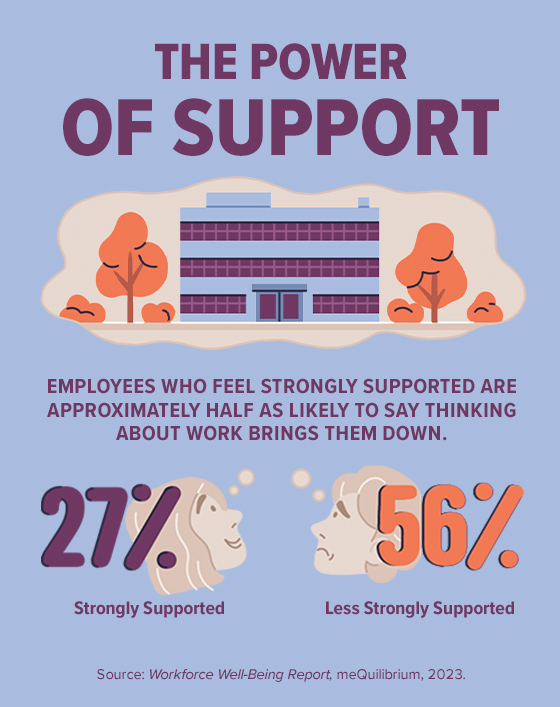
The meQuilibrium report also found that employees were less pessimistic about their work situation when they had a supportive manager. It concluded that manager support cuts turnover risk by 44 percent to 55 percent by helping to reduce factors such as burnout and the disconnection between work and life purpose.
Good supervisors “listen to their employees and understand where they are in the world, then use that [information] to make decisions. Let’s look at return to work (RTW). When I talk to organizations, I say they should be deliberate in their RTW policy. No matter what the decision is … all in the office, all remote, or some form of hybrid … there will be employees who love the decision, hate the decision or are indifferent. Know how employees will relate” to the decision, Robinson says.
Moving from pessimism to optimism can only happen through collective efforts, Putnam says. Doling out more individual interventions, such as mindfulness apps, will do little, as indicated by a recent study conducted by William J. Fleming, a fellow at Oxford University’s Wellbeing Research Center, who analyzed survey responses from 46,336 workers at companies that offer wellness programs.
This study, in combination with an earlier survey and analysis conducted by McKinsey Health Institute, indicates that companies are solving for the wrong problem. That is, they continue to target individuals, when the problem lies in how managers are leading their team members.
“No program, no mindfulness app, no exercise class, no platform can stand up to basic work practices,” Putnam says.
These basics include elements like:
- How meetings are run.
- How people are treated day in and day out.
- How much of a sense of belonging employees feel at work.
- What workloads are like.
- Whether there’s a perceived sense of fairness at work.
- How performance reviews are conducted.
- Whether employees are getting paid adequately for the work they do.
“In other words, it’s the broader organizational culture and how teams work together that need to be addressed—not the individual employees getting barraged with more wellness to-dos,” Putnam says.
“Effective approaches to burnout require employers to address unrealistic job demands, increase resources needed to get the job done, increase autonomy, address unfairness and increase peer support,” Grossmeier says.
 |
Here are some recommendations from experts interviewed for this article to help employees move from pessimism to optimism.
|
Dana M. Wilkie is a freelance journalist based in Panama.
Explore Further
SHRM provides resources and strategies to help employers support workers and overcome pessimism at work.
Employee Happiness Hits 4-Year Low
A report from BambooHR found that the overall average employee satisfaction score, which in part accounts for how likely employees are to recommend the organization as a place to work, dropped in 2023 to the lowest overall average score since 2019.
Does Your Leadership Have What It Takes? 6 Simple Questions to Find Out
Feeling heard, valued and understood are the trifecta for fulfilled remote employees, but the only way to deliver on these fundamentals is by sourcing regular feedback and implementing the suggestions. Employees need to be given the opportunity to voice their hopes and dreams, as well as their pessimism and frustrations.
Meeting Mental Health Needs Across Generations
Many workers are under stress, but the specific stressors and the supports required to alleviate them can differ depending on a person’s age and work experience.
Employee Financial Stress Peaks
Growing financial stress among workers is affecting job satisfaction and performance. Employers are responding with creative solutions, from financial counseling to emergency savings options.
What Working Mothers Really Need from Employers
Recent reports show that parents of young children are employed in record numbers. However, they continue to grapple with challenges that limit their ability to grow professionally while caring for their children.
Related Articles

Transform HR with mobile technology to streamline workflows, enhance communication, and boost employee engagement across distributed teams.

A new study found that talent development practitioners believe performance-based assessments are more effective at measuring employee learning outcomes than knowledge tests.

As AI makes deeper inroads into organizations, employee concerns about the technology continue to grow. Here's how HR leaders can address the fear of AI among their own staff, as well as in the wider organization.