Why Resilient Executives Are Better Leaders
Leaders must model resilience if they want their organizations to thrive even during challenging times.

Jay Baker has seen a lot in more than two decades as head of Jamestown Plastics. For example, when the COVID-19 pandemic took hold three years ago, the company pivoted almost overnight and began producing face shields for emergency responders that were sold worldwide.
"Attitude is what I think separates successful companies that make it for the long run," said Baker, whose family has run the Brocton, N.Y.-based business since the 1970s. He noted that resilient CEOs believe "there's nothing we can't overcome."
These days, there is plenty to overcome. A 2025 survey by the Conference Board found that the top external concerns of CEOs globally are intensified trade wars and concern of an economic downturn, with 46% identifying it as a high-impact issue.
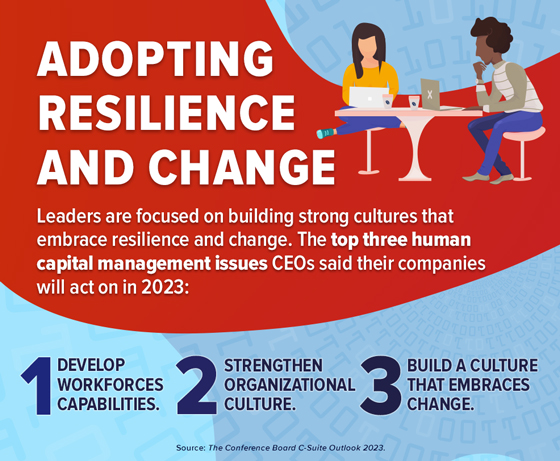
But business leaders and experts agree that leaders must model resilience if they want their organizations to thrive even during challenging times. And one of the top priorities for U.S. CEOs is to "build a resilient workforce to prepare for future challenges," the Conference Board survey found.
"Given the level of disruption we are facing, [resilience] is the skill set of our time [needed] to be successful," said Ama Marston, CEO and co-founder of Type R Partners, a San Francisco Bay Area botique consultancy that works with organizations, leaders and firms. She called this skill set "transformative resilience," which uses "change, disruption and stress as a catalyst for learning, growth and innovation."
Resilience hinges on the "ability to deal with adversity and withstand stress," said Jan Bruce, CEO of meQuilibrium, a Boston-based firm that offers digital resilience-building tools. Successful leaders need to be able to "adapt and accelerate in a crisis," she said.
Thriving Amid Adversity
At one time, Jamestown Plastics was the largest supplier of packaging for Fisher-Price toys. But when Fisher-Price moved its manufacturing abroad in the 1980s, Jamestown Plastics had to adjust. "That was something we had to rebuild from," Baker says. The company began to focus more of its efforts on working with clients in the medical and automotive industries.
Jamestown Plastics also readily shifted gears with the pandemic. It was already an essential business providing supplies for health care clients, so it never shut down, but it had to put new safety protocols in place to protect its workers.
One Friday evening, Baker got a call from the Chautauqua County executive, who is a local government official, saying the county's emergency services workers lacked face shields. He asked Baker if Jamestown Plastics could produce some. While the company had never made personal protective equipment before, it immediately rose to the task. The first face shield rolled off the production line four days after that phone call. Within a week and working around the clock, the company was producing 60,000 face shields a day.
To be resilient and effective, CEOs "need to be flexible, open to new opportunities and take risks," Baker said. "Nobody is going to be able to write the perfect playbook for every situation. Try not to sweat the small stuff, and don't be a jackass."
Learning and Self-Awareness in Leadership
Some people say leaders are born, not made, but experts agree that resilience can be learned.
"For some people, it's fairly well-baked. It comes almost naturally," said Steven Stein, a clinical psychologist and founder of Toronto-based Multi-Health Systems, a publisher of scientifically validated assessments. But "with the right training and practice, it can improve."
Bruce agrees. "The science is clear: [Resilience] is a learned behavior," she said.
This means senior executives should "learn how to learn," said Allison Bailey, managing director and senior partner with the Boston Consulting Group in Boston.
"The pace of change is so great," so establishing a peer network to learn what others have done can be helpful, she said. "Hearing from other peers tends to have more resonance."
It's also important to note that "[t]he way we look at resilience has changed," Stein said. "We used to think it was grit, being strong, getting through it. Now it has shifted to more self-awareness and responsiveness to the people around you."
The science is clear: [Resilience] is a learned behavior.
Marston added that resilience can be empowering. "It builds a mindset that we are able to rise to the challenges placed in front of us, reframe, and find the necessary internal and external resources," she said.
To learn resilience, a leader should "shelve your ego" and get ideas from others, added Dian Griesel, a New York City-based communications consultant. They can be "a sounding board for you. Not necessarily tell you what to do, but help you think it through."
Executives can also turn to coaches to help them develop and strengthen their skills. Stein suggested leaders focus on the three Cs:
- Commitment, or purpose: Focus not just on the day-to-day but on larger goals.
- Challenge: Look at things in different ways.
- Control: Know what you can and can't control. For example, you are not able to control what others do, but you can control your own reactions to situations.
While it's possible for organizations to be resilient in these ever-changing times, experts say it all begins with the CEO. "If the attitude isn't at the top, it's virtually impossible for the organization to have that attitude," Baker said. "You have to figure out how to communicate it through the organization."
Young Leaders Focus on Well-Being
The health and well-being of employees — and executives — has taken on new prominence since the start of the pandemic, and a new generation of leaders is starting to drive change.
"Individual health has worsened" with the pandemic, said Arthur Mazor, global human capital practice leader in the Atlanta office of the consultancy Deloitte. That can affect employees' productivity, as well as their social and mental well-being.
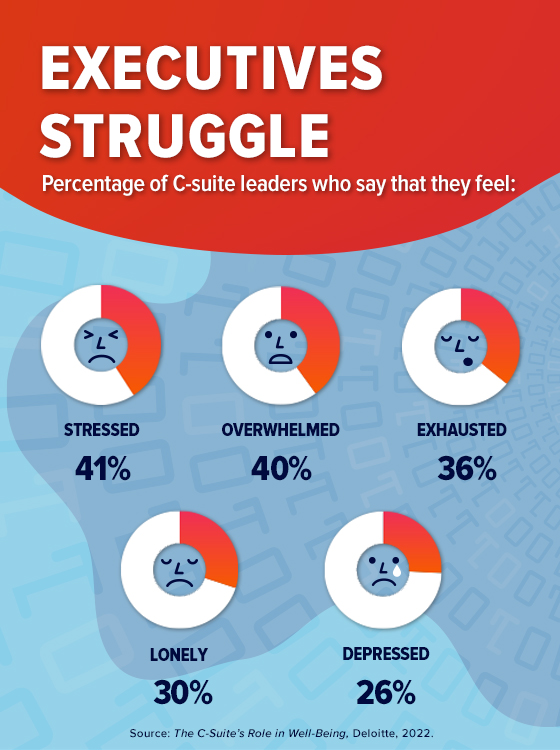
Those in the C-suite are not immune: About 40% said they felt stressed and overwhelmed, 36% were exhausted, and 30% were lonely, according to a 2022 Deloitte survey.
Almost 90% of executives in the survey said improving their well-being was a top priority. Among their top struggles are trying to start or stop work at a reasonable time, exercising, and taking at least a 30-minute lunch break.
However, change may be coming. "Young leaders seem to be creating pathways and opportunities for workforce well-being," Mazor said. And as they prioritize their own well-being, they are setting an example for the rest of the workforce.
Around 90% of Millennial and Generation Z leaders said they are increasing their focus on well-being benefits, consider themselves health-savvy, and have taken steps to help employees disconnect — far higher percentages than older leaders, the survey found.
In contrast, less than 55% of Baby Boomer leaders reported a focus on well-being benefits, and less than half said they are health-savvy.
"The most effective leaders are being incredibly intentional about what they need," said Tierney Remick, vice chairman and co-leader of Korn Ferry's global board and CEO practice in Chicago.
Such leaders aim to remain strong, focused and calm "in the midst of all the volatility," Remick said, and they do so by being deliberate about getting proper exercise, rest and nutrition. That helps their physical and mental resilience and allows them to "show up and be there for everyone else," she added.
It's a different strategy compared to a decade ago, when many CEOs prided themselves on how many hours they worked, how few hours they slept, and how much they traveled for work, Remick said. Now, younger leaders are much more focused on "what they need to show up and be their best selves."
Staying Resilient in Changing Times
Like Baker, Adam Coughran, president of Safe Kids Inc. in Costa Mesa, Calif., has the attributes of a resilient leader. Safe Kids develops curriculum to help kindergartners through 12th-graders prevent and survive violence in schools. But when schools closed their doors because of the pandemic, Coughran said he wondered, "Do we still have an industry? Can we out-survive our competitors?"
Coughran drew on his previous experience as a police officer to get through the challenge. Like other first responders, police are "always prepared for the next thing," and they know "the situation can change very rapidly," he said.
Initially, Safe Kids offered virtual live workshops focused on topics such as the pandemic lockdown and law enforcement. The company provided other new content, including an interview with an emergency room doctor, and workshops in fun areas such as dance and creative writing.
As schools began to reopen, Safe Kids offered virtual and in-person training on subjects such as talking to children about the pandemic. It later expanded to provide training on school reopening and content on mental health concerns, Coughran said.
While some leaders now are worrying about a possible recession, Coughran takes things in stride. "We've had those before," he said. "We have time to prepare for it."
By preparing in advance, leaders can "get ahead of a problem, not respond to it," Coughran added.
Griesel, who specializes in external and internal corporate communications, started her own business in 1997 and has kept going through the dot-com bust, 9/11 terrorist attacks, the Great Recession, and the pandemic.
"Know this, too, shall pass," she said. "Know that things are going to happen outside your control. When you have to shift, you have to shift."
In times of crisis, Griesel added, leaders need to make a plan, test it and adjust it as needed.
In other words, they need to be resilient.
Susan Ladika is a freelance writer based in Tampa, Fla.
Related Articles

Transform HR with mobile technology to streamline workflows, enhance communication, and boost employee engagement across distributed teams.

A new study found that talent development practitioners believe performance-based assessments are more effective at measuring employee learning outcomes than knowledge tests.

As AI makes deeper inroads into organizations, employee concerns about the technology continue to grow. Here's how HR leaders can address the fear of AI among their own staff, as well as in the wider organization.