What NASA’s Psyche Mission Lead Learned About Team Communication
Lindy Elkins-Tanton, director of the Berkeley Space Sciences Laboratory, shares leadership lessons from working as a deep-space mission leader.

Photo Credit: Aubrey Gemignani / NASA via Getty Images file
On October 13, 2023, NASA’s Psyche mission sent a spacecraft on an eight-year journey to investigate an asteroid between Mars and Jupiter, exploring for the first time a world made not of rock or ice, but of metal. As the leader of this $1.2 billion megaproject, Lindy Elkins-Tanton was midway through the biggest exploration of her life.
Below is an excerpt from her book, Mission Ready.

When the Psyche mission missed our 2022 launch date, we began holding all-team meetings over Webex to keep everyone in the loop. In retrospect, we should have started them much earlier, way before COVID, way back, well, right at the beginning — if I had known then what I know now.
I wasn’t sure at first whether everyone on the team would want to know everything that was happening. Parts of the science team, for example, had little to do with building the spacecraft and were on light work between the proposal and the arrival of the spacecraft at the asteroid, six years in the future. But two hundred people were consistently showing up to the all-team meetings, so the interest was broad enough.
What I hadn’t realized is that some people felt they were out of the loop and wanted to be in the loop, even when they didn’t have a lot of active work for their part of the project. These people were feeling disenfranchised, in part because they were the ones most emotionally and intellectually connected to and loyal to the project. Even if there were others on the team who did not come to the all-team meetings and did not feel the need (or have any practical need) to learn the day-to-day work the team was doing, there were others who did, and investing in them is critical for future team cohesion and success.
Nonetheless, I was not certain how well the communications in these meetings were being received, and I kept watching for reactions from the team. One day, a young scientist named Sean left his camera on and I could watch him. I could see the light in his eyes brightening as I briefed the group on what we would be presenting later that week to our program managers at NASA headquarters. Normally, parts of the science team would not get briefed on budget management and the progress of spacecraft integration. But I could see from the interest in his face and those of others, and the questions they asked, that this kind of information made each person feel more connected and helped them make their own decisions within their own part of the team.
Similarly, when we presented the budget management and spacecraft integration material to our manager at NASA headquarters later that week, we received feedback about how nice it was to have both our successes and our challenges laid out.
Communicating To the Whole Organization or Team
Laying out both successes and challenges is an approach I have insisted upon in our program reviews from the very beginning. We briefly summarize what we have achieved, show where we have challenges and what we have done to meet them so far, and invite ideas and participation. This way we share the challenges with the whole team and with our leadership at NASA, we can work together to solve them, and trust is built up for any harder times ahead.
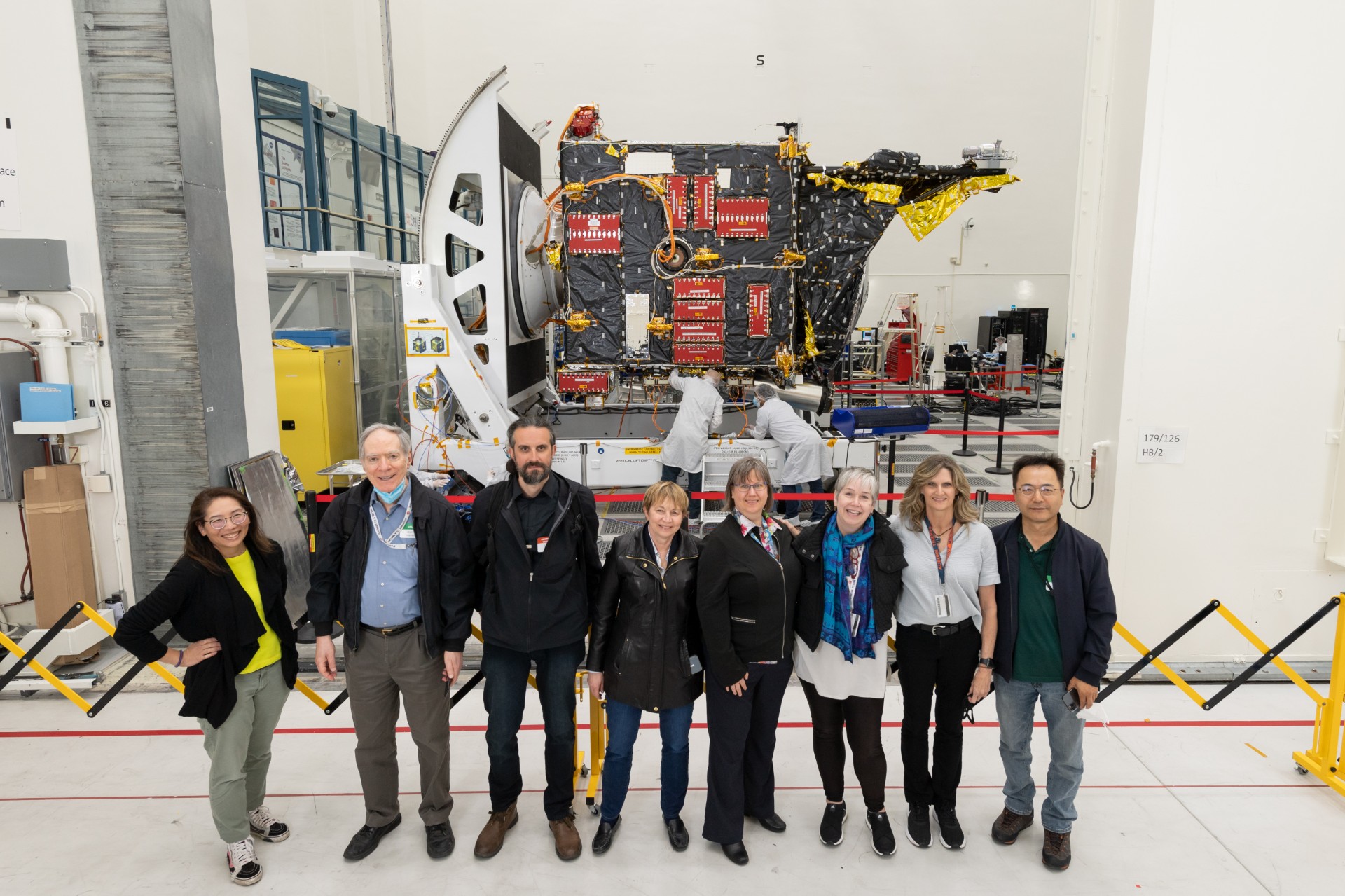
Photo Credit: NASA / JPL / ASU
Lindy Elkins-Tanton (third from right) with crew visiting the spacecraft being worked on before it was shipped to Florida.
One Psyche team member described this communications style as radical transparency. Whatever you want to call it, the aim is to respect the intelligence, responsibility, and dedication of your team and all your stakeholders within and outside your organization. Talking openly and unashamedly about challenges we face also models that good practice for the rest of the team and, we hope, helps people feel comfortable to bring forward problems in time to fix them.
But continuous, transparent communication can also be disruptive if it engenders anger, doubt, or misunderstanding. Be honest and also let everyone know the context. If there is bad news, share it. For example, if you’ve just learned you did not win a key grant or contract, you need to tell the team because they will be wondering anyway. Perhaps share that information along with what you might have learned about why you weren’t picked and what the team can do better next time; talk about next steps and the work ahead, so everyone is looking forward and needn’t be despondent or think that you are. Your team is strong and capable and smart. In fact, a team that can look at misfortunes and setbacks and simply start fixing them and learning together is a team that, in times of emergency, will feel like the safest place to be in, a place where calm, forward progress always happens.
In some cases, such as with especially sensitive information, communications should begin with individuals, then proceed to small groups, and then to the larger group; we call this socializing new information. In these cases, communications need to be designed to move upward, downward, and horizontally through organizations, reaching everyone.
Sensitive information is best served in small groups at first, but even then, some people might react strongly, or misunderstand, or want to take precipitate action. Fear of disruption cannot stop you from communicating. Part of the goal of communications is to empower each person to take responsibility for their job—they should not be sheltered from organizational trouble under a managerial welfare state, where the management takes responsibility for everything.
Ways to Improve Communication
According to Chris Argyris, who when he did this work was the James B. Conant Professor at the Harvard graduate schools of business and education, many communications from leadership to teams follows this script: Hide your fears about the other person’s likely resistance to self-analysis of metacognition to check on whether we are listening to information and are passing pertinent information on to the right people who can benefit from that knowledge — not all they need to know but all they can benefit from.
Overall, we want to avoid knowledge hiding. If team members feel relaxed, safe, and communicative, they will be less likely to hide critical knowledge.
What are some things that help?
- Confidence in the justice of the organization: Rational decisions and fair treatment lead to less knowledge hiding.
- Group understanding of how we relate to each other: If there is less conflict, there is less knowledge hiding.
- Confidence in communications: That’s what we are talking about in this chapter.
We need a team that can talk about what we don’t know instead of what we already know.
Lindy Elkins-Tanton is a professor at UC Berkeley, director of the Berkeley Space Sciences Laboratory, and lead of the NASA Psyche mission. She is the author of A Portrait of the Scientist as a Young Woman. She lives in Richmond, California.
Excerpted from Mission Ready: How to Build Teams That Perform Under Pressure. Copyright © 2025 by Lindy Elkins-Tanton. Available from Basic Venture, an imprint of Hachette Book Group, Inc.
Was this resource helpful?

Validate your HR expertise
Earning your SHRM-CP credential makes you a recognized expert and leader in the HR field.
Related Content

Learn how Marsh McLennan successfully boosts staff well-being with digital tools, improving productivity and work satisfaction for more than 20,000 employees.

The proliferation of artificial intelligence in the workplace, and the ensuing expected increase in productivity and efficiency, could help usher in the four-day workweek, some experts predict.

As artificial intelligence technology continues to develop, the demand for workers with the ability to work alongside and manage AI systems will increase. This means that workers who are not able to adapt and learn these new skills will be left behind in the job market.