How Recent Supreme Court Rulings Impact Employer Policies
Company leaders should review policies and practices related to compensation, religious accommodation and DE&I in light of recent U.S. Supreme Court decisions.

The U.S. Supreme Court recently wrapped up a term with several momentous cases focused on affirmative action, student loan relief, religious liberties and the authority of federal agencies. The result was a mixed bag of wins and losses for employers.
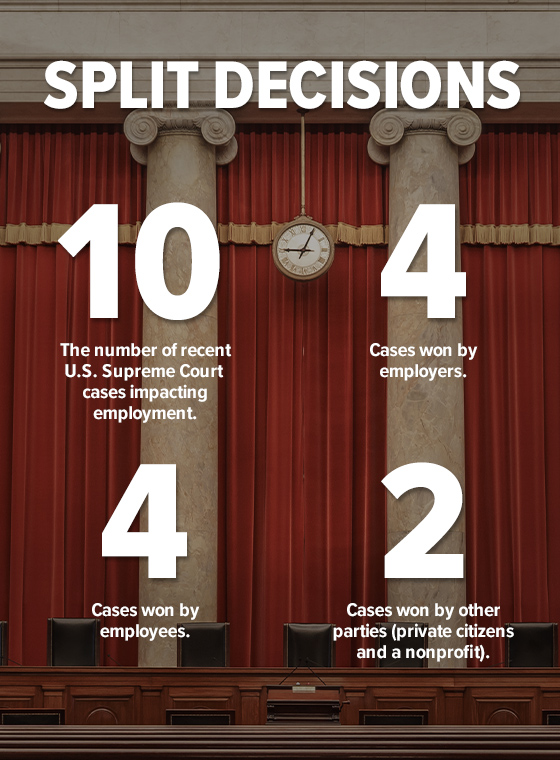
The court decided 10 employment-related cases during the term that spanned from October 2022 through June 2023. Employers won four of those cases and lost four. A private couple and a nonprofit organization, Students for Fair Admissions, won the other two.
Two of the cases were decided unanimously by the nine justices. They were split in the rest of the cases, with the three more-liberal justices often dissenting from the six-member conservative majority.
"It's fair to say there weren't any devastating losses in the employment law arena. Mostly, the justices created uncertainty for the employer community," says Joseph Beachboard, an attorney with Beachboard Consulting Group in Los Angeles.
In two important cases, the court sided in favor of religious freedoms in the workplace. For employers, now is a good time "to revisit equal employment opportunity policies, including nondiscrimination, antiharassment and religious accommodation policies," says Hannah Reisdorff, an attorney with Clark Hill in Detroit.
‘I think overall this court will be good for employers, given the majority's more conservative philosophy, but as we saw this year, that doesn't guarantee success in any particular case or necessarily more clarity for HR professionals.’
Joseph Beachboard
Other court opinions made it harder for employers to classify workers as exempt from overtime and outlawed affirmative action programs at universities.
"The important employer takeaway from the '22-'23 term is to review policies and practices relating to compensation, religious accommodation, and DE&I initiatives. Failure to do so could be very costly to employers," says Elaine Turner, an attorney with Hall Estill in Oklahoma City.
Affirmative Action
In one of its most high-profile rulings this term, the court ended affirmative action in student admissions at colleges that receive federal money. The decision in Students for Fair Admissions v. President and Fellows of Harvard College applies to student admissions processes, not the colleges' operations as employers. However, observers say the ruling could broadly jeopardize private employers' diversity, equity and inclusion (DE&I) programs and limit the diversity of the talent pool that employers will have access to in the future.
The court concluded that race-conscious admissions policies violated the 14th Amendment's "twin commands that race may never be used as a 'negative' and that it may not operate as a stereotype" under the U.S. Constitution.
The decision "effectively turns away from decades of precedent and will undoubtedly hamper the efforts of some colleges and universities to ensure diverse student bodies," says U.S. Equal Employment Opportunity Commission Chair Charlotte Burrows. "That's a problem for our economy because businesses often rely on colleges and universities to provide a diverse pipeline of talent for recruitment and hiring," she says. "Diversity helps companies attract top talent, sparks innovation, improves employee satisfaction and enables companies to better serve their customers."
However, Burrows adds, "It remains lawful for employers to implement diversity, equity, inclusion and accessibility programs that seek to ensure workers of all backgrounds are afforded equal opportunity in the workplace."
The decision's impact "will not be immediate, as lower courts will need to grapple with how the Supreme Court's analysis applies in other contexts. But smart organizations will want to look at their [DE&I] strategies, so as to maintain forward progress, while navigating potential legal and reputational risks," says Grace Speights, an attorney with Morgan Lewis in Washington, D.C.
Religious Freedoms
In Groff v. DeJoy, a Christian postal worker sued the U.S. Postal Service for not accommodating his religious practice of observing Sunday Sabbath. The court concluded employers can only deny an employee's request for a religious accommodation under federal law if the employers can prove the accommodation would result in substantial increased costs for the business.
"While the standard arguably raises the bar for when a requested religious accommodation will constitute an undue hardship on the employer, it is clear that the determination of whether an undue burden exists will be highly fact-specific from situation to situation, and employer to employer, given the emphasis on considering the conduct of the employer's particular business," says Christopher Durham, an attorney with Duane Morris in Philadelphia.
For now, it's unclear where to draw the line between undue hardship and lesser burdens.
"It will take decades for case law to develop such that we truly understand what employers must do when an employee requests an accommodation because a job duty conflicts with a sincerely held religious belief. For most employers, this dictates taking a conservative approach to avoid getting involved in litigation that clarifies what the law is," Beachboard says.
The 303 Creative decision 'is part of a trend of the current Supreme Court giving greater weight to religious freedom concerns.’
Christopher Durham
Religious accommodations can intersect with various workplace rules, including dress codes, vaccination requirements, work schedules and others corporate policies.
This case "will likely spawn countless actions based on an employer's right to mandate COVID-19 vaccines," predicts Pamela Moore, an attorney with McCarter & English in Hartford, Conn. "The court dramatically heightened the standard for religious accommodation in the workforce, despite its statements to the contrary," she says. "It will result in employers having greater difficulty managing the workplace and denying religious accommodations that are undoubtedly disruptive to an employer's organization."
Meanwhile, in 303 Creative v. Elenis, a Colorado website designer sued the state preemptively because she didn't want to create websites for same-sex weddings. She said her particular Christian beliefs conflicted with the state's antidiscrimination law, which protects LGBTQ+ individuals from discrimination. The court ruled in her favor, stating that her free speech rights trumped the state's legal protections against discrimination.
The ruling applies nationwide to businesses that sell creative goods or services to the public. It only kicks in "where a business offers services that are effectively its own speech, and where accepting a particular customer would require it to articulate a message that it disagrees with," says Katie Eyer, a professor at Rutgers Law School in Camden, N.J.
The 303 Creative decision "is part of a trend of the current Supreme Court giving greater weight to religious freedom concerns," Durham says.
The court has "clearly retreated" from its earlier views that the U.S. Constitution doesn't protect discrimination, Eyer says. But "it has also not afforded even religious or expressive businesses a blanket right to discriminate."
The 303 Creative decision "is forecast to have ripple effects," potentially impacting other protected classes and other civil rights, says Nonnie Shivers, an attorney with Ogletree Deakins in Phoenix. "But the impact on private employment may intersect most with religious accommodations," Shivers says.
Employers shouldn't "view this case in a vacuum, especially given the Supreme Court's decision in Groff, as well as recent cases in the past few years involving prayer at schools, required state support of religious schools and the refusal of religious social services organizations to work with same-sex couples. "Pattern does not necessarily equal practice, but the court's conservative makeup does seem to be trending in this direction," Reisdorff says.
"The court's traditional and conservative religious views are driving their decisions and will likely result in a curtailment of rights for other protected classes where the individual justices' religious beliefs conflict, e.g., the LGBTQ+ community," Moore says.
Key Supreme Court Decisions Affecting Employers
Illegal Strikes.
The court also clarified that labor strikes are not legal if they damage an employer's property. In Glacier Northwest v. International Brotherhood of Teamsters, a building materials company in Seattle sued its employees' union after workers started a strike while concrete was scheduled to be batched and delivered. The action risked damaging the company's concrete trucks.
Because the union "took affirmative steps to endanger Glacier's property, rather than reasonable precautions to mitigate that risk, the National Labor Relations Act (NLRA) does not arguably protect the union's conduct," Justice Amy Coney Barrett wrote in the majority opinion.
"While [it is] a good ruling for employers, the ruling will likely not have an impact on day-to-day labor relations," Turner says.
Mandatory Arbitration.
In Coinbase Inc. v. Bielski, the court ruled that a district court must stay its proceedings while an appeal on the question of arbitrability is ongoing. This ruling makes it less burdensome for employers to compel employees to enter arbitration.
The decision will "relieve the parties of the cost and burdens of engaging in litigation while they wait for a decision from an appeals court," says Samia Kirmani, an attorney with Jackson Lewis in Boston. The case "underscores that value proposition of employment arbitration agreements."
Overtime Pay.
In Helix Energy Solutions Group v. Hewitt, the court ruled that highly compensated employees can be eligible for overtime pay under the federal Fair Labor Standards Act (FLSA) if they are paid daily. The ruling showed the importance of applying the overtime exemption criteria properly, since misclassifying someone as exempt can be costly in the long run.
"The U.S. Department of Labor and federal courts continue to apply a strict and pro-employee interpretation of the FLSA overtime exemption tests," Turner notes. "Companies should vigilantly review overtime exemptions applied to employees to ensure compliance."
Personal Jurisdiction.
In Mallory v. Norfolk Southern Railway Co., the court upheld a Pennsylvania law that requires companies to face lawsuits in the state when they register to do business there. It ruled that an employee could continue his civil case against a transportation company in Pennsylvania courts, even though the events of his case didn't take place in the state. The ruling may impact the locations where employers could face future trials, perhaps giving plaintiffs more opportunity to choose a jurisdiction that would likely be the friendliest to them.
Federal Agency Powers.
Several cases showed the court's willingness to address what it considered executive branch overreach.
In Department of Education v. Brown and Biden v. Nebraska, the court struck down the Biden administration's plan to forgive up to $10,000 in student loans for borrowers who earn less than $125,000 annually and up to $20,000 for those who received Pell Grants. The justices decided in favor of Republican-led states that argued the plan overstepped the federal government's authority.
In Axon Enterprise v. Federal Trade Commission, the Supreme Court ruled that federal district courts can hear constitutional challenges to a federal agency's authority before the agency completes its own appeals process. Employers may find it easier to win legal battles against federal agencies based on this ruling.
In Sackett v. EPA, the court ruled that the U.S. Environmental Protection Agency (EPA) and the Army Corps of Engineers cannot regulate wetlands that are not directly connected to waters of the U.S. This limits the scope of the federal Clean Water Act. The decision also shows how the court has increasingly looked favorably on individuals and companies that challenge the power of federal agencies.
In addition, the court in May agreed to hear another case during its next term that could significantly alter the power of federal agencies. In Loper Bright Enterprises v. Raimondo, the justices will weigh overturning the longstanding Chevron precedent, which holds that when Congress writes a statute without a clear meaning, courts should defer to the interpretation of the federal agency applying the law, unless its directives were unreasonable.
And in April, the court permitted the U.S. Food and Drug Administration's (FDA's) longstanding approval of an abortion drug to be temporarily stayed until a legal challenge moves through the appeals process. This decision maintained the status quo for access to abortion pills in states that permit them.
The court also refused to hear a reverse discrimination and retaliation case brought by two white police officers who opposed a diversity initiative of the Michigan State Police. The court let stand an earlier district court ruling that found the white officers failed to show they were treated differently than non-white officers.
Going forward, "I think overall this court will be good for employers, given the majority's more conservative philosophy, but as we saw this year, that doesn't guarantee success in any particular case or necessarily more clarity for HR professionals," Beachboard says.
In the next term, says Turner, "We expect the court will work to resolve a split among the circuits and clarify the types of conduct which are actionable under federal employment discrimination laws."
Leah Shepard is the senior legal editor for SHRM.
Explore Further
SHRM provides business leaders with information and resources to help them respond to an ever-changing legal landscape.
SHRM Toolkit: Navigating Religious Beliefs in the Workplace
Employers must navigate a legal framework on issues relating to employees' religious beliefs, but they also have an opportunity to provide a welcoming and inclusive workplace that attracts and retains top talent.
Guide to Developing a Strategic Diversity, Equity and Inclusion Plan
A strategic diversity, equity and inclusion (DE&I) management plan can help an organization make the most of its diversity by creating an inclusive, equitable and sustainable culture and work environment.
SHRM Toolkit: Managing Federal Contractor Affirmative Action Programs
Proactive steps by contractors to comply with federal regulations will ensure that organizations will continue to be eligible to receive future federal contracts and subcontracts and reduce the risk of a difficult audit.

Related Articles

Transform HR with mobile technology to streamline workflows, enhance communication, and boost employee engagement across distributed teams.

A new study found that talent development practitioners believe performance-based assessments are more effective at measuring employee learning outcomes than knowledge tests.

As AI makes deeper inroads into organizations, employee concerns about the technology continue to grow. Here's how HR leaders can address the fear of AI among their own staff, as well as in the wider organization.