Black Workers Still Earn Less than Their White Counterparts
Employers can examine their pay policies to root out inequities

As employers in the U.S. tackle issues around racism, fresh attention is being given to the racial wage gap and why black men and women, in particular, still earn substantially less than their white counterparts. Nearly 56 years after the passage of the Civil Rights Act, "we find equal pay for equal work is still not a reality," noted Jackson Gruver, a data analyst at compensation data and software firm PayScale.
Last year, PayScale analyzed differences in earnings between white men and men of color using data from a sample of 1.8 million employees surveyed between January 2017 and February 2019.
Among the findings, Gruver reported: "Even as black or African-American men climb the corporate ladder, they still make less than equally qualified white men. They are the only racial/ethnic group that does not achieve pay parity with white men at some level."
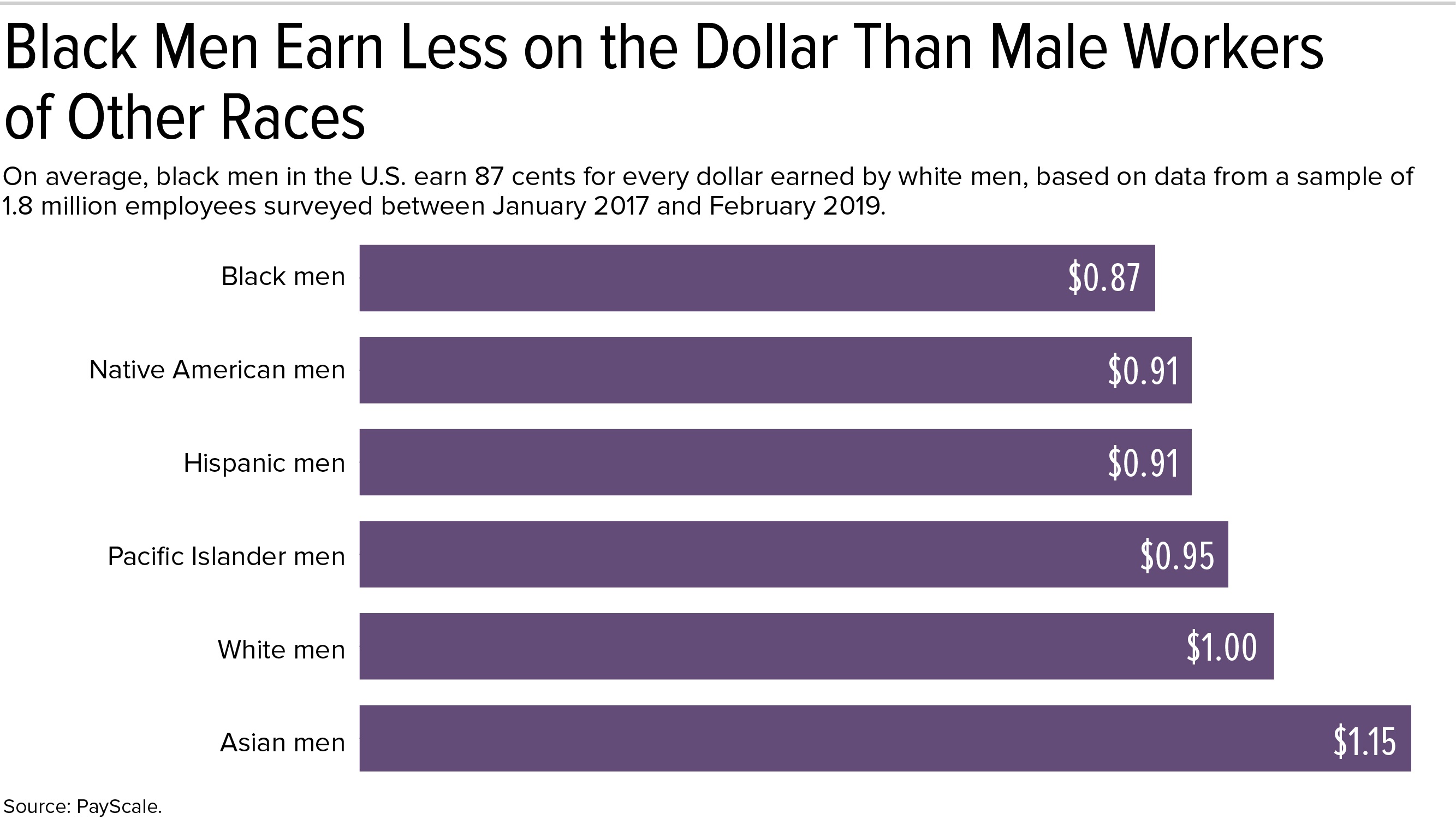
The study found that black men had the largest "uncontrolled pay gap" relative to white men, when comparing the average earnings of black men and white men in the U.S.
On average, black men earned 87 cents for every dollar a white man earned. Hispanic workers had the next largest gap, earning 91 cents for every dollar earned by white men. On the other side of the earnings spectrum, Asian men typically earned $1.15 for every dollar earned by a white male worker.
Better news was found in the controlled pay gap, a comparison of pay for black and white men with the same experience and education doing the same job in the same geographic location. This approach showed that black men earned 98 cents for every dollar earned by white men with the same qualifications. While that difference may seem small, when a 2 percent difference in pay is compounded over the course of a career, it adds up to black men taking home significantly less pay than their white male peers.
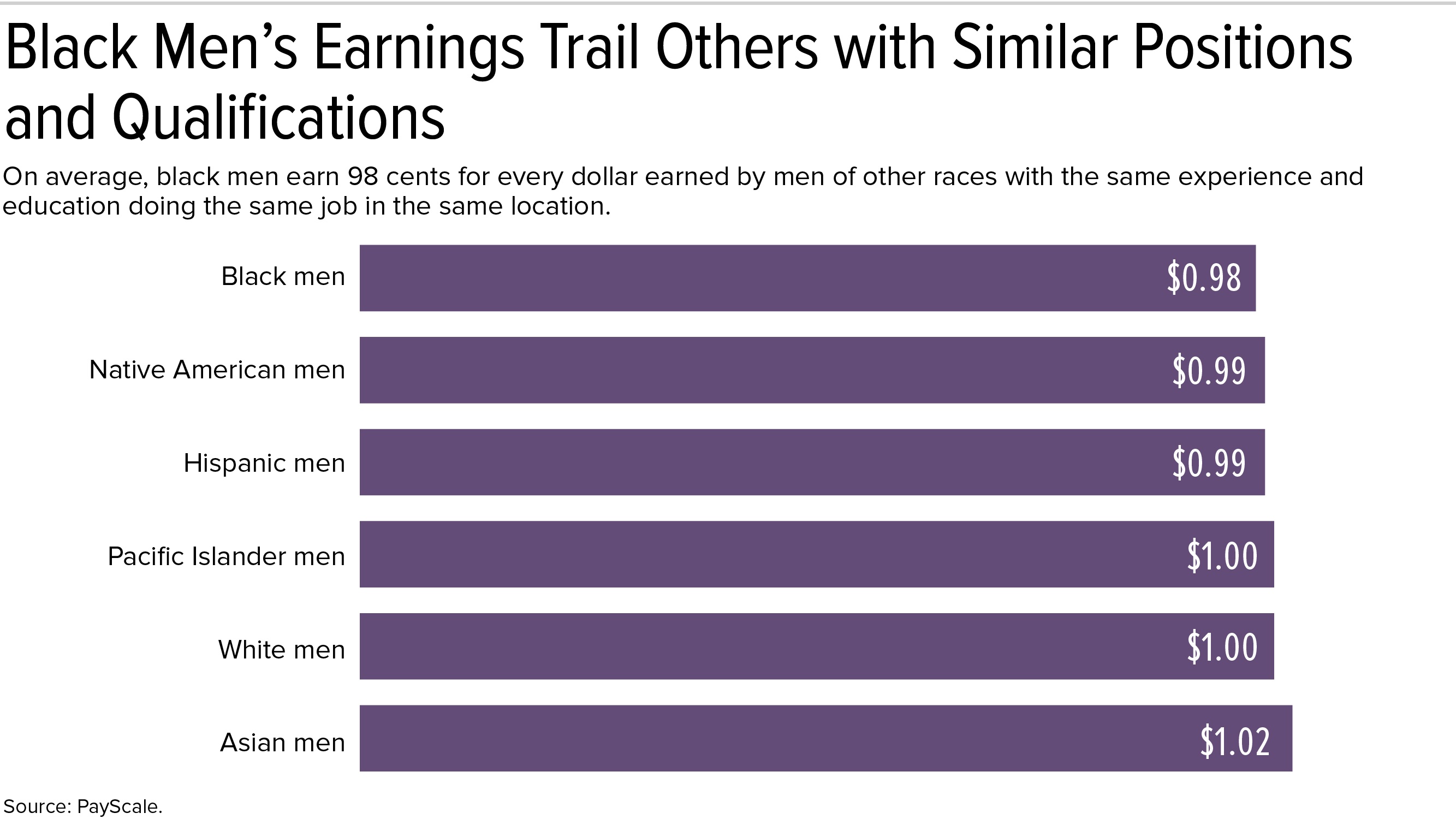
To put that in perspective, the median salary of a white man in our sample is $72,900; the controlled median pay for black or African-American men is thus $71,500," Gruver said. "This suggests a $1,400 difference in pay that is likely attributable to race."
An Opportunity Gap
Gruver attributed much of the racial pay gap to an opportunity gap and occupational segregation.
"When we look at the opportunity gap, we find men of color have higher rates of holding individual contributor jobs than white men," he noted. The study found, for instance, that a larger percentage of black men (63 percent) and Hispanic men (61 percent) held individual contributor roles, compared with 56 percent of white men who weren't in management.
Even when they hold management positions, black men are paid less than their white counterparts. Executive-level black men earned 97 cents for every dollar white men with the same qualifications took home, PayScale found. Even more concerning, the racial wage gap widened as black men moved up the corporate ladder.
This difference may be partly attributable to occupational segregation, meaning that black men are more likely to work in industries that generally pay less, such as social services, in comparison with white men in senior positions, Gruver said.
Black Women's Wage Gap
"Comparing what women of color are paid to what white, non-Hispanic men make demonstrates the enormous economic impact of the double burden of sexism and racism," wrote Brandie Temple, a public-policy fellow at the nonprofit National Women's Law Center (NWLC), and Jasmine Tucker, director of research at the organization, in an online post.
NWLC calculations, based on the U.S. Census Bureau's Current Population Survey for 2016, revealed that when comparing all men and women who work full time, year-round in the U.S., women were paid just 80 cents for every dollar paid to their male counterparts. But the wage gap was even larger when looking specifically at black women who work full time, year-round—they were paid only 63 cents for every dollar paid to white, non-Hispanic men.
"This gap, which amounts to a loss of $21,001 a year, means that black women have to work more than 19 months—until the very last day of July—to make as much as white, non-Hispanic men did in the previous 12-month calendar year," Temple and Tucker observed.
NWLC also found that:
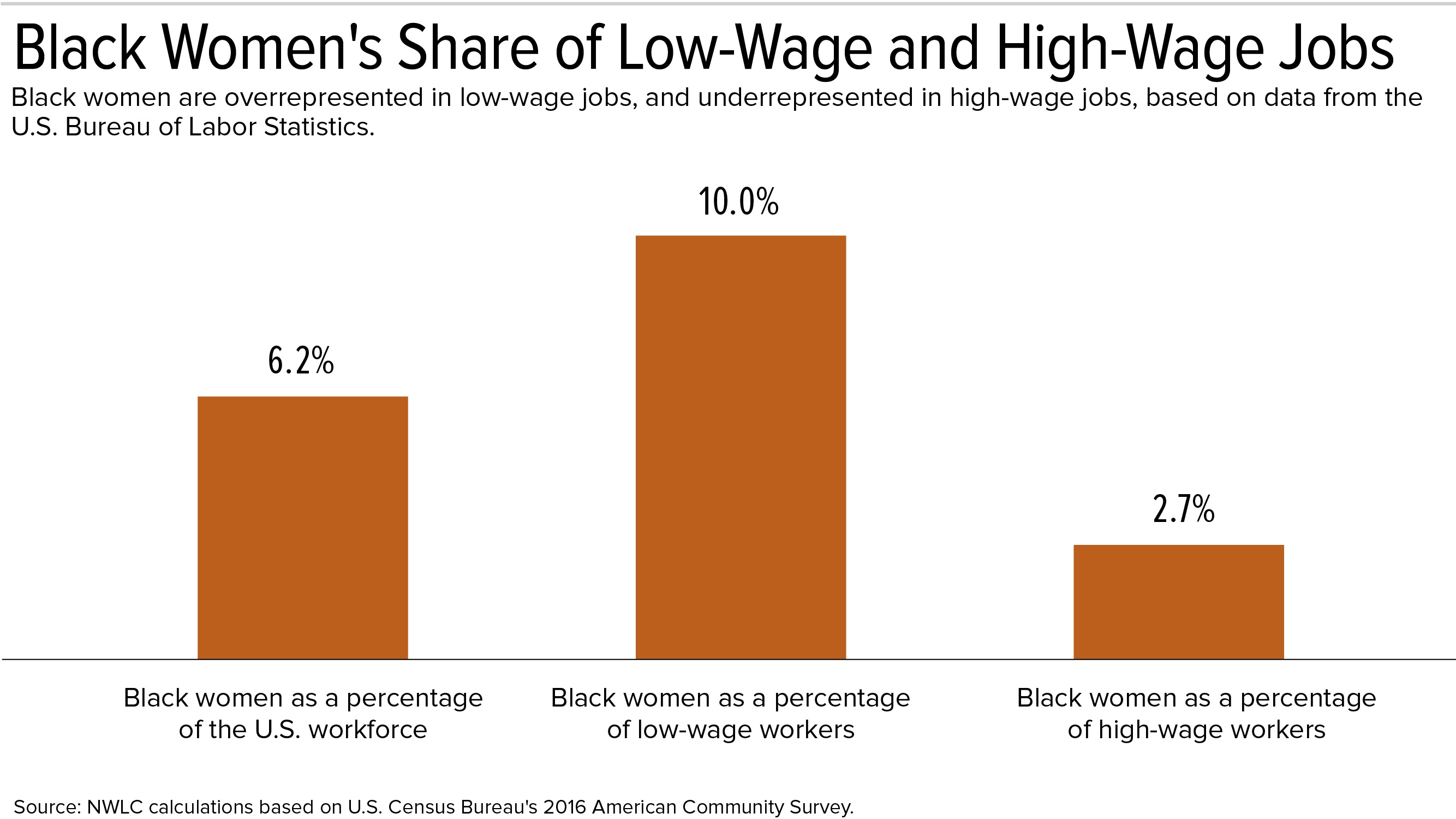
- Black women make up 10 percent of the low-wage workforce—jobs that typically pay less than $11 per hour, or about $22,880 annually—while they make up just 6.2 percent of the overall workforce.
- Black women's share of the high-wage workforce—jobs that pay more than $48 per hour, or about $100,000 annually—is less than half their representation in the overall workforce.
Black women who worked full time, year-round in low-wage occupations were typically paid about $21,700 annually, compared to the $36,000 typically paid to white, non-Hispanic men in these occupations, NWLC found. "This gap translates to a loss of $14,300 each year to the wage gap—more than enough to pay for an entire year's worth of rent or more than a year and a half of child care costs," Temple and Tucker noted.
Among workers in high-wage occupations—such as lawyers, engineers and physicians—black women who work full time, year-round were typically paid about $70,000, compared to the $110,000 typically paid to white, non-Hispanic men in the same jobs. This amounts to an annual loss of $40,000 each year, or $1.6 million over a 40-year career.
[SHRM members-only toolkit: Managing Pay Equity]
Education and Earnings
Even after completing undergraduate and graduate degrees, black and Hispanic workers earned less than non-Hispanic white workers with the same, or often less, education, said Roy Eduardo Kokoyachuk, a partner at ThinkNow Research, which helps companies respond to the demographic and cultural drivers that influence consumer decisions.
In a May 2020 column for the website Market Insider, Kokoyachuk wrote that "The numbers are sobering. I ran the Census Current Population Survey's 2018 median income levels by race and bachelor's degree attainment, and found that black and Hispanic bachelor's degree holders earn nearly a quarter less than Asians and whites with equal levels of education."
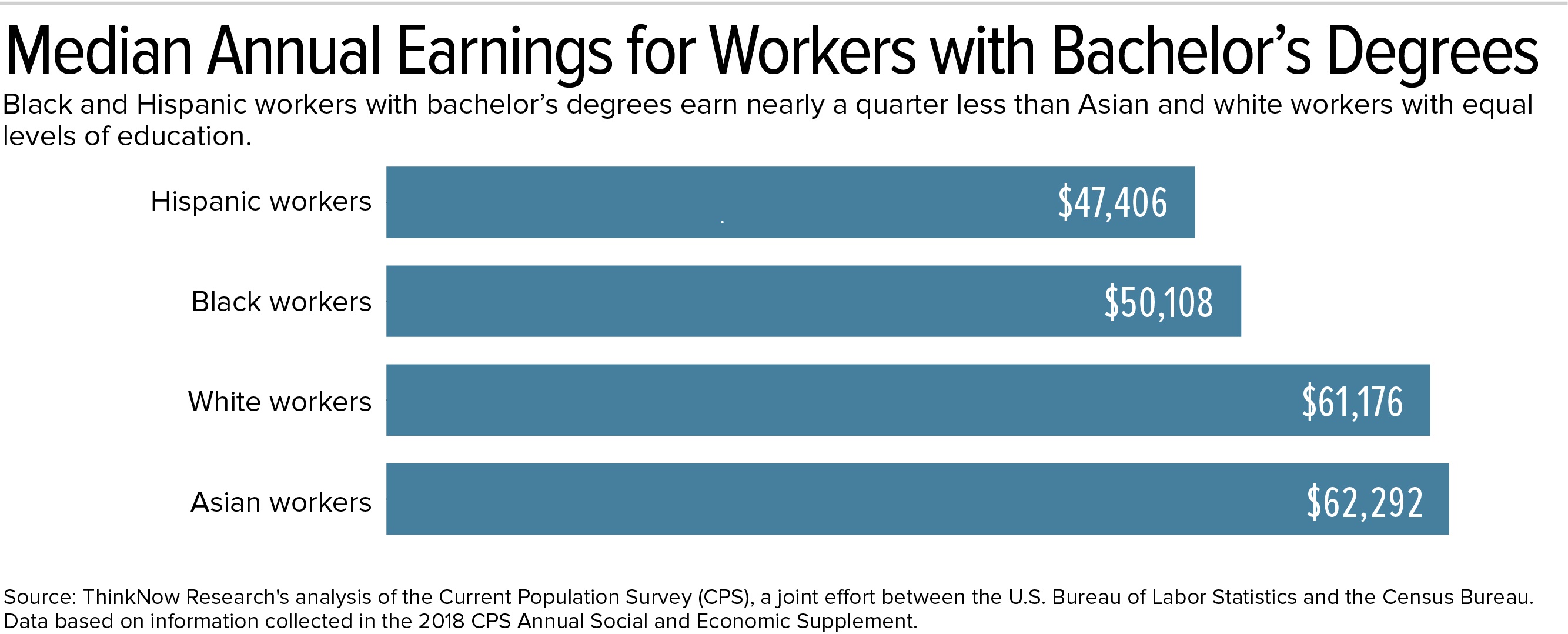
While some undergraduate majors lead to higher wages, and Asian students were more likely to major in science, technology, engineering and math (STEM) subjects, for instance, that doesn't explain why wage differences exist more broadly, Kokoyachuk noted.
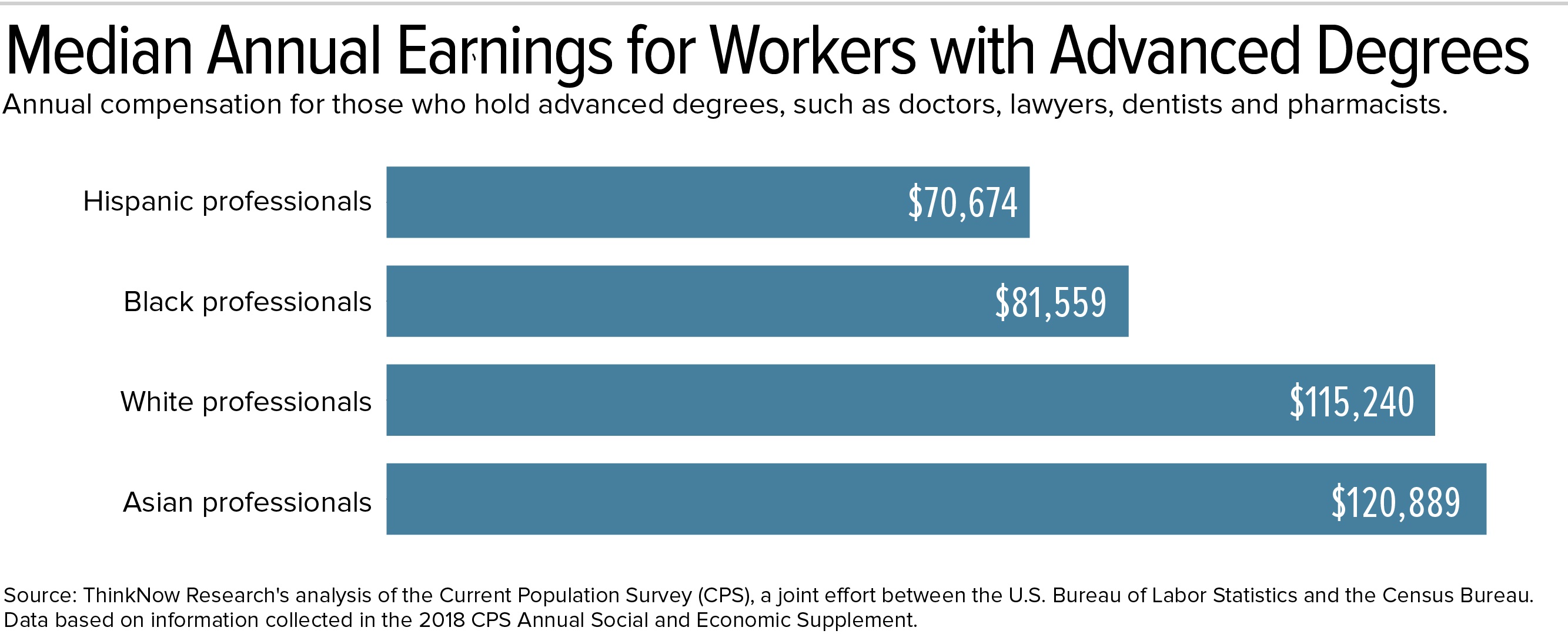
Even among black and Hispanic workers who have earned professional degrees, "their incomes still don't break six figures. Whites and Asians, however, double their incomes by earning professional degrees, allowing them to make well over $100,000 a year," Kokoyachuk said.
NWLC's analysis found that black women with a bachelor's degree were typically paid $46,694—just under what white, non-Hispanic men with only a high school degree were paid ($46,729). Black women had to earn a master's degree to make slightly more ($56,072) than white, non-Hispanic men with just an associate degree ($54,620).
Black Women's Wage Equality by Education
| Education | Black Women's Earnings | White, Non-Hispanic Men's Earnings | What Black Women Are Paid for Every Dollar Paid to White, Non-Hispanic Men |
| No high school degree | $21,847 | $36,480 | 60¢ |
| High school degree | $29,468 | $46,729 | 63¢ |
| Associate degree | $36,409 | $54,620 | 67¢ |
| Bachelor's degree | $46,694 | $75,080 | 62¢ |
| Master's degree | $56,072 | $87,051 | 64¢ |
Source: NWLC calculations based on U.S. Census Bureau's Current Population Survey, 2016 Annual Social and Economic Supplement.
Confronting the Problem
Although workers of all races, on average, earned higher wages in 2018 than in 2000, Kokoyachuk pointed out that "at every level of wage distribution, the gap between black and white wages was larger in 2018 than it was in 2000," the data showed.
The racial wage gap can be overcome, he said, if policymakers are committed to taking actions such as:
- Stepping up enforcement of employment anti-discrimination laws.
- Offering tax incentives for minority entrepreneurs and business owners.
Employers should consider taking these steps:
• Performing pay audits.
While pay audits have become common to address unconscious biases against women, racial biases should not be overlooked.
Employers should perform statistical self-audits of pay decisions and review policies regarding starting pay, allowable pay differences, merit pay increases and promotional pay increases to root out patterns of racial bias that may be unintentional on the part of managers.
• Not asking applicants about their past earnings.
According to new research from Boston University, salary history bans can substantially close both gender and racial gaps. After salary history bans were passed, wages increase for job changers by 8 percent for women and 13 percent for black people.
"Salary history bans do work and are an important component in closing gender and racial pay gaps," said Tanya Jansen, co-founder of beqom, a cloud-based compensation software provider.
• Upgrading technology.
"While instituting salary bans is progress in the right direction, companies should also consider instituting data-driven technology to help automate the compensation decision-making process and eliminate unconscious biases from the start of the recruiting and hiring process," Jansen said.
[Update: Beginning in August, the U.S. Army will no longer include photos of soldiers on records used to select future officers, to help eliminate unconscious biases in its promotion-and-advancement process, defense officials said on June 25.]
Career Mentoring
Because economic outcomes are heavily influenced by social networks, Kokoyachuk also advised improving career-mentoring programs for minority workers.
For younger workers at the start of their careers, these efforts can include "creating better opportunities for minority graduates to mingle with or be mentored or sponsored by decision-makers from other groups," he noted. Doing so can help them build up social connections that they can use when seeking higher-paying positions.
Additional resources on addressing wage disparity and workplace-bias issues are listed below:
- SHRM blog article on Recognizing and Mitigating Unconscious Bias in the Workplace.
- SHRM resource page on Pay Equity.
- SHRM How to Talk with Your Employees About Race Express Request.
Related SHRM Articles:
Black Workers Face Health Care and Retirement Savings Benefits Gaps, SHRM Online, July 2020
The Importance of Pay Equity, HR Magazine, Spring 2020
Creating a Mentoring Program: Yodas Not Required, SHRM Online, March 2020
Was this resource helpful?

Validate your HR expertise
Earning your SHRM-CP credential makes you a recognized expert and leader in the HR field.
Related Content

Transform HR with mobile technology to streamline workflows, enhance communication, and boost employee engagement across distributed teams.

A new study found that talent development practitioners believe performance-based assessments are more effective at measuring employee learning outcomes than knowledge tests.

As AI makes deeper inroads into organizations, employee concerns about the technology continue to grow. Here's how HR leaders can address the fear of AI among their own staff, as well as in the wider organization.