Belong First, Bounce Forward: The Secret to Productivity Most Leaders Overlook

You’ve implemented the best performance platforms. Your top talent is in place.
Pulse surveys? Done. Learning portals? Checked. Hybrid policies? Absolutely.
And yet—something isn’t clicking.
People show up, but not fully. They complete tasks but don’t take ownership. They stay busy, but the spark is missing.
Sounds familiar?
Here’s the thing no one wants to say out loud:
Most people aren’t underperforming because they lack skills.
They’re underperforming because they feel UNSAFE.
It is not physically unsafe, but speaking up is. Failing is. Being real is.
And the fear? It’s killing your highly qualified teams from the inside
out. It harms their hyperproductivity, performance, effectiveness, and efficiency. (There, I said it!)
Why Your Productivity Pyramid Might Be Stale
Most organizations still stack performance like this:
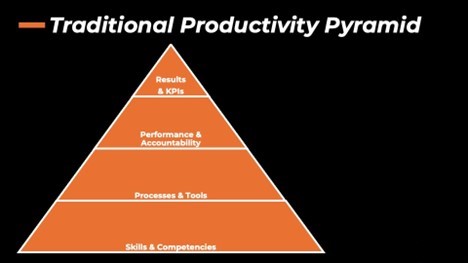
It seems logical and efficient. However, it breaks under pressure, especially when your team faces a rough patch, conflict, change, or crisis.
So, discard that pyramid!
Let’s replace that pyramid with a new one that works.
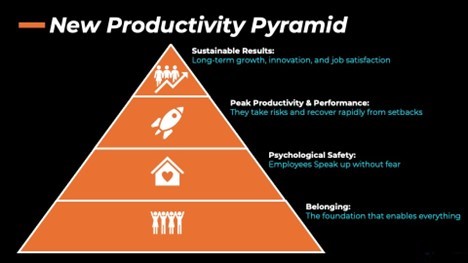
What if we started with belonging in the first place? What if the base of the productivity pyramid wasn’t SKILLS but BELONGING?
When they belong, people feel safe, connected, and trusted, and they don’t just work harder; they work as if it matters.
I refer to this as the Belonging-Based Productivity Pyramid, the foundation for every resilient, high-performing team I’ve worked with.
The Client Case Study That Changed Everything
During the pandemic, one of my clients, a five-star resort in the Maldives, had to shut down indefinitely.
They had to send back over 800 employees to their homes without any assurance of when they would reopen.
No guests. No revenue. No visibility into when they would reopen.
Now, imagine anxiety. Moreover, the fear of uncertainty is whether the employees will return to work when they finally open. Despite the significant setback, they recognized that their best option was to take a different approach. They moved beyond traditional methods to manage the situation.
Here’s what the leadership team did:
- They committed to paying 50% of their salaries despite having no income.
- They held monthly virtual check-ins, not to discuss work, but to check on the well-being of employees and their families.
- They provided the personal mobile numbers of C-suite leaders and told employees, “Call us. Anytime. For anything.”
When they reopened, 99% of the workforce came back.
How about some of their other competitors? About 55%-60% of employees returned to work.
That’s what belonging looks like in action. Done right, it can be a game-changer for your company.
Disengagement Doesn’t Always Appear as Disengagement
If you believe disengaged employees are merely those slacking off in the back row, you’re missing the point.
Some of your most disengaged people are still meeting deadlines.
Still attending meetings.
Still smiling.
They have stopped being themselves.
Here’s what to watch for when identifying disengagement in your teams:
1. Overcompliance
“Sure, whatever you say.”
ü Too quick to concur
ü Avoids constructive conflict
ü Seldom provides alternatives or pushback
What it signifies: A lack of psychological safety to express themselves when necessary.
2. Chronic Busyness
“I’d love to think strategically, but I’m swamped.”
ü Always multitasking
ü Avoids deep or creative work
ü Overemphasizes ‘doing’ over reflecting
What it signifies: Avoiding vulnerability or making decisions.
3. Silence in Setbacks
[No questions. No pushback. Just polite smiles.]
ü Does not ask for help
ü Seldom actively participates in meetings.
ü Conceals confusion or fear of being wrong
What it signifies: learned self-protection, not alignment. They have shut down emotionally.
4. Perfectionism
“I didn’t speak up because it wasn’t fully ready.”
ü Holds back ideas
ü Over-prepares
ü Will not share drafts or early thoughts.
What it signifies: They are overwhelmed by fear of failure or being judged incorrectly.
What Resilient Leaders Do Differently
I once worked with a leader who began every Monday team meeting by asking:
“What did we learn from what didn’t go well last week?”
Not to blame. Not to shame.
But to create space. For reflection. For honesty. For resilience.
That single practice transformed the team’s vibe. People started taking ownership of their mistakes before being prompted. They began assisting one another in troubleshooting. They developed trust in the understanding that perfection is not necessary.
I refer to that as Setback Leadership; it’s not solely about fixing problems.
It’s about developing resilience to grow through them.
Introducing: The Setback SOP™ Framework
The Setback SOP is my preferred framework for building team resilience, not reactively but systematically.
It consists of three layers:
- Mindset: Leaders demonstrate vulnerability and curiosity
- SOPs: Teams create rituals that encourage honesty and reflection
- Tools: Everyday language and frameworks that normalize the challenge
By utilizing these three layers of change, your teams learn to shift, own, and plan their productivity more efficiently and effectively, particularly in high-stakes environments. Think of it as an emotional infrastructure for performance under pressure.
Related Articles

Learn how Marsh McLennan successfully boosts staff well-being with digital tools, improving productivity and work satisfaction for more than 20,000 employees.

The proliferation of artificial intelligence in the workplace, and the ensuing expected increase in productivity and efficiency, could help usher in the four-day workweek, some experts predict.

As artificial intelligence technology continues to develop, the demand for workers with the ability to work alongside and manage AI systems will increase. This means that workers who are not able to adapt and learn these new skills will be left behind in the job market.