Rewards Value & Efficiency Framework (RVEF): Engineering Higher ROI from Every Reward Spend
In today’s fast-evolving business landscape, the role of rewards is undergoing a fundamental shift. Total Rewards teams are no longer limited to administering benefits or designing compensation structures—they are now expected to strategically align with both business and people outcomes while maximizing financial efficiency.
This shift is especially evident in technology sectors, where the intense competition for digital talent has led organizations to rethink not just pay, but the entire employee experience. Many tech employers now offer flexible benefits, wellness stipends, and personalized learning and development opportunities, using rewards as a lever to attract and retain top talent in a rapidly changing market.
In manufacturing, the dual challenge of cost containment and workforce upskilling is front and center as automation and digital transformation reshape job roles. Here, organizations are increasingly investing in internal mobility and reskilling initiatives, enabling them to redeploy existing talent efficiently and minimize the need for costly external hiring.
Within financial services, heightened regulatory scrutiny and growing emphasis on ESG (Environmental, Social, and Governance) factors have prompted HR leaders to design rewards programs that not only incentivize performance but also reinforce ethical conduct and sustainability objectives. For example, it is becoming more common to link a portion of variable pay or bonuses to ESG-related metrics, aligning employee incentives with broader organizational priorities.
Across all these sectors, CHROs are under mounting pressure. They must attract top talent, optimize rewards while controlling costs, align workforce strategies to global expansion, and support the CEO and Board on executive pay and succession. Simultaneously, they are expected to transform their own HR teams—delivering more with less, adopting digital capabilities, and demonstrating measurable ROI.
In this context, frameworks like the Rewards Value & Efficiency Framework (RVEF) are not just helpful—they’re essential. RVEF provides a pragmatic lens to evaluate rewards investments through both value and efficiency, turning reactive decisions into intentional strategy.
A growing body of evidence from global HR and consulting firms underscores the need for such a framework. Mercer Global Talent Trends 2024–2025 highlights the shift toward adaptive, digitally fluent organizations—a principle at the heart of RVEF’s focus on value creation through smarter processes. Deloitte 2023 Global Human Capital Trends emphasizes the move from rigid roles to fluid skills and agile deployment, aligning with RVEF’s “Sweet Spot” and “Value Multiplier” quadrants. By embedding these research-backed insights into strategic design, RVEF emerges as a practical imperative for today’s HR leaders.
Drawing inspiration from engineering disciplines—particularly Value Analysis and Value Engineering (VAVE)—this article introduces the Rewards Value & Efficiency Framework (RVEF), a novel approach to Total Rewards that offers a new lens for aligning value and efficiency in rewards strategy.
The core idea of RVEF is straightforward: every reward initiative should result in one of the following outcomes:
More value at the same or lower cost
The same value at a lower cost
More value at a lower cost
Avoiding higher costs for the same or lesser value
Just as Value Analysis and Value Engineering (VAVE) challenge engineers to deliver greater functionality or reduce input costs, the Rewards Value & Efficiency Framework (RVEF) equips Rewards professionals to achieve similar outcomes in the HR domain. RVEF encourages a disciplined approach to enhancing the impact of pay, benefits, and people processes—enabling organizations to unlock more business value through smarter program design, streamlined operations, and evidence-based decision-making.
The RVEF 2x2 Matrix: Strategic Quadrants
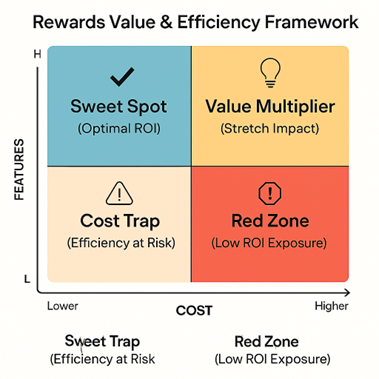
The above four quadrants can be defined as follows -
Quadrant
|
Value or Impact
|
Cost
|
Strategic Meaning
|
✅ Sweet Spot
|
High
|
Low
|
Optimal ROI with efficient cost and strong impact
|
💡 Value Multiplier
|
High
|
High
|
Higher cost matched by superior and strategic outcomes
|
⚠️ Cost Trap
|
Low
|
Low
|
Looks efficient but may silently erode effectiveness an |
The following scenarios demonstrate how each quadrant applies to real-world organizational challenges and opportunities:
RVEF Framework Applied: Sample Before vs. After Scenarios
Scenario
|
Without RVEF (Red Zone / Cost Trap)
|
With RVEF (Sweet Spot / Value Multiplier)
|
ROI Impact
|
Financial Services
|
Rigid benefits structure due to legacy constraints led to high turnover (18% attrition) and low engagement. Employees viewed rewards as uncompetitive and inflexible.
|
Introduced flexible benefits (mental health coverage, Outpatient Care Coverage, automated rewards administration, and linked bonuses to ESG (Environmental, Social, and Governance) metrics. Reduced attrition to 13% and improved engagement.
|
+25% retention, +30% satisfaction
|
Tech/Professional Services
|
Fixed schedules and generic annual recognition resulted in high turnover among employees. Limited flexibility and infrequent appreciation led to low morale and decreasing productivity.
|
Implemented flexible work timing, digital recognition platforms for ongoing & peer-to-peer appreciation with instant rewards and personalized messages, learning stipends for upskilling.
|
-10% turnover, +2x internal mobility
+75% engagement, +40% collaboration
|
Manufacturing
|
Productivity stagnation due to outdated incentive structures. No clear link between performance and rewards.
|
Launched a "Grand Prix" productivity contest with real-time metrics, skill-based bonuses, and internal mobility programs. Productivity increased by 35% over six years.
|
+35% productivity, +20% quality
|
Tech/Professional Services
|
Recognition programs limited to annual awards or generic e-mails, resulting in low engagement and perceived value. Employees felt their contributions were overlooked.
|
Adopted digital, peer-to-peer recognition platforms with instant rewards and personalized messages. Participation in recognition programs rose to 75%, boosting morale and collaboration.
|
+75% engagement, +40% collaboration
|
HR Operations
|
Manual rewards processes (letters, calculations) caused errors and high administrative costs. Employees lacked visibility into benefits.
|
Automated rewards workflows with AI-driven dashboards and personalized total rewards statements. Reduced processing time by 50% and errors by 90%.
|
-50% costs, +40% efficiency
|
Key Takeaways
Sweet Spot Wins: Flexible scheduling, digital recognition, and automation consistently deliver more value at the same or lower cost.
Avoiding Red Zones: Rigid, generic rewards and inflexible processes trap organizations in low-ROI cycles, while RVEF-aligned strategies break the cycle.
Value Multipliers: Skill-based bonuses, internal mobility, and digital recognition platforms create stretch impact by aligning rewards with strategic goals.
The following examples illustrate situations within each of the four quadrants, reflecting common experiences faced by many organizations.
✅ Sweet Spot (Optimal ROI)
- Benefit enhancement without additional cost using better analytics, personalization, or negotiation.
- Insurance upgrades (e.g., Outpatient Care Coverage, annual health check-up, Enhanced coverage limits) at same or lower cost.
- Subsidized food, benevolent funds, and non-cash wellness incentives.
- Vendor negotiations and pooled procurement strategies.
- Automation and digitization with initial investment that leads to efficiency, scale, and experience.
- Investment in compensation tools enabling scalability, accuracy, and design innovation.
- Centralized global payroll improving compliance, admin ease, and employee experience.
- Optimal workforce structure with balanced deployment across geographies (offshore/onshore) and capability levels (junior, mid, senior) aligned to business needs.
- Integrated talent strategy combining internal upskilling, strategic external hiring, and flexible deployment models (e.g., gig, contract, or contingent workforce).
- Scientific hiring grids integrating skills, experience, performance, and cost.
💡 Value Multiplier (Stretch Impact)
- Higher benefits such as enhanced Group Term Life (GTL) insurance / Group Medical Cover (GMC), well-being leave, sponsored holiday trips as recognition, higher education sponsorships, executive coaching, or skill-based Learning & Development (L&D) programs.
- Investments in leadership development Programs (LDPs), certifications, or participation in global learning networks.
- Sales and incentive programs tied to wealth creation and stretch performance.
- Rewards & Recognition platforms that amplify culture with higher utilization and experiential appeal.
- Strategic workforce planning with optimal deployment across internal rotations, talent pools, and external hires.
- Redesigned compensation grids aligning skills, impact, and pay progression to business strategy.
⚠️ Cost Trap (Efficiency at Risk)
- Benefit cuts (e.g., transport, flexibility, insurance) that may deliver short-term cost savings but ultimately reduce employee morale, experience, and perceived value.
- Sluggish automation or tech upgrades causing inefficiency and loss of competitive edge.
- Hiring freezes or delays as short-term measures leading to capacity mismatches with growth plans and ultimately causing strategic disadvantages in capability building.
- Short-sighted enablement reductions—cutting Learning & Development (L&D), benefits, recognition, and other foundational investments that sustain both performance and employee experience over time.
- Cross-subsidizing underperforming business units by stripping core employee programs.
- Variable pay plans structured with excessively tight thresholds or steep penalties, offering limited upside or earnings clarity—ultimately failing to motivate or reward sustained performance.
❌ Red Zone (Low ROI Exposure)
- Lateral hiring or retention at inflated cost without proportional business return or long-term project clarity.
- Capacity ramp-ups at unreasonable cost for short-term projects—often without long-term visibility or strategic infrastructure to onboard, develop, and retain talent, especially in cases like campus hiring from premium institutes.
- Risk-averse attitudes resulting in deferring the implementation of best-in-class tools, progressive practices, or timely policy evolution.
- Overspending on outdated or non-critical capabilities.
- Lack of policy agility, adherence to rigid legacy systems over dynamic needs.
- Investing in low-impact areas due to tradition or hierarchy, not strategy.
Why This Matters Now
Gartner, SHRM, Aon, and other leading firms all highlight HR’s challenges in aligning talent, cost, and value. Their latest reports reinforce RVEF’s relevance, confirming it as a strategic must-have.
Organizations are under dual pressure: attract and retain the best talent while maintaining fiscal discipline. RVEF bridges that gap with a design-led, outcomes-oriented approach that:
elevates HR’s credibility in boardroom conversations
makes every reward component measurable in ROI terms
aligns Total Rewards with productivity, performance, and purpose
balance cost with impact
Conclusion: Design for More, Spend for Less
RVEF brings an engineering mindset to Rewards. It demands that we look beyond tradition, hierarchy, and regular increments or fitments. Instead, we build a reward ecosystem where every dollar works harder, and every program is accountable to performance, potential, and purpose.
The future of Total Rewards is not just about generosity—it’s about engineering. With RVEF, we embed intention, efficacy, and impact into every rewards decision.
About the Author
Praveen Gandhi | Global Head and Vice President - Total Rewards, Performance, Global Mobility and Global Service Delivery, Tata Technologies Ltd.
Was this resource helpful?

Validate your HR expertise
Earning your SHRM-CP credential makes you a recognized expert and leader in the HR field.
Related Content

Transform HR with mobile technology to streamline workflows, enhance communication, and boost employee engagement across distributed teams.

A new study found that talent development practitioners believe performance-based assessments are more effective at measuring employee learning outcomes than knowledge tests.

As AI makes deeper inroads into organizations, employee concerns about the technology continue to grow. Here's how HR leaders can address the fear of AI among their own staff, as well as in the wider organization.