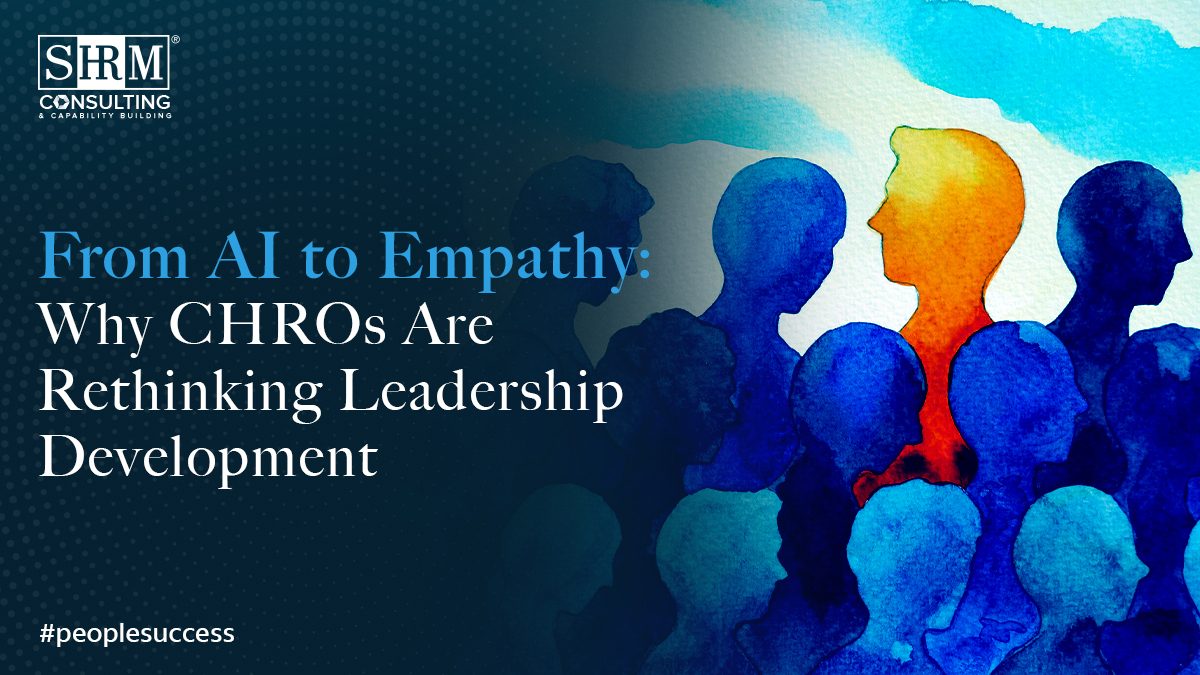
Just when we thought that artificial intelligence (AI) would be the biggest disruptor to human resources, a deeper, more nuanced challenge has emerged on the radar of Chief Human Resource Officers (CHROs): the urgent need for fundamental human leadership.
While AI is undeniably reshaping the workplace, bringing unparalleled efficiencies and performance enhancements, the human leadership element—how managers and leaders connect, engage, and inspire—is becoming the focal point for CHROs worldwide. According to SHRM's 2025 Executive Summary on CHRO Priorities and Perspectives, 51% of CHROs identified leadership and manager development as top priorities. This isn’t just a trend; it's a wake-up call for organizations to recalibrate their leadership strategies for the future.
The Paradox of Progress: Why Leadership Matters in an AI-Driven World
AI promises efficiency, speed, and automation of routine tasks. But as AI handles the transactional, the relational becomes more valuable. Organizations are realizing that while technology can improve how work gets done, it can't replicate how employees feel. Leaders serve as the critical link in this experience.
When employees are led by someone who understands their aspirations, recognizes their contributions, and creates psychological safety, they are more likely to be productive, engaged, and loyal. As such, human leadership becomes the differentiator. The SHRM report underscores this duality: while 90% of CHROs expect AI to become more prevalent in the workplace, a majority also anticipate an increased focus on employee well-being (59%), human-centered leadership (50%), and rapid skill development (53%).
The Multigenerational Mandate: One Style Doesn’t Fit All
Today’s workforce comprises employees from four to five generations, each with unique expectations:
- Gen Z (born after 1996) seeks purpose, inclusivity, and rapid growth. They prefer transparent communication and opportunities to innovate. A Gen Z employee might expect their manager to coach them regularly and provide real-time project feedback.
- Millennials (born 1981–1996) value work-life balance, flexibility, and professional development. A millennial leader may thrive in organizations that allow remote work and invest in upskilling opportunities.
- Gen X (born 1965–1980) brings a pragmatic mindset and appreciates autonomy and competence. They want leaders who respect their independence but are available for strategic alignment.
- Baby Boomers (born 1946–1964) emphasize loyalty, job security, and a strong sense of commitment. They respond well to personal recognition and leadership that honors legacy.
Given this diversity, leaders must evolve beyond one-size-fits-all management. They must be culturally aware, emotionally intelligent, and flexible in their leadership. This requires a new kind of leadership agility—the ability to customize their approach for different individuals and situations.
The New Skillset for Leaders: Managing the Human Element
The leadership toolbox is expanding. To thrive in an AI-enhanced workplace, managers must be equipped with a set of adaptive, human-centric capabilities:
1. Managerial Effectiveness in a Tech-Augmented World
As AI automates repetitive tasks, leaders must refocus on what can't be automated: human relationships. Effective managers now need to:
- Motivate dispersed or hybrid teams: In a world where remote work has become the norm, leaders must build digital intimacy. Regular check-ins, virtual team rituals, and platforms like Slack and Zoom must be used not just for work, but to foster camaraderie.
- Foster psychological safety: A culture where employees feel safe to share ideas, make mistakes, and be themselves is vital. Leaders must model vulnerability and openness, as seen in companies like Google, which attributes much of its team success to psychological safety.
- Translate vision into meaningful engagement: Leaders must help employees connect the dots between organizational goals and their personal work. For example, explaining how a data analyst’s report contributes to a better customer experience enhances meaning.
2. Coaching as a Core Leadership Style
The days of directive leadership are over. Employees don't want to be told what to do; they want to be guided, inspired, and enabled. Coaching is the answer. Effective leader-coaches:
- Ask powerful questions: Instead of prescribing solutions, they help team members discover their own. Questions like "What do you think is the best way forward?" invite ownership.
- Listen actively and empathetically: Leaders need to create space for authentic conversations. This means putting away distractions, summarizing what they've heard, and validating employee emotions.
- Empower growth over performance: Rather than solely measuring results, coaches focus on development. For instance, replacing performance reviews with growth conversations ensures learning remains continuous.
Companies like Microsoft have already embraced this shift. Under Satya Nadella, the organization moved from a culture of "know-it-alls" to "learn-it-alls," rooted in coaching principles.
3. Future-Ready Talent Development
As technology evolves, so too must talent. Leaders must be accountable for:
- Identifying and nurturing HiPo (High Potential) talent: These are the employees who will be the future leaders. Yet, traditional criteria often overlook diverse or unconventional profiles. Leaders must use data, observation, and mentorship to spot true potential.
- Creating personalized learning journeys: A one-size-fits-all approach to development doesn’t work anymore. Leaders should work with L&D teams to tailor learning paths based on individual career aspirations.
- Sponsorship, not just mentorship: HiPo employees need active advocates who open doors, not just give advice. Sponsorship involves putting your reputation on the line to push someone forward.
The SHRM report validates this shift, with 27% of CHROs prioritizing talent management and 24% emphasizing learning and development.
4. Rethinking HiPo Programs and Competency Models
Many legacy HiPo programs are outdated and fail to prepare leaders for today's complexities. CHROs must lead the redesign by:
- Embedding agility and emotional intelligence into new competency frameworks: The leaders of tomorrow must be comfortable with ambiguity, rapid change, and emotional nuance.
- Introducing digital dexterity as a core skill: Leaders must not only adopt technology but champion it. They must understand how AI tools work and how they affect people.
- Creating inclusive leadership models: The new age of leadership is diverse. It must reflect the lived experiences of the entire workforce.
For example, Accenture recently revamped its leadership competency model to include collaboration across ecosystems and leading with purpose as core skills.
Financial and Talent Pressures: The Twin Burdens
It isn't just leadership capability that CHROs are worried about — it's also the external and internal pressures squeezing HR strategy. The SHRM report notes:
- 61% of CHROs cite wage inflation as a significant pressure, leading to tighter salary budgets and harder decisions about rewards.
- 45% are contending with rising operational costs, which means HR functions must deliver more value with fewer resources.
Internally, CHROs are grappling with:
- Low morale and disengagement (50%): Burnout, lack of connection, and uncertainty are driving disengagement. Leaders need to reignite a sense of purpose.
- Attracting skilled employees (41%): The talent market is both global and competitive. Strong employer branding and meaningful leadership are more critical than ever.
- Retention struggles (40%): Employees are walking away from toxic or indifferent leadership. Retaining talent now depends more on culture than compensation.
And if that weren’t enough, CHROs themselves are under pressure. A full 34% of them say their greatest challenge is balancing their own workload and personal well-being. As they take care of others, who takes care of them?
Human-Centered Leadership: The Strategic Advantage
Forward-thinking CHROs are using leadership development as a strategic lever. Leadership isn’t just about soft skills anymore—it’s about hard results:
- Companies with strong leadership pipelines outperform their peers in revenue and employee engagement.
- Organizations that invest in leadership development see higher retention rates and stronger succession planning.
Examples of such moves include:
- Embedding leadership into onboarding: At Unilever, new hires are introduced to leadership expectations from day one, not after they become managers.
- Aligning leadership KPIs with culture and engagement: Adobe ties manager performance to how well they enable team learning and collaboration.
- Cross-functional partnerships: CHROs are working more closely with CFOs and CEOs to ensure leadership drives both cultural and financial outcomes.
The Road Ahead: CHROs as Architects of the Human Enterprise
Gone are the days when HR was a support function. Today, CHROs are leading the charge in organizational transformation. The SHRM report identifies three future-defining roles for CHROs:
- Cultivating future leaders: By embedding coaching, innovation, and adaptability into leadership DNA.
- Executing strategic change: By aligning talent programs with business transformation goals.
- Balancing AI and humanity: By ensuring that as tech scales, human connection does not shrink.
This shift redefines the CHRO role from reactive to proactive, transactional to transformational.
In 2025 and beyond, what will separate thriving organizations from surviving ones is not how fast they adopt AI, but how effectively they lead humans through it. Leadership, once considered a soft discipline, has become a hard-edged competitive advantage.
So, what’s keeping CHROs awake at night? It isn’t just algorithms or automation. It’s the challenge of ensuring that as we digitize our processes, we don't dehumanize our people.
Human leadership is not the antithesis of AI — it is complementary.
Was this resource helpful?

Validate your HR expertise
Earning your SHRM-CP credential makes you a recognized expert and leader in the HR field.
Related Content

Transform HR with mobile technology to streamline workflows, enhance communication, and boost employee engagement across distributed teams.

A new study found that talent development practitioners believe performance-based assessments are more effective at measuring employee learning outcomes than knowledge tests.

As AI makes deeper inroads into organizations, employee concerns about the technology continue to grow. Here's how HR leaders can address the fear of AI among their own staff, as well as in the wider organization.