“The appearance of control is not governance. Control attempts to eliminate uncertainty. Governance establishes the conditions under which uncertainty can be handled responsibly.”
Host of The CEO Daily Brief
BNY reported in its 2025 annual report that it now has 134 “digital employees” — multi-agent AI systems that operate autonomously alongside human colleagues. Nearly half of the bank’s human employees are also building AI agents.
According to BNY CEO Robin Vince, each digital employee reports to a human manager and receives performance reviews. The good news is that artificial intelligence will probably be thrilled to receive a “meets expectations,” which may be the clearest evidence yet that it is not human.
So why are we calling these systems employees? And why are we putting software into reporting structures built for people?
Because management does not have a mental model for work without a worker. And that has consequences.
The Employee Metaphor Changes Accountability
A 2026 working paper, Putting AI on the Org Chart, asked managers to review the same error-filled documents attributed to an AI tool, a human employee named Alex or an AI employee named Alex-3. Among managers whose organizations already put agents on org charts, those reviewing the “AI employee” performed 16% worse, caught 18% fewer errors and assigned less accountability to themselves.
Calling software an employee did not make the software more accountable. It made managers act as though they were less accountable.
That result offers a clue about the mental machinations at work here. “Employee” is not merely an icky word choice. It changes the psychological relationship. When I use an AI tool, the story is clear: I used this software to produce the work. When I manage an AI employee, the story becomes: I delegated the work to someone else. Except there is no someone else.
This is the control reflex operating at the level of language. We have already seen the same reflex with remote work. When leaders can no longer see people working, they often try to restore the feeling of control through office mandates, monitoring software, activity dashboards and more meetings. The green dot beside someone’s name becomes evidence of contribution, as though availability was an outcome. Some of these decisions serve legitimate business needs. But too often, the intervention answers a different question: not “What will improve performance?” but “What will reassure me that work is happening?”

From Visible Activity to Measurable Outcomes
Thrive Market CEO Nick Green described the alternative on The CEO Daily Brief. When remote work “cut the leash,” his company had to stop relying on visible activity and become more rigorous about outcomes. Green calls the philosophy “culture over control”: greater freedom paired with greater accountability, supported by “guardrails and guidelines, not hard rules.”
Green did not make invisible work visible again. He made the expectations and results more visible.
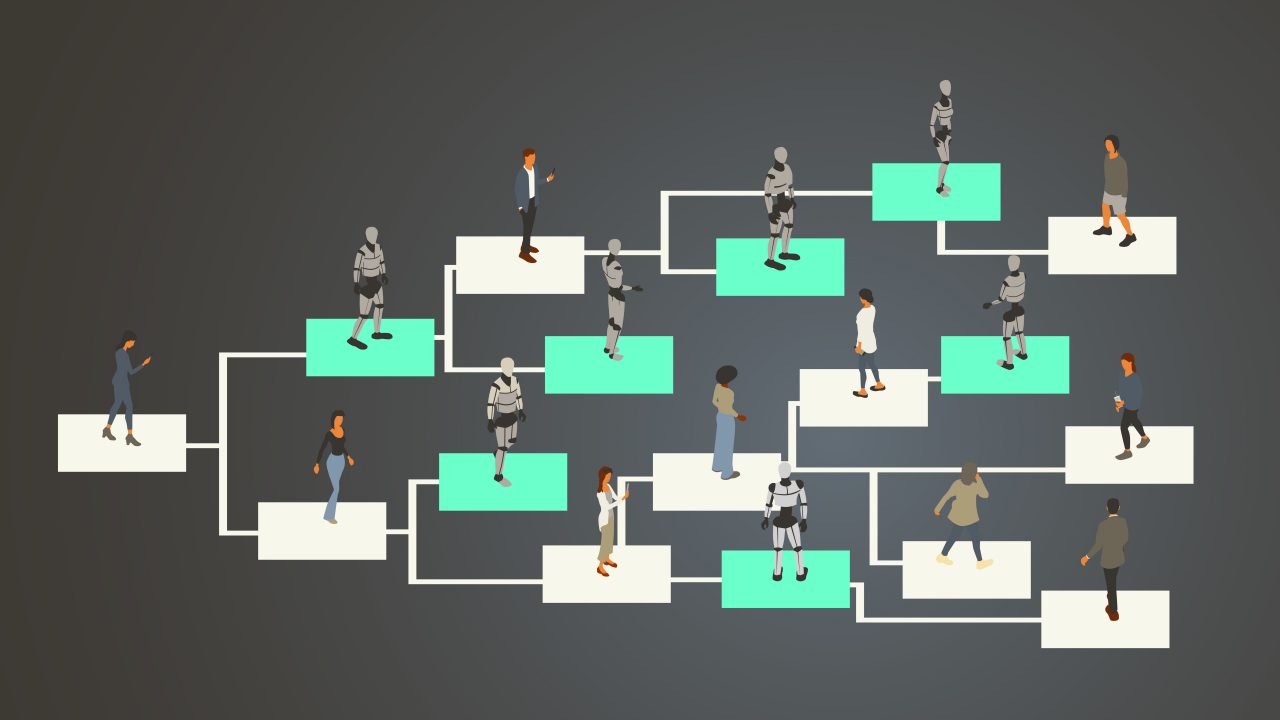
AI agents push the same leadership problem one step further. With remote work, the worker is out of sight. With AI, there may be no worker at all. Rather than creating a new management model for that reality, we convert the software into something familiar: an employee with a role, a manager, and a place on the org chart.
We are not merely anthropomorphizing software. We are trying to contain uncertainty by converting it into a worker.
And BNY is not alone. SHRM Labs has described a future in which AI agents hold actual positions inside organizations. Workday has introduced an Agent System of Record for tracking agents’ skills, access, usage, performance, and ownership.
These companies are addressing a legitimate problem. Organizations need to know which agents exist, what they can access, what they are doing, and whether they are producing value.
But visibility is not personhood.
That distinction becomes even more consequential when software moves from employee to supervisor. Humancore CEO Mike Dolen and I explored that possibility: Could AI eventually replace the manager?
Dolen argued that people become excited to follow authentic, passionate human beings, not machines. I played devil’s advocate: Would some employees prefer a chatbot with no ego, office politics, or mood swings to a manager who woke up angry and decided to make it everyone’s problem? Possibly. But “less moody” is a fairly low bar for the future of leadership. AI may support the relationship. It cannot care about the employee or take responsibility for what happens next.
The Org Chart Was Built for People
For most of modern management history, work became understandable by attaching it to a person. The person received a role. The role received a job description. The job received a manager. The manager received a higher box on the org chart. Accountability supposedly traveled up the connecting lines.
When software begins performing the work, that model breaks. Work is happening, but there may be no human worker to place in the box. That makes responsibility harder to locate within the management structures we already have. Rather than invent a different model — one organized around workflows, decision rights, permissions, evidence, and accountable human owners — we retrofit the software into the structure we already understand.
Give it a name. Write it a job description. Assign it a boss. Put it on the org chart. Schedule its performance review. We call this innovation because the software is new. The bureaucracy, apparently, is timeless.
In Surrender to Lead, Joe Terry and I describe the Action Trap as the false belief that more effort, structure and control will eventually produce the result we want. But the Action Trap limits what leaders can imagine. We are trapped in our own best thinking. We know how to make work visible by turning it into a worker. The agent appears on the org chart, and suddenly the unfamiliar feels familiar. The technology has a place. The work has an owner. The uncertainty appears contained.
But the appearance of control is not governance. Control attempts to eliminate uncertainty. Governance establishes the conditions under which uncertainty can be handled responsibly.

What Responsible AI Governance Requires
Surrender means accepting reality as it is. An AI agent is not a human employee. It does not possess beliefs, commitment, courage, judgment, or a personal stake in the organization’s purpose. It may generate an action, but it cannot experience accountability for the result.
The leader’s job is therefore not to control every action the agent takes. That will become increasingly impossible as agents grow more autonomous and interact with one another. The job is to create the conditions within which those actions remain aligned, observable, and accountable. So, what does responsible governance require?
For every consequential AI agent, leaders should be able to answer five questions:
1. What result is this agent authorized to pursue?
2. What may it decide or execute without human approval?
3. What evidence must a human review before accepting its work?
4. Which person owns the result — including the errors, unintended consequences, and effects on customers or employees?
5. Under what conditions will the agent be paused, restricted, or shut down?
If the answer to the fourth question is “Alex-3,” keep asking.
This is not softer accountability. It is more precise accountability. Leaders will not be able to observe every prompt, decision, handoff, and interaction among hundreds of agents. Nor should they try. But they can make authority, boundaries, evidence and human ownership unmistakable.
AI agents will become more capable. They will perform more work, make more decisions, and appear in more organizational systems. Some may be given names, titles, and performance reviews. People name their Roombas, so I do not expect us to resist this temptation.
But leaders cannot allow a human metaphor to create a nonhuman accountability system.
Give the agent credentials, permissions, performance thresholds, audit logs, an accountable human owner, and a kill switch. Give it a cute name if you must. Just do not confuse a personality with a person, a reporting line with responsibility, or visibility with management.
As work becomes invisible, the job of management is not to make machines look more human.
It is to make human accountability unmistakable.
Was this resource helpful?

Validate your HR expertise
Earning your SHRM-CP credential makes you a recognized expert and leader in the HR field.
Related Content

Transform HR with mobile technology to streamline workflows, enhance communication, and boost employee engagement across distributed teams.

A new study found that talent development practitioners believe performance-based assessments are more effective at measuring employee learning outcomes than knowledge tests.

As AI makes deeper inroads into organizations, employee concerns about the technology continue to grow. Here's how HR leaders can address the fear of AI among their own staff, as well as in the wider organization.