The Human Side of M&As
How the CHRO of a large health care organization helped unite people, culture, and systems during a major merger — and 5 lessons she learned along the way.

Every now and then, an opportunity knocks at your door that offers to test the critical leadership competencies required of an HR leader. For me, this was accepting the CHRO position at Keck Medicine of USC (University of Southern California) as it prepared to acquire Methodist Hospital of Southern California.
As an adjunct professor of business management and organization, I had been teaching a course called “Managing in a Global Economy” to MBA students for a few semesters. Studying and teaching about mergers and acquisitions equipped me with a thorough understanding of the M&A process, from identifying potential targets to post-deal integration. While leading transformations had been central to my progress as a health care industry leader, I had not come across a career opportunity where my skill set would be tested equally alongside my knowledge base. It was a great opportunity to perfect my scholar-practitioner portfolio.
As the new CHRO, I knew we needed a strategic plan to successfully integrate the workforce of a newly acquired hospital with our existing health system. Merging thousands of new employees, managing various logistical processes, and creating pathways to cultural assimilation would be challenging and would require contributions from many individuals.
The Acquisition: Keck Medicine of USC Brings Methodist Hospital into the Fold
Keck Medicine is a fast-growing academic medical institution affiliated with USC, including four hospitals and over 100 ambulatory locations. It combines academic research and specialized medical care for acute patients across the nation.
In July 2022, Keck Medicine of USC acquired Methodist Hospital of Southern California, renaming it USC Arcadia Hospital. At the time of acquisition, Methodist Hospital had 348 licensed beds and around $300 million in annual revenue. This new addition to the Keck Medicine health system enabled it to expand services in the San Gabriel Valley and secure the exceptional legacy of both organizations.
As of the July 2022 closing date, all employees of Keck Medicine of USC were employees of the University of Southern California. This included employees based at three hospital entities — Keck Hospital of USC, USC Norris Cancer Hospital, and Verdugo Hills Hospital — as well as all ambulatory locations. However, a strategic decision was made to leave the newly acquired USC Arcadia Hospital employees as W-2 employees of the previous hospital, with the intention to transition them into the USC system within the first three years of the deal. Central to the success of this process was the migration of all USC Arcadia employees into USC’s HRIS system (Workday) and integration of the employer identification number (EIN).
Why EIN Integration Is a Critical Step in M&A Workforce Transitions
An EIN is more than just a tax ID — it’s the legal identity of an employer. Every aspect of an employee’s work relationship flows from it: paychecks, W-2s, taxes, and benefits eligibility. That’s why, in M&As, the EIN transition is one of the most critical parts of workforce integration, and it’s often central to the success of a newly acquired organization’s transition.
For employees, the shift isn’t always obvious. An organization might change its name overnight, new signage might go up, and leadership may start referring to a new parent organization. But until employees are formally moved under the acquiring company’s EIN, their pay stubs, tax records, and benefits remain tied to the old entity. In effect, they’re still legally employed by their prior organization. That was the case when USC acquired Methodist Hospital of Southern California. Even after the name changed to USC Arcadia, staff remained on Methodist’s EIN until the full transition took place.
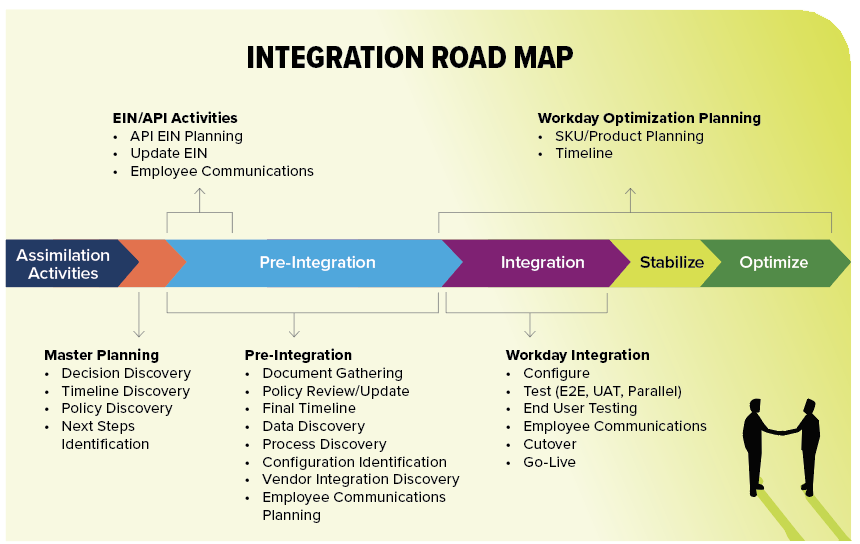
Executing this move required a massive effort behind the scenes. Methodist employees had to be migrated into USC’s HRIS and payroll systems, their employment records had to be reissued under USC’s EIN, and their benefits needed to be restructured. During the transition, USC opted for a hybrid approach — preserving some of Arcadia’s lower-cost, high-quality benefits while aligning others with USC’s programs. At the same time, legacy payroll processes and some benefit vendor integrations were retired and replaced with USC’s systems.
It’s important to note that EIN integration is not just a paperwork exercise. It’s a significant step in going from partial integration to full integration in transitioning the employee status of USC Acadia as part of USC — legally, financially, and operationally.
Setting the Stage: Listening and Assessment
The EIN transition for USC Arcadia began with deliberate listening and alignment. Before strategy or implementation could take shape, it was essential to understand the transition efforts already underway and build cohesion among HR leaders at both the system and local levels. Establishing synergy, governance structures, and defined workgroups was important to ensure that planning was thorough and intentional before any design work began.
By March 2023, after an eight-month assessment, the first master planning workshop was convened, followed by additional sessions to clarify timing, scope, and methodology. These strategy sessions, involving leaders from USC, Keck Medicine, USC Arcadia, and consulting partner Chartis, laid the foundation for a unified road map. By early 2024, the “when, what, and how” of the integration was in place, with Jan. 1, 2025, set as the official date for all Methodist Hospital employees to formally transition under USC’s EIN.
How Governance and Project Management Eased the Transition
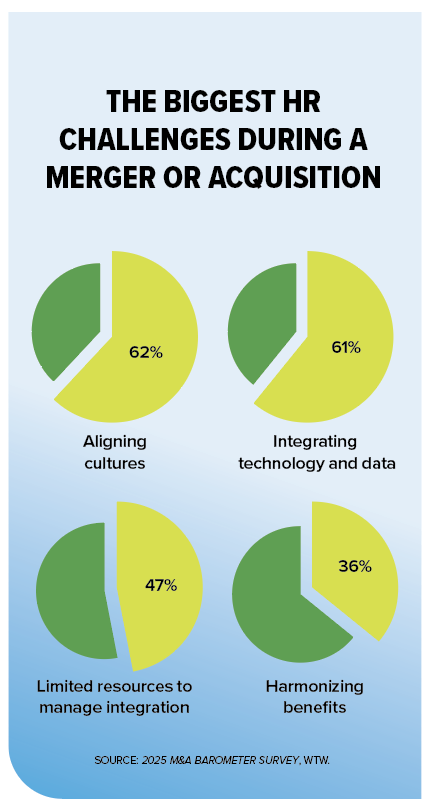
The USC Arcadia transition was guided by a 15-month integration road map developed through collaboration between Keck Medicine’s HR team, university partners, and finance and IT departments. The scope was extensive, requiring cross-disciplinary coordination with more than 100 contributors working across 11 designated work lanes, including system integrations, communications, employee leave, learning management, benefits, compensation, job architecture, payroll, and tax.
Merging a hospital into a larger health system brought both operational and financial considerations. Beyond the technical and compliance demands, we had to evaluate the benefits cost structure of the acquired entity. The challenge was to balance efficiency and accessibility against the need for alignment with USC’s broader benefits framework. In some cases, maintaining lower-cost, high-quality offerings was preferable to enforcing a centralized model that could overlook entity-specific needs.
To manage such complexity, strong governance and disciplined project management were essential. Governance structures clarified accountability, ensuring the right stakeholders reviewed and approved changes to budget, scope, and timelines. They also resolved escalated issues, provided updates to the board, and reinforced transparency. These mechanisms enabled full alignment across functions, timely decision-making, and confidence that the integration outcomes were delivered with both rigor and clarity.
Effective the first pay period of 2025, all Methodist Hospital employees became USC employees, establishing the success of an initiative that involved more than 100 project participants, 99 new or remediated integrations, and 1,500 employees plus 300 contractors being migrated from API to Workday.
While the cultural integration process remains ongoing, this collaborative effort generated several insights that can guide HR executives in leading similar initiatives.
5 Key CHRO Competencies and Guidance
Successful integrations demand both operational precision and cultural leadership. HR leaders can navigate this complex process by focusing on five essential competencies that drive lasting impact:
1. Prioritize Cultural Aspects Throughout the Integration Process
Cultural assimilation isn’t just a step of the M&A process — it’s the foundation. And while assimilation doesn’t happen overnight, culture must be the starting point of any successful integration strategy. That foundation is best laid when the approach to process and system integrations is being discussed.
Culture is intangible and carries significant personal value for members of an organization. In health care, it affects the quality of care and patient outcomes. Deeply embedded cultural norms can pose a significant risk to the success of an integration effort in M&A situations. Therefore, recognizing cultural nuances throughout the integration process is important, especially for workforce integration efforts.
2. Assess the Existing Systems Before Making Any Changes
Transitioning to a new EIN is a complex process that requires careful planning and thorough understanding of the existing setup of the acquired entity. Employee management systems, including total rewards packages, recruitment and retention strategies, performance management methods, and employee development processes, operate as integrated frameworks in which modifying one component impacts the others.
It is imperative to understand that policies inform practices and become formalized over time. Although policy changes can be quickly implemented in writing, altering the practices linked to former policies requires substantial effort and effective change management strategies. It’s important to ensure systematization won’t hinder daily operations of management.
3. Clearly Define Responsibilities for All Contributors
The success of a transition process hinges on clearly defining the roles of all contributors, whose collaboration — whether significant or minor — will determine the outcome of your initiative. In our case, the success of integrating Arcadia’s workforce relied on involving the university HR team as essential contributors, because the EIN transition of USC Arcadia included HR technology, benefits, and payroll, all managed centrally within a shared services model by the university, the parent organization of Keck Medicine of USC.
Such large projects require early alignment and commitment from all stakeholders. Even if a solid governance structure is implemented, its effectiveness is largely dependent on the clear establishment of collaboration and accountability from the outset.
4. Energize Cultural Transformation
The full value of a merger can only be realized if an effort is made to build and leverage organizational synergies beyond the transactional aspects of logistical operations. The culture integration process should include:
Cultural alignment. Accelerate change and elevate every moment of the employee experience through listening efforts with employees at all levels, across all facilities.
Value proposition repositioning. This included the development of a new system narrative to attract, retain, and foster meaningful connections with both consumers and patients, as well as top talent in a highly competitive market.
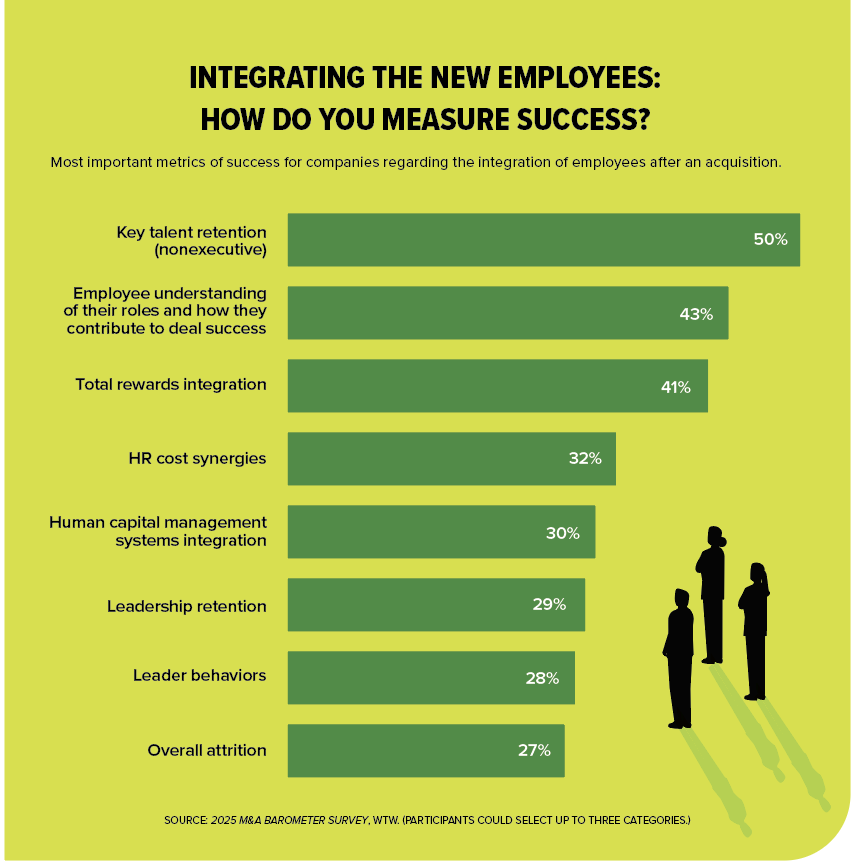
Redefinition of (and re-emphasis on) the value of every employee. Ensure that every employee knows how they contribute to who you are, how you operate, and where you are going.
The integration process takes place over time. Focusing on cultural assimilation is critical and essential to successfully integrate new employees and foster a positive workplace culture.
Our cultural integration process continues through the gradual launch of our key system programs at USC Arcadia along with embracing the good in the hospital’s existing operations and extending those to the system level where possible. This approach has helped us build credibility with local leadership and convey sincerity in our welcoming approach.

The success of a transition process hinges on clearly defining the roles of all contributors, whose collaboration — whether significant or minor — will determine the outcome of your initiative.”
Keck Medicine of USC
5. Stay Engaged and Aware — Without Micromanaging
The saying, “It takes a village,” exemplifies the success of large-scale M&A initiatives. The CHRO’s role can be challenging, as it demands walking the fine line between control and empowerment, between specific direction and organic evolution, and above all maintaining a balance between the financial realities and employer obligations of a system structure. While leading the multiple stakeholder relationships is a critical responsibility of the CHRO, the need to secure alignment and agreement for financially sensitive decisions with system and entity CEOs and CFOs is a must.
Honoring the network of relationships in a matrix environment and the values that bind different entities together can go a long way in carving out a winning strategy and execution for such integration initiatives. Leaders who are undertaking similar journeys should ensure that:
Organizational leaders are engaged, committed, and supportive of the process.
Decisions are made at the right level, in a timely and definitive manner.
Decisions and outcomes are understood across the project and associated teams.
Teams attend and actively participate in scheduled meetings to support ongoing communication and transparency.
Key milestones and wins are recognized and celebrated.
The Assimilation Continues
At Keck Medicine of USC, we ensured that leaders at various levels of the organization helped guide the reidentification and assimilation processes to successfully integrate a large hospital with thousands of employees into our unified health system.
The road map to a successful integration isn’t simply logistical. A merger is a multifaceted coalition of cultural and operational elements. A large cornerstone in making our merger successful was helping employees adapt and feel a new sense of belonging and workplace identity as a Keck Medicine of USC employee.
The logistical and legal processes to merge the hospital with our health system demanded paying attention to detail, key timelining, and developing a helpful partnership with an outside consultant. Additionally, creating the culture transformation has been essential in building a cohesive environment of an employee’s feeling of belonging to a new organization.
Ekta Vyas, Ph.D., is the CHRO for Keck Medicine of USC, the academic medical system of the University of Southern California, and an adjunct professor at USC Marshall School of Business.
SHRM's M&A TOOLKIT: A majority of all M&As fail to achieve their objectives, often due to HR-related factors, according to Harvard Business Review. For step-by-step advice on the HR leader’s role in navigating the M&A process, access SHRM’s toolkit, Managing Human Resources in Mergers and Acquisitions.
GLOBAL CULTURE REPORT: Building strong cultures is critical in all workplaces, not only in M&A situations. SHRM’s 2024 Global Culture Report surveyed more than 17,000 workers in 19 countries to identify the five fundamental elements that contribute to favorable workplace cultures.
Related Articles

Transform HR with mobile technology to streamline workflows, enhance communication, and boost employee engagement across distributed teams.

A new study found that talent development practitioners believe performance-based assessments are more effective at measuring employee learning outcomes than knowledge tests.

As AI makes deeper inroads into organizations, employee concerns about the technology continue to grow. Here's how HR leaders can address the fear of AI among their own staff, as well as in the wider organization.