  • Personal
  • Business
  • Foundation
    Close
  • Select Region
    • Global
    • India
    • MENA
  • mySHRM Login
  • MySHRM
    • Dashboard
    • Account
    • Logout
SHRM
  • Membership
    • Membership

      As a SHRM Member®, you’ll pave the path of your success with invaluable resources, world-class educational opportunities and premier events.

      Membership Benefits
  • Certification
    • SHRM Certification

      Demonstrate your ability to apply HR principles to real-life situations.

      • How to Get Certified
      • Eligibility Criteria
      • Exam Fees & Options
      • SHRM-CP
      • SHRM-SCP
      • Which Certification is Best for Me?
      • Recertification
      Prepare for the Exam
      • Exam Preparation
      • SHRM BASK
      • SHRM Learning System
      • Instructor-Led Learning
      • Self-Study
      Specialty Credentials

      Demonstrate targeted competence and enhance your HR credibility.

      PMQ

      Gain a deeper understanding and develop critical skills.

  • Events & Education
    • India Events

      Demonstrate your ability to apply HR principles to real-life situations.

      • Talent Leadership Summit
      • Tech Conference
      • India Annual Conference
      MENA Events
      • MENA Annual Conference
      Global Events
      • US Annual Conference
      Webinars
  • Resources
    • Resources

      Stay up to date with news and leverage our vast library of resources.

      • Compliance
      • HR Research
      • Legal & Compliance
      • Latest News & Trends
      • Tools & Guides
      HR Topics
      • AI in the Workplace
      • Civility at Work
      • Compensation & Benefits
      • Inclusion & Diversity
      • Talent Acquisition
      • Workplace Technology
      • Workplace Violence Prevention
  • SHRM Connect
  • Shop
    • SHRM Store

      Shop for HR certifications, credentials, learning, events, merchandise and more.

      Workplace Essentials
      • SHRM Memberships
      • SHRM Certification
      • Specialty Credentials
      • HR Tools & Tech
      Education
      • Seminars
      • eLearning
      • Books
      Merchandise
      • Accessories
      • Apparel
      • Office & Home
Become a Member
Renew
Rejoin Now
Renew
Close
  • Personal
  • Business
  • Foundation
  • Membership
    back
    Membership
    • Membership

      As a SHRM Member®, you’ll pave the path of your success with invaluable resources, world-class educational opportunities and premier events.

      Membership Benefits
  • Certification
    back
    Certification
    • SHRM Certification

      Demonstrate your ability to apply HR principles to real-life situations.

      • How to Get Certified
      • Eligibility Criteria
      • Exam Fees & Options
      • SHRM-CP
      • SHRM-SCP
      • Which Certification is Best for Me?
      • Recertification
      Prepare for the Exam
      • Exam Preparation
      • SHRM BASK
      • SHRM Learning System
      • Instructor-Led Learning
      • Self-Study
      Specialty Credentials

      Demonstrate targeted competence and enhance your HR credibility.

      PMQ

      Gain a deeper understanding and develop critical skills.

  • Events & Education
    back
    Events & Education
    • India Events

      Demonstrate your ability to apply HR principles to real-life situations.

      • Talent Leadership Summit
      • Tech Conference
      • India Annual Conference
      MENA Events
      • MENA Annual Conference
      Global Events
      • US Annual Conference
      Webinars
  • Resources
    back
    Resources
    • Resources

      Stay up to date with news and leverage our vast library of resources.

      • Compliance
      • HR Research
      • Legal & Compliance
      • Latest News & Trends
      • Tools & Guides
      HR Topics
      • AI in the Workplace
      • Civility at Work
      • Compensation & Benefits
      • Inclusion & Diversity
      • Talent Acquisition
      • Workplace Technology
      • Workplace Violence Prevention
  • SHRM Connect
  • Shop
    back
    Shop
    • SHRM Store

      Shop for HR certifications, credentials, learning, events, merchandise and more.

      Workplace Essentials
      • SHRM Memberships
      • SHRM Certification
      • Specialty Credentials
      • HR Tools & Tech
      Education
      • Seminars
      • eLearning
      • Books
      Merchandise
      • Accessories
      • Apparel
      • Office & Home
Become a Member
Renew
Rejoin Now
Renew
  • Select Region
    • Global
    • India
    • MENA
SHRM
mySHRM Login
  • MySHRM
    • Dashboard
    • Account
    • Logout
Close

  1. Topics & Tools
  2. Workplace News & Trends
  3. Employee Relations
  4. Viewpoint: Quiet Quitting Is About Bad Bosses, Not Bad Employees
Share
  • Linked In
  • Facebook
  • Twitter
  • Email

Lorem ipsum dolor sit amet, consectetur adipiscing elit. Vivamus convallis sem tellus, vitae egestas felis vestibule ut.


Error message details.

Copy button
Reuse Permissions

Request permission to republish or redistribute SHRM content and materials.


Learn More
News

Viewpoint: Quiet Quitting Is About Bad Bosses, Not Bad Employees

September 2, 2022 | Jack Zenger and Joseph Folkman

A group of business people walking in an office.


​Editor's Note: SHRM has partnered with Harvard Business Review to bring you relevant articles on key HR topics and strategies.

Every employee, every workday, makes a decision: Are they only willing to do the minimum work necessary to keep their job? Or are they willing to put more of their energy and effort into their work?

In the last few weeks, many of those who choose the former have self-identified as "quiet quitters." They reject the idea that work should be a central focus of their life. They resist the expectation of giving their all or putting in extra hours. They say "no" to requests to go beyond what they think should be expected of a person in their position.

In reality, quiet quitting is a new name for an old behavior. Our researchers have been conducting 360-degree leadership assessments for decades, and we've regularly asked people to rate whether their "work environment is a place where people want to go the extra mile." To better understand the current phenomenon of quiet quitting, we looked at our data to try to answer this question: What makes the difference for those who view work as a day prison and others who feel that it gives them meaning and purpose?

Our data indicates that quiet quitting is usually less about an employee's willingness to work harder and more creatively, and more about a manager's ability to build a relationship with their employees where they are not counting the minutes until quitting time.

What the Data Shows

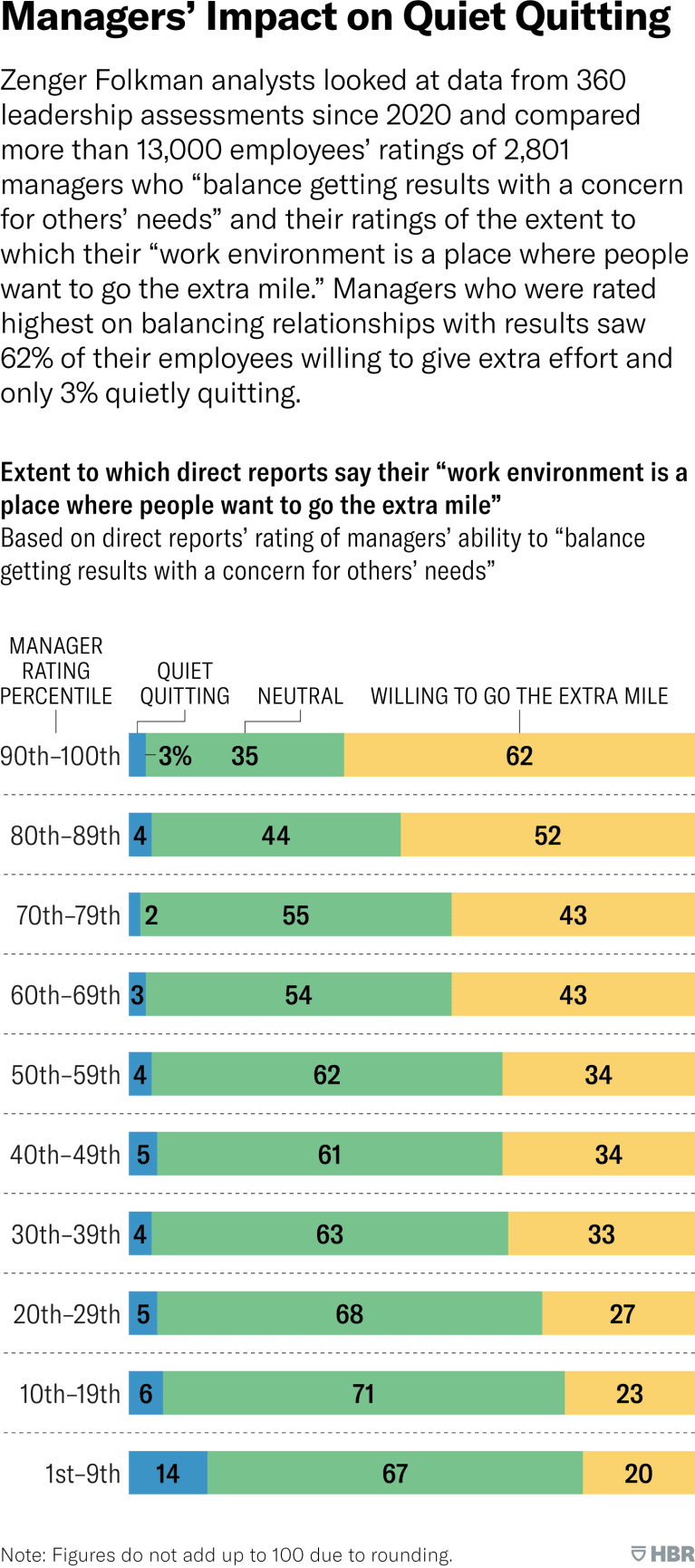
We looked at data gathered since 2020 on 2,801 managers, who were rated by 13,048 direct reports. On average, each manager was rated by five direct reports, and we compared two data points:

  • Employees' ratings of their manager's ability to "Balance getting results with a concern for others' needs"
  • Employees' ratings of the extent to which their "work environment is a place where people want to go the extra mile"

The research term we give for those willing to give extra effort is "discretionary effort." Its effect on organizations can be profound: If you have 10 direct reports and they each give 10% additional effort, the net results of that additional effort are increased productivity.

The graph below shows the results. We found that the least effective managers have three to four times as many people who fall in the "quiet quitting" category compared to the most effective leaders. These managers had 14% of their direct reports quietly quitting, and only 20% were willing to give extra effort. But those who were rated the highest at balancing results with relationships saw 62% of their direct reports willing to give extra effort, while only 3% were quietly quitting.
Many people, at some point in their career, have worked for a manager that moved them toward quiet quitting. This comes from feeling undervalued and unappreciated. It's possible that the managers were biased or they engaged in behavior that was inappropriate. Employees' lack of motivation was a reaction to the actions of the manager.

Most mid-career employees have also worked for a leader for whom they had a strong desire to do everything possible to accomplish goals and objectives. Occasionally working late or starting early was not resented because this manager inspired them.

What to Do If You Manage a 'Quiet Quitter'

Suppose you have multiple employees who you believe to be quietly quitting. In that case, an excellent question to ask yourself is: Is this a problem with my direct reports, or is this a problem with me and my leadership abilities?

If you're confident in your leadership abilities and only one of your direct reports is unmotivated, that may not be your fault. As the above chart shows, 3% or 4% of the best managers had direct reports who were quietly quitting.

Either way, take a hard look at your approach toward getting results with your team members. When asking your direct reports for increased productivity, do you go out of your way to make sure that team members feel valued? Open and honest dialogue with colleagues about the expectations each party has of the other goes a long way.

The most important factor is trust. When we analyzed data from more than 113,000 leaders to find the top behavior that helps effective leaders balance results with their concern for team members, the number one behavior that helped was trust. When direct reports trusted their leader, they also assumed that the manager cared about them and was concerned about their wellbeing.

Our research has linked trust to three behaviors. First, having positive relationships with all of your direct reports. This means you look forward to connecting and enjoy talking to them. Common interests bind you together, while differences are stimulating. Some team members make it easy to have a positive relationship. Others are more challenging. This is often a result of differences (age, gender, ethnicity or political orientation). Look for and discover common ground with these team members to build mutual trust.

The second element of trust is consistency. In addition to being totally honest, leaders need to deliver on what they promise. Most leaders believe they are more consistent than others perceive them.

The third element that builds trust is expertise. Do you know your job well? Are you out of date on any aspects of your work? Do others trust your opinions and your advice? Experts can bring clarity, a path forward and clear insight to build trust.

By building a trusting relationship with all of your direct reports, the possibility of them quietly quitting dissipates significantly. The approach leaders took to drive for results from employees in the past is not the same approach we use today. We are building safer, more inclusive and positive workplaces, and we must continue to do better.

It's easy to place the blame for quiet quitting on lazy or unmotivated workers, but instead, this research is telling us to look within and recognize that individuals want to give their energy, creativity, time and enthusiasm to the organizations and leaders that deserve it.

Jack Zenger is the CEO of Zenger/Folkman, a leadership development consultancy. He is a coauthor with Joseph Folkman of the book Speed: How Leaders Accelerate Successful Execution (McGraw Hill, 2016). Connect with Jack at twitter.com/jhzenger.Joseph Folkman is the president of Zenger/Folkman, a leadership development consultancy. Connect with Joe at twitter.com/joefolkman.

This article is reprinted from Harvard Business Review with permission. ©2022. All rights reserved.

Engagement
Labor & Employee Relations
Management Skills

Was this resource helpful?

Leave Feedback

SHRM-CP Promo Image
Validate your HR expertise

Earning your SHRM-CP credential makes you a recognized expert and leader in the HR field.

Get Certified


Related Content

(opens in a new tab)
News
How One Company Uses Digital Tools to Boost Employee Well-Being

Learn how Marsh McLennan successfully boosts staff well-being with digital tools, improving productivity and work satisfaction for more than 20,000 employees.

(opens in a new tab)
News
A 4-Day Workweek? AI-Fueled Efficiencies Could Make It Happen

The proliferation of artificial intelligence in the workplace, and the ensuing expected increase in productivity and efficiency, could help usher in the four-day workweek, some experts predict.

(opens in a new tab)
News
Rising Demand for Workforce AI Skills Leads to Calls for Upskilling

As artificial intelligence technology continues to develop, the demand for workers with the ability to work alongside and manage AI systems will increase. This means that workers who are not able to adapt and learn these new skills will be left behind in the job market.

HR Daily Newsletter

Stay up to date with the latest HR news, trends, and expert advice each business day.

Success title

Success caption

Manage Subscriptions
Our Brands

SHRM Foundation Logo
SHRM Executive Network Logo
CEO Circle Logo
SHRM Business Logo
SHRM Linkage Logo
SHRM Labs
Overview


  • About SHRM
  • SHRM India Advisory Council
  • Careers at SHRM
  • Press Room
  • Contact SHRM India
  • Book a SHRM Executive Speaker
  • Ask an Advisor
  • SHRM Newsletter
  • Post a Job
  • Find an HR Job
  • Advertise with us
  • Copyright & Permission
Contact Us


Email: shrmindia@shrm.org
Phone: (1)800.103.2198
WhatsApp: +919810503727

SHRM India Corporate Information

© 2026 SHRM. All Rights Reserved
SHRM provides content as a service to its readers and members. It does not offer legal advice, and cannot guarantee the accuracy or suitability of its content for a particular purpose. Disclaimer

Follow Us

  • LinkedIn
  • Facebook
  • Twitter
  • Instagram
  • YouTube

  1. Your Privacy Choices

  2. Terms of Use

  3. Accessibility

Join SHRM for Exclusive Access to Professional Content

SHRM Members enjoy unlimited access to articles and exclusive member resources.

Already a member? Login
Free Article

Login to unlock unlimited access or join SHRM today to get unlimited access to articles and member-exclusive resources.

Already a member? Login
Limit Reached

You've reached the limit of 1 free article this month. Join to access unlimited articles and member-only resources.

Already a member? Login
Free Article

Login to unlock unlimited access or join SHRM today to get unlimited access to articles and member-exclusive resources.

Already a member? Login
Exclusive Executive-Level Content

You've reached the limit of 1 free article this month. Join the Executive Network and enjoy unlimited content.

Already a member? Login
Unlock Your Career with SHRM Membership

Please enjoy this free resource! Join SHRM for unlimited access to exclusive articles and tools.

Already a member? Login
Join SHRM for Exclusive Access to Professional Premium Content

SHRM Members enjoy unlimited access to articles and exclusive member resources.

Already a member? Login
Join SHRM for Exclusive Access to Student Content

SHRM Members enjoy unlimited access to articles and exclusive member resources.

Already a member? Login
Join SHRM for Exclusive Access to Executive Network Content

SHRM member enjoys unlimited access to articles and exclusive member resources.

Already a member? Login

Your membership is almost expired! Renew today for unlimited access to member content.

Renew now

Your membership has expired. Renew today for unlimited access to member content.

Renew Now

Your Executive Network membership is nearing its expiration. Renew now to maintain access.

Renew Now

Your membership has expired. Renew your Executive Network benefits today.

Renew Now
