
Every ebb and flow of workplace dynamics reinforces the importance of one metric – the Revenue Per Employee as an indicator for organisational effectiveness, beyond the desired financial output. Even as AI presents itself as a worthy disruptor, the fragmentation of data, tools, and processes is increasingly cited as a core contributor to the workforce productivity crisis. This is often referred to as the ‘AI Productivity Paradox’, where investment and activity rise faster than measurable outcomes.
Consider this increasingly common scenario:
An organisation automates core HR operations and deploys advanced talent analytics. As a result of these measures, efficiency improves, and insights multiply. However, workforce plans, leadership investments, and promotion decisions remain largely unchanged, year on year, despite richer insights being available. The challenge here is not limited to capability or intent. Instead, it is the lack of concerted effort to equip the top leadership with a reliable, decision-grade single source of truth.
The simplest solution in principle would be to ensure that data travels, insights compound, and decisions learn from each other.
Connected Intelligence is about closing the gap between knowing and deciding.
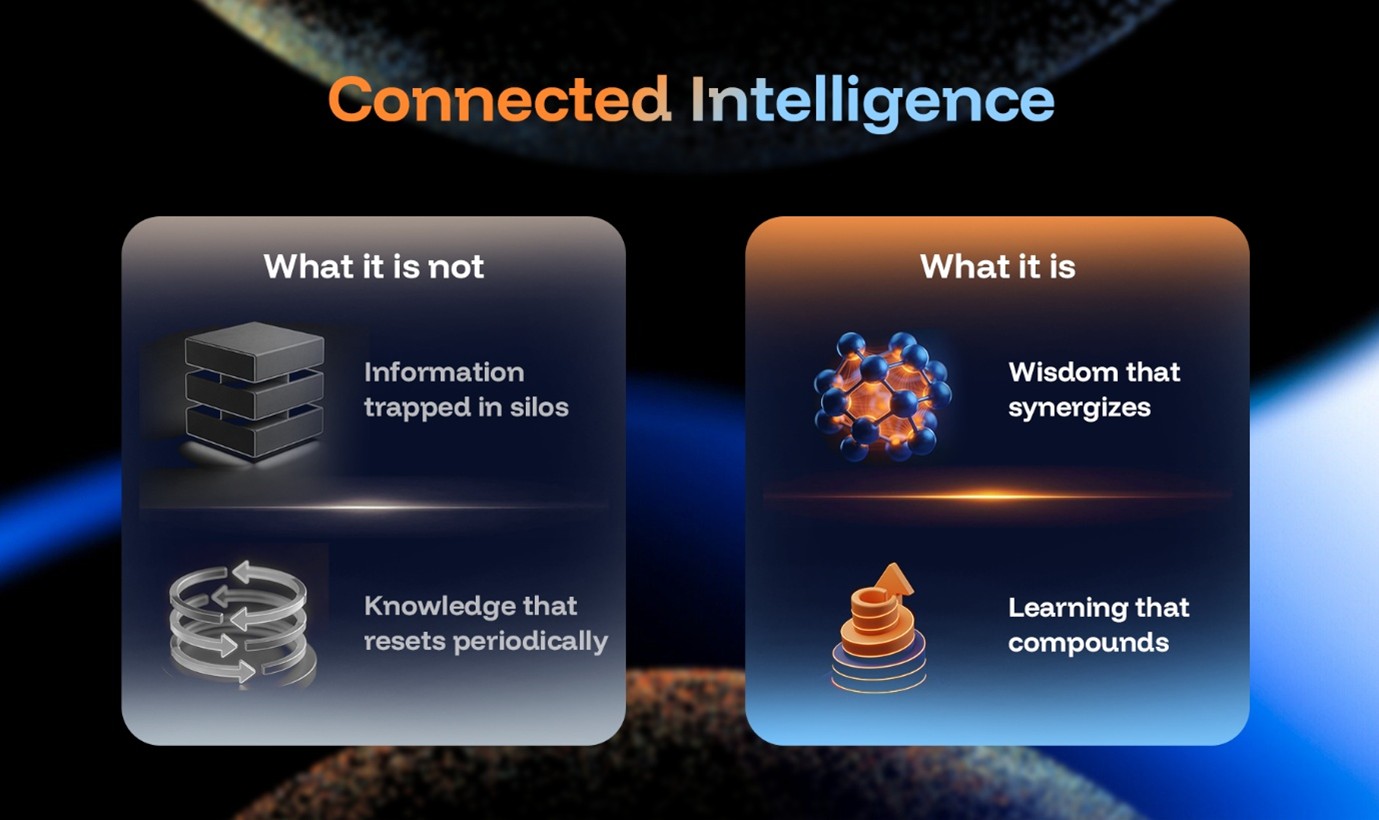
What Connected Intelligence Is and What It Is Not
Connected intelligence is the ability of people, systems, and data to learn from each other continuously, creating insights that build and improve over time. It is not isolated information or one-time learning that resides in silos and resets periodically instead of compounding.
What the Data Says
In the past year, ~43% of HR professionals agreed that their tech stack is effective in enabling strategic outcomes, signaling a significant strategic gap and an opportunity for organisations to leap ahead by rethinking HR tech adoption. [1] Only 13% of GCCs report enterprise-level adoption of AI in Talent Ops. per SHRM India and LinkedIn report titled “Talent Strategy Playbook: The Future Starts Now”. [2]
SHRM’s research suggests that automation is advancing faster than the organisational ability to absorb its implications - a hallmark of disconnected intelligence. In India’s large, complex enterprises and GCCs, fragmented intelligence is often a critical factor preventing automation from becoming decisive.
Task Automation and Displacement
The disconnect is also evident when examining automation risk. Just about 9.3% of all HR roles that have at least 50% of tasks automated and no definitive non-technical barriers to displacement are at risk (Ref. Image 1). This is without factoring in the range of new job roles that are being created in the new workplace reality.
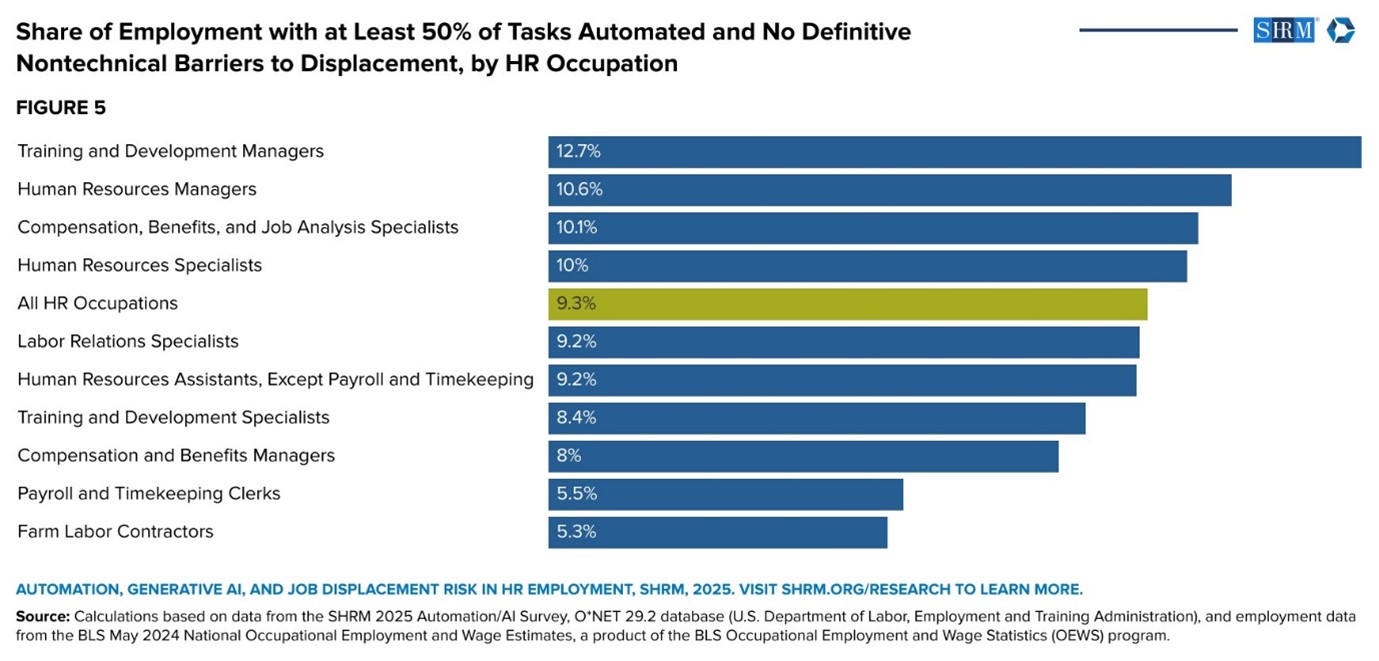
The question, then, is clear: If automation capability was the real constraint, a lot of these roles should already be disappearing. But this clearly isn’t the case.
The reason: Automation is task-level but disconnected at the decision level. While systems can execute, these cannot yet coordinate judgment across learning, performance, rewards, workforce planning, and leadership decisions at scale.
CHRO Priorities Amidst Massive Tech Disruption
Over the past year, CHRO priorities have remained relatively stable, revealing an underlying disconnection (Ref. Image 2). If intelligence were truly connected, one would expect automation insights to shift priorities, with analytics and workforce foresight reigning supreme. Instead, leadership and EX remain dominant, while HR tech and analytics remain peripheral, and the future of work inches forward but does not accelerate.

The Real Deal
HR is producing more data than ever, but not enough trusted intelligence to change what leaders prioritise. Automation intelligence exists downstream (tasks, workflows, and roles); however, it does not connect upstream (strategy, investment, and governance). This is a classic case of disconnected intelligence at play and requires a sustained effort to overcome the limitations it presents. For institutions committed to building better workplaces and a better world, the opportunity lies not in choosing sides on technology but in ensuring intelligence connects, compounds, and ultimately informs wiser decisions.
Was this resource helpful?

Validate your HR expertise
Earning your SHRM-CP credential makes you a recognized expert and leader in the HR field.
Related Content

Transform HR with mobile technology to streamline workflows, enhance communication, and boost employee engagement across distributed teams.

A new study found that talent development practitioners believe performance-based assessments are more effective at measuring employee learning outcomes than knowledge tests.

As AI makes deeper inroads into organizations, employee concerns about the technology continue to grow. Here's how HR leaders can address the fear of AI among their own staff, as well as in the wider organization.