What About Teams?
Effective performance management for teams can have a powerful impact to unleash the full potential and engagement of the workforce

Editor's Note: SHRM has partnered with ATD (https://www.td.org/) to bring you relevant articles on key HR topics and strategies.
Traditional assumptions about people, performance, and organizational design have been upended in today's workplace because agility, collaboration, and teamwork are required for organizational success. As a consequence, formal organizational charts, which promote a hierarchical, command-and-control approach, have become largely obsolete.
Performance management is now in the hot seat to address new workplace requirements.
Performance management reimagined
The old focus on an end-of-year process, in which individuals are held accountable for past behavior, is inadequate. With virtually nothing in business conforming to an annual cycle, performance management is being redesigned to more closely mirror the reality of rapid change. There is compelling evidence that traditional performance management approaches are broken, as supported by this CEB research from 2016:
- 95 percent of managers are dissatisfied with their performance management systems.
- 56 percent of employees said they do not receive feedback on what to improve.
- Almost 90 percent of HR heads report their performance management systems do not yield accurate information.
Some of the performance management being considered or implemented at many organizations include:
- two-way communication between managers and employees, versus the traditional top-down approach
- shifting from annual or biannual to ongoing
- emphasizing development instead of evaluation
- eliminating rankings involving multiple stakeholders and not just the manager.
Some organizations—notably, GE, Adobe, Netflix, and Cisco—have argued for a complete transformation of performance management, as discussed in a recent Harvard Business Review article by Anna Tavis and Peter Cappelli; 70 percent of multinational corporations are in the process of adaptation, according to Bersin by Deloitte. An example of this redesign in process is PepsiCo, the global food and beverages company. Christopher T. Rotolo, vice president of enterprise talent management and organization development, describes how business imperatives are shaping a new performance management design.
"Our operating model has shifted even more toward a matrix structure with horizontals focused on platforms such as nutrition. …Our old annual performance management approach—where objectives are locked in at the beginning of the year, there's a midyear review, and end-of-year evaluation, etc.—is simply outdated for our current realities. We need a much more dynamic and flexible process that allows us to continually update and reprioritize our objectives and give managers the freedom to drive, evaluate, and reward their team as they deem appropriate."
A key driver for redesigning performance management at the France-based Publicis, an advertising agency network, is learning and development. "We want to have a greater focus on increased dialogue with more career development thinking. We are now implementing an approach which is more future-oriented and helps employees to look at their skills in the current role, engagement with the job, recent successes and misses, and short- and long-term career aspirations," says Michele Olton, vice president of HR at Publicis Re:Sources, which offers shared services to the organization. "The new approach, which is being used by about 70 percent of our Publicis agencies, focuses on 'contribution, connection, craft, and career.'"
Joe Ilvento, chief learning officer and worldwide director at Commvault, a U.S.-based data and information software management company, reports great success with the firm's new performance management design, "Unlocking Potential," which provides the opportunity to initiate and ask for feedback. "Managers have the discretion to ask for feedback from peers and external customers to round out their data points," he explains. The global, automated system is easy to use and serves multiple talent needs. Managers at CommVault are asked core questions about their team members, including data about "results and contributions; living and breathing our values; high potential level; degree of flight risk; and time frame for an expanded role or promotion," he adds.
Getting the balance right between not enough and too much feedback is another issue. A case in point is Amazon's continual rating process, which reportedly resulted in emotional stress and burnout within the organization, as reported in a controversial front-page New York Times story. When to deliver feedback is another consideration and should be connected with the type of work being accomplished. A call-center team, for example, may find daily or weekly feedback sessions useful; for a research and development team, feedback sessions may be most relevant when timed with key project milestones.
Eliminating ratings, another performance management design choice, may be counter-cultural in many organizations. "From a design perspective, we considered the option of eliminating ratings. Many companies are trying that and it's gotten a lot of press. However, we concluded that given our strong pay-for-performance culture, we will continue using ratings," says Rotolo of PepsiCo. Indeed, research from CEB suggests that eliminating the review can cause a drop in engagement and performance as high as 10 percent, and can result in less feedback because managers may shift to other priorities that are explicitly required.
Teams are changing performance management
Team performance management, with its multidirectional and real-time feedback, is a more accurate reflection of how work is being accomplished today, with potential to offer richer data and reduce some single-rater bias compared with manager-only focus. Sean Helsel, formerly the division vice president of HR at Sears Automotive, says, "Our approach, 'performance enablement,' allows us to have more transparency and democratization about performance. As supervisors may not be familiar with all day-to-day interactions, [the approach] allows us to obtain feedback from multiple sources through our 'sound board' and allows for real-time adjustments in OKRs [objectives/key results measurement]."
In a highly competitive environment, in which shoppers have an unprecedented array of choices of how and where they make purchases, Sears has been struggling. As such, performance enablement "has actually proven to be helpful because it helps to adapt to a shifting landscape more quickly with regular check-ins, compared with a traditional approach of one major conversation at the end of the year," Helsel says.
Given the emphasis on teams, new models for performance management should address performance in this context. Requirements for team performance and development are notably different from individual development:
- Team motivations and behaviors differ from individuals'.
- Behaviors that make a team successful vary, based on the purpose of the team, its composition, and duration.
- Teams often have multiple overlapping needs, including linkage to the organization, individual development needs, and performance.
- Competing priorities with other initiatives and structures (such as geographical, functional, product line, and reporting relationships) are another dynamic at play.
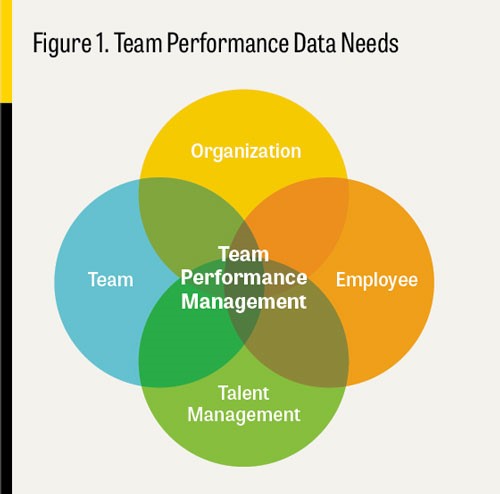
- Organization—Align work processes at the team level, focused on key objectives, such as efficiency, effectiveness, operational excellence, and innovation.
- Team—Include overall team process, relationships and results, equal participation, and output.
- Employee—Address individual needs to ensure that team members are fully contributing, engaged, and meeting personalized needs for development.
- Talent management—Enable organizations to understand existing trends impeding or advancing team performance to be better able to make predictions about future performance.
Technology and team performance management
Just as emerging HR analytics help companies define the degree of existing talent alignment and gaps, with technologies deployed to map global talent assets across businesses, providing real-time feedback across organizations also has become a reality in the digital age. Examples include IBM, which created its own app (called Checkpoint) that employees use to set goals and obtain more feedback, with five areas of focus. Likewise, Accenture has created an app (Accenture People) designed to foster a "performance achievement culture."
Commvault's approach, which serves multiple talent analytic needs along with performance management, includes "a calibration meeting, [which] provides the manager with a variety of coaching and career development data points and ideas that form the basis for ongoing check-in conversations." The process also includes line of sight for talent mapping, a list of ready-now expanded roles and promotable talent, a flight risk report, and a high-potential talent map. "We believe that simplicity leads to more accuracy as well as greater participation rates—our adoption rate is 100 percent," Ilvento notes.
Meanwhile, smartphone solutions that allow for real-time feedback are becoming increasingly available. As an example, Zalando, a European e-retailer, has rolled out a mobile app that allows for crowdsourced feedback from multiple sources, including supervisors and colleagues, with a set of questions on a slider.
As such feedback is more informal than the traditional manager-to-employee approach, it raises some issues, including:
- How will organizations track the feedback (and how should they)?
- What about concerns of intra-team competition, with employees trying to "game the system" by highlighting their own contributions while downgrading their peers'?
A powerful enabler to capture and disseminate feedback in real time, technology also has the potential for reducing the quality of feedback that must be addressed for effective performance management redesign. "Our key takeaway is [that] manager and employee conversations are the byproduct of the process, which in turn creates a dialogue that improves employee engagement," says Ilvento about Commvault's process.
A proposed team performance management model
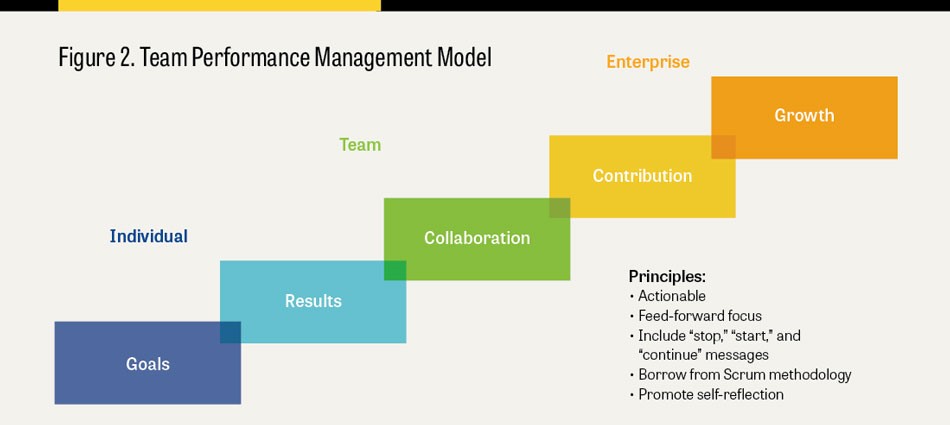
Calibrating team performance in real time borrows from Agile project management (originally designed for use with software development teams), which emphasizes clear goals, customer focus, simplicity, sprint cycles, and promoting reflection at key intervals.
Keeping those factors in mind, a proposed model for performance management and teams is designed to capture multiple levels of performance—individual, team, and enterprise (see Figure 2)—with generous usage of Scrum methodology (born from the term "scrummage" in rugby, referring to stop and start action to respond in real time to changing conditions on the field) to iteratively assess and reassess progress.
Implementation issues
As a new trend, it will take time to determine if the new approaches for performance management, both on an individual worker level and on a team level, will live up to the promise. However, in the meantime, here are five questions worth considering when transitioning to a new, team-based performance management approach:
- What will be the impact on trust between colleagues as ongoing feedback is considered the new normal?
- What kinds of tracking mechanisms and roll-up data should be deployed?
- How will common rating errors (such as recency halo, confirmation bias, blind spots, and personal self-interest) be mitigated in an informal rating system?
- Will this new kind of digital check-in run afoul of some country privacy regulations?
- How can organizations capture insights across the enterprise from consolidated data, and for what purposes will the data be used?
Looking ahead
With employee demands for "always-on" feedback, combined with the central role of teams today, it is clear that the once-a-year performance review, with feedback provided solely by the manager, is a relic of the past. The rate of change is so pronounced today that an annual static snapshot is likely not actionable when delivered. In contrast, greater frequency and multiple perspectives allow for ongoing opportunities to calibrate and recognize performance in real time.
Calibrating team performance in real time borrows from Agile project management (originally designed for use with software development teams), which emphasizes clear goals, customer focus, simplicity, sprint cycles, and promoting reflection at key intervals.
Keeping those factors in mind, a proposed model for performance management and teams is designed to capture multiple levels of performance—individual, team, and enterprise (see Figure 2)—with generous usage of Scrum methodology (born from the term "scrummage" in rugby, referring to stop and start action to respond in real time to changing conditions on the field) to iteratively assess and reassess progress.
Marjorie Derven is founder of Hudson Research & Consulting, providing research, training, and organization development and diversity and inclusion strategies to maximize organizational performance, which increasingly involves virtual teams. She is also a senior fellow at the Conference Board, Human Capital Practice, and has written more than 20 articles on topics that include learning, diversity and inclusion, talent management, and organizational change. Marjorie served as chairperson of the T+D magazine Editorial Advisory Board and is a frequent speaker at global conferences.
This article is reprinted from https://www.td.org with permission from ATD. C 2017 ATD. All rights reserved.
Was this resource helpful?

Validate your HR expertise
Earning your SHRM-CP credential makes you a recognized expert and leader in the HR field.
Related Content

Transform HR with mobile technology to streamline workflows, enhance communication, and boost employee engagement across distributed teams.

A new study found that talent development practitioners believe performance-based assessments are more effective at measuring employee learning outcomes than knowledge tests.

As AI makes deeper inroads into organizations, employee concerns about the technology continue to grow. Here's how HR leaders can address the fear of AI among their own staff, as well as in the wider organization.