  • Personal
  • Business
  • Foundation
    Close
  • Select Region
    • Global
    • India
    • MENA
  • mySHRM Login
  • MySHRM
    • Dashboard
    • Account
    • Logout
SHRM Executive Network
  • Solutions
    • HR Solutions
      • Corporate Membership
      • Certifications
      • Team Training & Development
      • Assessments
      • Conferences & Events
      Leadership Solutions
      • SHRM Linkage
      • SHRM Executive Network
      HR Tools Marketplace
      • Partner Products
  • News & Insights
    • EN Research
      EN News
      EN Podcast
      EN Insights Forum
  • Executive Network
    • About EN
      Executive Insights
      The EN Experience
Find Your Solution
Close
  • Personal
  • Business
  • Foundation
  • Solutions
    back
    Solutions
    • HR Solutions
      • Corporate Membership
      • Certifications
      • Team Training & Development
      • Assessments
      • Conferences & Events
      Leadership Solutions
      • SHRM Linkage
      • SHRM Executive Network
      HR Tools Marketplace
      • Partner Products
  • News & Insights
    back
    News & Insights
    • EN Research
      EN News
      EN Podcast
      EN Insights Forum
  • Executive Network
    back
    Executive Network
    • About EN
      Executive Insights
      The EN Experience
  • Find Your Solution
  • Select Region
    • Global
    • India
    • MENA
SHRM Executive Network
mySHRM Login
  • MySHRM
    • Dashboard
    • Account
    • Logout
Close

  1. Executive News & Insights
  2. Survey: Remote Work Isn't Going Away and Executives Know It
Share
  • Linked In
  • Facebook
  • Twitter
  • Email

Lorem ipsum dolor sit amet, consectetur adipiscing elit. Vivamus convallis sem tellus, vitae egestas felis vestibule ut.


Error message details.

Copy button
Reuse Permissions

Request permission to republish or redistribute SHRM content and materials.


Learn More
News

Survey: Remote Work Isn't Going Away and Executives Know It

September 12, 2023 | Nicholas Bloom, Jose Maria Barrero, Steven Davis, Brent Meyer and Emil Mihaylov

A man is on a video call with several people on a computer screen.

Editor's Note: SHRM has partnered with Harvard Business Review to bring you relevant articles on key HR topics and strategies.


Remote work spiked during the pandemic, from about 6 percent of full workdays in the U.S. to more than 50 percent in the spring of 2020. Since then, it’s steadily decreased and since early 2023 has hovered around 28 percent. Many executives believe it’s time to come back to the office: Jamie Dimon, CEO of JPMorgan, has declared himself a remote-work skeptic; Mark Zuckerberg has declared that engineers “get more done” in the office; and Google’s chief people officer recently told employees that office attendance would factor into performance reviews. Even Zoom’s leadership wants employees back in person two days a week.

The only problem? Not even senior management expects this return-to-office push to work.

The Survey of Business Uncertainty is jointly run by the Atlanta Federal Reserve Bank, the University of Chicago, and Stanford. It surveys senior executives at roughly 500 U.S. businesses across industries and regions each month. 

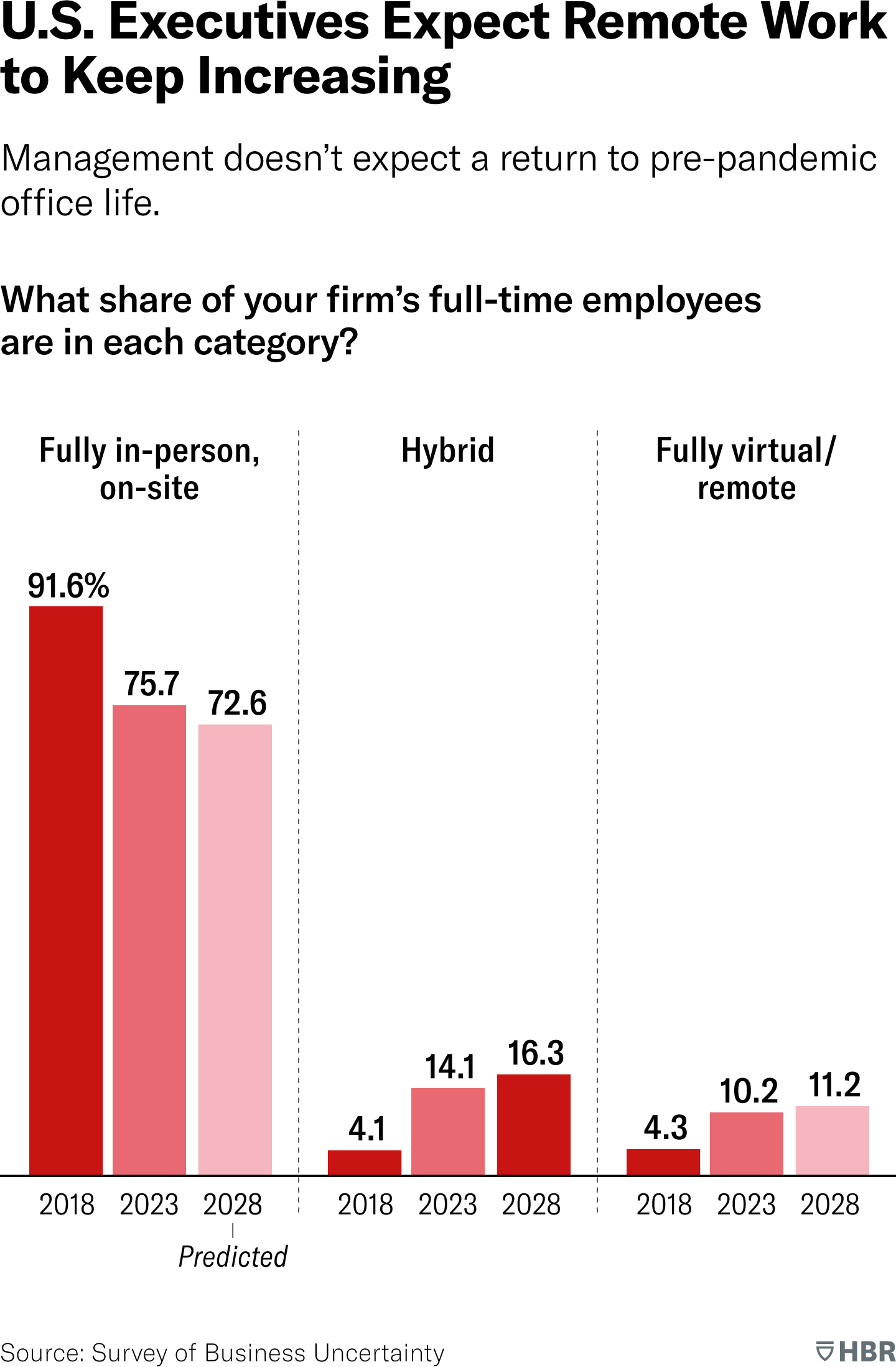
The most recent iteration of the survey, conducted in July 2023, asks: “Looking forward to five years from now, what share of your firm’s full-time employees do you expect to be in each category [fully in person, hybrid, fully remote] in 2028?”

As the chart below illustrates, executives expect both fully remote and hybrid work to continue to grow.

See more HBR charts in Data & Visuals


They’re right to expect remote and hybrid work to increase, for four reasons.

FIRST, as remote-working technology improves, the share of people working remotely increases. In the 1960s, offices were entirely paper-based, and working from home was very inconvenient. By the 1980s, personal computers began to become more widespread and remote work became easier. By the 2000s, the internet and nascent video calls made it easier still. The response followed basic economic logic: As the “costs” of remote work fell (lower inconvenience, for example), more people chose to do it. Work-from-home rates grew steadily over the half-century leading up to the pandemic, albeit from a very low starting point. And this trend will continue: The pandemic significantly increased the amount of research and patenting happening in technologies that support remote interactions.

SECOND, remote work will increase because startups born since the pandemic are more likely to use it. As these younger firms grow, the share of jobs offering remote work will increase.

THIRD, and perhaps least obvious, the U.S. is well positioned for remote work. Already, the U.S. has one of the highest rates of remote work of any country, behind only New Zealand and Canada among the 34 countries we surveyed. That makes sense. Remote work is a form of decentralization and personal autonomy: It gives employees more discretion over how and when they work. Management researchers have long known that for decentralized decision making to succeed, a company must be especially well managed. Separate research by our colleagues consistently finds that U.S. firms have better management practices, on average, than firms in other countries. Those better practices enable U.S. firms to more effectively manage remote work. It also helps that Americans have larger residences, which makes it easier to create a dedicated workspace at home.

FINALLY, remote work will increase because employees like it. The evidence suggests that working from home is valued by employees about the same as an 8 percent pay increase, on average. It’s a huge amenity and helps reduce turnover — in one recent, large study, by as much as 35 percent.

What about worries that remote work lowers productivity? Research suggests that fully remote work is up to 10 percent less productive than onsite work, on average. But it’s also much cheaper, because it cuts space needs and enables hiring from anywhere. Productivity in hybrid mode differs across jobs and people and with management practices. On average, however, hybrid work seems to have little net effect on productivity and may increase it. Hybrid arrangements also save on the costs — in time and money — of commuting. If employees accomplish the same amount of work whether they commute into the office two or five days a week, they’re actually spending their time more efficiently in the hybrid arrangement.

Companies and their leaders should seriously consider the merits of working from home, at least a couple of days a week. Managed hybrid, where teams all gather in the office the same day or two each week, may well be the best of both worlds. It can be profitable for companies, popular with employees, and better for the planet due to less energy consumption.

While the future extent of remote work remains uncertain, there’s little chance we will see a big return to the office. Remote technologies will only get better, and employees will gravitate to firms with more flexible policies. The biggest clue that the return-to-office push won’t work, though, is the fact that executives themselves privately predict that remote work will keep increasing.

This article is reprinted from Harvard Business Review with permission. ©2023. All rights reserved.

Culture
Leadership & Manager Development
Learning & Development
Models of Work
Remote Hybrid
Total Rewards

Was this resource helpful?

Leave Feedback

SHRM-CP Promo Image
Validate your HR expertise

Earning your SHRM-CP credential makes you a recognized expert and leader in the HR field.

Get Certified


Related Content

(opens in a new tab)
News
How One Company Uses Digital Tools to Boost Employee Well-Being

Learn how Marsh McLennan successfully boosts staff well-being with digital tools, improving productivity and work satisfaction for more than 20,000 employees.

(opens in a new tab)
News
A 4-Day Workweek? AI-Fueled Efficiencies Could Make It Happen

The proliferation of artificial intelligence in the workplace, and the ensuing expected increase in productivity and efficiency, could help usher in the four-day workweek, some experts predict.

(opens in a new tab)
News
Rising Demand for Workforce AI Skills Leads to Calls for Upskilling

As artificial intelligence technology continues to develop, the demand for workers with the ability to work alongside and manage AI systems will increase. This means that workers who are not able to adapt and learn these new skills will be left behind in the job market.

HR Daily Newsletter

Stay up to date with the latest HR news, trends, and expert advice each business day.

Success title

Success caption

Manage Subscriptions
Our Brands

SHRM Foundation Logo
SHRM Executive Network Logo
CEO Circle Logo
SHRM Business Logo
SHRM Linkage Logo
SHRM Labs
Overview

  • About SHRM
  • Careers at SHRM
  • Press Room
  • Contact SHRM
  • Post an HR Job
SHRM Named to Newsweek's 2026 America's Top Online Learning Provider List
Advocacy

  • SHRM Advocacy
  • Federal Policies
  • State Affairs
  • Global Policy
  • Take Action
  • SHRM E2 Initiative
Brand Partnership

  • Partnership Opportunities
  • Advertise with Us
  • Exhibit & Sponsorship
  • Recertification Providers
  • Book a Speaker
Member Resources

  • Ask an HR Advisor
  • SHRM Newsletters
  • SHRM Flagships
  • Topics & Tools
  • Find an HR Job
  • Vendor Directory

© 2026 SHRM. All Rights Reserved
SHRM provides content as a service to its readers and members. It does not offer legal advice, and cannot guarantee the accuracy or suitability of its content for a particular purpose. Disclaimer

Follow Us

  • LinkedIn
  • Facebook
  • Twitter
  • Instagram
  • YouTube
Feedback

  1. Your Privacy Choices

  2. Terms of Use

  3. Accessibility

Join SHRM for Exclusive Access to Professional Content

SHRM Members enjoy unlimited access to articles and exclusive professional content resources.

Already a member? Login
Free Article

Login to unlock unlimited access or join SHRM today to get unlimited access to articles and member-exclusive resources.

Already a member? Login
Limit Reached

You've reached the limit of 1 free article this month. Join to access unlimited articles and member-only resources.

Already a member? Login
Free Article

Login to unlock unlimited access or join SHRM today to get unlimited access articles and member-exclusive resources.

Already a member? Login
Limit Reached

You've reached the limit of 1 free article this month. Join the Executive Network and enjoy unlimited content.

Already a member? Login
Unlock Your Career with SHRM Membership

Please enjoy this free resource! Join SHRM for unlimited access to exclusive articles and tools.

Already a member? Login
Join SHRM for Exclusive Access to Professional Premium Content

SHRM Members enjoy unlimited access to articles and exclusive professional premium resources.

Already a member? Login
Join SHRM for Exclusive Access to Student Content

SHRM Members enjoy unlimited access to articles and exclusive member resources.

Already a member? Login
Join SHRM for Exclusive Access to Executive Network Content

SHRM member enjoys unlimited access to articles and exclusive executive member resources.

Already a member? Login

Your membership is almost expired! Renew today for unlimited access to member content.

Renew now

Your membership has expired. Renew today for unlimited access to member content.

Renew Now

Your Executive Network membership is nearing its expiration. Renew now to maintain access.

Renew Now

Your membership has expired. Renew your Executive Network benefits today.

Renew Now
