Transparency Shrinks Gender Pay Gap
Talking more openly about compensation can combat unconscious bias

The pay gap between men and women disappears for most jobs when employers adopt transparent pay practices, new research shows. Meanwhile, companies are increasingly taking action to address and resolve gender pay gap issues.
Does Pay Transparency Close the Gender Wage Gap?, a report by compensation data and software firm PayScale, reveals that disclosing how wages and salaries are set, how pay raises are decided and the criteria for awarding bonuses can mitigate the unconscious bias of managers and HR leaders who determine compensation. The analysts drew on 1.6 million survey responses about compensation collected over a two-year period (September 2017 to September 2019).
"This latest research shows just how powerful transparent pay practices can be for organizations," PayScale CEO Scott Torrey said. "When employers use real market data and talk openly with employees about their pay, it serves to challenge the underlying bias that can impact decisions about compensation. Most employers want to ensure they're paying fairly, so we encourage HR departments and senior leaders to adopt transparent pay practices as an important step toward achieving this goal."
In its study, PayScale examined the "controlled" pay gap, a comparison of pay for men and women with the same experience and education doing the same job in the same geographic location. This approach showed that women now earn 98 cents for every dollar earned by men, up from 97.8 cents in 2018.
While that difference may seem small, when a 2 percent difference in pay is compounded over the course of a career, it adds up to women taking home significantly less pay than their male peers.
However, when employees said they have a transparent pay process at their company, women were estimated to earn between $1 and $1.01 for every dollar men earn—effectively erasing the gender pay gap.
Some areas of the talent market, however, proved more resistant to achieving pay equality:
- The gender pay gap persists at the director and executive levels. Transparent pay discussions appear to have the largest impact for individual contributors, supervisors and managers. By contrast, female directors and executives still faced discriminatory pay penalties for their gender, although the gender pay gap is diminished with transparent pay practices.
- All industries benefit from a transparent pay process, but some benefit more than others. While all industries showed a marked reduction in the gender pay gap among respondents who work in a pay-transparent organization, the wage gap did not completely disappear in accommodation and food services, retail and customer service, and transportation and warehousing.
- Male-dominated occupations still showed a gender pay gap. Jobs that continued to reflect a pay gap, even in organizations with transparent pay practices, were most common in food preparation and serving, installation, maintenance and repair, production, protective services and sales.
Torrey recommended training managers and HR departments to have open and ongoing conversations with employees about compensation, using market data to show how pay was determined.
[SHRM members-only toolkit: Managing Pay Equity]
Pay-Equity Analysis a Common Practice
Companies are increasingly taking action to address and resolve the gender pay gap, other research shows.
Gender pay gap and broad pay-equity analyses are becoming standard practice for organizations, with remediation efforts not far behind, according to results in the Snapshot Survey: Pay Equity Practices and Priorities report by WorldatWork, an association of total rewards professionals.
Based on responses from more than 350 compensation managers at mostly large North American companies, the August 2019 survey found the following:
- Gender pay gap and broad pay-equity analyses are becoming standard practice for large organizations, and last year they were conducted by more than 70 percent of survey respondents.
- Remediation strategies to correct pay-gap issues were undertaken by 55 percent of respondents.
- Recruitment and hiring practices were evaluated for pay-gap biases by more than 80 percent of respondents between 2018 and 2020, as were individual pay determination decisions.
- Market pay data, performance management practices, and paid time off and flexibility benefits were other areas that a majority of respondents examined for potential biases leading to pay disparities.
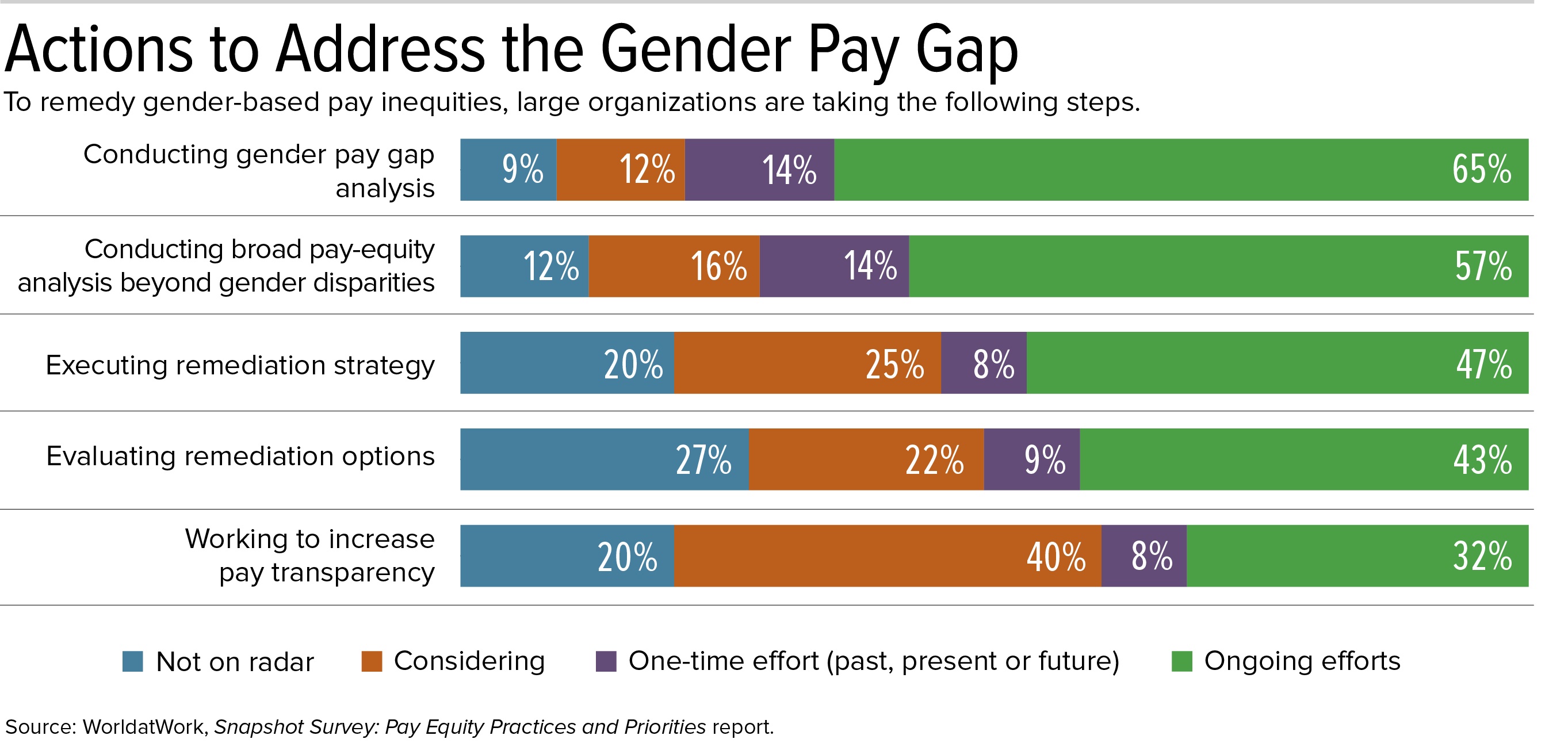
These results "confirm what has become increasingly apparent—pay equity is one of the single fastest-growing topics the HR profession has seen in decades," said WorldatWork's president and CEO, Scott Cawood.
"It's not just about salary, though," he added. "Organizations are expanding their understanding of areas where potential bias or gaps may exist," such as hiring and promotion.
While the survey reveals positive movement toward remedying pay inequities, benefits programs received the least amount of attention when looking for potential biases that may contribute to total rewards disparities. However, greater understanding of how benefits programming can skew to attract or serve one group over another is beginning to emerge, Cawood noted.
"The level of scrutiny for all pay-related systems will only increase in the next few years," he predicted. "In the future, performance management programs will have to adhere to updated frameworks in order to be bias-free."
A separate pay transparency survey with responses from nearly 500 WorldatWork members found that when pay equity adjustments are made:
- 53 percent of organizations explicitly communicate to the employees that the increase is the result of a pay equity adjustment.
- 30 percent bundle it with other pay increases without explicit communication on the adjustment.
"As organizations address potential areas of unintended bias with pay systems, it’s reassuring to see that pay transparency is becoming more of a priority," said Cawood.
Salary Ranges: To Share or Not Businesses are split on one aspect of transparency: sharing salary ranges with job candidates and employees. LinkedIn's 2019 Global Talent Trends report, based on responses from 5,164 talent professionals and hiring managers, showed that the percentage of talent professionals who said their company shares salary ranges with employees or early-stage candidates, or is likely/unlikely to start sharing in the next five years, were as follows:
Of those 27 percent that share salary ranges: 67 percent of them share salary ranges with candidates early in the hiring process, 59 percent share ranges with employees, and 48 percent share ranges publicly on job posts. As the transparency trend gains further momentum, these numbers are expected to grow, LinkedIn predicts. Companies fear disputes, but those who share salaries see benefits, LinkedIn noted. "Fear of upsetting employees is by far the most commonly cited reason for not sharing salary ranges," the report states. "Companies often worry that people will immediately ask for the high end of a salary range or become unhappy after seeing what others make." However, according to talent professionals who practice it, "pay transparency makes the hiring process more efficient by streamlining negotiations," LinkedIn reported. "It also helps ensure fair pay across gender and race, which is why many governments have recently introduced pay transparency laws." |
Learning and Development Matter
"Pay transparency is critical to creating inclusive work environments but it's important to remember that this is just one piece of the puzzle," said Claudio Erba, founder and CEO of learning-management software firm Docebo. "Transparent pay policies have been shown to neutralize the gender pay gap, but jobs at the director and executive level are still struggling to achieve pay equality, and this is especially true with roles that involve tech. Women continue to be underrepresented in these positions and industries, and in many cases poor training and development is to blame."
While technical skills training is part of the answer to closing gender pay gaps, so to is helping employees to develop softer skills like negotiation tactics, coaching, management and self-promotion, which can "make the biggest difference in increasing female presence in leadership positions," Erba said. In addition, unconscious-bias training can help managers "understand the challenges women face in the workplace, and what their role is in eliminating those biases."
Start at the Top
Tanya Jansen, co-founder at beqom, a cloud-based compensation software provider, believes that "the push for gender wage equality must start from the top." She encourages employers to better define equity pay gaps "to achieve both total pay equality across employees in similar positions and across employees of varying levels."
Companies, she said, should "look beyond simple salary comparisons and evaluate how they're recruiting employees, how noncash rewards are distributed, and how promotions and raises are decided."
"Pay transparency alone can't narrow the wage gap between men and women," Bill Olson, senior vice president of operations at United Benefit Advisors, recently blogged. "But shedding light on that disparity is the first step to ending the wage gap entirely."
Related SHRM Articles:
Viewpoint: What Employers Don't Know About Pay Equity Can Hurt Them, SHRM Online, January 2020
Federal Appeals Court Lowers Bar to Advance Pay Equity Claims, SHRM Online, December 2019
U.S. Companies Are Working to Fix Pay-Equity Issues, SHRM Online, May 2019
Unequal Career Advancement Fuels Gender Pay Gap, SHRM Online, April 2019
Employers Join Consortium to Close Gender Wage Gap, SHRM Online, April 2019
[Visit SHRM's resource page on Pay Equity.]
Was this resource helpful?

Validate your HR expertise
Earning your SHRM-CP credential makes you a recognized expert and leader in the HR field.
Related Content

Transform HR with mobile technology to streamline workflows, enhance communication, and boost employee engagement across distributed teams.

A new study found that talent development practitioners believe performance-based assessments are more effective at measuring employee learning outcomes than knowledge tests.

As AI makes deeper inroads into organizations, employee concerns about the technology continue to grow. Here's how HR leaders can address the fear of AI among their own staff, as well as in the wider organization.