Employees at a downtown Minneapolis brand public relations firm literally reap what they sow—between 350 and 450 pounds of tomatoes and more than 400 cucumbers annually, for a start—from a plot of land outside of town.
Haberman is among a growing number of employers who are digging the concept of community-sponsored agriculture to improve employee health through better dietary choices—and to grow morale in the process. PepsiCo, for example, opened its organic garden at the company’s Purchase, N.Y. world headquarters in May 2009.
In Minneapolis, the work has yielded a bumper crop of benefits.
“This is an experiment far more successful than I’ve ever imagined,” Haberman President and CEO Fred Haberman said. The garden provides free food to about 30 employees and to the community, culminating in a company harvest party and prompting the canning of extra produce.
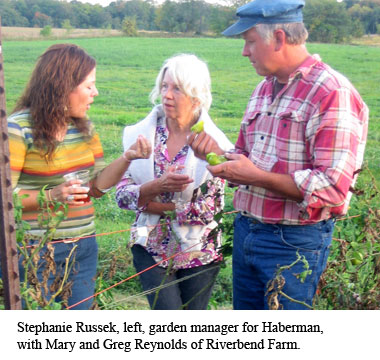
Work on the garden, known as The Dude Ranch, began the first week of May 2009. Haberman speaks of organic farming with the passion and excitement of a convert.
The company blog notes the company’s and the man’s interest in “working to inspire a national movement to create awareness of employer-sponsored gardens and all of the benefits associated with them.”
“We envision businesses nationwide starting their own gardens and being a part of the solution to our food sustainability issues, the health care crisis and unemployment problems,” a post from business partner Liz Morris Otto says.
Haberman believes that company-sponsored gardens lead to a healthier, more productive workforce—and by extension lower health care costs. In addition, it might prompt employers to provide healthy, organic food in the company dining rooms. Plus, “it does create loyalty, and it does attract talent,” he said.
Planting the Idea
The idea sprouted after a meeting with a client and a desire to do a better job of identifying with the needs of clients, an increasing number of which are organic food and health care companies.
The idea was an easy sell to management and the 22 full-time and seven part-time employees, according to Haberman. Participation is voluntary, conducted during off hours, and there is no minimum time commitment. Key to the garden’s success is having someone to prioritize necessary tasks and to communicate those to employees, such as with a checklist, he said.
The company rented one-third of an acre from Otto, an experienced gardener with farmland about 25 miles outside of town. The company spent $5,000 for seeds, equipment and land rental and hired two youngsters and their parents to pick up the gardening slack during summer months. He spent another $5,000 in soft expenses such as research and creating the web sitethat contains recipes, photos and links to the Seed Savers Exchange and similar resources.
He’s quick to point out, though, that employers can spend less than $5,000 and grow plenty of food.
“This is an inexpensive proposition with a huge return on investment,” he said. “It’s about the land and the seeds and the people working the garden.”
Finding land can be challenging, he acknowledged, but noted: “More often than not people either have the land or there is a plot of land close to corporate headquarters or possibly even on the roof of their building.”
In 2008, a branch of HomeStreet Bank in Washington turned a landscaped bed next to the drive-through lane into an employee garden. It moved drought-tolerant plants from a plot about the size of two parking spaces and transformed it into a vegetable garden that employees work during their off hours.
Haberman advises HR professionals to look at their organizations’ facilities budget and consider how it can be applied to a company-sponsored garden. He recommends conducting a soil test first, especially in urban areas where soil might be contaminated and requires amending.
“You can get access to very fertile soil, organic soil that is composted” to improve quality. “That should not get in the way of a garden.”
Hatching an Idea
Chickens are being added during fall 2009 to the company organic garden of TS Designs, located on about 2.2 acres of an industrial park just outside the city limits of Burlington, N.C. Business partners Eric Henry, president, and Tom Sineath, CEO, have sponsored an organic garden for its nearly 20 full-time employees since 2006.
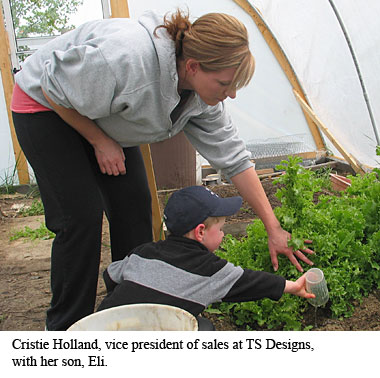
“We did not sacrifice any other [employee] benefits to put this one in,” Henry said. “[We] see the garden as an extension of what we’re doing to be a more sustainable company” and its mission of looking after the three P’s of people, the planet and profits.
The T-shirt design business’ sustainability efforts include a beehive, organic cotton scrap mulch pile, wind turbine, and sun tunnel lighting that allows sunlight into windowless areas. The property includes a hothouse and greenhouse, giving the organization a nearly year-round growing season.
TS Designs spent between $3,000 and $5,000 to start the garden, which included setting up a watering system and installing a fence to keep out deer and groundhogs. However, the cost “will be much lower the second year,” Henry says.
Employees have the option of signing up to tend the garden on land next to the building where they work. A list of chores—from watering to major weeding— is posted in the break room. Workers can take the free produce; extra food is used for employee lunches.
In 2009, the garden evolved from nine individual two-foot-square gardens into 12 20-foot-long rows of plants that included sweet potatoes, okra, cantaloupe, tomatoes, squash, cabbage, broccoli, eggplant and lettuce. It is managed by a $10-per-hour plant/gardening manager. Employees work the garden a minimum of two hours per week and reap the benefits—about 50 percent participate in a level that makes an impact, Henry says—but the plant manager comes in weekly for one to 10 hours.
“We still wanted to keep our employees engaged,” Henry said, “but [we] wanted a place to grow our own food” to feed the firm’s many guests and tour groups. The plant manager prepares the garden beds and pitches in during periods of low employee activity.
“When you need [the employees] the most,” such as during the summer, “that’s when they’re least interested because it’s so hot,” Henry observed.
Some overplanting led to waste.
“I’m not saying it happened a lot,” Henry said, but “we didn’t have a very good plan with what to do with the overage.” A better distribution plan will be addressed for 2010, along with readjusting the planting volume of various crops.
“Sustainability to us is like a religion,” Henry said of himself and Sineath, and they believe that part of their job is to help educate their employees about good food and the health impact of fast food.
“We’ve got employees who, pretty much, all they know is fast food,” he said. “A better educated employee is a healthier employee is a happier employee,” he said.
Change can be slow, though.
“Sometimes you go into the break room and they’re eating a big ol’ thing of fried seafood.” When that happens they often apologize for not eating healthier, he said.
“I think we have raised awareness,” says Henry.
Rich Harvest
As at TS Designs, Haberman employees who participate in the company-sponsored garden get first dibs on the veggies and herbs, but even the 20 percent who don’t weed, hoe or otherwise participate are free to take produce home.
What’s left over is given to local Minneapolis people in need. Some goes to local churches to distribute; some is put into gift baskets to clients. Tuesdays are distribution days. Not everything was a rousing success; the peas yielded a small bowl’s worth shared during a staff meeting.
Still, says Haberman, “I was blown away by how one-third of an acre can generate so much food,” such as 300-pound containers of green beans and yielding 130 zucchini from four hills of the plant.
“You don’t need to start with a large plot of land. You can start with a fifth of an acre and generate a lot of produce.”
The garden is an added benefit during a hard year, Haberman says. No benefits have been cut and there have been no layoffs or hiring freezes. But the recession has had an impact. Profits are down, and the company has not experienced the growth it’s known in prior years, he said.
A garden can reach beyond its employees.
Avista Utilities in Spokane, Wash., for example, transformed an acre of company property into a community garden in 2003. That year they donated more than a ton of food to the Second Harvest Food Bank. The garden has since yielded food for a local retirement community and the Women & Children’s Free Restaurant, according to the Avista web site.
“You’re going to be creating goodwill in your community, and you’re going to be creating a more loyal, productive and healthy workforce,” Haberman said.
“There’s nothing more powerful than giving food to people,” he said. “It’s a win-win-win for your employer, the employee and the community.”
Start Small
One Haberman client is the Minneapolis-based Institute for Agriculture and Trade Policy. One of the institute’s Food & Society Fellows is Rose Hayden-Smith, the director of the University of California Extension Service for Ventura County anda victory garden advocatewho attended the opening of the White House Kitchen Garden in 2009.
Hayden-Smith says she understands employers’ reluctance to jump in to a company-sponsored garden.
“We can’t all be a Haberman, but we can do something to accommodate” workplace gardens on a small scale, she told SHRM Online. “I understand no employer wants a half-acre of weeds.”
Start small, she said, with options that eliminate the need for land acquisition and soil testing. She pointed to raised-bed gardens that can be assembled in seven minutes and are available for less than $50 apiece, and self-watering grow boxes that cost about $30 each.
“I’ve seen these [grow boxes] just overflowing, and it’s a significant amount of food that becomes available,” she said. “At a time when employers [have] to reduce benefits, this is one area … where they can actually add value and add a benefit in a way that is really meaningful and intentional.”
For those who say they’d rather have more money, not more tomatoes, Hayden-Smith would tell them that workplace gardens can help reduce employee grocery bills. It is a concept that dates to the late 1800s when U.S. government assistance such as food stamps didn’t exist, she said.
“We forget there are employees in our own companies [today] on the lower end of the scale that really may not be making it economically, especially single moms,” she said.
She advises employers to survey employees about their interest in an employee garden and to find employees to champion it. Employers may contact her at rhaydensmith@ucdavis.edu, where she is director of the University of California Extension Service, for more information on company gardens.
She recommends looking at model programs. She pointed to the U.S. Department of Agriculture’s “People’s Garden” as an example of a public-sector employer; to Kaiser Permanente as an example of a large private employer; and to Patagonia Corp. and Haberman as examples of small, nimble companies active in the movement.
“There is a garden revolution going on in this nation,” she said.
Kathy Gurchiek is associate editor for HR News. She can be reached at kathy.gurchiek@shrm.org.
Express Request: SHRM members have access to additional resources on this topic. To receive these resources, visit our Hot Topics Express Request Service http://apps.shrm.org/HRResources/ExpressRequests.aspx?type=6 and select key term WORKPLACE Vegetable Gardens (BENEFITS).
Was this resource helpful?

Validate your HR expertise
Earning your SHRM-CP credential makes you a recognized expert and leader in the HR field.
Related Content

Transform HR with mobile technology to streamline workflows, enhance communication, and boost employee engagement across distributed teams.

A new study found that talent development practitioners believe performance-based assessments are more effective at measuring employee learning outcomes than knowledge tests.

As AI makes deeper inroads into organizations, employee concerns about the technology continue to grow. Here's how HR leaders can address the fear of AI among their own staff, as well as in the wider organization.