Built to Include: How Structured I&D Unlocks Organizational Performance

Inclusion & Diversity at an organization is not a policy exercise - it is a design challenge.
When I&D is approached as a structural and cultural priority, rather than a compliance requirement, the organization will consistently outperform those that do not. Over the years, SHRM MENA's approach to I&D has offered its clients a rigorous, actionable lens through which to assess, design, and embed I&D across the full spectrum of their people practices.
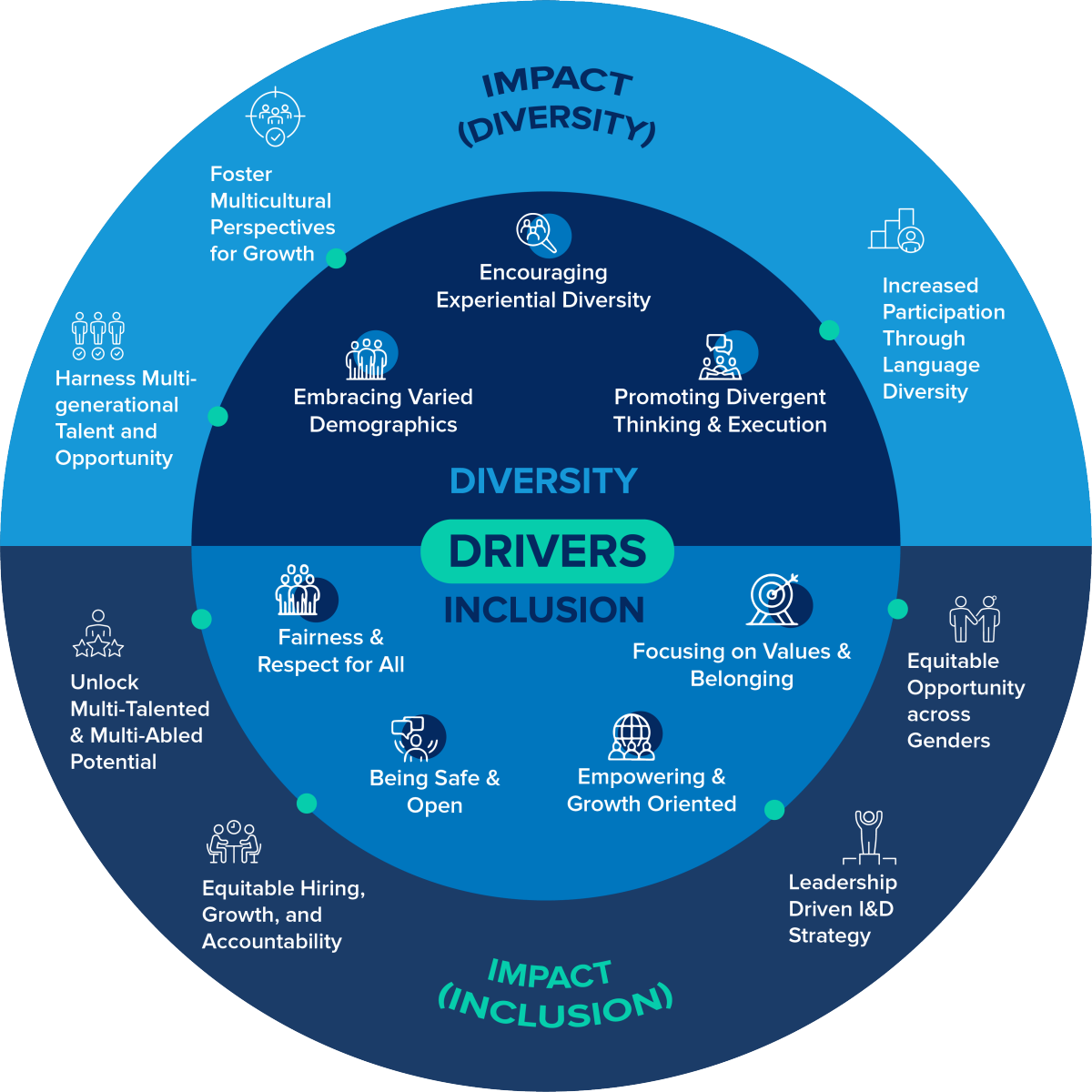
The approach is built on two interdependent aspects: Drivers and Impact Points. The Drivers establish what an organization brings to the table - including legacy, experiential, and thought diversity - and the quality of inclusion it fosters through fairness, belonging, psychological safety, and equitable access to growth. These are not abstract concepts, but observable and measurable characteristics of how an organization is structured, and how its people experience it daily.
The Impact Points define what I&D delivers when those drivers are activated. A workplace that harnesses diverse dimensions across generations, cultures, languages, abilities, and genders, and backs this with committed leadership, equitable talent practices, and accountability mechanisms; builds the conditions for sustained performance, innovation, and retention.
Putting the Approach to Work
SHRM MENA partners with organizations across the GCC to deliver on this approach throughout the employee lifecycle – from workforce planning and talent acquisition to performance management, career development, rewards, and leadership effectiveness. SHRM evaluates where structural barriers exist, where inclusive intent is not yet translating into equitable outcomes, and where leadership behaviors are enabling or undermining the culture. From there, SHRM MENA co-develops a prioritized I&D roadmap aligned to the organization's strategic agenda, workforce composition, and regional context, including nationalization objectives and GCC-specific workforce dynamics where relevant.
SHRM helps organizations address critical questions that determine whether I&D efforts translate into measurable business impact. Some of the challenges that get addressed are:
Is our I&D effort structural or symbolic? Moving beyond policy statements and awareness programs to embed inclusion into hiring, progression, and leadership practice.
Where are the gaps between intent and experience? Identifying where diverse employees exist in the workforce but are not advancing, contributing, or staying - and why.
Are our leaders equipped and accountable? Assessing whether leadership behaviors are actively enabling inclusion or inadvertently undermining it.
Are we measuring meaningful outcomes beyond representation? Building metrics that go beyond headcount diversity to capture belonging, equity of access, and cultural inclusion at every level.
In addition to the above, governance and measurement are embedded in the program design from the outset. I&D without accountability is an aspiration without traction. SHRM MENA helps organizations define meaningful metrics, build reporting structures, and create ownership at leadership level - so that progress is visible, tracked, and tied to business outcomes.
I&D as an Organizational Advantage
SHRM MENA believes that inclusive workplaces are high-performing workplaces. The strategic value it delivers for its clients in GCC is not diversity for its own sake - it is the ability to harness the full range of human dimensions within a workforce to drive better decisions, stronger teams, and more resilient organizations. Where others offer I&D as a standalone program, SHRM integrates it as a core dimension of organizational effectiveness.
Was this resource helpful?

Validate your HR expertise
Earning your SHRM-CP credential makes you a recognized expert and leader in the HR field.
Related Content

Learn how Marsh McLennan successfully boosts staff well-being with digital tools, improving productivity and work satisfaction for more than 20,000 employees.

The proliferation of artificial intelligence in the workplace, and the ensuing expected increase in productivity and efficiency, could help usher in the four-day workweek, some experts predict.

As artificial intelligence technology continues to develop, the demand for workers with the ability to work alongside and manage AI systems will increase. This means that workers who are not able to adapt and learn these new skills will be left behind in the job market.