Learning as Strategy

A comprehensive organizational learning approach, in my view, needs to be anchored in business strategy and future capability needs rather than being positioned as a standalone people/ employee initiative.
The Impact
The observable impact of learning as a strategic initiative is clear. Organizations that align learning to strategy typically see 20–30% faster transformation outcomes and significantly higher workforce adaptability. Those that invest meaningfully in leadership development often achieve up to 2–3x higher success rates in transformation initiatives, because leadership capability directly influences adoption, culture, and execution.
To add to the above, based on industry data and experience, strong manager capability typically drives 20–25% higher employee engagement and can reduce attrition by 10–15%, making it one of the highest ROI areas in learning.
What I’ve also seen is that organizations that invest in structured reskilling can reduce hiring costs by 15–20% (industry standards) and improve internal mobility by 30–40%, creating both financial and capability advantages.
The Game Changers
Leading organizations such as Accenture, IBM, and Unilever have been particularly effective in aligning learning with priorities like AI, digital transformation, and sustainability, to enable agility. This kind of alignment ensures that learning is not just activity-driven but clearly tied to measurable business outcomes.
For example: Accenture links investments in AI training and the acquisition of training platforms like Udacity - directly to career growth, skill development, and internal promotion pathways. IBM is renowned for its "digital badge" ecosystem, allowing employees to gain verified credentials in areas like Watsonx AI, machine learning, and cloud computing. This approach drives continuous reskilling by allowing employees to showcase their capabilities professionally.
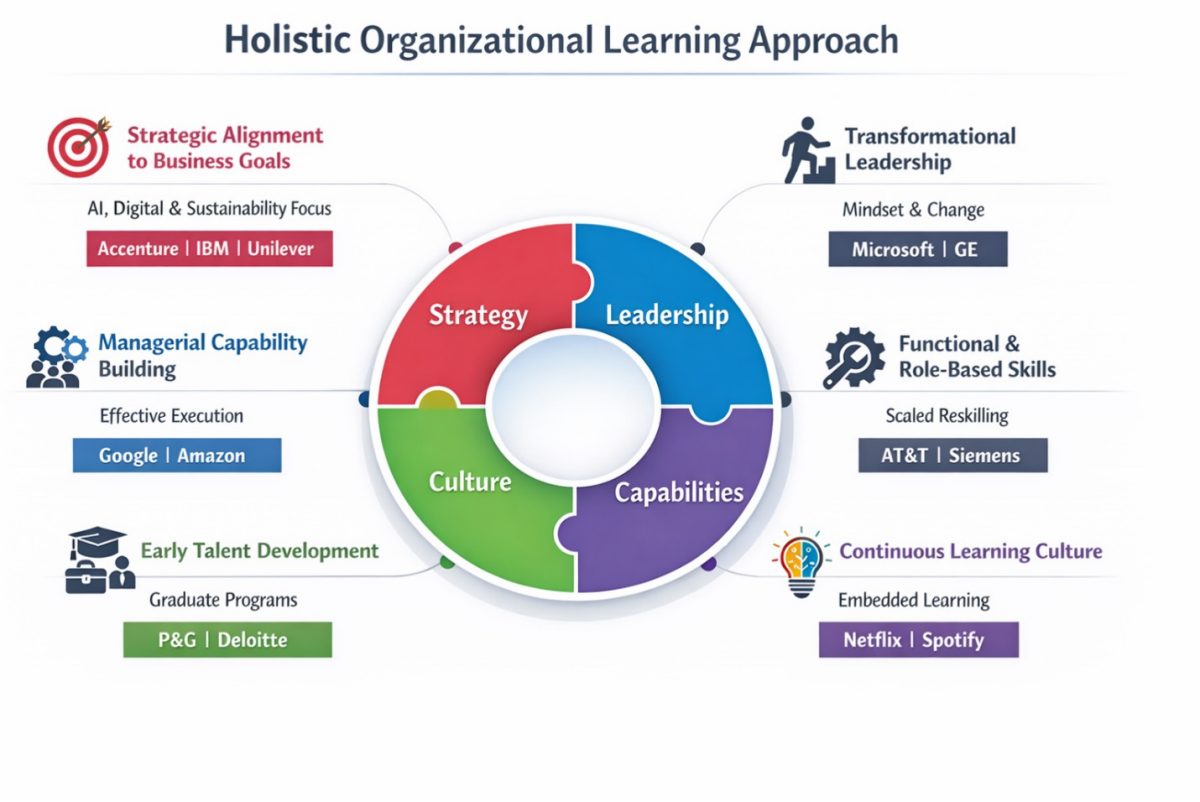
Targeted Priority Setting for Learning
Leadership: At the leadership level, I strongly believe that development needs to go beyond capability building into mindset transformation. Organizations like Microsoft and General Electric demonstrate this well. Microsoft’s shift to a “learn-it-all” culture under Satya Nadella is, to me, one of the strongest examples of how leadership learning can reshape an entire organization’s trajectory, moving explicitly from a "know-it-all" culture that valued expertise and certainty, to one that values curiosity and growth. Similarly, GE’s Crotonville model reinforces the importance of immersive, experience-led leadership development. My perspective is that leadership capability is the single biggest multiplier: when leaders evolve, the organization follows.
Management: From a managerial standpoint, I see this layer as the most critical in translating strategy into execution. Organizations such as Google and Amazon have taken a very practical, data-driven approach here. Google’s Project Oxygen is a great example of identifying what good management looks like and building targeted interventions around it, while Amazon’s leadership principles create consistency in how managers lead and deliver results. In my experience, when managers are equipped with the right tools, coaching capabilities, and clarity, they significantly influence engagement, culture, and performance.
Early Talent: I also place a lot of importance on early talent and pipeline development as a long-term capability lever - a high-value, long-term investment. Organizations such as Procter & Gamble and Deloitte have consistently demonstrated the value of investing in talent early through structured programs, mentorship, and rotational experiences. What I find particularly effective is how these organizations create clear career pathways, which in turn drives both retention and engagement. Building capability from within, rather than relying solely on external hiring, creates a far more sustainable talent model.
Overall, my perspective is that a truly effective learning approach is one that integrates strategy, leadership, capability building, and culture into a single ecosystem. The organizations that get this right treat learning not as a one-time intervention, but as a continuous, strategic lever that drives performance, innovation, and long-term growth.
Partika Raj is Head of Consulting and Capability Building at SHRM MENA. She has over 20 years of global experience in the field of Human Resources and Talent Development. Chartered MCIPD, SHRM SCP.
Was this resource helpful?

Validate your HR expertise
Earning your SHRM-CP credential makes you a recognized expert and leader in the HR field.
Related Content

Transform HR with mobile technology to streamline workflows, enhance communication, and boost employee engagement across distributed teams.

A new study found that talent development practitioners believe performance-based assessments are more effective at measuring employee learning outcomes than knowledge tests.

As AI makes deeper inroads into organizations, employee concerns about the technology continue to grow. Here's how HR leaders can address the fear of AI among their own staff, as well as in the wider organization.