  • Personal
  • Business
  • Foundation
    Close
  • Select Region
    • Global
    • India
    • MENA
  • mySHRM Login
  • MySHRM
    • Dashboard
    • Account
    • Logout
SHRM
  • Membership
    • Membership

      As a SHRM Member®, you’ll pave the path of your success with invaluable resources, world-class educational opportunities and premier events.

      Membership Tiers
      • Professional
      • Student
      • Global
      • Executive
      • Business
      Membership Benefits
  • Learning
    • Learning

      Build capability, credibility, and confidence to influence strategy, shape culture, and drive measurable business impact.

      SHRM Certification

      Demonstrate your ability to apply HR principles to real-life situations.

      • Choosing Your Certification
      • SHRM-CP
      • SHRM-SCP
      • How to Get Certified
      • Prepare for the Exam
      • Recertification
      Seminars

      Stand out from among your HR peers with the skills obtained from a SHRM Seminar.

      Specialty Credentials

      Demonstrate targeted competence and enhance your HR credibility.

      Educational Programs

      Designed and delivered by HR experts to empower you with the knowledge and tools you need to drive lasting change in the workplace.

      • Essentials of HR
      • eLearning
      Qualifications

      Gain a deeper understanding and develop critical skills.

  • Attend
    • Events

      Demonstrate your ability to apply HR principles to real-life situations.

      • SHRM26 Annual Conference & Expo
      • The AI+HI Project 2026
      • Talent 2026
      • Linkage Institute 2026
      • BLUEPRINT 2025
      State Conferences

      Attend a SHRM state event to network with other HR professionals and learn more about the future of work.

      Seminars

      Stand out from among your HR peers with the skills obtained from a SHRM Seminar.

      Webinars

      Learn live and on demand. Earn PDCs and gain immediate insights into the latest HR trends.

  • Resources
    • Resources

      Stay up to date with news and leverage our vast library of resources.

      • Flagships
      • HR Research
      • Legal & Compliance
      • Latest News & Trends
      • Tools & Guides
      • Webinars
      HR Topics
      • AI in the Workplace
      • Civility at Work
      • Compensation & Benefits
      • Inclusion & Diversity
      • Talent Acquisition
      • HR Technology
      • Workplace Violence Prevention
      Educational Programs

      Designed and delivered by HR experts to empower you with the knowledge and tools you need to drive lasting change in the workplace.

  • Community
    • Find a SHRM Chapter

      Easily find a local professional or student chapter in your area.

      • SHRM Northern California
      SHRM Connect

      Post polls, get crowdsourced answers to your questions and network with other HR professionals online.

      Membership Councils

      Learn about SHRM's five regional councils and the Membership Advisory Council (MAC).

      Volunteers

      Learn about volunteer opportunities with SHRM.

  • Shop
    • SHRM Store

      Shop for HR certifications, credentials, learning, events, merchandise and more.

      Workplace Essentials
      • SHRM Memberships
      • SHRM Certification
      • Specialty Credentials
      • HR Tools & Tech
      Education
      • Seminars
      • eLearning
      • Books
      Merchandise
      • Accessories
      • Apparel
      • Office & Home
Become a Member
Renew
Rejoin Now
Renew
Ask an HR Advisor
Close
  • Personal
  • Business
  • Foundation
  • Membership
    back
    Membership
    • Membership

      As a SHRM Member®, you’ll pave the path of your success with invaluable resources, world-class educational opportunities and premier events.

      Membership Tiers
      • Professional
      • Student
      • Global
      • Executive
      • Business
      Membership Benefits
  • Learning
    back
    Learning
    • Learning

      Build capability, credibility, and confidence to influence strategy, shape culture, and drive measurable business impact.

      SHRM Certification

      Demonstrate your ability to apply HR principles to real-life situations.

      • Choosing Your Certification
      • SHRM-CP
      • SHRM-SCP
      • How to Get Certified
      • Prepare for the Exam
      • Recertification
      Seminars

      Stand out from among your HR peers with the skills obtained from a SHRM Seminar.

      Specialty Credentials

      Demonstrate targeted competence and enhance your HR credibility.

      Educational Programs

      Designed and delivered by HR experts to empower you with the knowledge and tools you need to drive lasting change in the workplace.

      • Essentials of HR
      • eLearning
      Qualifications

      Gain a deeper understanding and develop critical skills.

  • Attend
    back
    Attend
    • Events

      Demonstrate your ability to apply HR principles to real-life situations.

      • SHRM26 Annual Conference & Expo
      • The AI+HI Project 2026
      • Talent 2026
      • Linkage Institute 2026
      • BLUEPRINT 2025
      State Conferences

      Attend a SHRM state event to network with other HR professionals and learn more about the future of work.

      Seminars

      Stand out from among your HR peers with the skills obtained from a SHRM Seminar.

      Webinars

      Learn live and on demand. Earn PDCs and gain immediate insights into the latest HR trends.

  • Resources
    back
    Resources
    • Resources

      Stay up to date with news and leverage our vast library of resources.

      • Flagships
      • HR Research
      • Legal & Compliance
      • Latest News & Trends
      • Tools & Guides
      • Webinars
      HR Topics
      • AI in the Workplace
      • Civility at Work
      • Compensation & Benefits
      • Inclusion & Diversity
      • Talent Acquisition
      • HR Technology
      • Workplace Violence Prevention
      Educational Programs

      Designed and delivered by HR experts to empower you with the knowledge and tools you need to drive lasting change in the workplace.

  • Community
    back
    Community
    • Find a SHRM Chapter

      Easily find a local professional or student chapter in your area.

      • SHRM Northern California
      SHRM Connect

      Post polls, get crowdsourced answers to your questions and network with other HR professionals online.

      Membership Councils

      Learn about SHRM's five regional councils and the Membership Advisory Council (MAC).

      Volunteers

      Learn about volunteer opportunities with SHRM.

  • Shop
    back
    Shop
    • SHRM Store

      Shop for HR certifications, credentials, learning, events, merchandise and more.

      Workplace Essentials
      • SHRM Memberships
      • SHRM Certification
      • Specialty Credentials
      • HR Tools & Tech
      Education
      • Seminars
      • eLearning
      • Books
      Merchandise
      • Accessories
      • Apparel
      • Office & Home
Become a Member
Renew
Rejoin Now
Renew
Ask an HR Advisor
  • Select Region
    • Global
    • India
    • MENA
SHRM
mySHRM Login
  • MySHRM
    • Dashboard
    • Account
    • Logout
Close

  1. Topics & Tools
  2. Workplace News & Trends
  3. Compensation & Benefits
  4. Salary Range Structure Practices
Share
  • Linked In
  • Facebook
  • Twitter
  • Email

Lorem ipsum dolor sit amet, consectetur adipiscing elit. Vivamus convallis sem tellus, vitae egestas felis vestibule ut.


Error message details.

Copy button
Reuse Permissions

Request permission to republish or redistribute SHRM content and materials.


Learn More
News

Salary Range Structure Practices

November 16, 2009 | Culpepper and Associates


Salary structures are an important component of effective compensation programs and help ensure that pay levels for groups of jobs are competitive externally and equitable internally. An effective salary structure allows management to reward performance and the development of skills while controlling overall base salary costs by providing a cap on the range paid for particular jobs or locations.

The following is a summary of results from a 2009 Culpepper Pay Practices Survey on base salary range structure practices, conducted Aug. 20 through Oct. 8, 2009, primarily among North American technology, life sciences and health care services companies.

Key Survey Findings

• 71 percent of surveyed companies reported having formal base salary range structures.

• 77 percent of companies with formal base salary range structures review their structures annually.

• 94 percent use market data when designing salary structures.

• 78 percent use traditional salary structures; 11 percent use broadband structures.

• 55 percent have multiple structures varying by job and/or location.

• Salary range spreads and midpoint-to-midpoint differentials vary significantly by job level.

Salary Ranges and Structures Defined
A salary range is the span between the minimum and maximum base salary an organization will pay for a specific job or group of jobs.

A salary range structure (or salary structure) is a hierarchal group of jobs and salary ranges within an organization. Salary structures are often expressed as pay grades or job grades that reflect the value of a job in the external market and/or the internal value to an organization.

Percent of Companies with Formal Base Salary Range Structures
Seventy-one percent of surveyed companies reported having formal base salary range structures. However, as companies increase in size they are more likely to have salary range structures. Less than half of companies with fewer than 100 employees use salary range structures. In contrast, about four out of five companies with more than 500 employees use salary range structures.

Table 1.
Percent of Companies with Formal Salary Range Structures

All companies

71%

By number of employees

1 to 100

42%

101 to 500

61%

501 to 2,500

82%

2,501 to 10,000

81%

Over 10,000

80%


Frequency of Salary Range Structure Review
Salary range structures should be reviewed regularly to maintain a competitive edge in attracting and retaining top talent. Most companies with formal base salary range structures review their ranges and structures annually, while 17 percent of companies review salary structures every two or three years. Fourteen percent of participants with formal salary range structures reported that they do not use salary structures with executives.

Table 2.
Frequency of Salary Range Structure Review

Job Level

Percent of Companies

Annually

Every Two Years

Every Three Years

Other/ Varies

No Formal Ranges for
Job Level

Executives

68%

10%

6%

2%

14%

Non-executives*

80%

11%

6%

2%

1%

*Non-executives include directors and managers, professionals, and hourly/nonexempt employees.

Companies choosing “other/varies” indicated that the frequency for reviewing structures varies by type of job, business unit, location or union status. Examples include:

• Some companies with union employees review salary structures based on the length of multiyear labor contracts and review other nonunion jobs annually.

• Some companies in very competitive job markets review salary structures for critical jobs semi-annually.

Methods Used to Design Salary Range Structures
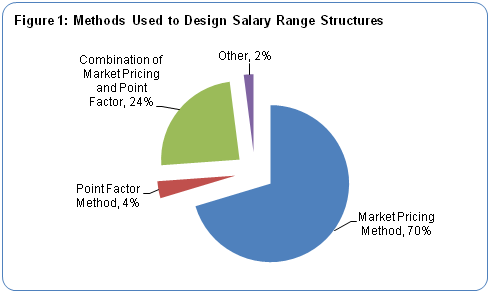
The two most common methods companies use to design base salary structure ranges are market pricing using external market data and point factor focusing on internal pay equity.

Most companies use a market-pricing approach with current salary survey data for individual jobs to design and adjust salary range structures. Only 4 percent of companies rely solely on the point-factor method, which assigns point values to jobs within a company.

Twenty-four percent of companies blend market-based and point-factor approaches when designing salary range structures.
 

Traditional vs. Broadband Salary Structures
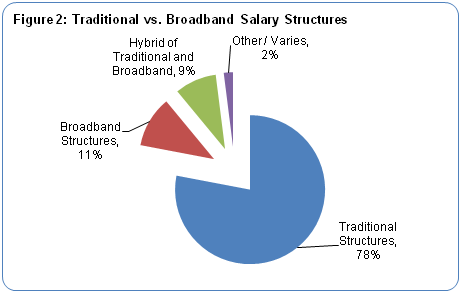
Traditional salary structures are organized with numerous layers and range structures (or pay grades) with a relatively small distance between each range. Traditional structures provide a hierarchal system enabling employees to be promoted from one pay grade to another. Designed correctly, traditional structures enable the recognition of differing rates of pay for performance and guarantee a reasonable level of control over internal compression and salary expenditures.

Broadband salary structures are more flexible and consolidate pay grades into fewer structures with wider salary ranges. Broadband structures tend to be used by relatively flat organizations with few levels and small companies without a dedicated compensation staff to establish traditional structures.

On average, 78 percent of companies use traditional salary structures while 11 percent use broadband structures. Nine percent utilize a hybrid or mix of traditional and broadband structures.
 

Single vs. Multiple Salary Structures
Fifty-five percent of companies with salary range structures have multiple structures varying by job and/or location.

As companies increase in size, they typically have a higher number of salary structures to accommodate more locations and job structures. Companies with more than 500 employees are more likely to have multiple locations and use different salary structures varying by location than companies with fewer than 500 employees.

There is a strong correlation between job level and number of salary structures. Single salary structures are most common for executives, and multiple salary structures are most common for lower-level positions. For example, 58 percent of companies have single structures for executives and 63 percent of companies have multiple salary structures for hourly and nonexempt employees.

Table 3.
Single vs. Multiple Salary Structures

Percent of Companies

Single Structure

Multiple Structures Differing by Job Function

Multiple Structures Differing by Location

Multiple Structures Differing by Job and Location

Other

All companies

43%

21%

19%

15%

3%

Number of employees

1 to 100

42%

41%

8%

6%

4%

101 to 500

47%

29%

8%

16%

2%

501 to 2,500

46%

18%

21%

13%

2%

2,501 to 10,000

41%

12%

23%

21%

3%

Over 10,000

39%

14%

27%

15%

4%

Job level

Executives

58%

18%

12%

8%

4%

Directors / Managers

43%

21%

19%

15%

2%

Professional

38%

22%

20%

18%

2%

Hourly / Nonexempt

34%

21%

24%

18%

3%

Note: Significant differences were not found between industry sectors and different types of ownership.

------------------

​​​Data Source​

Data is from the 2009 Culpepper Salary Range Structure Practices Survey of 332 organizations.

​Survey dates: Aug. 20 through Oct. 8, 2009.

Participants by sector: technology 47%, life sciences 12%, health care services 7%, energy 3%, engineering 1%, other 30%.

Participants by number of employees: up to 100: 18%, 101 to 500: 19%, 501 to 2,500: 29%, 2,501 to 10,000: 22%, Over 10,000: 12%.

Participants by ownership: public 42%, private 44%, nonprofit 10%, government 3%, other 1%.

Participants by location: United States 90%, Canada 5%, other 5%.

Culpepper and Associates conducts worldwide salary surveys and provides benchmark data for compensation and employee benefit programs.

Reposted with permission

Source: 2009 Culpepper Salary Range Structure Practices Survey, November 2009, www.culpepper.com

Related Culpepper Survey Reports:

Salary Range Structure Increases for 2009 and 2010, September 2009

Salary Increase Budgets for 2009 and 2010, September 2009

Related Article:

Building a Market-Based Pay Structure From Scratch, SHRM Online Research Articles, December 2008

Quick Links:

SHRM Online Compensation Discipline

SHRM Salary Survey Directory

SHRM Compensation Data Center

• Sign up for SHRM’s free Compensation & Benefits e-newsletter

Compensation Management

Was this resource helpful?

Leave Feedback

SHRM-CP Promo Image
Validate your HR expertise

Earning your SHRM-CP credential makes you a recognized expert and leader in the HR field.

Get Certified


Related Content

(opens in a new tab)
News
How One Company Uses Digital Tools to Boost Employee Well-Being

Learn how Marsh McLennan successfully boosts staff well-being with digital tools, improving productivity and work satisfaction for more than 20,000 employees.

(opens in a new tab)
News
A 4-Day Workweek? AI-Fueled Efficiencies Could Make It Happen

The proliferation of artificial intelligence in the workplace, and the ensuing expected increase in productivity and efficiency, could help usher in the four-day workweek, some experts predict.

(opens in a new tab)
News
Rising Demand for Workforce AI Skills Leads to Calls for Upskilling

As artificial intelligence technology continues to develop, the demand for workers with the ability to work alongside and manage AI systems will increase. This means that workers who are not able to adapt and learn these new skills will be left behind in the job market.

HR Daily Newsletter

Stay up to date with the latest HR news, trends, and expert advice each business day.

Success title

Success caption

Manage Subscriptions
Our Brands

SHRM Foundation Logo
SHRM Executive Network Logo
CEO Circle Logo
SHRM Business Logo
SHRM Linkage Logo
SHRM Labs
Overview

  • About SHRM
  • Careers at SHRM
  • Press Room
  • Contact SHRM
  • Post an HR Job
SHRM Named to Newsweek's 2026 America's Top Online Learning Provider List
Advocacy

  • SHRM Advocacy
  • Federal Policies
  • State Affairs
  • Global Policy
  • Take Action
  • SHRM E2 Initiative
Brand Partnership

  • Partnership Opportunities
  • Advertise with Us
  • Exhibit & Sponsorship
  • Recertification Providers
  • Book a Speaker
Member Resources

  • Ask an HR Advisor
  • SHRM Newsletters
  • SHRM Flagships
  • Topics & Tools
  • Find an HR Job
  • Vendor Directory

© 2026 SHRM. All Rights Reserved
SHRM provides content as a service to its readers and members. It does not offer legal advice, and cannot guarantee the accuracy or suitability of its content for a particular purpose. Disclaimer

Follow Us

  • LinkedIn
  • Facebook
  • Twitter
  • Instagram
  • YouTube
Feedback

  1. Your Privacy Choices

  2. Terms of Use

  3. Accessibility

Join SHRM for Exclusive Access to Professional Content

SHRM Members enjoy unlimited access to articles and exclusive professional content resources.

Already a member? Login
Free Article

Login to unlock unlimited access or join SHRM today to get unlimited access to articles and member-exclusive resources.

Already a member? Login
Limit Reached

You've reached the limit of 1 free article this month. Join to access unlimited articles and member-only resources.

Already a member? Login
Free Article

Login to unlock unlimited access or join SHRM today to get unlimited access articles and member-exclusive resources.

Already a member? Login
Limit Reached

You've reached the limit of 1 free article this month. Join the Executive Network and enjoy unlimited content.

Already a member? Login
Unlock Your Career with SHRM Membership

Please enjoy this free resource! Join SHRM for unlimited access to exclusive articles and tools.

Already a member? Login
Join SHRM for Exclusive Access to Professional Premium Content

SHRM Members enjoy unlimited access to articles and exclusive professional premium resources.

Already a member? Login
Join SHRM for Exclusive Access to Student Content

SHRM Members enjoy unlimited access to articles and exclusive member resources.

Already a member? Login
Join SHRM for Exclusive Access to Executive Network Content

SHRM member enjoys unlimited access to articles and exclusive executive member resources.

Already a member? Login

Your membership is almost expired! Renew today for unlimited access to member content.

Renew now

Your membership has expired. Renew today for unlimited access to member content.

Renew Now

Your Executive Network membership is nearing its expiration. Renew now to maintain access.

Renew Now

Your membership has expired. Renew your Executive Network benefits today.

Renew Now
