
It's likely that you've either read about or discussed the concept of HR professionals thinking like marketers and treating the workforce like customers. These are valuable concepts, but where do you start? At the same place where the very best design teams in the world start: personas.
There are many definitions of the term written by interaction design experts, and this one from marketing software designer Hubspot sums it up well:
Personas are fictional, generalized characters that encompass the various needs, goals and observed behavior patterns among your real and potential customers. They help you understand your customers better.
To apply the concept of personas in HR, simply replace the term "customers" in this definition with "workers," which helps pave the way for the right design mindset.
[SHRM members-only platform: SHRM Connect]
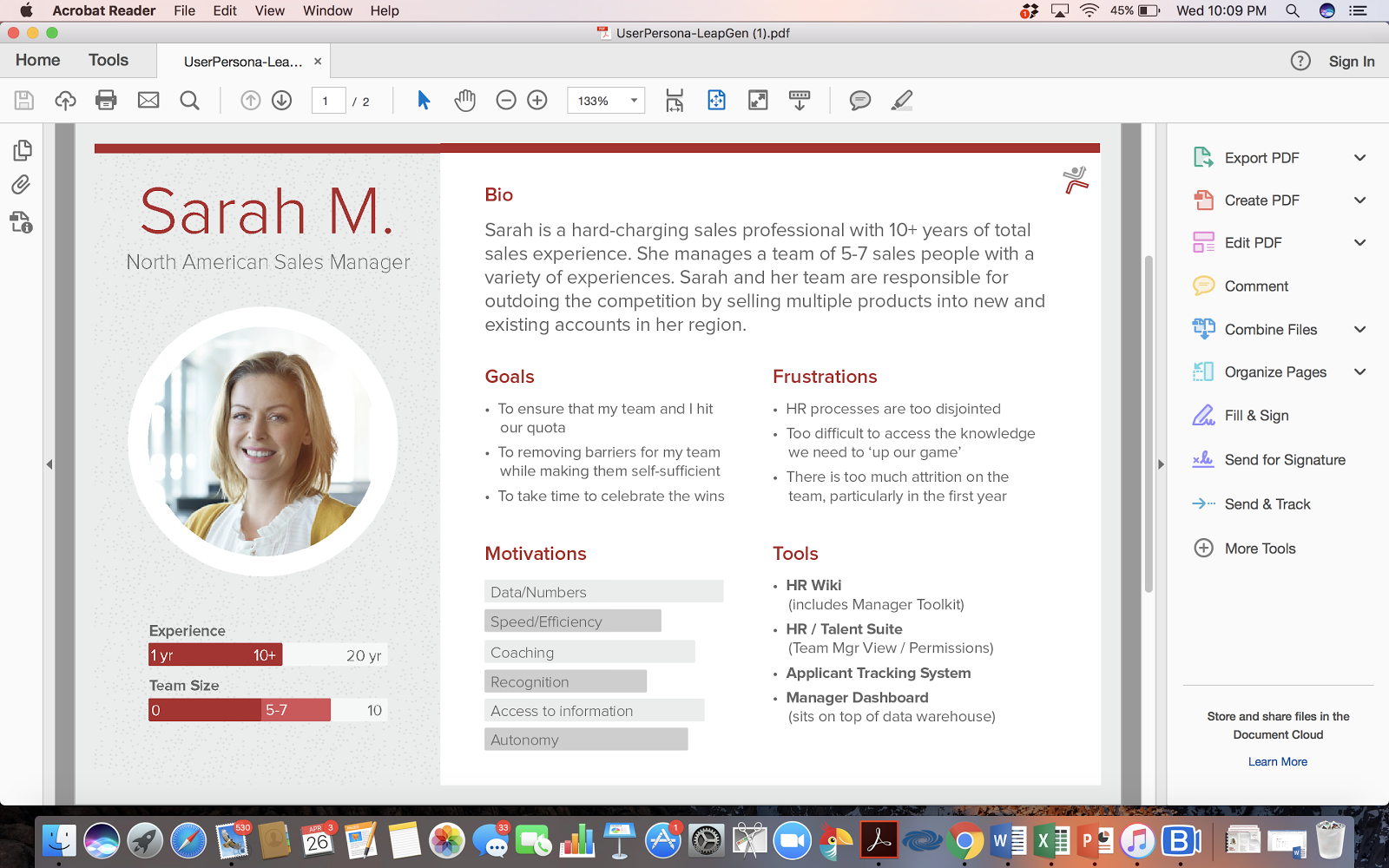
"A persona is depicted as a specific person but is not a real individual; rather, it is synthesized from observations of many people," said Mo Goltz, a senior user experience designer in Chicago. Each persona represents a significant portion of people in the real world and enables designers to focus on a manageable and memorable cast of characters, instead of thousands of individuals. Personas aid in creating different designs for different kinds of people—designing for a specific somebody, rather than a generic nobody. Please see Figure 1 to get a sense of what a persona looks like.
What better way to approach the job of serving employees and helping them succeed than to truly understand their points of view, goals, needs, challenges and frustrations? With thoughtfully constructed personas, HR strengthens the foundation for design thinking by gaining the perspective of the workers and bringing their voice to the table. The result? Workforce solutions designed by HR are better adopted, more efficient and more successful.
Additional benefits that HR teams gain from user personas include:
- Empathy. By creating personas, you can learn what it's like to walk in the shoes of various workforce segments through a variety of "journeys," such as onboarding, open enrollment and performance evaluations. By walking through these experiences, you'll gain a deeper perspective of work in departments other than HR and, from this point of view, make decisions that are authentic to the workforce's goals, needs and desires.
- Focus. Personas help HR avoid the "peanut butter spread" approach, which applies vague assumptions about wants and needs across the entire workforce. Most workforces have more than one "user type." Developing a persona to represent each one helps you both define a solution's design and hone its intended targets.
- Efficiency. By walking through processes persona by persona, HR can identify redundant touch points and eliminate inefficiencies like re-entering a name multiple times or requiring three levels of approval when only two are needed.
- Buy-in. A persona document helps HR communicate research findings to other stakeholders in the business, mapping specific journeys that reflect an understanding of what different types of workers truly want and need. This makes building consensus faster and easier.
- Guiding principles. Personas help illuminate what the majority of users want, allowing you to see what is most commonly useful and what is a "one-off." When strategy or process design questions come up, personas are a practical tool for making better decisions.
Now that we've made the case for using personas, let's discuss step by step how to go about creating them.
Step 1: Identify your challenges.
What business and workforce challenges are you trying to address? Are you trying to fill critical positions in 30 locations? Are you trying to make global project teams more productive? Identifying the challenges you need to address are where the persona-building process starts. By focusing on these issues, you'll ask the best questions and observe the most relevant behaviors that help you zero in on a solution.
"The job of HR is to help people get comfortable with new habits," says Dean Carter, corporate officer for HR, legal, finance and shared services at Patagonia in Ventura, Calif. "Businesses change over time, and goals change over time. You need a system that reflects business reality and real human reality, which are always changing."
Step 2: Identify your target market and their journeys.
Once you've identified what business and workforce challenges you need to address, you should identify your target markets and reimagine each of the journeys in scope. Examples of HR journeys include enrolling in benefits, onboarding, navigating performance management or finding the right content to improve a skill.
"Managing performance is not about managing a process. It's about managing behaviors and outcomes," said Cheryl Johnson, HR head at Echo Global Logistics in Chicago. "Happy and engaged employees take care of customers, and when customers are happy, they'll keep coming back and we'll keep growing. We're teaching managers how to coach people to be successful. Everything we do, every step we take, every action we make is about helping people realize the steps necessary to be successful."
To find common needs, behaviors and attitudes, you must find patterns within specifically defined groups. While traditional personas may stop at geographic, demographic, psychographic and behavioral data, HR must consider regions or functions that have critical mass and segment them accordingly to address nuances. For example, a sales department may comprise individual contributors, team leaders and contracted resellers who all play a role—and who all work in different environments with different challenges, frustrations and desires.
Step 3: Decide what to ask.
The most reliable way to learn from employees is to simply ask them directly what you need to know. Questions can cross a broad range of topics, from current frustrations to goals and motivations. You can dive deeply into different behaviors and attitudes and what a future desired state looks like to your workforce.
The potential for questions is endless, but the following are useful starting points for conversations:
- What is your role in this company's journey?
- What do you hope to get out of it?
- Can you walk through the major steps and activities that make up the process for you today?
- Where do you spend most of your time in the process?
- What tools and services do you use?
- With whom do you interact?
- What do you like about it?
- What don't you like about it?
- What ideas do you have to improve how it is done?
These questions are open-ended and encourage people to both show and tell, often through examples.
Step 4: Collect the data.
To create reasonable composite characters through personas, your sample size needs to be large enough. Ideally, research should be done through interviews and focus groups that may be supplemented by a survey. That's usually enough for trends and patterns to emerge. One thing to note: Finding your most opinionated rock stars is important in this step. They are usually very eager and quite willing to tell you exactly what they think.
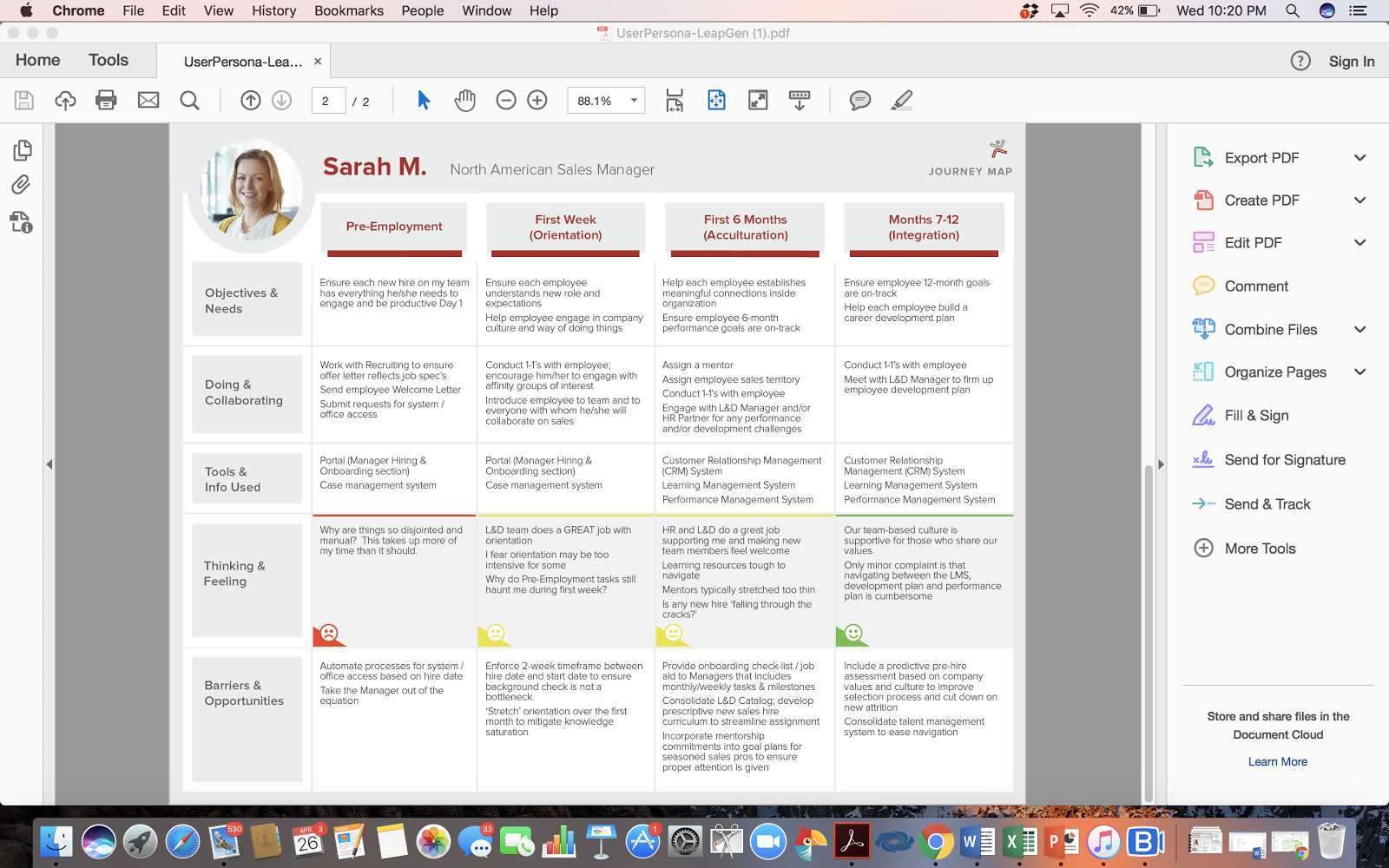
Whenever possible, conduct interviews one-on-one or in small groups. It's the most reliable way to gain empathy and secure the most trustworthy answers. If face-to-face interviews aren't possible, surveys and focus groups work, too. Below is an example of a Journey Map that can be used to discuss the current state and set the stage for designing new ways of doing things.
Step 5: Distill the personas and verify accuracy.
Identify common patterns of behavior or specific attitudes and frustrations around the current state of different employee journeys. You'll also gain insight into what the workforce really prefers. These insights can vary widely across people who hold similar roles. Therefore, it's important to realize that a role is not necessarily a persona.
Let's take another look at the sales department example from Step 2. You may have very seasoned sales reps who are change-resistant and slow to adopt anything new for fear of jinxing their proven processes. You may also have newer reps who are eager to adopt new systems and have not yet created deeper patterns of behavior (or superstitions). Common patterns of behaviors and attitudes among the different salespeople should be grouped and represented by a unique persona—for example, "Sarah the Sales Manager" or "Jeremy the Junior Sales Associate."
Whether it's because we fear the judgment or we simply forget, it's so easy to get through a process like this and skip one of the most critical steps—verifying accuracy with employees who took the time to share their input. This step cannot be undervalued. If personas are not accurate, they will do more harm than good by giving you a false sense of confidence. Take the step and ask the people on whom you based each persona to rate the accuracy.
Step 6: Use the personas to design your solution.
Having a clear picture of who is doing the work helps you audit the experience to account for the different behaviors, attitudes and preferences inherent with each employee journey. Through your research, you'll be able to design processes and roll out solutions that modernize how work gets done and make for a better workforce experience in terms of efficiency, effectiveness and transparency.
"We want to provide a consumer-grade experience for all our employees," said Pam Velcheck, manager of HR shared services at General Mills in Minneapolis. "We want their experience to be as seamless and easy as shopping on Amazon. They should be able to quickly and easily interact with HR to get the services they need, regardless of who or where they are. Our goal is to provide a consistent employee service experience whether they are a remote production employee or an executive at headquarters."
As HR professionals, we must accept that we are naturally limited by our own points of view. However, with practical tools like personas we can tap into the mindsets of the colleagues we support and make decisions that not only serve the workforce but also have the potential to drive real change.
Mike Brennan is the co-founder and chief service officer at LeapGen and has nearly 20 years of enterprise consulting experience in both HCM and CRM. Most recently, Brennan spent over a decade at Appirio in various consulting and leadership roles, including launching the Cornerstone OnDemand (CSOD) Practice, which under his stewardship became CSOD's largest services partner.
Was this article useful? SHRM offers thousands of tools, templates and other exclusive member benefits, including compliance updates, sample policies, HR expert advice, education discounts, a growing online member community and much more. Join/Renew Now and let SHRM help you work smarter.
Was this resource helpful?

Validate your HR expertise
Earning your SHRM-CP credential makes you a recognized expert and leader in the HR field.
Related Content

Transform HR with mobile technology to streamline workflows, enhance communication, and boost employee engagement across distributed teams.

A new study found that talent development practitioners believe performance-based assessments are more effective at measuring employee learning outcomes than knowledge tests.

As AI makes deeper inroads into organizations, employee concerns about the technology continue to grow. Here's how HR leaders can address the fear of AI among their own staff, as well as in the wider organization.