  • Personal
  • Business
  • Foundation
    Close
  • Select Region
    • Global
    • India
    • MENA
  • mySHRM Login
  • MySHRM
    • Dashboard
    • Account
    • Logout
SHRM
  • Membership
    • Membership

      As a SHRM Member®, you’ll pave the path of your success with invaluable resources, world-class educational opportunities and premier events.

      Membership Benefits
      Secure your membership
  • Learning
    • SHRM Certification

      Demonstrate your ability to apply HR principles to real-life situations.

      • Register for the SHRM US Batch
      • Self-Study for your SHRM CP/SCP Certification
      • Book your SHRM CP/SCP Exam
      Prepare for the Exam
      • Exam Preparation
      • SHRM BASK
      • SHRM Learning System
      • Instructor-Led Learning
      • Self-Study
      Specialty Credentials

      Demonstrate targeted competence and enhance your HR credibility.

      ACHRM
      CEHRM
      AI in HR
      ACE.W
      PMQ
  • Events
    • MENA Events

      Demonstrate your ability to apply HR principles to real-life situations.

      • MENA Annual Conference
      • CEO Academy
      • SHRM Leadership Circle
      Global Events
      • US Annual Conference
  • Resources
    • Resources

      Stay up to date with news and leverage our vast library of resources.

      • Flagships
      • HR Research
      • Tools & Guides
      • Webinars
      HR Topics
      • AI in the Workplace
      • Civility at Work
      • Inclusion & Diversity
      • Talent Acquisition
      • HR Technology
      • Workplace Violence Prevention
  • Partners
Become a Member
Renew
Rejoin Now
Renew
Close
  • Personal
  • Business
  • Foundation
  • Membership
    back
    Membership
    • Membership

      As a SHRM Member®, you’ll pave the path of your success with invaluable resources, world-class educational opportunities and premier events.

      Membership Benefits
      Secure your membership
  • Learning
    back
    Learning
    • SHRM Certification

      Demonstrate your ability to apply HR principles to real-life situations.

      • Register for the SHRM US Batch
      • Self-Study for your SHRM CP/SCP Certification
      • Book your SHRM CP/SCP Exam
      Prepare for the Exam
      • Exam Preparation
      • SHRM BASK
      • SHRM Learning System
      • Instructor-Led Learning
      • Self-Study
      Specialty Credentials

      Demonstrate targeted competence and enhance your HR credibility.

      ACHRM
      CEHRM
      AI in HR
      ACE.W
      PMQ
  • Events
    back
    Events
    • MENA Events

      Demonstrate your ability to apply HR principles to real-life situations.

      • MENA Annual Conference
      • CEO Academy
      • SHRM Leadership Circle
      Global Events
      • US Annual Conference
  • Resources
    back
    Resources
    • Resources

      Stay up to date with news and leverage our vast library of resources.

      • Flagships
      • HR Research
      • Tools & Guides
      • Webinars
      HR Topics
      • AI in the Workplace
      • Civility at Work
      • Inclusion & Diversity
      • Talent Acquisition
      • HR Technology
      • Workplace Violence Prevention
  • Partners
Become a Member
Renew
Rejoin Now
Renew
  • Select Region
    • Global
    • India
    • MENA
SHRM
mySHRM Login
  • MySHRM
    • Dashboard
    • Account
    • Logout
Close

  1. Topics & Tools
  2. Workplace News & Trends
  3. 'Niceness' Can Hurt an Organization
Share
  • Linked In
  • Facebook
  • Twitter
  • Email

Lorem ipsum dolor sit amet, consectetur adipiscing elit. Vivamus convallis sem tellus, vitae egestas felis vestibule ut.


Error message details.

Copy button
Reuse Permissions

Request permission to republish or redistribute SHRM content and materials.


Learn More
News

'Niceness' Can Hurt an Organization

July 17, 2019

A group of people sitting around a table in an office.


​A "culture of nice" sounds, ummm … kinda nice. But a work environment where never is heard a discouraging word can hurt an organization when employees are afraid they will be seen as combative or rocking the boat if they voice an opposing opinion or concern.

Having great relationships at work is critical and wanting colleagues to like you is important, said Stacey Engle, president of Fierce Conversations, a training company that teaches people how to have effective workplace conversations. "There is a disconnect, however, in what 'nice' entails. Our data suggests that [employees think] being nice means never raising issues or concerns, and never providing negative feedback in any case."

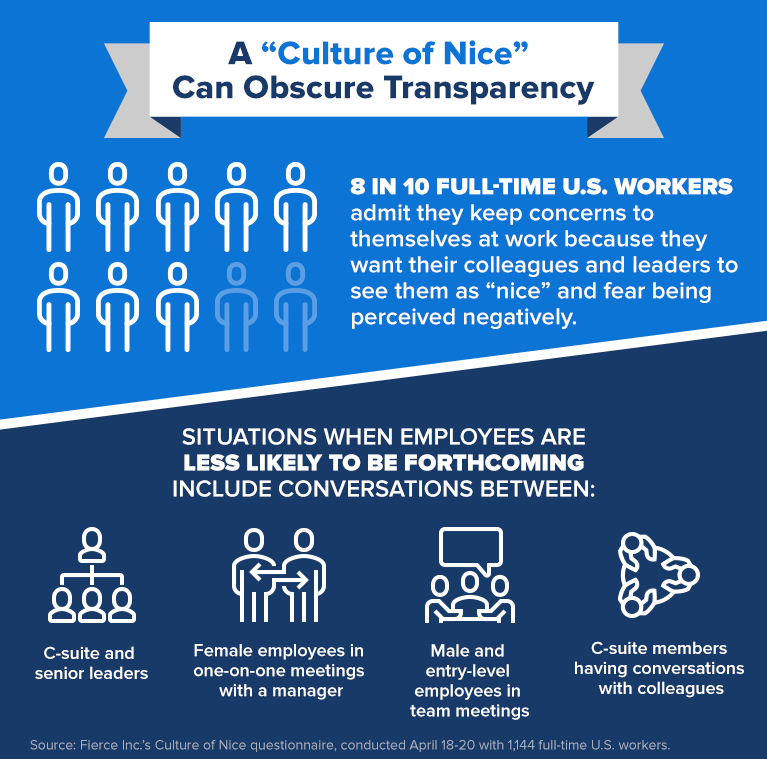
When employees keep their concerns to themselves, it often is because they are afraid peers and leadership will view them in a negative light, according to the results of the Seattle-based company's online survey in April of 1,144 full-time U.S. workers.

Among its findings:

  • 80 percent of employees said it's important that co-workers consider them nice because it makes it easier to get things done, they'll get more interesting work or opportunities if people like working with them, and work is more enjoyable when they get along with colleagues.
  • 63 percent have chosen not to share a concern or negative feedback at work.
  • Women are less likely to speak up in one-on-one meetings with managers, while men and entry-level employees are more likely to avoid sharing their opinions in team meetings. 
  • Senior leaders and members of the C-suite are least likely to speak up in conversations with company leaders.


Engle thinks it's important to define what it means to be nice.

"Are you being 'nice' when you don't raise issues that you have with another person … or is [it] the 'nice' thing to do [to] address that person directly—respectfully and from a place of good intentions—so that issues get resolved? We believe the latter is the right approach."
Nice graphic.png

Many of the companies that Fierce works with, Enge said, have admitted that they suffer from people being afraid to speak openly or confront behavior.

"Being nice to colleagues and others is a good thing. However, when prioritized above all else, this trait can get in the way of an organization's success," Engle noted, and can result in wasted time and revenue, such as when workers don't voice concerns about a leader's proposed project.

"If your employees were less concerned with rocking the boat, some of these concerns would have been addressed and discussed early in the process," she said. "Sure, the idea may have still been implemented, but chances are it would have been looked at differently and may have turned out to be successful with the right tweaks."

In The Power of Nice: How to Conquer the Business World with Kindness (Doubleday, 2006), Linda Kaplan Thaler and Robin Koval write that being nice does not mean everyone has to agree.

"At the end of the discussion … you just need to feel that each of you has been heard," they write, quoting a Harvard negotiation teacher. "When you listen and ask questions, you give the other person some control and show that you respect their point of view."

Creating an Environment of Trust 

Despite the credo that honesty is the best policy, "many of us believe that we'll go further in life if we can package the truth at times or even keep it under wraps" because we don't want to hurt someone's feelings or are worried about repercussions, Thaler and Koval note in their book.

However, it's important for supervisors to "create an environment where your employees are comfortable telling you that they think your brilliant creative idea is a dud or that the slightly racy joke you've been telling might offend a buttoned-down client or a fellow employee."

[SHRM members-only toolkit: Managing Organizational Communication]

In fact, how supervisors react to employee suggestions can impact whether an employee will open up in the future, according to Danielle King.

She is assistant professor of psychology at Rice University in Houston and lead author of "Voice Resilience: Fostering Future Voice After Non-Endorsement of Suggestions" in the May 2019 issue of the Journal of Occupational and Organizational Psychology.

The paper is based on findings from two university-led studies and explains how leaders can use language that encourages workers to offer more ideas in the future, even if their suggestions are not implemented.

"Our results highlight the practical importance of providing sensitive explanations for why employee suggestions cannot be embraced. Specifically, it is critically important for leaders to exhibit sensitivity in their communication with employees," she said in a news release.

"It would be useful for organizations to offer training and development for leaders on how to let employees down gently while encouraging them to speak up in the future," King said.

Explaining why an employee's idea was not acted upon can encourage workers to speak up and help them understand there may be extenuating circumstances that prevent implementing potentially good ideas.

"If such explanations are delivered in a sensitive manner, this should maintain the type of leader-employee relationship that encourages employees to speak up in the future," King said.

Labor & Employee Relations

Was this resource helpful?

Leave Feedback

SHRM-CP Promo Image
Validate your HR expertise

Earning your SHRM-CP credential makes you a recognized expert and leader in the HR field.

Get Certified


Related Content

(opens in a new tab)
News
How One Company Uses Digital Tools to Boost Employee Well-Being

Learn how Marsh McLennan successfully boosts staff well-being with digital tools, improving productivity and work satisfaction for more than 20,000 employees.

(opens in a new tab)
News
A 4-Day Workweek? AI-Fueled Efficiencies Could Make It Happen

The proliferation of artificial intelligence in the workplace, and the ensuing expected increase in productivity and efficiency, could help usher in the four-day workweek, some experts predict.

(opens in a new tab)
News
Rising Demand for Workforce AI Skills Leads to Calls for Upskilling

As artificial intelligence technology continues to develop, the demand for workers with the ability to work alongside and manage AI systems will increase. This means that workers who are not able to adapt and learn these new skills will be left behind in the job market.

HR Daily Newsletter

Stay up to date with the latest HR news, trends, and expert advice each business day.

Success title

Success caption

Manage Subscriptions
Our Brands

SHRM Foundation Logo
SHRM Executive Network Logo
CEO Circle Logo
SHRM Business Logo
SHRM Linkage Logo
SHRM Labs
Overview


  • About SHRM
  • Careers at SHRM
  • Press Room
  • Contact SHRM MENA
  • Ask an Advisor
  • SHRM Newsletter
  • Copyright & Permission
Contact Us


Email: SHRM.MEA@shrm.org
Landline: +971 43649464

SHRM KSA Office (Riyadh)
+966507266968

SHRM UAE Office (Dubai)
+971581101786


© 2026 SHRM. All Rights Reserved
SHRM provides content as a service to its readers and members. It does not offer legal advice, and cannot guarantee the accuracy or suitability of its content for a particular purpose. Disclaimer

Follow Us

  • LinkedIn
  • Facebook
  • Twitter
  • Instagram
  • YouTube

  1. Your Privacy Choices

  2. Terms of Use

  3. Accessibility

Join SHRM for Exclusive Access to Professional Content

SHRM Members enjoy unlimited access to articles and exclusive member resources.

Already a member? Login
Free Article

Login to unlock unlimited access or join SHRM today to get unlimited access to articles and member-exclusive resources.

Already a member? Login
Limit Reached

You've reached the limit of 1 free article this month. Join to access unlimited articles and member-only resources.

Already a member? Login
Free Article

Login to unlock unlimited access or join SHRM today to get unlimited access to articles and member-exclusive resources.

Already a member? Login
Exclusive Executive-Level Content

You've reached the limit of 1 free article this month. Join the Executive Network and enjoy unlimited content.

Already a member? Login
Unlock Your Career with SHRM Membership

Please enjoy this free resource! Join SHRM for unlimited access to exclusive articles and tools.

Already a member? Login
Join SHRM for Exclusive Access to Professional Premium Content

SHRM Members enjoy unlimited access to articles and exclusive member resources.

Already a member? Login
Join SHRM for Exclusive Access to Student Content

SHRM Members enjoy unlimited access to articles and exclusive member resources.

Already a member? Login
Join SHRM for Exclusive Access to Executive Network Content

SHRM member enjoys unlimited access to articles and exclusive member resources.

Already a member? Login

Your membership is almost expired! Renew today for unlimited access to member content.

Renew now

Your membership has expired. Renew today for unlimited access to member content.

Renew Now

Your Executive Network membership is nearing its expiration. Renew now to maintain access.

Renew Now

Your membership has expired. Renew your Executive Network benefits today.

Renew Now
