Viewpoint: How to Formalize Mentoring
If done the right way, mentoring programs can have long-lasting, positive effects on participants.
Introduction
From the Association for Talent Development (ATD).
"I don't think formal mentoring programs work."
The first time I heard that sentiment was from Tanya Axenson, vice president of human resources for Allegis Group, as we were sitting in her office getting ready to match her up with a high-potential mentee. Axenson, like many of the executives I've worked with, believes in the power and impact of mentoring, just not through "forced" matches like those in a formal program.
After almost two decades in talent development, I have yet to meet an executive who believes mentoring is a waste of time. Overall, senior leaders are in favor of mentoring and often will cite their own mentors who have helped them drive toward success. Throughout my conversations, it became clear that many executives are happy to talk about mentoring relationships, but are less inclined to discuss mentoring programs.
In fact, I began to reach out purposely to connect with senior leaders to talk about mentoring programs. Interestingly, even though I might ask about programs, the answers often would come back about the relationships. Through those interviews, the most common themes were:
- Mentoring relationships are important.
- Mentoring programs often are ineffective.
- The impact of mentoring relationships is easy to identify, but the success of mentoring programs is more challenging to measure.
Mentoring Relationships Are Important
Although not everyone agrees on the definition of mentoring versus coaching, or what to call people in mentoring relationships (mentees? learners? proteges?), there is one point with total agreement: Mentoring relationships have significant impact and can change the trajectory of a career.
At an organizational level, the strategic results of mentoring have been well-proved. For example, in Modern Mentoring, Randy Emelo highlights the ability of mentoring to create an innovative, "nimble workforce that can adapt to rapid change, new demands, and unforeseen challenges."
Individually, the results are just as powerful. Anecdotally, mentees participating in mentoring programs designed by TERP Associates report impressive accomplishments. "Because of one mentor, I learned that I was really good, but that I could get even better," says Bobby Herrera, president of Populus Group. "We all want to be the 2.0 version of ourselves." Herrera notes the importance of a mentor in developing talent to the next level.
Axenson has taken on the role of mentor for many individuals in her organization. She is an accomplished lawyer with impressive credentials, and in her current role as an HR executive, she has been responsible for revitalizing that function for her large organization to be more effective, strategic, and cohesive. Axenson is a prime candidate to mentor others. But how many mentees can one mentor support? That is one of the many reasons formal mentoring programs are so important to creating capability and capacity in our organizations—if done the right way.
The most effective mentors know how to challenge, encourage, question, and promote. Mentors connect with their mentees and facilitate the mentees' own learning processes. Keenan Lotz, vice president of training for Bojangles, says the relationship is key to success.
"Mentoring success is based on a relationship you can impact," Lotz explains. "A lot of people think mentoring programs are task-based. That's only partially true. The largest part is the relationship. The first thing that is critical is building the relationship between the individuals. Strong relationships create engagement."
The impact of a deep, trusting mentoring relationship affects individuals for their entire careers, and generates ongoing strategic results for organizations. "My mentor told me what I needed to hear when I needed to hear it. He helped me create intentionality in my own development and focus on strengths-based development of my talent," Herrera notes.
Balancing Structure and Simplicity
There seems to be two prevailing views from the C-suite on mentoring programs: Either they are completely ineffective or mentoring programs are cheap, easy, and fast alternatives to training. Neither is accurate.
Like Axenson, many executives view mentoring programs as overly rigid, creating awkward "first date" scenarios between forced matches. Herrera even says, "In my experience, mentoring programs are often over-complicated and focus on individual weaknesses instead of the strengths they bring to the team."
The executives I interviewed for this article consistently shared their preference for organic matches over assigned relationships. Of course, in an ideal world, each employee would seek out and find her perfect mentor without the help of an administrator or leadership. However, in reality, employees often need help expanding their networks to get the same access to the best mentors.
That is another reason formal mentoring programs can be valuable and effective. Well-designed mentoring programs eliminate the closed networks and give each participant the same options as everyone else.
Several executives had strong negative feelings about formal mentoring programs. The phrase conjures images of overly complex and rigid programs that force people who don't like each other to share too much personal information just to check a box in a learning management system. The idea of formal programs is not the same thing as highly structured programs. Lotz says that mentoring programs "sound like they have guard rails up," reducing creativity and minimizing the human element of mentorship. But that should not be the case.
Effective mentoring programs should have the right balance of structure and simplicity demanded by the culture of the organization they are built for. Some successful programs we have built have been very simple, with minimal guidelines for participants.
The other misconception that some executives shared is the view that effective mentoring programs can be implemented more quickly and less costly than traditional training. For me, this relates back to the adage, "You can have it good, fast, or cheap ... pick two." Mentoring programs that are launched haphazardly are destined to fail, or even fizzle out, before they ever have a chance to create results.
In many organizations, mentoring programs are minor events thrown together by practitioners with little or no prior experience. Most of the effort is placed on the program launch, with little effort placed on supporting the overall participant experience.
In my experience, people have as many stories about failed mentoring programs as they do successful ones. Effective programs are supported programs. They have enough infrastructure in place to create the best experience for participants, and a budget is allotted for the program, which includes support for staff or a dedicated administrator. Participants can get what they need from resources and training. Relationships are matched on data. Mentors and mentees are brought together in a purposeful way to create a positive experience. And most importantly, executives and senior leaders are kept informed of decisions along the way to ensure buy-in.
Finding Success
Taken all together, the concerns expressed by these executives signifies the need for a better way forward. Mentoring programs need to be seen as part of the culture rather than an overly complex and rigid add-on. Programs need to remove barriers to networking and enable deep and trusting mentor matches. Formal mentoring programs also need to be measurable, so talent development practitioners can share the story of the program's success.
How do we achieve all these goals? Current industry methodologies are focused on event-based learning (training and e-learning). To move forward and create a supportive, sustainable learning experience, we need to use a new flexible framework.
Enter the AXLES framework for developing mentoring programs. It is a methodology created entirely to address the unique needs and constraints of mentoring programs. The framework consists of five components:
Align to a purpose.
Design the experience.
Launch the program.
Evaluate for effectiveness.
Support all participants.
Each of the components has a role to play in delivering strategic results and authentic relationships without the drawbacks executives see in mentoring programs.
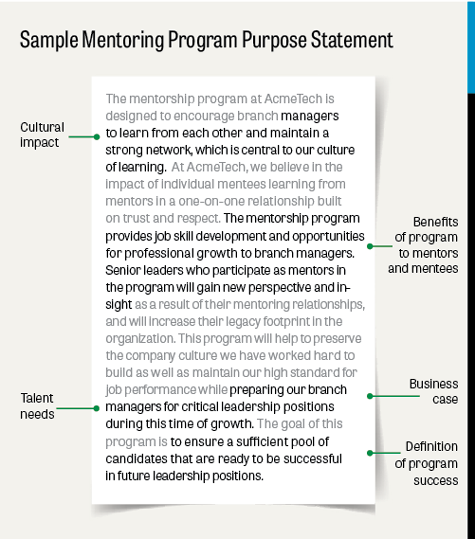
The align to a purpose component sets up your mentoring program for sustainable and scalable impact by reviewing organizational culture and how it affects the design of the program. In other words, does your organization require more or fewer guidelines, more or less help creating matches, etc.? The main deliverable for the align component—a mentoring program purpose statement—helps to create more transparency with senior leaders by defining the solution in clear terms. Mentoring program purpose statements define mentoring for the organization, describe mentoring relationships, and identify factors of success (see figure below).
Other components, such as experience and support, are focused on the nature of the relationship. Concerns listed by Axenson, Herrera, Lotz, and other executives are addressed by ensuring the matching process is warm and genuine, and providing skills development and resources to mentors to enable true momentum within mentoring relationships.
However, the biggest gap between failed and successful mentoring programs that most executives have experienced is the measurement of success. Typical mentoring programs are not evaluated correctly, if at all. Executives have no or incorrect data to use to determine the success of mentoring programs.
The evaluate effectiveness component of the AXLES framework creates a process by which mentoring programs are measured. Based on the New World Kirkpatrick Model, this component uses a backward-planning process to determine the formats and frequency to measure.
As talent development practitioners, we are called upon to show our work. To alter the perception of formal mentoring programs as being ineffectual, we have to create the story that demonstrates success.
Mentoring relationships can be truly powerful at both the individual and organizational levels. When designed using the AXLES framework, formal mentoring programs have the opportunity to create sustainable and scalable results for the organization. The framework is the first step in turning the story around for our executives so they also can see not just the power of mentoring relationships, but of mentoring programs too.
Measuring the Value of Mentoring Programs
Mary Lou Voytko, emeritus professor at Wake Forest School of Medicine (WFSM), has been working closely with mentoring programs for decades, as both a program administrator and mentor. With all of that experience, you would think that if anyone could prove the success of a program, it would be her. If you have a conversation with Voytko, she can sell you on program success in no time flat. However, showing it on paper is another thing entirely.
A perfect example is the WFSM Mentoring Program for Women Junior Faculty, which Voytko began in 2000. Despite having multiple years' worth of data, it has been a challenge to provide specific statistics about the success of the program. Initially, it was thought that information gleaned from the annual satisfaction surveys would provide evidence that participants were promoted more quickly than their counterparts who did not participate. Unfortunately, without an appropriately matched control group it was not possible to do that analysis.
Another challenge of analyzing the data was due to the fact that the satisfaction survey changed almost every year, with questions being added and deleted to continually refine the instrument. In 2010, however, the surveys were completely reworked so that questions on the mentor and mentee surveys paralleled one another.
With such data challenges, it was necessary to demonstrate the program's success by examining overall participant satisfaction and other less concrete factors. This satisfaction has manifested itself in the fact that both mentees and mentors highly recommend program participation and that mentees have expressed gratitude regarding their mentors' advice in topics such as career growth and promotion, accepting new administrative duties, locating institutional resources, and networking. There also have been a variety of collaborative outcomes among the mentoring pairs, such as grants, manuscripts, and presentations.
Successes also have shown up in a variety of ways outside of the survey results: The mentoring program has existed for 17 years, has enjoyed a steady growth over the years (currently up to 217 total participants), and there is anecdotal evidence that it is being successfully used as a recruitment and retention tool.
While program administrators ideally would like to demonstrate the efficacy and success of their mentoring program through quantitative statistics, sometimes that approach is not feasible for a variety of factors, including that the purpose of mentoring programs can be multidimensional (for example, promotion, cultural integration, and decreased isolation). Examining other aspects and outcomes of mentoring programs (for example, program satisfaction and recommendation, networking, and career advice) can be just as valuable for understanding the impact of the program. In either case, it is the faculty participating in the mentoring program who are the true winners.
Jenn Labin is the owner of TERP Associates in Baltimore, a team that seeks to grow talent and ignite potential. Jenn is the author of Real World Training Design (ATD Press), a visual quick guide for creating exceptional results within tight budgets and timelines; and Mentoring Programs That Work (ATD Press). Jenn co-authored a chapter in the ASTD Handbook, 2nd edition. Jenn's work also can be found in 101 Ways to Make Training Active and How to Write Terrific Training Materials. Jenn has a BA from the University of Maryland Baltimore County in digital art, and an MA in instructional systems design.
This article is reprinted from https://www.td.org with permission from ATD. C 2017 ATD. All rights reserved.
Related Articles

Transform HR with mobile technology to streamline workflows, enhance communication, and boost employee engagement across distributed teams.

A new study found that talent development practitioners believe performance-based assessments are more effective at measuring employee learning outcomes than knowledge tests.

As AI makes deeper inroads into organizations, employee concerns about the technology continue to grow. Here's how HR leaders can address the fear of AI among their own staff, as well as in the wider organization.