From Going Digital to Being an AI-Pioneer

Picture an HR Director - Noor, who works at a mid-sized retail organization in MENA. At the last leadership meeting, the CEO asks her a question she has been expecting for months: “Finance uses AI to forecast future budgetary considerations, Marketing uses it to analyse customer insights. How is HR using it?”
Most HR leaders face the same question. SHRM’s State of AI in HR 2026 research shows that 62% of organisations use AI in some parts of their business, but only 39% of HR departments do. While the rest of the business has moved on quickly, HR has been a bit slow to catch up.
Noor’s first thought while answering the question posed to her, was to buy a tool. Instead, her curiosity got her to look at her own team. She finds recruiters already using free AI tools to write job descriptions, employee data stored in four different systems, and a few people who are confident in using AI. Now she knows where she stands.
Next, she reaches out to her team, and they list all their ideas, from a chatbot for policy questions, to AI that screens job applicants. Noor sorts them using SHRM’s AI Field Manual, which ranks 138 HR uses of AI by risk and cost. Writing job descriptions and answering routine questions are low risk and easy to start. Screening applicants carries more risk, because fairness and the law are at stake. She chose two easy wins to begin with.
The trials follow one simple rule: a person always checks the AI’s work. Recruiters review every job description before it goes live. The policy chatbot only uses approved documents and has clear rules on employee data referencing or usage. Applicant screening is tested separately from real hiring decisions.
Three months later, Noor goes back to the leadership with real results, not just ideas. Her team has measured time saved, work quality, and the cost of each use case so that everyone can see where AI is really helping.
Those results open the door to the next stage. With routine writing being done faster, recruiters have more time to advise hiring managers. AI is no longer just doing tasks; it is helping people make better decisions. Next, Noor plans for AI agents to handle onboarding steps from start to finish, with her team stepping in when something needs a human eye.
By the end of the year, the question has changed. The CEO now asks Noor to lead AI adoption across the organisation.
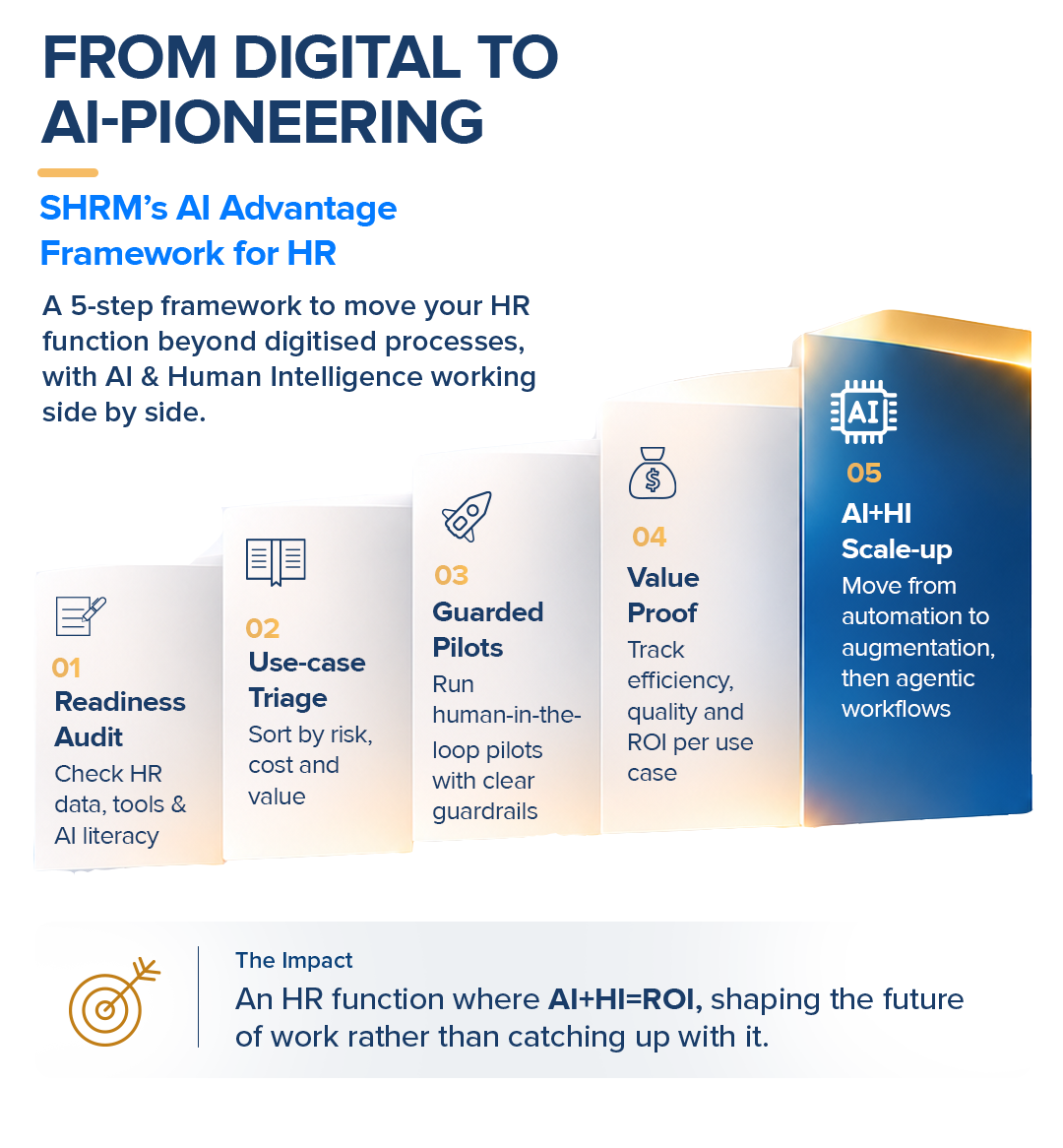
Noor’s journey follows SHRM’s AI Advantage Framework for HR: Readiness Audit, Use-case Triage, Guarded Pilots, Value Proof and AI+HI Scale-up. Many HR Leads will now follow the same path. SHRM’s 2026 CHRO Priorities and Perspectives research shows that 87% of CHRO’s expect more AI in HR processes this year. The question now is not how much HR will use AI, but how well.
For HR professionals ready to begin or trying to navigate how best to adopt AI, SHRM’s AI Advantage Framework and our AI in HR Professional Certificate Program offer a clear starting point. The certificate program, builds skills, shows how to match AI to real business needs, and helps turn plans into measurable results. These are the skills that move HR from being digital adopters to AI-pioneers.
Was this resource helpful?

Validate your HR expertise
Earning your SHRM-CP credential makes you a recognized expert and leader in the HR field.
Related Content

Transform HR with mobile technology to streamline workflows, enhance communication, and boost employee engagement across distributed teams.

A new study found that talent development practitioners believe performance-based assessments are more effective at measuring employee learning outcomes than knowledge tests.

As AI makes deeper inroads into organizations, employee concerns about the technology continue to grow. Here's how HR leaders can address the fear of AI among their own staff, as well as in the wider organization.