Talent Planning Isn’t just for Your Top 10%

We are well into the third quarter of 2026, and the key focus areas for organisations have been very clear – skilling for better talent assimilation & retention, adoption of AI through structured ways and improving workplace experience at the ground level.
Any company who has struggled to meet even one of the above priorities, knows how central Talent Planning is to getting it right. But what is talent planning, really? How is it different from strategic workforce planning? And what does it have to do with workplace experience or AI adoption?
Strategic Workforce Planning is more of a strategic business or leadership initiative - long term capability mapping, resourcing, policies, role structuring and reading the internal & external variables that will shape your workforce. Whereas Talent Planning is more specific & people centric, focusing on the available talent pool and how you develop their potential, retain them and support them through targeted interventions in the short term.
So how does talent planning then become the center for long term growth or larger initiatives? Talent Planning is the operational anchor for the implementation plan organisations put in place to drive the larger strategic agendas. Take AI adoption, it requires a few basic things: employees who have, or can quickly learn, the specific skills to drive adoption; creative thinkers who can design and merge existing processes with AI; and early champions who prove the value through visible impact in their own work and career progress. Talent planning is how you find, develop, and position those people deliberately rather than hoping they emerge.
The same logic explains the link to workplace experience. Targeted high-potential development, succession planning, internal mobility, and thoughtful restructuring - when done through careful planning - create a genuinely positive experience for the employees involved, and that shows up directly in engagement and satisfaction survey results.
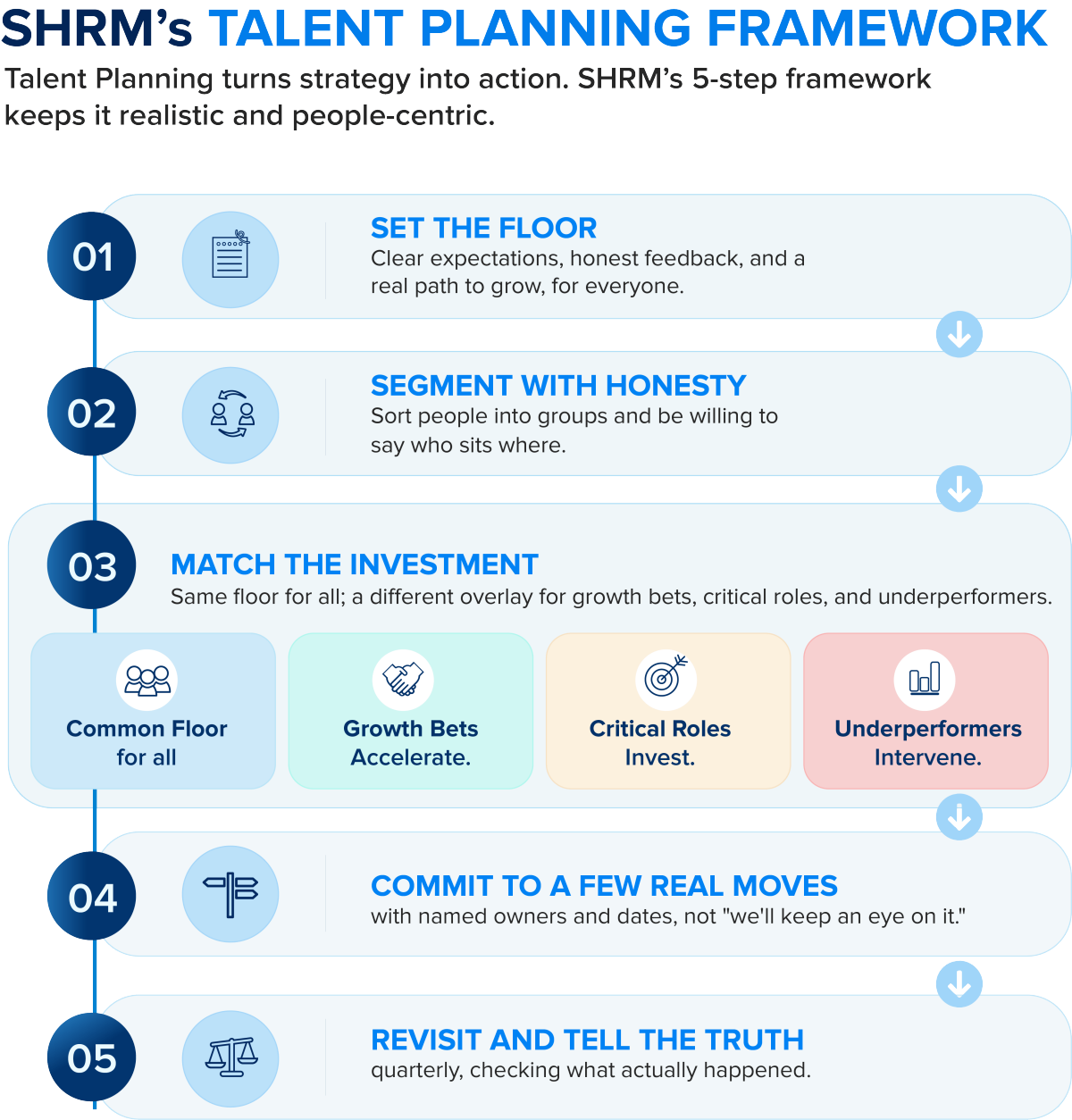
The main question is: how do we approach talent planning for an entire workforce, and not just a few. The answer is to create a floor for everyone, plus deliberate extra investment for a targeted group. Here is SHRM’s 5 step Talent Planning Framework through which this can be achieved:
- Set the floor everyone gets. Clear expectations, honest feedback, a manager who has real development conversations, and a visible path to grow. This is a baseline, not a perk. If it isn't consistently real, nothing you build on top of it counts.
- Segment your people with honesty. Sort the workforce into a few plain groups - solid, valued performers (most people), growth bets, critical-role holders, and underperformers. The discipline is admitting that most people sit in the "valued, but not on an accelerated track" group, and being willing to say so.
- Match the investment to the segment. Solid performers get the floor plus retention and respect. Growth bets get stretch assignments and sponsorship. Critical-role holders get succession and knowledge protection. Underperformers get an honest, time-bound conversation and support to challenge themselves. The same floor for everyone; a different overlay for each.
- Commit to a few real moves, with owners and dates. You can only meaningfully accelerate a handful of people, and fix a handful of gaps, in a year. Choose them, name who is responsible, and put a date on it. "We'll keep an eye on it" is not a move.
- Revisit, and be honest about what happened. Quarterly, not annually. Did the floor hold? Did the growth bets get their shot? Did the tough conversations actually take place? The same gaps year after year, with the same notes attached, mean the process has become theatre.
The crux of it is simple: guarantee a real floor to everyone, deliberately overlay extra investment on a small, honestly-chosen few, and check that both actually happened. The hard part was never the framework; it is the courage to differentiate openly, and to keep the baseline strong while you do.
Was this resource helpful?

Validate your HR expertise
Earning your SHRM-CP credential makes you a recognized expert and leader in the HR field.
Related Content

Transform HR with mobile technology to streamline workflows, enhance communication, and boost employee engagement across distributed teams.

A new study found that talent development practitioners believe performance-based assessments are more effective at measuring employee learning outcomes than knowledge tests.

As AI makes deeper inroads into organizations, employee concerns about the technology continue to grow. Here's how HR leaders can address the fear of AI among their own staff, as well as in the wider organization.