The Talent Attraction-Retention Divide

We tend to assume that whatever attracted an employee to our organization is the same thing that will keep them, and that its absence is what will drive them out. SHRM's Q2 2026 Global Employee Monitor, a quarterly pulse of workers across 26 countries, complicates that tidy story and spills the truth: why people join isn't why they leave. The reasons people join, stay, and leave sit inside a single ecosystem of "push" and "pull" factors; but those factors don't align in the way we expect.
Pay is the constant. It was the strongest driver across all three decisions in Q2, cited by nearly half of workers as a reason they were attracted to an employer (47%), stayed with an employer (47%), or left an employer (46%). But underneath that headline, the drivers diverge. Benefits and job security rank among the strongest reasons people are attracted to and stay with an employer. Yet the leading non-pay reasons people leave are different: career advancement opportunities and work/life balance dominate turnover and turnover intentions.
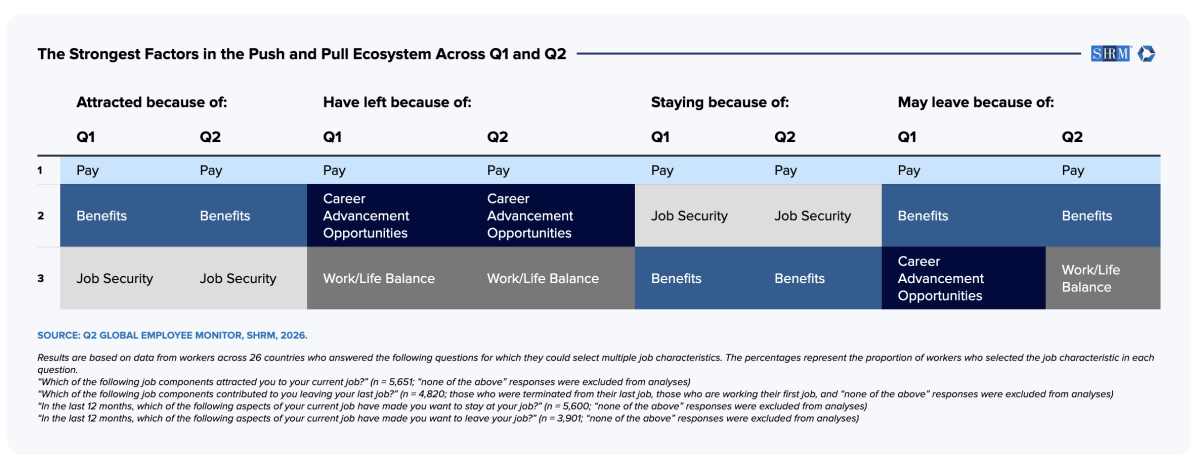
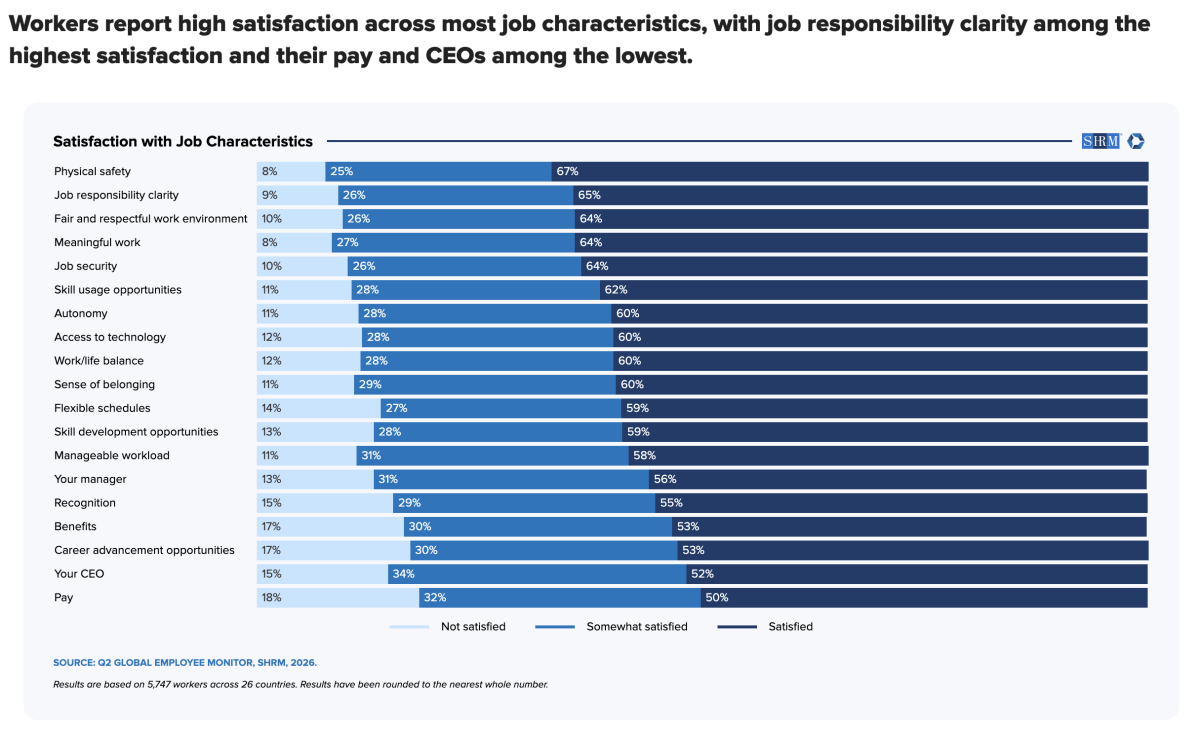
The survey tracks how core elements of the employee value proposition - pay, benefits, growth, work design, and workplace relationships - shape job decisions and outcomes. Its headline finding is stability: the top factors driving attraction, retention, and turnover held steady between Q1 and Q2, suggesting workers' fundamental expectations remain constant despite economic and technological change. Most workers are stay-oriented (61% more inclined to stay than leave), and satisfaction is broadly high. Although satisfaction with pay (50%) and career advancement (53%) ranks among the lowest-rated areas, these remain the strongest drivers influencing why employees leave or consider leaving.
This gap matters. What pulls talent in - a competitive offer, solid benefits, security - is largely transactional. What pushes them out is often driven by career growth and work-life fit, needs that surface only after someone is already inside. SHRM reinforces this elsewhere: the factors predicting engagement (meaningful work, skill use, advancement) differ from those predicting retention (pay, belonging, a fair and respectful environment).
For People and HR Leaders, the implication is clear. Attraction strategies and retention strategies cannot be the same playbook. Treating attraction and turnover as distinct but connected experiences enables organizations to design offers that win talent and development pathways that retain it. The next competitive edge in people strategy lies in designing the entire employee ecosystem, not just the front door.
Read the full research here: SHRM Global Employee Monitor — GEM Data Brief
Was this resource helpful?

Validate your HR expertise
Earning your SHRM-CP credential makes you a recognized expert and leader in the HR field.
Related Content

Transform HR with mobile technology to streamline workflows, enhance communication, and boost employee engagement across distributed teams.

A new study found that talent development practitioners believe performance-based assessments are more effective at measuring employee learning outcomes than knowledge tests.

As AI makes deeper inroads into organizations, employee concerns about the technology continue to grow. Here's how HR leaders can address the fear of AI among their own staff, as well as in the wider organization.