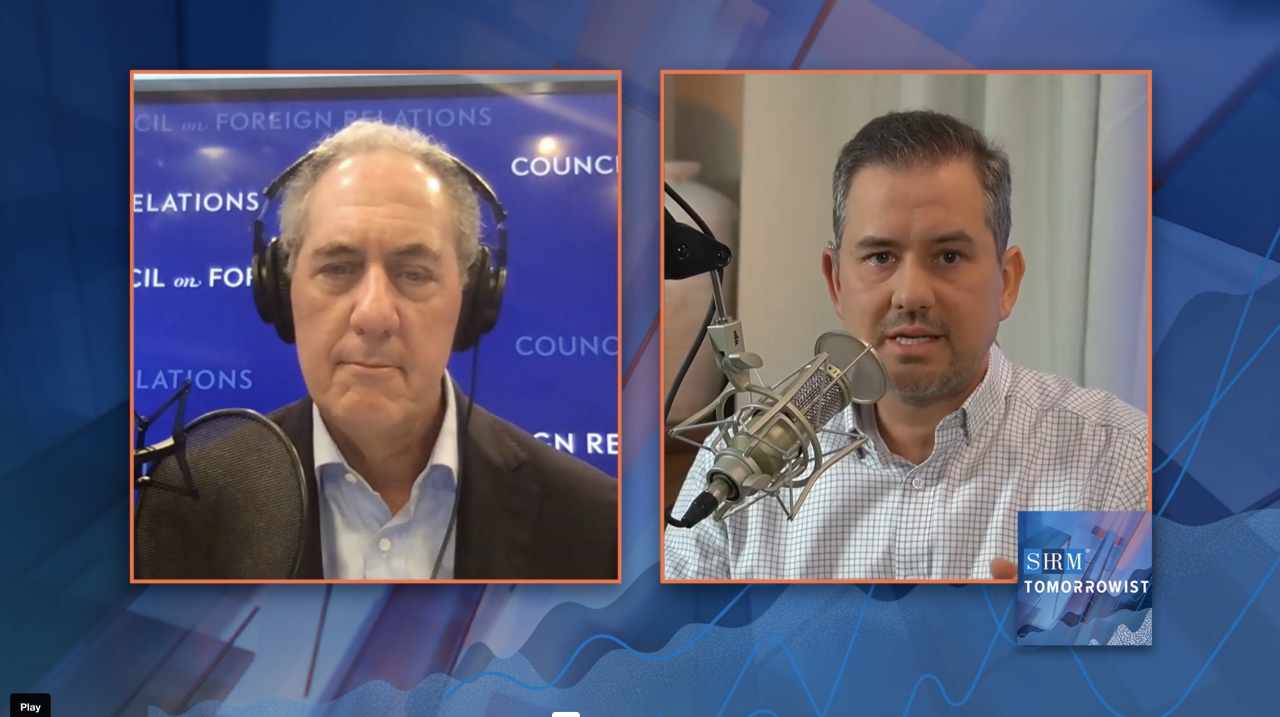
President of the Council on Foreign Relations Michael Froman recently appeared on SHRM's Tomorrowist podcast. A summary of that conversation appears below.
Up until recently, it wasn’t uncommon for many U.S. workers to share projects with remote workers in Russia, China, Israel, Ukraine, and other countries. But with rising geopolitical tensions, is the globalized workplace era ending? Michael Froman is president of the Council on Foreign Relations and offers workplace leaders a perspective that comes from a career split between the corporate world and the highest government office.
Corporate Leaders Need to Be Geopolitically Aware Now
Froman served in President Barack Obama’s Cabinet as the deputy national security advisor for international economics, and recently was vice president and chairman of strategic growth at Mastercard. On Tomorrowist, he highlights the increasing complexity of the global environment, asserting that the intersection of foreign policy and business has never been more pronounced since World War II.
“For employers who may not have thought they needed to think much about politics or geopolitics, they’re quickly coming to the conclusion that foreign policy is going to affect them,” Froman explains. This shift is significant. Today, CEOs, CHROs, and business leaders must now incorporate geopolitical awareness into their strategic planning, particularly regarding supply chains, new office locations, and employee training.
Froman acknowledges that while cross-border connectivity among employees continues, geopolitical tensions are posing a challenge. Sanctions against Russia, regulations around China, and setbacks in Ukraine and Israel have forced companies to reassess the placement of their employees and operations.
Workplaces are now focusing on resilience and redundancy. Will this lead to reshoring or nearshoring operations to mitigate the risks associated with geopolitical instability? What’s next for the global workplace?
“I think it perhaps is entering a new phase. As companies are deciding where to put their next plants or their next office, they’re having to think twice about, ‘Oh, do I put it in China, or may I run afoul of either Chinese policy concerns or U.S. policy?’” says Froman. “Many companies had employees in Russia and either had to shut down because of the sanctions or move some of those employees to other locations.”
The Future of Global Investment
When asked about the future of globalized workforces, Froman indicates that businesses might not be moving away from globalization but rather entering a new phase of strategic planning. He contrasts how U.S. companies are looking at operations in Ukraine versus China.
“In the case of Ukraine, the government of Ukraine desperately wants foreign companies to come in and help them rebuild their economy when this war is over,” says Froman. “Ukraine’s going to have a major rebuilding effort when the war comes to an end, and that creates interesting opportunities for firms.”
Froman notes that while major investments may be premature, now is the time for companies to plan for future involvement in Ukraine’s reconstruction. “I don’t think many businesses are going to say now is the time, as missiles are still flying, to make major investments in physical plants in Ukraine, but I think it is the right time to plan for it,” he says.
China is a different story for now. “I think in the case of China, we’re receiving quite contradictory messages from the government or the party there,” Froman says. “There’s almost no major foreign investment going into China, at least with the United States, and very little from the rest of the world.”
Froman also addresses exciting growth occurring in the United Arab Emirates and Saudi Arabia, noting that these nations are eager to attract foreign investment despite regional tensions. He highlights the normalization of relations with Israel as a positive development that’s enhancing the business climate in these areas. “The tensions with Israel actually have improved relationships in some respects,” he comments, providing a balanced view of the Middle Eastern investment landscape. “And there’s a lot of interest in India given its growth rates and its commitment to attract investment.”
Preparing Leaders for Geopolitical Challenges
Froman believes that the role of CHROs and workplace champions is evolving, emphasizing the need for them to either become well versed in geopolitics or ensure access to experts who can navigate these complexities. “Employees care deeply about what’s going on elsewhere around the world,” Froman cautions. They will look to leadership to help them make sense of conflicts and their impact on not only their job or projects, but also their work relationships. “Figuring out ways of accessing that kind of geopolitical expertise is becoming increasingly critical.”
Workplace leaders are entering an era when geopolitical events significantly impact their operations. This new reality forces companies to be well informed about global issues, which has become increasingly critical for strategic decision-making.
Froman says: “Leaders are being called upon to explain, sometimes take positions, but certainly to understand what’s going on around the world.”
Was this resource helpful?

Validate your HR expertise
Earning your SHRM-CP credential makes you a recognized expert and leader in the HR field.
Related Content

Transform HR with mobile technology to streamline workflows, enhance communication, and boost employee engagement across distributed teams.

A new study found that talent development practitioners believe performance-based assessments are more effective at measuring employee learning outcomes than knowledge tests.

As AI makes deeper inroads into organizations, employee concerns about the technology continue to grow. Here's how HR leaders can address the fear of AI among their own staff, as well as in the wider organization.