The CHRO & CFO: Profit from Partnership
How Finance and HR Can Deliver Business-Changing Results When Working in Sync

Just as a ship needs both crew and engine, organizations rely on the balance of people and financial strength. Without that strong partnership of human capital and financial strategy, organizations falter. And while this CHRO-CFO alliance isn’t new, it’s more critical than ever today as companies are forced to navigate rapid technological shifts, talent shortages, and economic headwinds.
“I’ve had many CEOs tell me that their ‘three-legged stool’ of leadership consists of themselves, their CHRO, and CFO,” said Tom Wilson, partner and technology/digital practice leader at the Buffkin Baker executive search firm. “It’s a good complementary team because you don’t want the organization to over-focus on either the finance or the talent aspects of the business.”
In recent years, CEOs have increasingly turned to the combined insights of their CHRO and CFO to shape organizational strategy, especially during the pandemic and post-pandemic years. These two leaders bring some of the broadest perspectives of the organization into the C-suite. Their partnership grounds bold ideas in financial reality while keeping people at the center. And for CEOs, that balance isn’t just helpful — it’s essential to building organizations that can adapt and endure.
Evolution of an Alliance
Over the past three decades, the C-suite has expanded dramatically. Between 1990 and 2023, the average company’s non-CEO leadership team increased by 160% as several new C-level roles have been added, according to The Evolution of the C-Suite, a SHRM Executive Network research report.
With more titles and functions now at the table, decision-making has become more complex and the voices that touch every part of the entire enterprise carry even greater weight. Among these influential voices, the CHRO and CFO stand out, shaping enterprise strategy in ways that go beyond their traditional roles.
“I’ve seen the evolution of finance — similar to the CHRO — over the last 10 to 15 years as the C-suite looks to finance for broader help beyond simply handling the revenue and expenses of an organization,” noted Louis Gutierrez, a former senior HR executive at Time Warner, Paramount, and the Walt Disney Company.
In the past, CFOs were comfortable — and expected — to stay in their left-brain world of analytics, data, and dollars. CHROs, by contrast, traditionally occupied the right-brain space where empathy, culture, and people strategies reign. But like the hemispheres of a brain, finance and HR aren’t parallel functions. They’re interconnected, with shared goals that directly affect a company’s performance.
Today, those old distinctions have faded. The most effective CFOs combine analytical precision with emotional intelligence, pairing strategic planning with a deep understanding of people. Meanwhile, CHROs have increasingly moved toward the strategic and financial side of the business, blending people insight with business acumen. In fact, a PwC survey found that 60% of CEOs consider their CHRO to be a critical strategic partner in decision-making, second only to the CFO.
Why Collaboration Can’t Wait
In today’s fast-moving environment, organizations that can align talent strategy with financial strategy have a big advantage. In fact, according to a McKinsey & Company study, companies that excel in both people development and financial performance are four times as likely as their peers to outperform their peers financially. McKinsey found that the higher performance is due to the CHRO and CFO bringing unique perspectives that complement each other and fuel greater collaboration.
Another reason for the timely CHRO-CFO connection is that financial-related challenges are a dominant concern for CHROs these days. According to SHRM’s 2025 CHRO Priorities and Perspectives report, CHROs cited the following issues as the top overall organizational challenges they’re facing (with the percentages who reported each topic as a challenge):
Rising operational costs — 45%.
Pressure to achieve financial goals — 38%.
Fostering clear communication — 34%.
Adapting to technology advances — 29%.
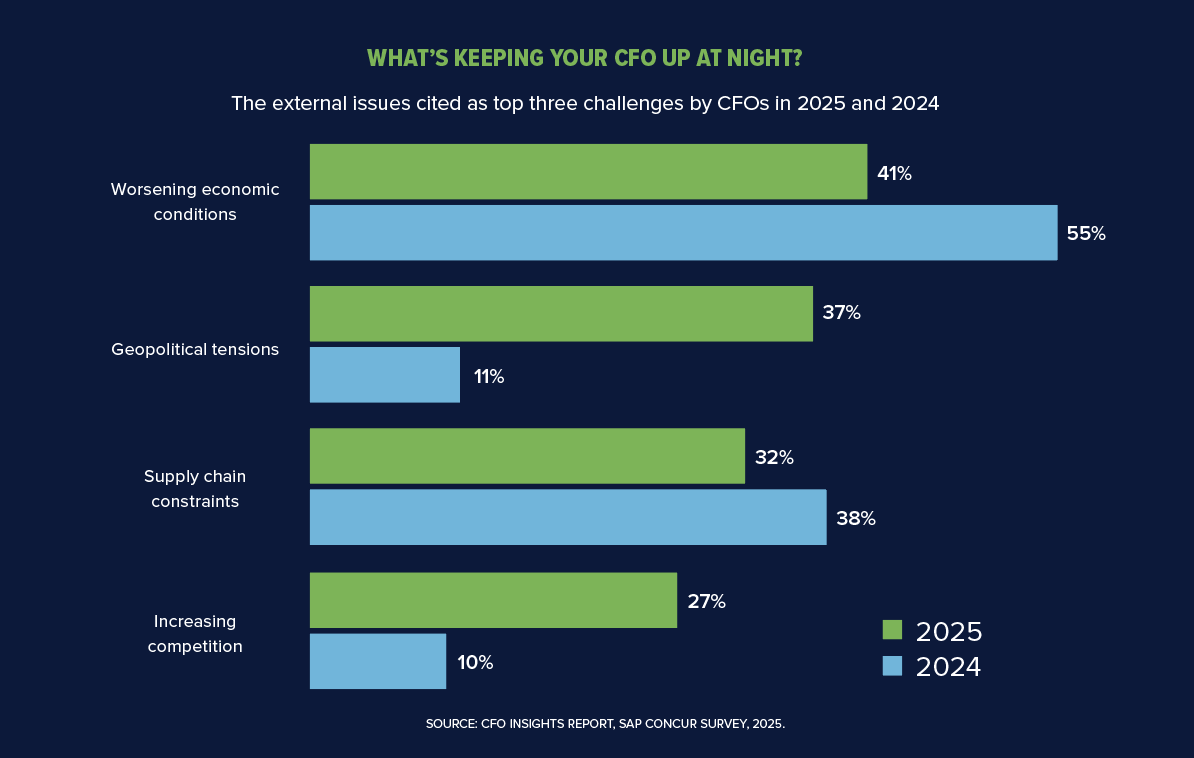
When asked about the top macroeconomic challenges they’re facing, CHROs cited wage inflation, price inflation (the rising costs of goods and services), and economic uncertainty as their top three this year. A separate survey by SAP Concur said the top three external challenges that CFOs are worried about are degrading economic conditions, geopolitical tensions, and supply chain constraints (see chart, page 10).
All of these challenges are intricately linked to key HR practice areas, such as recruiting and total rewards, underscoring the need for CHROs to work closely with their CFO counterparts to deliver value to the organization while reining in expenses.
Building a Strategic Partnership
Achieving CHRO-CFO integration is critical, but it isn’t automatic. It demands a proactive approach of cultivating cross- functional relationships and breaking down silos.
For CHROs in particular, it’s not enough to simply keep an eye on budgets and reports from the finance team. Instead, they should seek to develop a more well-rounded understanding of the business, connecting financial insights with talent strategy and becoming more vocal in big-picture decision-making.
“I’m not saying you need to have the same deep intimate knowledge that the finance leaders have, but CHROs certainly need some ability to look at a set of data and then pull or assume interpretations from that,” said SHRM CHRO Jim Link, SHRM-SCP, during a recent webinar with his CFO counterpart at SHRM, Jane Hadley.
For CFOs, there’s a growing opportunity to go beyond traditional finance responsibilities and actively connect financial strategy with the broader culture and dynamics of the organization.
“How finance is reviewed and understood throughout the whole organization is such an important part of the culture,” said Hadley, who noted that partnering with the CHRO is an opportunity to expand her lens and take a more holistic view of talent management. With that expansion comes a stronger connection between the work of the finance department and the outcomes that reverberate throughout the organization, supporting teams as they move forward.
Strong CHRO-CFO alignment looks like a shared foundation from which both leaders can act. According to Link, that alignment begins for CHROs with “an open awareness and acknowledgment of the finances of anything that happens across the organization, but particularly in human resources.” That includes the current cost for actions taken by HR, whether acquiring new talent, adding a new program, or people leaving the organization.
It’s not only the line-item costs that matter. Hadley said, “It’s important for human capital leaders to really understand not just what things cost, but the impact of that cost down the road. We spend a lot of time in dialogue talking about those things, from the cost of adding a benefit to the savings we expect to get from that benefit.”
For example, she said, the overt cost of a new wellness benefit is a consideration on its own. But that view should be expanded to include the potential savings expected from fewer employees seeking medical care due to improved wellness. Alignment comes from looking at things holistically, and it requires transparency and a shared understanding of each other’s priorities.
To enhance these skills and build toward alignment, CHROs should adopt four key practices.
1. Speak the Same Language as Your CFO
Metrics should be the common language between HR and finance. Some of the top metrics that CFOs care most about include cost-per-hire, time-to-hire, turnover rates, retention of key talent, revenue per employee, absenteeism rates, training costs per employee, and employee engagement scores.
It’s critical that both HR and finance agree on which metrics are most relevant to the business and how to properly calculate them. Identifying and tracking such metrics requires a solid grounding for CHROs in the business and how it makes money. HR needs to come prepared with solid data and be able to explain how these numbers help support their recommendations.
2. Learn from Each Other to Lead
This mindset is crucial. CHROs and CFOs alike must embrace continuous learning — especially in the age of AI, which is changing how decisions are made. Can AI help build better finance models that enable more efficient decision-making when it comes to staffing and client services?
For CHROs, consistent face time with the CFO is crucial. Regularly asking questions and exploring how the CFO approaches decisions — how they analyze data, weigh risks, and prioritize trade-offs — can sharpen strategic capabilities.
“The insights that I get from Jane — because her brain operates a little bit differently in the way that problems get solved — make me a smarter, more capable chief human resources officer because we have that interaction and that dialogue,” Link explained.
That regular dialogue should include discussions of budgeting cycles, revenue models, and profit planning. CFOs, in turn, must grasp the core principles of organizational culture, engagement, and retention. That shared language and patience for each other’s working styles is essential.

I’ve seen the evolution of finance — similar to the CHRO — over the last 10 to 15 years as the C-suite looks to finance for broader help beyond simply handling the revenue and expenses of an organization.”
Time Warner and Paramount
3. Prepare for Different Personalities
In the C-suite, CHROs and CFOs can each develop their own leadership style and personality that fulfills the mission, but it may not be a perfect fit for collaboration.
When CHROs are seeking to build a strategic partnership with the CFO, they should prepare for different working and leadership styles. For Gutierrez, this looked like communicating dissent respectfully to the CFO in an organization where many leaders would fall in line, holding back disagreements in favor of keeping the waters calm.
“You don’t have to be the smartest person in the room, but be the most relatable,” he said. This relatability earned Gutierrez not only respect, but also collaboration with the CFO. In turn, he was able to demonstrate the positive impact of his work on the business.
4. Tie Enterprise Impact to Your Work
CHROs can forge strong partnerships through connecting enterprise impact with the projects they lead. There is inherent complexity in deciding which HR initiatives to pursue and which to set aside. The best CHROs break down the complexity by understanding the unique variables of their business and the marketplace in which they operate.
“They’re paying attention to [those variables], they’re monitoring them at least on a monthly basis, and they are very attuned and aware of how benefits impact their total overall workforce,” Link explained. This attunement can help CHROs better understand the potential impacts of benefits changes and communicate the risk to the CFO and other stakeholders.
Developing this deep understanding enables the strategic partnerships that support enterprise-level impact through key HR decisions. Whether implementing a new total rewards system or revamping a leave policy, CHROs must communicate not only the human benefits but the financial implications — both of action and inaction.
Turn Collaboration into Advantage
For decades, it’s been easy to stereotype: CFOs are risk-averse and numbers-driven, while CHROs are people-focused and emotion-driven. But such generalizations hinder progress and are increasingly false. Partnership thrives on empathy and understanding, not assumptions.
Today’s rapid change and uncertainty mean that having strong CHRO-CFO alignment in your organization is no longer a luxury — it’s a strategic imperative. Businesses need more than isolated expertise, they need synchronized leadership. CHROs and CFOs can co-navigate the path to resilience, adaptability, and long-term success by understanding each other’s languages, aligning on goals, and investing in their partnership.
Martha Ekdahl is a SHRM senior content specialist who writes for the SHRM Executive Network’s People + Strategy Brief newsletter and SHRM Business.
Pitfalls That Can Sink the CHRO-CFO Partnership
The CHRO-CFO relationship can be a powerful alliance, but even the best-intentioned partnerships can stumble. Here are common pitfalls that derail the CHRO-CFO connection and how to avoid them:
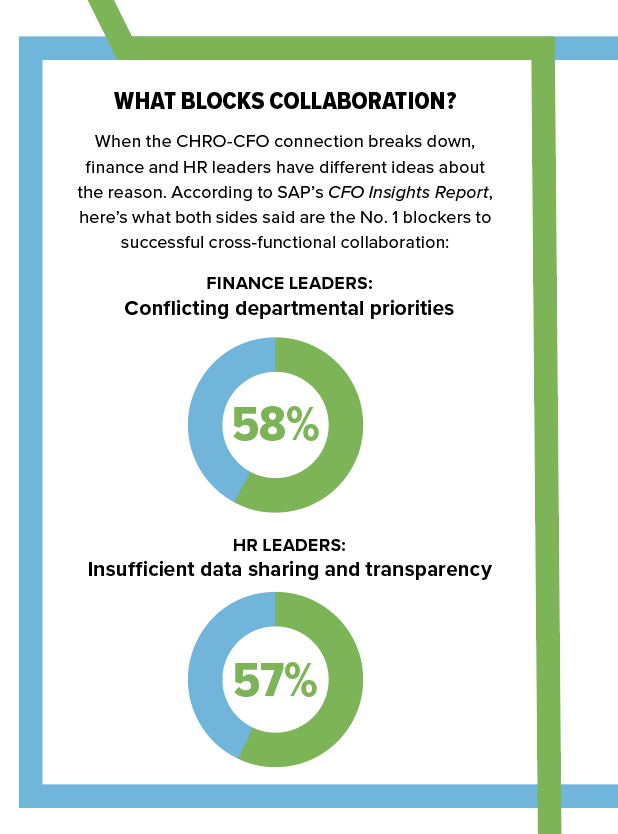
Talking past each other (finance vs. people language): Finance leaders speak mostly the language of numbers, forecasts, and shareholder value. HR leaders bring expertise in people, culture, and engagement. Without translating insights into terms the other side can act on, conversations will stall. Both sides need a “bilingual” approach that bridges financial and human capital metrics.
Focusing only on costs, not value: When talent decisions are framed strictly as expenses, opportunities to show return on investment get lost. CHROs and CFOs should collaborate to spotlight where people initiatives — such as leadership development or retention programs — produce measurable business outcomes.
Working in data silos: If HR dashboards and finance systems don’t talk to each other, leaders are left making decisions with incomplete pictures. Integrate people and financial data to enable smarter workforce planning, sharper forecasts, and clearer accountability.
Overlooking cultural and engagement impacts: Numbers alone don’t capture the full story. A decision that looks good financially but undermines morale or retention can cost far more in the long run. Avoid short-sighted trade-offs by balancing hard metrics with cultural indicators.
Treating HR investments as one-off expenses, not assets: Talent initiatives are too often seen as discretionary spending rather than long-term strategic investments. By working together, CHROs and CFOs can reframe these investments as drivers of growth, resilience, and competitive advantage.
Related Articles

Learn how Marsh McLennan successfully boosts staff well-being with digital tools, improving productivity and work satisfaction for more than 20,000 employees.

The proliferation of artificial intelligence in the workplace, and the ensuing expected increase in productivity and efficiency, could help usher in the four-day workweek, some experts predict.

As artificial intelligence technology continues to develop, the demand for workers with the ability to work alongside and manage AI systems will increase. This means that workers who are not able to adapt and learn these new skills will be left behind in the job market.