
These days, an average person following the news could be forgiven for thinking they are moments away from losing their job due to rapidly developing technologies in the world of artificial intelligence.
One reason is that proponents of these technologies often describe the future of work in bleak terms. For example, Dario Amodei, CEO of Anthropic, which developed the Claude generative AI (GenAI) tool, told Axios recently that AI has the potential to wipe out half of all entry-level white-collar jobs and drive the unemployment rate to between 10% and 20% within the next one to five years.
In short, we have entered an age of heightened fears about workers being replaced by automation. Although such job-loss fears among blue-collar and white-collar workers are by no means new, the emergence of increasingly complex AI technology, especially GenAI tools, has reshaped our perception of the types of workers that might be displaced.
Fortunately, there is no concrete reason to believe that the dire predictions currently making headlines will come to pass in the near future. In fact, recent evidence from the SHRM 2025 Automation/AI Survey suggests that although near-term automation displacement will still affect millions of individual workers, these effects are likely to be much more limited, complex, and nuanced than eye-catching headlines might suggest.
Technical vs. Nontechnical Barriers: What Protects Jobs?
To understand why the impact will be more limited and complex, it is important to remember that automation displacement in an organization can only occur when two types of barriers have been overcome: technical barriers and nontechnical barriers.
The first hurdle requires that a technology, such as GenAI, be able to complete a task that was formerly completed by a human worker. SHRM’s survey results suggest that this kind of task displacement is already quite common.
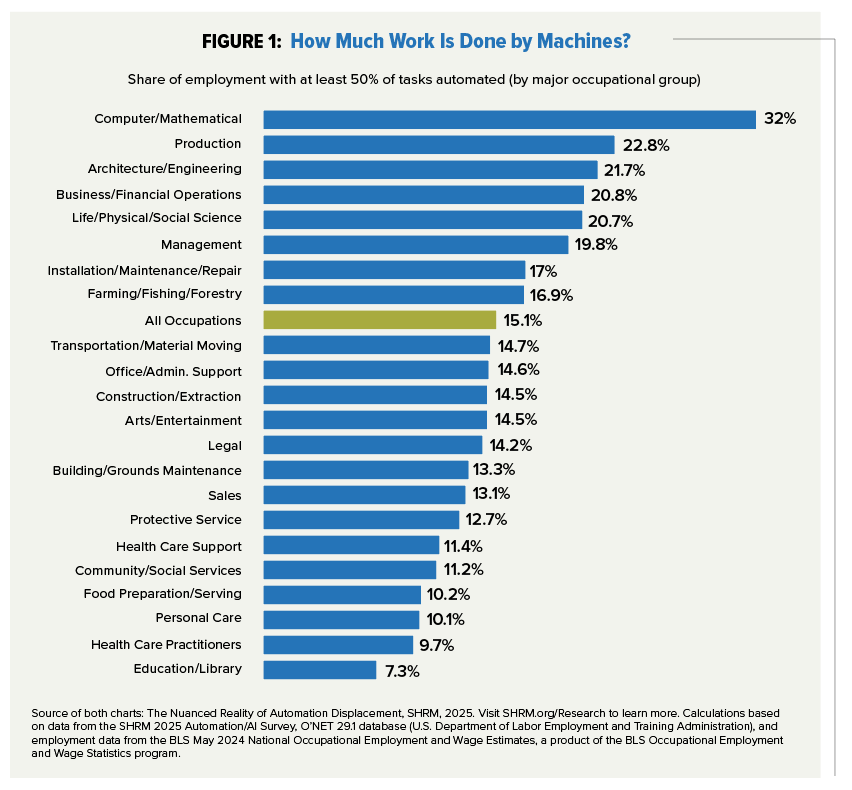
In fact, our analysis suggests that at least 50% of tasks are automated in 15.1% of U.S. wage and salary employment, which amounts to about 23.2 million jobs. The share of employment attaining this 50% task automation threshold varies significantly by occupational group, from a high of 32% of employment in the computer and mathematical group to a low of 7.3% in education and library jobs (see Figure 1).
Once at least half of a job’s tasks become automated, the likelihood of automation-driven displacement increases for two main reasons.
First, the technological leap required for a job to go from “mostly automated” to “fully automated” is likely to be relatively small.
Second, even without further technological change, a worker in a job that is at least 50% automated may face greater risk of displacement if the employer decides that the remaining nonautomated tasks in the worker’s job can be eliminated entirely or redistributed among other employees. For example, as GenAI tools become increasingly proficient at writing and reviewing computer programs, the need for dedicated human programmers is likely to decline in many settings.
Looking solely at technical considerations, the findings in Figure 1 suggest that slightly more than 15% of U.S. wage/salary workers face a high risk of job displacement. However, this conclusion ignores the importance of nontechnical barriers that can limit automation-driven job loss. These barriers may be able to shield jobs from displacement, even in cases where those jobs are already highly automated.
For example, modern commercial airliners typically fly with very little input from pilots, yet there has been no serious efforts to remove pilots from the cockpit. Beyond the legal and regulatory barriers that would prevent this, it seems likely that many passengers would recoil at the thought of boarding a plane that had no human pilot.
How Client Preference and Other Nontechnical Factors Can Reduce Job Loss
To explore the issue of nontechnical barriers to automation displacement in detail, the 2025 SHRM Automation/AI Survey asked respondents whether such barriers exist in their current jobs and what the nature of those nontechnical barriers is.
Our analysis of the survey data indicated that at least one nontechnical barrier to automation displacement exists in more than 60% of U.S. jobs. The most common barrier cited: client preferences, meaning that clients and customers would prefer to interact with a real person rather than a machine.
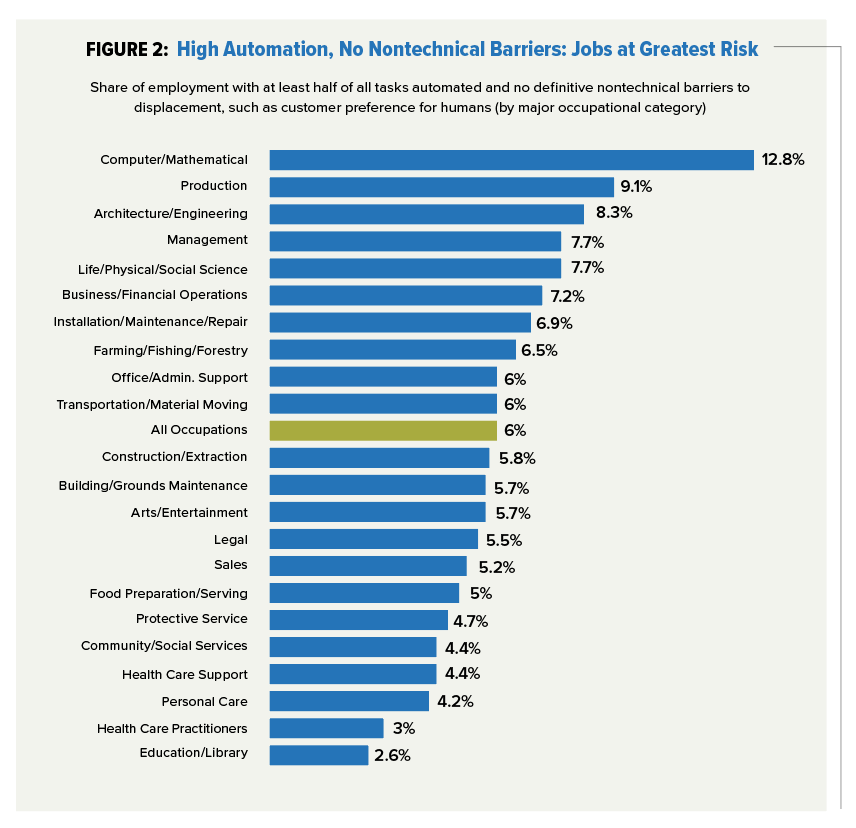
Recognizing how important nontechnical barriers are to the impact on job displacement, we revisited the Figure 1 analysis to estimate the share of jobs that are both at least half automated and face no nontechnical barriers to automation. Figure 2 reports the share of employment that meets both of these conditions, both overall and by major occupational group.
In comparing the two charts, it is clear that the presence of nontechnical barriers plays a major role in limiting the share of jobs at high risk of automation displacement. Overall, we estimated that just 6% of wage and salary employment — roughly 9.2 million jobs — is both at least half automated and faces no nontechnical barriers to automation.
This share varies significantly by occupational group. On the high end, we estimated that nearly 13% of workers in computer and mathematical roles meet both conditions. Conversely, in six other occupational groups — including education and health care occupations — the share falls below 5%.
Uneven Impact Across Jobs and Industries
The upshot of these findings is that the relationship between technological advances in automation (including GenAI) and job displacement is complex.
It is true that millions of jobs face a high risk of displacement in the near future, largely because they are already highly automated and don’t face nontechnical barriers that could slow or prevent job displacement. However, we expect these at-risk cases to account for a relatively small share of overall employment.
Currently, there are far more jobs that are plausibly shielded from automation displacement in the near future, either because their tasks are mostly nonautomated or because they are protected by nontechnical barriers that make full automation difficult (or both). This suggests that while automation will certainly reshape portions of the workforce, its effects are likely to be uneven, nuanced, and influenced by factors beyond technology alone.
Having reached this conclusion, it’s also important to recognize that these conditions can change quickly. For example, as customers grow more comfortable interacting with AI interfaces rather than humans, evolving preferences promise to expose additional jobs to automation displacement.
In this fast-moving and dynamic environment, it is increasingly critical that business leaders understand not only how automation technologies currently function within their organizations, but also how these technologies may evolve over time — and the implications of these changes for attracting, retaining, and developing talent.

Justin Ladner is the senior labor economist at SHRM.
Related Articles

Transform HR with mobile technology to streamline workflows, enhance communication, and boost employee engagement across distributed teams.

A new study found that talent development practitioners believe performance-based assessments are more effective at measuring employee learning outcomes than knowledge tests.

As AI makes deeper inroads into organizations, employee concerns about the technology continue to grow. Here's how HR leaders can address the fear of AI among their own staff, as well as in the wider organization.