ROI-Driven HR
The 5 Critical People-Based Investments for 2025 and Beyond

As stewards of organizational growth and culture, CHROs are in a unique position to guide companies through the ever-evolving landscape of modern business. But with finite budgets and growing pressure to show measurable results, the challenge for HR leaders is deciding how to strategically invest the resources they can leverage to ensure not only survival but long-term success.
Based on years of research and practice in HR, five critical priorities stand out as the pillars where HR investments deliver the most outsized returns. By focusing on these areas, CHROs can amplify their influence and dramatically enhance organizational capacity. This article focuses on these five interconnected pillars that deliver the biggest ROI for your organization:
- Leadership development.
- Human-centered digital transformation.
- Organizational capability building.
- Talent architecture.
- Culture engineering.
Far from being standalone initiatives, these key focus areas form a cohesive framework where each element amplifies the others. The organizations that will lead tomorrow’s business landscape are those making deliberate, systematic investments in these five areas today. This article offers a practical road map for prioritizing and investing in these five pillars to strengthen not only the HR function but also the entire organization.
1. Leadership Development: Build Skills that Stick
Exceptional leadership is the hallmark of a thriving organization. Yet traditional approaches to leadership development often fall short of addressing today’s complex workplace challenges.
Take health care as an example. It’s typical for health care organizations to promote their best nurses into supervisory positions, simply because the person is a great nurse. But often, the organization loses a great nurse and gets a less-than-great manager. The same thing happens in many other industries. Firms promote their most skilled individual contributors while neglecting to provide an adequate level of leadership development, setting these individuals up for failure.
But it doesn’t have to be this way. Investing in a leadership development program that’s intentional and scalable can yield extraordinary results.
The data bears this out. For example, a Gallup study found that organizations with highly engaged talent outperform their competitors by an extraordinary 147% in earnings per share. This speaks volumes about the transformative power of engagement. Gallup’s data also shows that leaders’ actions go a long way in supporting (or killing) engagement, and as a consequence, the bottom line. When organizations invest in developing essential leadership skills — so-called soft skills, such as communication, influence, presence, and emotional regulation — employees are 65% more likely to want to be involved in their work, said Gallup.
In my own work, I’ve found that organizations that have implemented a high-involvement leadership training program (i.e., training, development, coaching, action planning, and succession planning) have reduced turnover by up to 75%, with an average retention increase of 40%. These outcomes are not anomalies, but they do require significant investment from the organization. Still, this financial investment in leadership development can offer a tenfold return on investment.
The primary investment comes in the form of time and effort. Firms need to allow leaders and employees the time, effort, and space to truly develop. There’s compelling evidence that leadership development is far more than a strategic initiative that can be marked as “complete” on a checklist. Rather, it’s a dynamic core business function, and the foundation upon which employee motivation, performance, and organizational success are built.
When leaders are equipped with the skills to inspire, engage, and empower their teams, employees are more likely to feel valued and committed. This reduces turnover and creates a ripple effect on morale and productivity — a ripple that comes back full circle to reinforce good leadership.
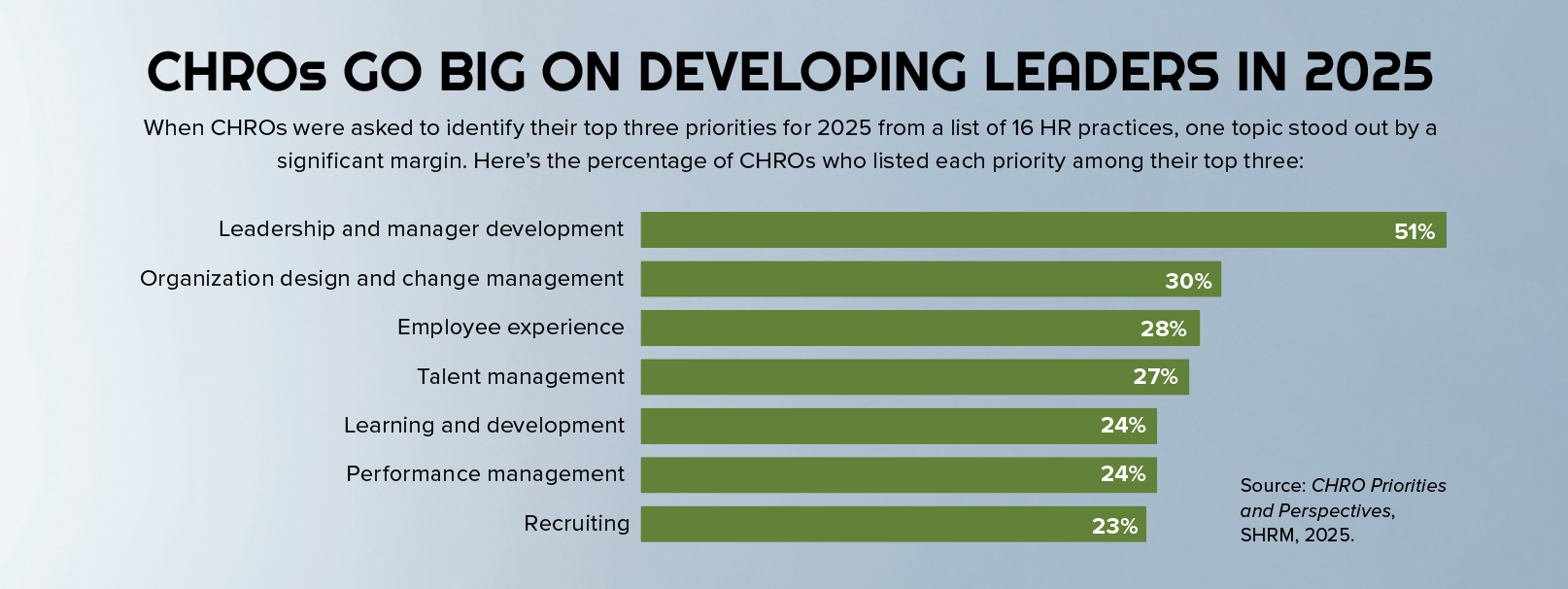
The good news: Organizations are getting the message about the importance of this topic. According to SHRM’s CHRO Priorities and Perspectives report, more than half of CHROs (51%) identified leadership and manager development as a top priority in 2025, making it the most frequently cited focus among these leaders (see chart).
For HR executives, the challenge lies in not only designing leadership programs that go beyond surface-level training but also convincing other C-suite members that the investment will pay off exponentially. To demonstrate value, focus on cultivating adaptive leaders who can navigate complexity, foster innovation, and model the values your organization holds dear. Then track the benefits and ROI from a quantitative and qualitative perspective.
Embedding leadership development into your organization’s DNA could involve mentorship programs, real-time feedback loops, and experiential learning opportunities that simulate real-world challenges. Such programs should start from “day zero.” Start investing in leadership upon a new employee’s hire date, not the first day they show up to work. When firms hire new leaders, they can use assessment data from selection systems to create onboarding coaching plans.
By investing in your leaders today, you’re not just building individual capacity; you’re creating a foundation for long-term organizational resilience.
2. Digital Transformation: Create Efficiencies with Empathy and Purpose
The digital revolution has fundamentally reshaped the workplace, touching every aspect of how we work, communicate, and innovate. Yet many organizations still treat digital transformation as a purely technological endeavor — a checklist of software upgrades, system migrations, and automation initiatives. This narrow focus overlooks the most critical component of any successful transformation: the people who bring the technology to life.
A human-centered approach to digital transformation reimagines operational efficiency by integrating cutting-edge technology with empathy, collaboration, and purpose. At its core, human-centered digital transformation acknowledges that technology is not an end in itself, but a means to empower employees. This perspective shifts the narrative from one of disruption to one of opportunity — an opportunity to build workplaces where innovation and well-being can coexist.
HR executives are uniquely positioned to lead this charge. Acting as both advocates for employees and architects of organizational change, they hold the key to ensuring that digital transformation efforts are engaging and impactful. Rather than imposing new systems in a top-down way, HR professionals can foster a culture of collaboration by involving employees in the transformation journey from the very beginning.
Engaging employees early on isn’t just a courtesy; it’s a strategic imperative that provides employees with psychological ownership over the process. By soliciting feedback on existing pain points, organizations can uncover valuable insights that might otherwise go unnoticed. Employees are often the first to identify inefficiencies in workflows or gaps in resources that hinder productivity. When their voices are heard and valued, they become active participants in co-creating solutions that address these challenges.
For example, before rolling out a new project management tool, HR teams can facilitate workshops or surveys to understand which features employees need. This collaborative approach will ensure the new technology is aligned with the day-to-day realities of the workplace. The result? A smoother adoption process, higher engagement levels, and solutions that genuinely enhance both efficiency and employee satisfaction.
One of the most exciting aspects of digital transformation is its potential to free employees from repetitive and boring tasks, allowing them to focus on work that’s more meaningful and fulfilling. AI tools can automate routine administrative duties, such data entry and scheduling, giving employees more time to engage and focus on innovation and strategic planning. This shift increases productivity and fosters a sense of purpose by enabling employees to contribute at a higher level.
Similarly, advanced data analytics tools can provide HR leaders with actionable insights into workforce trends such as employee engagement, turnover rates, and skill development needs. Armed with this information, organizations can make more informed decisions about talent management strategies while proactively addressing challenges before they escalate.

At its core, human-centered digital transformation acknowledges that technology is not an end in itself, but a means to empower employees. This perspective shifts the narrative from one of disruption to one of opportunity."
3. Organizational Capability: Well-Being Fuels Performance
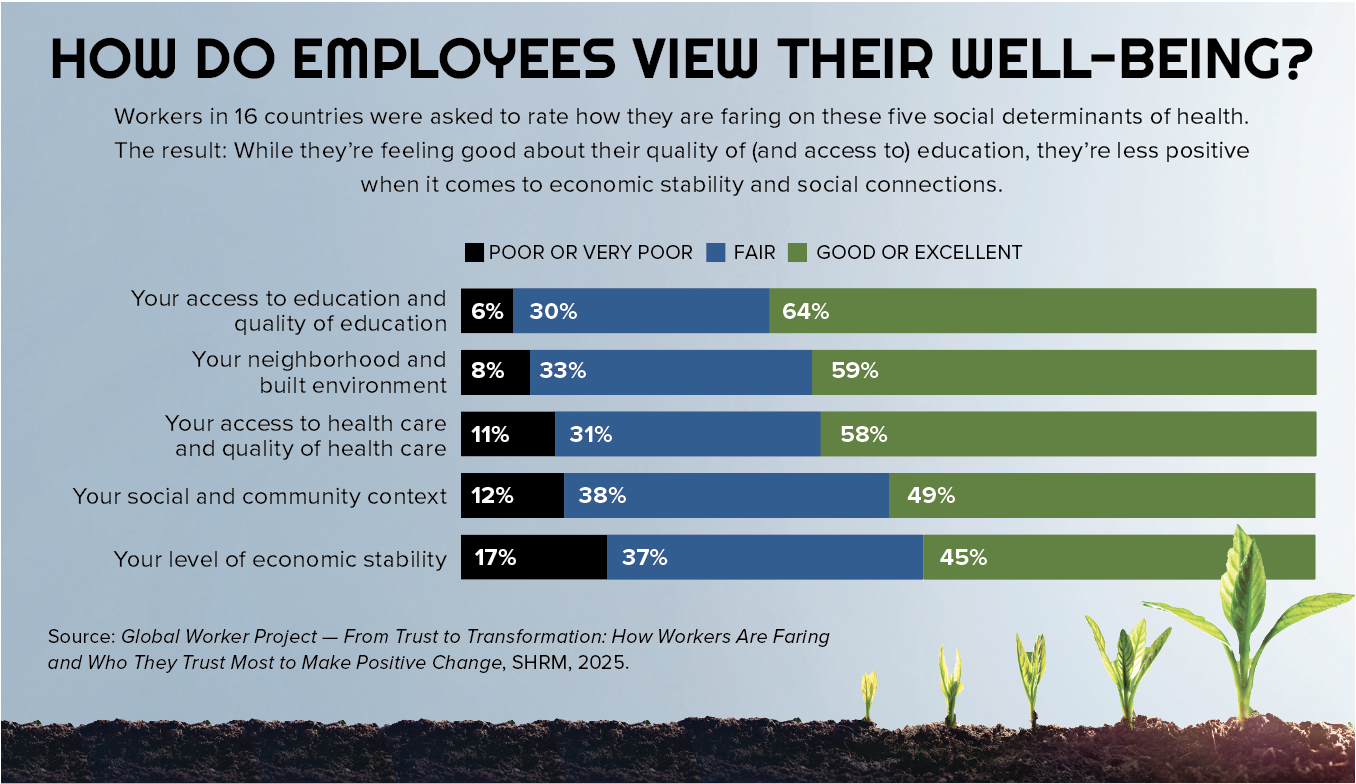
Well-being is no longer a nice-to-have but a must-have. Employees who feel supported in their physical, emotional, and professional needs are more engaged and more productive. They’re also more likely to become advocates for their organization. According to the American Psychological Association, 89% of employees who work at organizations where leaders support well-being initiatives are likely to recommend their employer as a great place to work.
HR leaders must adopt a holistic view of capability building — one that puts employee well-being in the foreground. By fostering a culture that prioritizes the physical, mental, emotional, and social health of employees, businesses can create a thriving workforce. Deloitte found that each dollar invested in employee mental health support yields roughly a fivefold return for employers. That’s a big return, not to mention the resulting increases in engagement and performance.
When employees feel supported, their productivity and engagement soar. Organizations that prioritize well-being also experience reduced turnover and absenteeism because workers are less likely to burn out or disengage. Additionally, investing in well-being generates significant cost savings by mitigating the financial burden of stress-related illnesses and mental health challenges.
To enhance employee well-being, employers should prioritize four key strategies that address both individual needs and organizational culture:
- Embrace flexible work arrangements, such as hybrid schedules and adjustable hours. This empowers employees to balance personal and professional responsibilities, reducing stress and boosting engagement.
- Offer comprehensive mental health support through counseling services, mental health days, and mindfulness programs. This creates a supportive environment that addresses emotional well-being.
- Foster a culture of recognition and social belonging through team-building activities, peer-to-peer acknowledgment, and inclusive events. This strengthens relationships and morale.
- Promote physical wellness by subsidizing gym memberships, providing onsite fitness options, and organizing inclusive wellness challenges. This improves health and also signals the company’s commitment to holistic employee care.
Together, these strategies create and promote an environment where employees feel valued, supported, and motivated.
Remember that capability building is an ongoing process rather than a one-time event. It’s the same thing for well-being. As you integrate employee well-being programs, make sure you build with flexibility.
4. Talent Architecture: Align Skills with Strategic Goals
Talent is an organization’s most valuable asset, but only if it’s correctly aligned with strategic objectives. That’s where talent architecture comes in. A robust talent architecture ensures that the right people with the right skills are in the right roles at the right time.
This requires more than just effective recruitment. It demands a comprehensive approach to talent management that spans onboarding, development, succession planning, and retention. HR executives must act as strategic partners to business leaders, ensuring talent strategies are directly tied to organizational priorities.
One way to achieve this is through workforce planning tools that map current capabilities against future needs. This allows you to proactively identify critical skills gaps and address them via targeted developmental strategies, whether through hiring new talent or upskilling existing employees.
Skills mapping will be critical in the AI age. Globally, by 2030, employees’ skills are projected to change by 50% — or by 68% when the explosion of generative AI is factored in, according to the 2024 Work Trend Index by Microsoft and LinkedIn.
Additionally, HR professionals should consider how diversity plays into their organization’s talent architecture. That includes diversity of mindsets, skills, and experiences. Diverse mindsets bring fresh perspectives and innovative solutions to complex problems. By prioritizing diversity of thought and skill set at every stage of the talent life cycle — from sourcing candidates to promoting from within — you can position your organization for long-term success.
5. Intentional Culture Engineering: Develop the Behaviors You Want
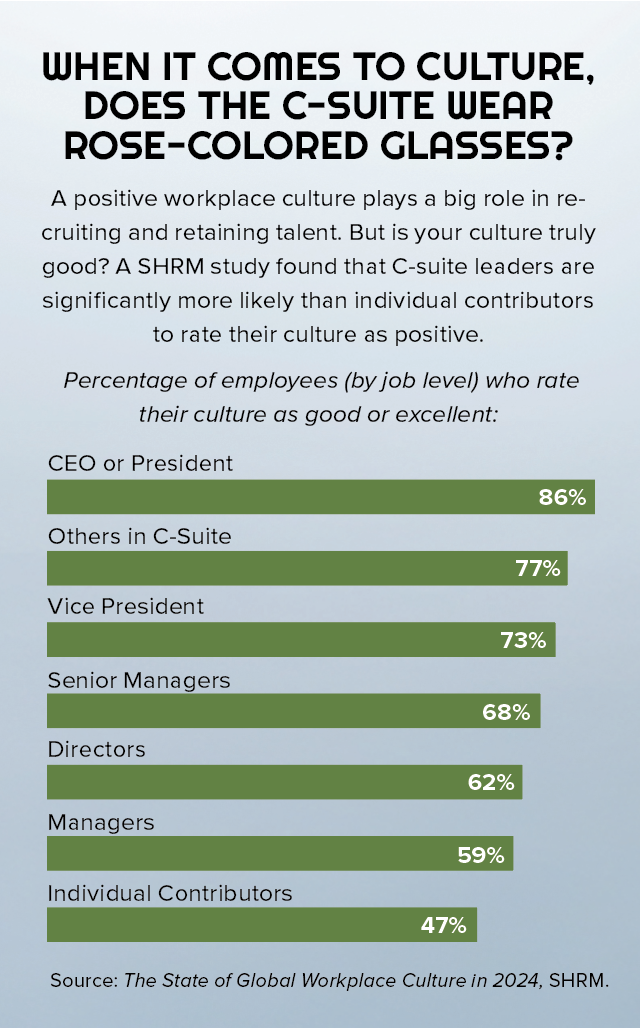
Company culture is often described as “the way we do things around here.” But what if leaders reimagined culture as something to intentionally design, rather than passively inherit? What if, instead of allowing culture to evolve organically, we treated it as a living, breathing system that can be shaped to fuel performance, engagement, leadership development, employee well-being, and long-term business success?
Intentional culture engineering does exactly that. It transforms culture from ambient pseudo-stimuli into a strategic asset, a source of competitive advantage that not only defines the company but also propels it forward with clarity and purpose.
Begin with the end in mind by defining what “success” truly means for your organization. This isn’t just about financial metrics or market share. It’s about painting a vivid picture of the behaviors, values, and mindsets that will drive long-term success. What do you want your organization to stand for? What kind of environment will empower your people to thrive?
Once you’ve articulated your vision of success, reverse-engineer your desired culture by identifying the ingredients, systems, processes, habits, and rituals that will breathe life into it. Think of it as designing an ecosystem where every element, big or small, works in harmony to reinforce your organization’s cultural DNA.
Here’s a concrete example of how to get started: First, define your key values — for example, innovation. To strengthen your culture of innovation, ask yourself: How can we foster an environment where creativity flourishes and calculated risk-taking is celebrated? This may mean building high involvement and psychological safety into your leadership philosophy, so employees feel empowered to experiment without fear of failure (see page 46). Or perhaps it involves rethinking how you recognize and reward employees, not just for outcomes, but for radical, game-changing ideas and the courage to experiment with such ideas.
On the other hand, if collaboration is more central to your strategy, consider how you can design both physical and virtual spaces that encourage connection and knowledge sharing. From open office layouts to digital platforms that connect remote teams, every touchpoint should reflect and amplify your commitment to teamwork.
Intentional culture engineering requires ongoing care and vigilance, just like the previous four pillars of HR success. Cultures aren’t static; they evolve as organizations grow, markets shift, or new challenges arise. Conduct regular “culture checks” to ensure alignment with your strategic goals and adapt when necessary.
Ask yourself: Are the rituals you established still relevant? Do the systems you’ve put in place continue to support the behaviors you value most? By staying attuned to these dynamics, you can ensure that culture remains a powerful driver of performance, rather than an obstacle to progress.
How These 5 Pillars Work Together
While each of these pillars offers significant benefits on its own, their true power lies in their interconnectedness. Leadership development enhances culture. Digital transformation supports human efficiency and performance. Talent architecture aligns with both strategy and well-being, and so on.
HR executives must adopt a holistic mindset when implementing these strategies. Treat capacity building not as a series of isolated initiatives, but as an integrated framework where each element reinforces the others. For example:
- Leadership development programs should incorporate insights from digital transformation efforts.
- Talent strategies should be informed by cultural priorities.
- Capability-building initiatives should align with both individual well-being goals and broader organizational objectives.
By weaving these threads together into a cohesive tapestry of strategic investment — and treating capacity building as an ongoing journey rather than a destination — you’ll position your organization not just for today’s challenges, but also tomorrow’s opportunities. The organizations that will dominate tomorrow’s business landscape are those currently making deliberate investments in leadership development, digital transformation, capability building, talent architecture, and culture engineering.
So ask yourself: Which investments will you make today to ensure your organization leads tomorrow? The answer lies within these five pillars — and your ability as an HR leader to bring them to life.

Craig Wallace, Ph.D., is an organizational psychologist and the founder and managing partner of InvolvedTalent, a talent development and organizational advisory and consulting firm. He also serves as the head of the Management Department at the Powers College of Business at Clemson University and is a fellow of the Society for Industrial and Organizational Psychology.
Related Articles

Transform HR with mobile technology to streamline workflows, enhance communication, and boost employee engagement across distributed teams.

A new study found that talent development practitioners believe performance-based assessments are more effective at measuring employee learning outcomes than knowledge tests.

As AI makes deeper inroads into organizations, employee concerns about the technology continue to grow. Here's how HR leaders can address the fear of AI among their own staff, as well as in the wider organization.