  • Personal
  • Business
  • Foundation
    Close
  • Select Region
    • Global
    • India
    • MENA
  • mySHRM Login
  • MySHRM
    • Dashboard
    • Account
    • Logout
SHRM
  • Membership
    • Membership

      As a SHRM Member®, you’ll pave the path of your success with invaluable resources, world-class educational opportunities and premier events.

      Membership Benefits
  • Certification
    • SHRM Certification

      Demonstrate your ability to apply HR principles to real-life situations.

      • How to Get Certified
      • Eligibility Criteria
      • Exam Fees & Options
      • SHRM-CP
      • SHRM-SCP
      • Which Certification is Best for Me?
      • Recertification
      Prepare for the Exam
      • Exam Preparation
      • SHRM BASK
      • SHRM Learning System
      • Instructor-Led Learning
      • Self-Study
      Specialty Credentials

      Demonstrate targeted competence and enhance your HR credibility.

      PMQ

      Gain a deeper understanding and develop critical skills.

  • Events & Education
    • India Events

      Demonstrate your ability to apply HR principles to real-life situations.

      • Talent Leadership Summit
      • Tech Conference
      • India Annual Conference
      MENA Events
      • MENA Annual Conference
      Global Events
      • US Annual Conference
      Webinars
  • Resources
    • Resources

      Stay up to date with news and leverage our vast library of resources.

      • Compliance
      • HR Research
      • Legal & Compliance
      • Latest News & Trends
      • Tools & Guides
      HR Topics
      • AI in the Workplace
      • Civility at Work
      • Compensation & Benefits
      • Inclusion & Diversity
      • Talent Acquisition
      • Workplace Technology
      • Workplace Violence Prevention
  • SHRM Connect
  • Shop
    • SHRM Store

      Shop for HR certifications, credentials, learning, events, merchandise and more.

      Workplace Essentials
      • SHRM Memberships
      • SHRM Certification
      • Specialty Credentials
      • HR Tools & Tech
      Education
      • Seminars
      • eLearning
      • Books
      Merchandise
      • Accessories
      • Apparel
      • Office & Home
Become a Member
Renew
Rejoin Now
Renew
Close
  • Personal
  • Business
  • Foundation
  • Membership
    back
    Membership
    • Membership

      As a SHRM Member®, you’ll pave the path of your success with invaluable resources, world-class educational opportunities and premier events.

      Membership Benefits
  • Certification
    back
    Certification
    • SHRM Certification

      Demonstrate your ability to apply HR principles to real-life situations.

      • How to Get Certified
      • Eligibility Criteria
      • Exam Fees & Options
      • SHRM-CP
      • SHRM-SCP
      • Which Certification is Best for Me?
      • Recertification
      Prepare for the Exam
      • Exam Preparation
      • SHRM BASK
      • SHRM Learning System
      • Instructor-Led Learning
      • Self-Study
      Specialty Credentials

      Demonstrate targeted competence and enhance your HR credibility.

      PMQ

      Gain a deeper understanding and develop critical skills.

  • Events & Education
    back
    Events & Education
    • India Events

      Demonstrate your ability to apply HR principles to real-life situations.

      • Talent Leadership Summit
      • Tech Conference
      • India Annual Conference
      MENA Events
      • MENA Annual Conference
      Global Events
      • US Annual Conference
      Webinars
  • Resources
    back
    Resources
    • Resources

      Stay up to date with news and leverage our vast library of resources.

      • Compliance
      • HR Research
      • Legal & Compliance
      • Latest News & Trends
      • Tools & Guides
      HR Topics
      • AI in the Workplace
      • Civility at Work
      • Compensation & Benefits
      • Inclusion & Diversity
      • Talent Acquisition
      • Workplace Technology
      • Workplace Violence Prevention
  • SHRM Connect
  • Shop
    back
    Shop
    • SHRM Store

      Shop for HR certifications, credentials, learning, events, merchandise and more.

      Workplace Essentials
      • SHRM Memberships
      • SHRM Certification
      • Specialty Credentials
      • HR Tools & Tech
      Education
      • Seminars
      • eLearning
      • Books
      Merchandise
      • Accessories
      • Apparel
      • Office & Home
Become a Member
Renew
Rejoin Now
Renew
  • Select Region
    • Global
    • India
    • MENA
SHRM
mySHRM Login
  • MySHRM
    • Dashboard
    • Account
    • Logout
Close

  1. Topics & Tools
  2. Employment Law & Compliance
  3. How Do You Decide Who Stays and Who Goes?
Share
  • Linked In
  • Facebook
  • Twitter
  • Email

Lorem ipsum dolor sit amet, consectetur adipiscing elit. Vivamus convallis sem tellus, vitae egestas felis vestibule ut.


Error message details.

Copy button
Reuse Permissions

Request permission to republish or redistribute SHRM content and materials.


Learn More
News

How Do You Decide Who Stays and Who Goes?

November 12, 2019 | Allen Smith, J.D.


More from The Fairer Layoffs Series

Part 1
How Do You Decide Who Stays and Who Goes?

Part 2
When RIF Selections Go Wrong

Part 3
Should Employers Notify in Writing or Not?

Part 4
Have a Plan for Saying Goodbye

The trade war between the United States and China, plus the length of time that has passed since the last recession, have CEOs and HR leaders wondering when the next recession will be. Is it just around the corner? Are we entering it already? Or is it years away?

Now is the time to prepare for the next recession, since the economy, like the stock market, does not expand indefinitely. And whether a recession happens later rather than sooner, layoffs occur more often than you might think. How can HR make them as fair as possible?

The right selection criteria, avoiding adverse impact on protected groups of employees, announcing the layoff decision and parting ways on the best terms possible can make a difference.

Are We Headed for a Recession?

The economy can be in a recession before the recession is widely recognized as having begun. The National Bureau of Economic Research (NBER) didn't note the start of the Great Recession, which began in December 2007, until December 2008. "However, it's pretty clear once an economy has been in a recession for a couple of months," said Ryan Sweet, director of real-time economics for Moody's Analytics in West Chester, Pa.

Although the media often define a recession as two consecutive quarters of negative gross domestic product growth, that description isn't accurate, according to Sweet. The NBER defines a recession as a "significant decline in economic activity spread across the economy, lasting more than a few months." The NBER examines several indicators, including gross domestic product and gross domestic income, payroll employment, incomes, wholesale retail sales and industrial production.

"It's possible that not one single event but rather a combination causes enough damage to the economy and psyche that a recession results," Sweet said. "For example, a perfect storm would be an escalation in the U.S. and China trade tensions, sudden tightening in financial market conditions and Brexit all occurring around the same time."

At least one organization, the liberal American Bridge 21st Century, disputes that the economy is strong, noting that more than 716,341 workers have been notified of plant closings and layoffs thus far while President Donald Trump has been in office. The figure is based on the organization's review of Worker Adjustment and Retraining Notification Act notice filings from Jan. 20, 2017, to Aug. 19, 2019. Even if the economy is, in fact, strong, these figures show that many layoffs occur when there isn't a recession. So regardless of whether a recession is imminent, employers need to be ready for the possibility of changed circumstances or repositioning in their business that necessitates a reduction in force (RIF).
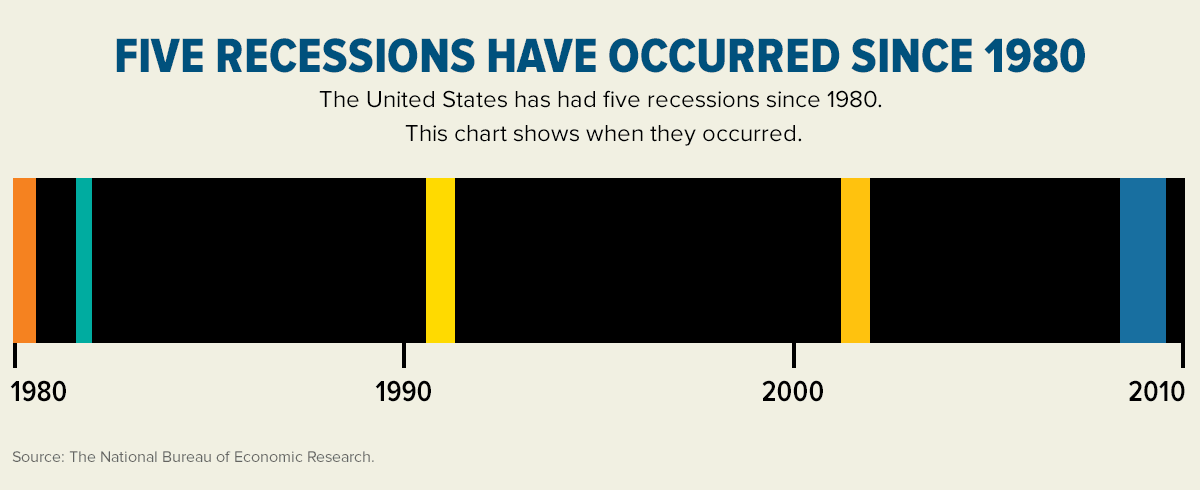
Five Recessions Have Occurred Since 1980

Reasons for Layoffs

Layoffs may occur for many different, legitimate reasons. These reasons include eliminating or downsizing a business unit that is not performing well, laying off employees with performance issues, or closing an office or plant, noted Evan Parness, an attorney with DLA Piper in New York City.

Ron Taylor, an attorney with Venable in Baltimore, said that common reasons for a RIF include:

  • A need or desire to restructure. An employer may choose to eliminate duplicative positions following a merger or acquisition, or realign functions to achieve efficiencies.

  • To reduce costs. A company might lay off workers in reaction to reduced demand for a product or to cut labor costs.

  • To eliminate a function. Employers could outsource a function that the company can no longer perform efficiently, or cease a function made unprofitable by competition or obsolete by technological advances.

  • To relocate. Relocation of operations to a new site, city, state or country may result in layoffs in the old location.

Organizations must periodically rightsize, said Joyce Chastain, SHRM-SCP, president of Chastain Consulting in Tallahassee, Fla. Often in times of growth, companies add beneficial but nonessential positions. Those positions likely will be eliminated in a RIF.

Keep workers apprised of company finances to the extent possible so they are less surprised if layoffs occur, recommended Lynne Anne Anderson, an attorney with Drinker Biddle in Florham Park, N.J.

'The Most Critical Decision'

An employer's choice of selection criteria to determine who will be laid off "is the most critical decision made in the course of a RIF," said Gerald Hathaway, an attorney with Drinker Biddle in New York City.

[SHRM members-only resource: Reduction in Force (RIF) Strategy and Selection Checklist]

Three main methods of selecting employees for layoff are "last in, first out," in which the most recently hired employees are the first to be let go; reliance on performance reviews; and forced rankings, said Kelly Scott, an attorney with Ervin Cohen & Jessup in Los Angeles.

The more objective the selection criteria, the more defensible they are if later challenged in court, said Molly Batsch, an attorney with Greensfelder in St. Louis. Seniority-based criteria are typically easier to defend than subjective performance-based criteria, she said.

However, the laid-off workers might feel that using seniority as a basis for choosing whom to lay off is unfair, said Steve Wolfe, executive vice president of operations at Addison Group in Chicago.

If an employer relies on performance-based criteria in selecting who will be laid off, it should minimize the level of subjectivity. For example, performance-based criteria that account for objective sales targets or other objective performance metrics are easier to defend in court than performance-based criteria that consider only managers' opinions, Batsch said. 

If managers' opinions are factored in to the decisions to let employees go during a layoff, their opinions should be supported by documentation, such as performance evaluations, and scrutinized by the RIF decision-makers.

Most employers prefer performance-based layoffs, as they like to keep the best workers, Scott said. This isn't always possible if a company hasn't kept proper records. If documentation is inadequate, forced ranking is typically done, he said. Employees then are ranked from 1 to 10 using all the criteria the employer has, such as absenteeism and the ability to perform different functions. The employer keeps the employees with the best scores.

"The key is coming up with the criteria by looking at job descriptions and getting management together," Scott said. "The more input, the better."

Looking to the Future

David Froiland, an attorney with Ogletree Deakins in Milwaukee, said that "while lawyers sometimes gravitate toward [selection] criteria that are objective and mathematical—such as length of service or absolute sales numbers—these criteria often fail to reflect the skills and strengths that the business needs to change and grow in the future."

The employee with the most seniority may not be the best performer. The top sales employee with a declining book of business or in a declining sector may be less attractive than the fifth highest sales representative who is growing business or works in a strategically important sector, he explained.

"Ideally, the selection criteria should reflect factors that will be most important to the ongoing business after the RIF is implemented," Froiland said. "Maybe this is a particular skill set. Maybe it is proficiency in a range of software applications or other technologies. Or maybe it is a mix of factors, as ranked in a matrix."

PART 2: When RIF Selections Go Wrong

ESG, Ethics & Compliance
Leadership & Manager Development
Learning & Development
Workforce Planning

Was this resource helpful?

Leave Feedback

Related Articles

(opens in a new tab)
News
How One Company Uses Digital Tools to Boost Employee Well-Being

Learn how Marsh McLennan successfully boosts staff well-being with digital tools, improving productivity and work satisfaction for more than 20,000 employees.

(opens in a new tab)
News
A 4-Day Workweek? AI-Fueled Efficiencies Could Make It Happen

The proliferation of artificial intelligence in the workplace, and the ensuing expected increase in productivity and efficiency, could help usher in the four-day workweek, some experts predict.

(opens in a new tab)
News
Rising Demand for Workforce AI Skills Leads to Calls for Upskilling

As artificial intelligence technology continues to develop, the demand for workers with the ability to work alongside and manage AI systems will increase. This means that workers who are not able to adapt and learn these new skills will be left behind in the job market.

Workplace Compliance Newsletter

Keep abreast of employment law and compliance developments and their wide-reaching impacts.

Success title

Success caption

Manage Subscriptions
Our Brands

SHRM Foundation Logo
SHRM Executive Network Logo
CEO Circle Logo
SHRM Business Logo
SHRM Linkage Logo
SHRM Labs
Overview


  • About SHRM
  • SHRM India Advisory Council
  • Careers at SHRM
  • Press Room
  • Contact SHRM India
  • Book a SHRM Executive Speaker
  • Ask an Advisor
  • SHRM Newsletter
  • Post a Job
  • Find an HR Job
  • Advertise with us
  • Copyright & Permission
Contact Us


Email: shrmindia@shrm.org
Phone: (1)800.103.2198
WhatsApp: +919810503727

SHRM India Corporate Information

© 2026 SHRM. All Rights Reserved
SHRM provides content as a service to its readers and members. It does not offer legal advice, and cannot guarantee the accuracy or suitability of its content for a particular purpose. Disclaimer

Follow Us

  • LinkedIn
  • Facebook
  • Twitter
  • Instagram
  • YouTube

  1. Your Privacy Choices

  2. Terms of Use

  3. Accessibility

Join SHRM for Exclusive Access to Professional Content

SHRM Members enjoy unlimited access to articles and exclusive member resources.

Already a member? Login
Free Article

Login to unlock unlimited access or join SHRM today to get unlimited access to articles and member-exclusive resources.

Already a member? Login
Limit Reached

You've reached the limit of 1 free article this month. Join to access unlimited articles and member-only resources.

Already a member? Login
Free Article

Login to unlock unlimited access or join SHRM today to get unlimited access to articles and member-exclusive resources.

Already a member? Login
Exclusive Executive-Level Content

You've reached the limit of 1 free article this month. Join the Executive Network and enjoy unlimited content.

Already a member? Login
Unlock Your Career with SHRM Membership

Please enjoy this free resource! Join SHRM for unlimited access to exclusive articles and tools.

Already a member? Login
Join SHRM for Exclusive Access to Professional Premium Content

SHRM Members enjoy unlimited access to articles and exclusive member resources.

Already a member? Login
Join SHRM for Exclusive Access to Student Content

SHRM Members enjoy unlimited access to articles and exclusive member resources.

Already a member? Login
Join SHRM for Exclusive Access to Executive Network Content

SHRM member enjoys unlimited access to articles and exclusive member resources.

Already a member? Login

Your membership is almost expired! Renew today for unlimited access to member content.

Renew now

Your membership has expired. Renew today for unlimited access to member content.

Renew Now

Your Executive Network membership is nearing its expiration. Renew now to maintain access.

Renew Now

Your membership has expired. Renew your Executive Network benefits today.

Renew Now
