A Personalized Approach to Corporate Learning
How companies big and small are making highly tailored, responsive training a reality.
Introduction
For Marney Andes, overseeing employee training is literally a matter of life and death. “Our pilots have to make split-second decisions,” says Andes, senior director of talent management at Air Methods, a 2,800-person helicopter company in Englewood, Colo., that provides medical transport for 100,000 people every year. “It’s not good enough for them just to know the answer. They need to be extremely confident in their knowledge.”
That’s why she and other company leaders decided to ditch old-school webinars that served up the same cookie-cutter training to all employees, regardless of their learning speeds or styles. In January 2016, the HR team implemented Amplifire, a cloud-based learning system that uses artificial intelligence to adapt to each user’s specific knowledge of a topic and test him or her via short, frequent multiple-choice quizzes and games. If a particular pilot struggles with one of the training areas, the system will linger on that section, presenting the information in a new way and retesting before progressing the employee to the next module.
The adaptive learning program has become not just a more effective method for engaging Air Methods’ pilots in learning, Andes says, but also a point of competitive differentiation for the organization. “Personalized learning is becoming a way to attract talent,” she says. “We look at online message boards that pilots participate in, and the number of positive comments about the system is unbelievable.”
But the good news doesn’t end there. By the end of 2017, Andes estimates, Air Methods will have fully recouped its sizable investment in Amplifire and will begin to see cost savings. The company has been able to reduce by half the number of in-person, instructor-led training sessions it offers and has also halved the duration of its new onboarding program from 10 days to five. And, as any HR pro will attest, greater engagement with training can mean better performance on the job and lower turnover.
Welcome to the promising world of personalized training, in which learning experiences fit each employee’s personal needs, learning style, retention speed and even interests. Many experts say it offers an elegant solution to a long-standing dilemma: Learning and development are critical to corporate success, but if leaders aren’t careful, training can quickly swallow big chunks of employees’ time and a company’s budget.
Offering education is non-negotiable because new hires won’t stick around if they feel they’ve been left to fend for themselves, and long-tenured employees may also decamp if they aren’t being challenged. Moreover, many industries require continuing education or competency tests—and virtually all 21st century employers expect workers to continually learn and grow in order to keep up with the fast pace of business and technological change.
Yet offering never-ending webinars or lectures is the quickest way to induce employee eye rolls, and often no one retains a lick of information the following day.
Taking a personalized approach and adapting lessons based on an employee’s retention and performance can instead elevate training “from a necessary evil that CEOs would love to minimize” to “a strategic powerhouse,” says Charles Smith, founder and chief research officer at Knowledge Factor, the Denver-based company that owns Amplifire. “In every single industry, there’s between 25 and 35 percent constantly held misinformation in a person’s brain,” he explains. “If you eliminate that, you can dramatically enhance the performance of an organization and, at the end of the day, help employees be more productive and successful.”
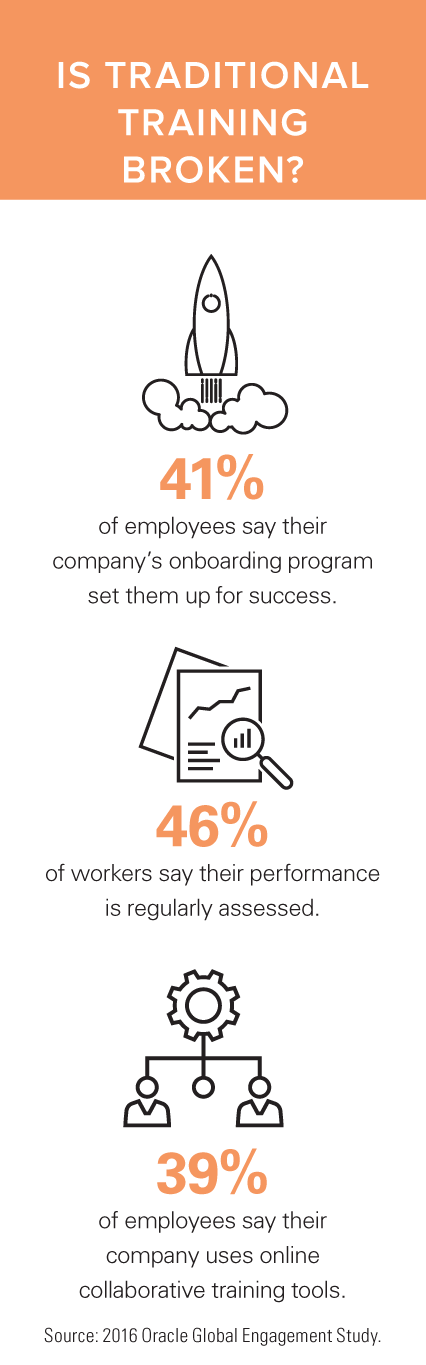
No wonder, then, that HR professionals are taking note. Bertrand Dussert, vice president of human capital management transformation at Oracle, advises nearly one-third of Fortune 100 companies in any two-year period. Many of those large companies are now transitioning to personalized learning, he says. That’s because traditional, or static, learning delivery methods—in which an instructor goes through information at the same pace for all employees—are not just expensive but also boring and quickly forgotten. Dussert points to a 2016 Oracle survey that found that only 41 percent of new employees believe their company’s onboarding system set them up for success.
“As business continues to get faster and faster, companies have to detect threats and opportunities ever-earlier,” he says. Employees need to turn on a dime and learn quickly, which is driving a fundamental shake-up in the corporate training world. “Five-year-old training content is, in many cases, totally irrelevant today,” he continues. “Everyone is questioning, ‘Does what I have actually work? Are we actually getting the ROI [return on investment] from traditional learning and development solutions?’ ”
As more HR professionals eye the chasm between traditional training and employee needs, they’re finding that a personal approach can close the gap.
Putting the 'I' in Training
 What if employees saw training less as a series of boxes to check and more as a curated menu of possibilities? Just as Netflix and Amazon rely on machine learning to make video and book recommendations for consumers, HR departments are following suit with learning and development.
As an example, Dussert describes how a company can use a video library to personalize training. “If I’m an expert in how to fix an MRI machine, I can make a five-minute video, and [other, similar] training videos are consolidated in a YouTube-like platform with a robust search function,” he says. Employees could proactively search for how-to videos or, thanks to advances in machine learning, get served up periodic recommendations based on their goals or potential growth opportunities. “You may still have a mandatory enterprise training, but you’re also offering this really targeted training that’s not general and not static,” Dussert says.
McDonald’s Corp. recently launched that type of on-demand training with an online program called Fred, named after Fred Turner, a former senior chairman of the fast-food chain and the founder of Hamburger University. Until last year, McDonald’s still printed and shipped paper training manuals to its tens of thousands of franchisees. What little computer-based training it offered required employees to use a desktop computer—an approach that was necessarily limited since most restaurant workers lacked access to such equipment. But after hiring San Francisco-based Inkling to help digitize its offerings, the company now has a system that can be accessed by tablet or mobile phone and that allows workers to select from educational videos about relevant topics, such as how to fix a fryer.
The cost of these programs varies based on the scope of the training, number of employees, and other factors. The Association for Talent Development puts organizations’ current direct expenditures for training and development at $1,252 per employee.
Even smaller companies with slim IT budgets can tailor training to employees’ professional interests. LaSalle Network, a Chicago-based professional staffing and recruiting firm, for example, prides itself on its growth-centric culture: 90 percent of management rose from within, and half started in entry-level positions.
LaSalle’s 150 employees are regularly asked what weak spots they want to strengthen and what skills they want to acquire, says Chief Human Resources Officer Sirmara Campbell Twohill, SHRM-CP. And those training questions aren’t lobbed at them only by HR—everyone from managers and mentors to the training team and even the CEO has posed the questions to employees at every level of the company.
When one recruiter mentioned to CEO Tom Gimbel that he wanted to eventually work in operations, the executive coordinated with HR to have the employee work under the COO just a few weeks later. “It doesn’t matter what role they’re in,” Gimbel says. “If someone wants to learn about something, we believe in our people enough to let them take a shot.”
Questions to Personalize Training |
1. How does this employee learn? By visual or audio means? Through hands-on activities or by talking it out? Knowing someone’s learning style makes it easier to tailor delivery. |
2. What’s his learning speed? Short bursts are typically better for comprehension, but how quickly someone moves through modules is highly specific to each individual. |
3. What does she want to learn? Yes, everyone has to go through enterprise training, but whether you tack on a Photoshop workshop or a session on presentation skills should depend in part on what interests the employee and what aligns with her professional development plan. |
4. What have others responded to? Even without souped-up tech, you can channel the approach used by Amazon and Netflix by making recommendations based on what people have liked in the past—or what others in similar roles have responded to. |
Do It with (Learning) Style
 Personalized learning may be lauded as the future of training—particularly thanks to the recent wave of responsive technology—but the idea dates back to the 1950s. That’s when Harvard psychologist B.F. Skinner created a “teaching machine” that required students to master a sequence of very small steps in order to learn a complicated process. Skinner was one of the fathers of behaviorism, the theory on which today’s personalized learning programs are based, says Jennifer Morrison, an assistant professor of education at Johns Hopkins University in Baltimore.
Indeed, today’s adaptive corporate training systems incorporate behaviorist principles, which include breaking lessons into small parts, focusing on each step and testing the student multiple times along the way. Learning startup GamEffective is a prime example: Employees who use the personalized program experience onboarding training as a series of small missions made up of quizzes, simulations and videos that never exceed five minutes.
CEO Gal Rimon says the Charlotte, N.C.-based company was born of his experience at his last company, which analyzed “big data” to help corporate managers understand their business problems. “The problems were always about employees and how their training wasn’t aligned to corporate goals,” he says. “Traditional training is totally broken. You take an hour of everyone’s time, and almost nothing sticks. It doesn’t translate to employees’ ability to perform better, and employees consider it a chore.”
[SHRM members' only toolkit: Introduction to the HR Discipline of Organizational and Employee Development]

Every employee has something unique they want to work on, and they also learn in different ways.
Sirmara Campbell Twohill, SHRM-CP, LaSalle Network
So Rimon launched GamEffective in 2012. Today, the company has more than 50 employees and is growing its customer base by more than 100 percent every year. He mentions a big bank client that previously required employees to log 40 annual training hours by December. “It was the lousiest process in the world because everyone completed all the hours in November,” he says. Using GamEffective, the HR team broke the process into tiny pieces that stretched throughout the year, testing retention of the material at each step. “We improved the outcomes by a factor of three and didn’t add a single second to the training,” Rimon says.
LaSalle Network also caters to individual learning styles and offers mini-lessons and frequent check-ins to gauge retention. But in the absence of high-tech tools, that personalized approach means HR must communicate more with managers to put together detailed plans for each of the company’s 150 employees.
“Every employee has something unique they want to work on, and they also learn in different ways,” Twohill says. “Are they an audio learner? A visual learner? Do they need to shadow someone to really understand it? Or do they do best when they’re hands-on and getting immediate feedback? All of that factors into their training.” While that may sound like a lot of upfront work, the personalization of training is clearly paying off: LaSalle Network regularly tops lists for best places to work and best office culture, and voluntary turnover is less than 3 percent annually.
A focus on results is one of the main drivers fueling personalized learning’s explosive growth, says Bill Pelster, a principal at Deloitte Consulting who previously served as Deloitte’s chief learning officer. “Modern employees are so overwhelmed that the old-school model of a two-hour learning module just doesn’t work anymore,” he says. “In all the conversations I’m having with companies, the bottom line is, ‘We’ve got to get it down to 15 minutes before people get pulled into doing their jobs again.’ And if you want to rise above the noise, you have to personalize it. There’s nothing more frustrating than sitting through a two-hour learning that wasn’t relevant.”
The Brain Science Behind Retention |
| Helping people absorb information is only one piece of the learning puzzle. Retention, or people’s ability to hold on to what they learn, is equally important—and frequently difficult. A 2014 study out of the University of East Anglia found that students in their first week of college could only remember 40 percent of their high school studies. To improve retention, experts recommend that you: |
| Quiz often. Brain research has shown that retrieval practice, or asking learners to take periodic tests of their newly acquired knowledge, enhances retention. A 2006 study in the journal Psychological Science called this approach “a powerful means of improving learning, not just assessing it.” That’s why adaptive learning programs frequently test employees. |
| Space it out. Then there’s the spacing effect, which shows that information that is broken up and presented at well-spaced intervals is better remembered than material that is crammed in over a short period. For this reason, many adaptive learning programs use so-called micro-learning segments. Providing short bursts of information improves learning without swallowing large parts of an employee’s workday. |
The Personalized Toolbox
Personalized learning doesn’t have to come from a pricey, cloud-based artificial intelligence system. It can also come from the person next to you. “The older apprenticeship and mentorship models are really classic personalized, adaptive learning,” Pelster points out. “They provide constant feedback and new challenges.”
Old-fashioned mentorship has transformed NW MT HR Solutions, LLC in Kalispell, Mont., a fast-growing company that builds disaster-response trailers equipped with high-tech communications systems, according to Ronda Gress-Wakefield, SHRM-SCP, the organization’s HR manager. When Gress-Wakefield started there three and half years ago, the 55-person company suffered from high turnover due to ineffective training. Today, each task in the manufacturing process—from installing the vehicle’s doors to adding the wiring—is owned by a team expert who breaks everything down into terms so simple that “even the HR lady can understand it,” she says with a laugh.
[SHRM members' only toolkit: Developing Employees]
That expert then stands side by side with every new employee for two weeks, explaining the technical work. And the trainers aren’t just reciting from some rote script while the new hires zone out—they’re tailoring the educational experience to each employee, repeating sections that seem confusing, and asking questions as the lesson unfolds to test comprehension and retention.
The experts who serve as mentors must be high-performing employees with at least six months on the job, Gress-Wakefield says, and they receive a pay boost as an incentive for assuming the role. As Nomad has nearly doubled in size to 105 people, this low-tech personalized program has significantly reduced turnover while creating room for career growth. “It has also helped us hire better, because making the training process so specific and so personalized has clarified the skills we need to be looking for,” Gress-Wakefield says.
LaSalle Network is so serious about the impact of mentoring that employees participate in “corporate grandfathering,” in which managers mentor not only their direct reports but workers at the level below that as well. And leaders reinforce lessons often. “I’m a firm believer in repetition,” Twohill says. “We have three- or four-minute videos about closing a candidate, and we tell our recruiters to watch that video five times.”
Sometimes, personalizing the training is as simple as putting the employee in the spotlight. At Next College Student Athlete, a 650-person Chicago-based company that helps high schoolers win collegiate athletic scholarships, the training team uses a video database and records its salespeople to help them refine their pitch performances, says Lisa Amann, the organization’s head of HR. The feedback and training are highly personalized, and employees tend to be fully engaged because they’re the stars of the sessions.
“A fair number of our employees are remote, so we do tend to default to webinars and boring trainings,” Amann says. “The move toward personalized training is an ever-evolving process.”
Indeed, the artificial intelligence that powers many of the more high-tech learning systems is only several years old. But with or without tech, companies are tailoring their training to individuals. “We’re definitely still in the early innings of the game, but there’s widespread acknowledgment that this is the future of learning,” Oracle’s Dussert says. “Employees will begin to expect it.”
Kate Rockwood is a freelance writer based in Chicago.
Illustration by Michael Korfhage for HR Magazine.
Was this article useful? SHRM offers thousands of tools, templates and other exclusive member benefits, including compliance updates, sample policies, HR expert advice, education discounts, a growing online member community and much more. Join/Renew Now and let SHRM help you work smarter.
Related Articles

Transform HR with mobile technology to streamline workflows, enhance communication, and boost employee engagement across distributed teams.

A new study found that talent development practitioners believe performance-based assessments are more effective at measuring employee learning outcomes than knowledge tests.

As AI makes deeper inroads into organizations, employee concerns about the technology continue to grow. Here's how HR leaders can address the fear of AI among their own staff, as well as in the wider organization.