Skills-Based Hiring Is Gaining Ground
Employers try a new hiring approach, with mixed results.

About 18 months ago, pharmaceutical maker Bristol Myers Squibb decided to bolster its commitment to developing cell therapies. However, there was an issue: Few individuals have experience working with this relatively new method, which draws certain cells from an individual, re-engineers them to fight diseases such as cancer, and then infuses them back into the patient.
That’s why BMS started using skills-based hiring to bring people on board to work on the expanded effort. This method for finding talent focuses on individuals’ abilities and competencies rather than their education and direct experience. It’s a more expansive approach that considers individuals who don’t fit the traditional template for a role yet have skills and other experience that can be applied to the job. It often eliminates four-year degree requirements to open up the potential pool of candidates to those who acquired their knowledge through less traditional paths.
You have to be innovative in identifying skills.”
Céline Raffray
Cell therapy “is not a capability that’s everywhere in the market because it’s so new,” says Céline Raffray, vice president of talent acquisition at New York City-based BMS. “You have to be innovative in identifying skills.”
Skills-based hiring has become increasingly popular amid the recent tight labor market, which is pushing companies to try unorthodox approaches to finding employees. In fact, 73 percent of employers used skills-based hiring last year, up from 56 percent in 2022, according to a survey of 3,000 international workers and employers by Amsterdam-based TestGorilla, a talent assessment platform.
Education Skepticism
When college degrees are no longer mandatory, the labor pool is broadened to a more diverse group. That’s important with so many individuals reconsidering whether to go to college because it is costly and can leave them saddled with significant debt. Most U.S. residents don’t believe a college degree is worth the cost, according to a poll of 1,000 adults conducted last year by The Wall Street Journal and NORC at the University of Chicago. Over half of adults (56 percent) say a degree is a bad investment, up from 47 percent in 2017 and 40 percent in 2013.
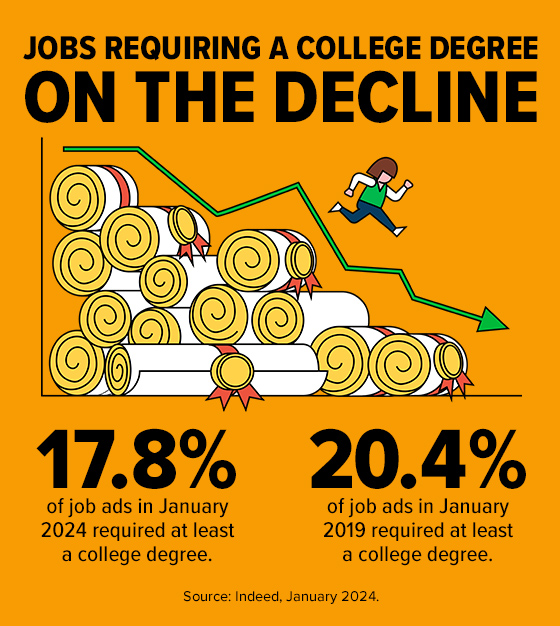
That belief is understandable. An analysis conducted by Indeed this year found that the number of job ads requiring at least a college degree fell to 17.8 percent in January 2024, from 20.4 percent five years ago. It also found that formal education requirements have declined in 87 percent of occupational sector
Of course, this doesn’t mean degree requirements will completely vanish. Experts say that certain professions like doctors and lawyers will still need formal education, and there will always be roles that require specialized degrees. However, employers realize that certain skills, especially in technology, can be either self-taught or acquired through a trade school. Plus, skills-based hiring helps diversify workforces, which is important for many employers and their workers, especially younger ones.
Cory Stahle, an economist at Indeed, says skills-based hiring is also expanding because there are more tools than ever to test whether someone has the abilities they claim. He adds that AI will likely further propel the adoption of skills-based hiring.
“It could be that AI transforms and augments jobs in a way that leads employers to be able to hire people without college educations, because it can fill in gaps for workers without formal training,” Stahle says.
A New Mindset
For all the advantages of skills-based hiring, the process can be challenging to implement. It requires a mindset change from people who have relied on degrees as a proxy for skills for years, if not decades. It also means that employers must thoroughly examine what skills are necessary for each role to decide if a degree is required, as well as rewrite job descriptions and postings to detail which capabilities are essential.
Just because you no longer have degree requirements doesn’t mean you will change how you hire. There’s no obligation to hire a candidate because they fill the requirements.”
Matt Sigelman
Only 1 in 7 jobs was filled using skills-based hiring last year, according to a study of about 11,000 roles at big companies by the Harvard Business School’s Managing the Future of Work Project and the Burning Glass Institute, a workplace research organization.
“It’s a lot easier to change policies than practice,” says Matt Sigelman, president of the institute. “Just because you no longer have degree requirements doesn’t mean you will change how you hire. There’s no obligation to hire a candidate because they fill the requirements.”
Sigelman says that sometimes a CEO will decide their company should adopt skills-based hiring, but their attention will shift to something else before the organization makes systematic changes to fulfill the directive.
Assessing Risks
Aflac has used skills-based hiring very selectively and may implement it more widely next year after addressing some concerns and potential risks about the approach, says Jeri Hawthorne, CHRO of the Columbus, Ga.-based supplemental insurer. However, she sees two “barriers” to adoption.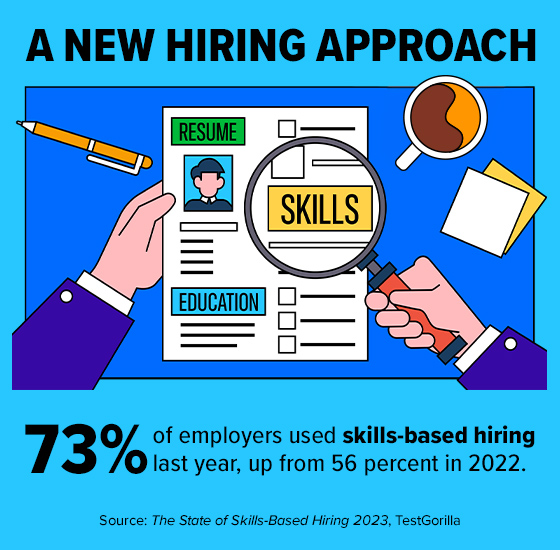
Hawthorne says the company needs time to outline what skills are necessary for each role and train interviewers to focus on capabilities rather than hallmarks like education and years of experience, which has been the norm.
Discerning equitable pay may also be an issue. For example, an employee who was required to have a college degree and a certain amount of experience for a job may balk when they learn someone who doesn’t have a degree and who has less experience is earning the same amount of money. Hawthorne says that situation could lead someone to allege age discrimination.
“I’m calling them barriers,” Hawthorne says. “I don’t think they are deal breakers. I think there are obstacles that organizations need to heavily consider and to have good change management plans around before they rip the Band-Aid off and make these changes.”
BMS’s Raffray said the company spent considerable time and effort educating staff about the new approach. As part of the pilot program, BMS also set up a platform that makes it easier for its employees to identify and apply for open positions. Raffray says BMS noticed there wasn’t much internal movement at the company and hopes skills-based hiring will facilitate people changing jobs.
Raffray believes the early effort has been a success. The company has hired individuals who have experience creating other types of specialized drugs, and the skills-based approach has even shortened the time-to-hire by a few days. Last September, BMS expanded skills-based hiring to other departments, including human resources and IT.
BMS is considering other departments where the skills-based approach can be implemented, says Raffray, adding there will always be roles that require degrees and specialized knowledge. “There will always be places where you can’t compromise,” Raffray says.
AI Booster
Indeed, IBM, a pioneer in skills-based hiring, still requires degrees for 50 percent of its roles. It started using the approach about seven years ago when it was having difficulty finding individuals to fill open positions, says Chris Foltz, chief talent officer at the Armonk, N.Y.-based tech company.
The half-life of skills is expiring faster and faster. You have to continuously refine and upskill [talent].”
Chris Foltz
Foltz says that besides looking at skills when hiring people, the company also wants to find individuals with a learning mindset.
“The half-life of skills is expiring faster and faster,” Foltz says. “You have to continuously refine and upskill (talent). We’re looking for talent that is eager to learn and excited to grow.”
IBM’s dedication to skills-based talent is essential now as it looks for individuals who can work in AI, a new field lacking individuals with vast experience.
“You have to have a broader aperture [for finding talent] because these skills are fresh, new, evolving, growing every day,” Foltz says. “You want to be competitive in this talent market.”
Theresa Agovino is the workplace editor for SHRM.
 |
In years past, having a college degree was required for almost every salaried job—and many hourly jobs, as well. Candidates who didn’t have a degree often would lose out on opportunities and struggle to advance their careers. Recently, widespread talent shortages and several other cultural shifts have prompted more employers to revisit that requirement. About two-thirds of working-age adults (64 percent) do not hold a bachelor’s degree, and undergraduate college enrollment fell by 8 percent from 2019 to 2022. The share of jobs that require a college degree fell to 44 percent last year, down from 51 percent in 2017, according to research from the Burning Glass Institute. As a result, major employers such as Dell, IBM and Bank of America have eliminated the college degree requirement for many jobs, and many other businesses are following suit. “College degrees are incredibly expensive, and the costs continue to rise,” says Kim Jones, vice president of human resources at Toshiba America Business Solutions in Lake Forest, Calif., which employs more than 2,000 workers. “Many people are deciding not to sign up for lifelong student debt.” While Jones believes there is value in a traditional college education, not requiring a degree often makes workplaces more diverse. “Everyone doesn’t need to have the same background,” she said. “Diversity of thought builds strong teams and creates successful businesses.” At Boston-based Liberty Mutual, the college degree requirement was dropped for entry-level positions in 2017 to open the doors for people of different backgrounds. “A college degree continues to be valuable, but it isn’t accessible to everyone, and we want to ensure equity in our hiring process,” says Maura Quinn, vice president of early career; diversity, equity and inclusion; and talent acquisition programs at the insurance provider, which boasts 35,000 U.S. employees. “There are many ways people can learn and build new skills, which is why we’ve expanded beyond four-year degree programs. Talent is everywhere, but opportunity is not.” In the past, Leyda Lazo, SHRM-SCP, says she placed a significant emphasis on candidates having college degrees, but she recently changed her tune. “Our organizational focus began to shift in 2018 as a result of our concentrated diversity and inclusion efforts,” says Lazo, an HR consultant at Human Capital Consultants International in Miramar, Fla., who oversees a team of 27 consultants. “We recognized that the requirement for a college degree might inadvertently exclude exceptionally talented individuals from underprivileged backgrounds who might not have had equal access to higher education opportunities.” Compounding the issue has been the lack of available workers, which Lazo says convinced her to focus on candidates’ skills rather than degrees. “The ongoing labor shortage has undoubtedly played a role in catalyzing our shift,” she says. “In sectors like logistics and transportation, there’s a distinct scarcity of skilled workers. Emphasizing skills over degrees enables us to bridge these gaps in a more expedient and effective manner.” — Kylie Ora Lobell |
Related Articles

Transform HR with mobile technology to streamline workflows, enhance communication, and boost employee engagement across distributed teams.

A new study found that talent development practitioners believe performance-based assessments are more effective at measuring employee learning outcomes than knowledge tests.

As AI makes deeper inroads into organizations, employee concerns about the technology continue to grow. Here's how HR leaders can address the fear of AI among their own staff, as well as in the wider organization.