- Video
- Audio Only
The hiring process is undergoing a seismic shift as AI takes center stage. With companies automating recruitment and job seekers leveraging AI to stand out, the question remains: who’s really making the decisions? Marcus Sawyerr, founder and CEO of EQ.app, shares how organizations can balance efficiency with humanity. From the decline of resumes to the rise of skills-based hiring, discover how AI is reshaping recruitment and what it means for the future of work.
This episode is sponsored by:

Explore the 2026 Salary Guide From Robert Half to view salary information for over 425 roles, as well as the latest trends in hiring, benefits, and the workplace.
Related AI+HI Resources:
The AI+HI Project 2026
At The AI + HI Project 2026, you won't just hear about AI, you'll use it. From hands-on demonstrations to peer-driven innovation labs, every part of your experience is infused with AI to elevate your learning, your network, and your impact.
AI+HI Specialty Credential
Master the intersection of artificial intelligence and human intelligence to lead innovation and equip yourself with practical, ethical, and strategic tools to implement AI solutions with confidence.
The podcast is just the beginning. The weekly AI+HI Project newsletter features articles on AI trends that are redefining the future of work. Explore these must-read insights from the latest issue. Subscribe now to start turning AI+HI into maximum ROI.
News + Insights

SHRM's AI+HI executive in residence summarizes how AI's impact on work as we know it continues to widen.

GenAI is disrupting entry-level roles and career paths in highly skilled professions. Get insights into designing a workforce strategy for alternative pathways.

AI tools can help health care organizations predict and prevent workplace violence, protecting staff well-being and improving patient safety.

As AI hype surges, HR teams face a harsh reality. Learn how grounded, staff-built tools — not grand promises — deliver real transformation.
Podcast Episode Guest
-

Marcus Sawyerr
Marcus Sawyerr is a pioneering force in AI and the staffing and recruitment industry, with over 19 years of experience in driving innovation. As the Founder & CEO of EQ.app, Marcus is dedicated to leveraging AI to build inclusive talent communities. His career includes a significant decade at Careerbuilder.com, where he developed his expertise in sales and technology. Marcus became a Global Fortune 500 Executive at The Adecco Group, leading digital business transformations as Global President of Adecco X. He has been pivotal in buying, building, and investing in staffing & recruitment technology & a Limited Partner in venture capital at Semper Virens. Recognized as a Top 100 Most Influential Industry Leader by Staffing Industry Analysts in 2018 and a DE&I influencer in 2023, Marcus continues to champion diversity and innovation across the recruitment landscape.
Episode Transcript
This transcript has been generated by AI and may contain slight discrepancies from the audio or video recording.
Nichol: The hiring process is becoming increasingly automated with companies using AI to screen candidates and job seekers leveraging AI to mass apply to roles, but with bots on both sides of the equation. Who is really making the hiring decisions?
To help us unpack what we're seeing in SHRM's new 2026 trends and priorities report, we're thrilled to welcome Marcus Sawyerr, a global leader in HR technology, and the founder and CEO of EQ app. Marcus has been at the forefront of innovation and talent acquisition, and he's here to share his insights on how organizations can balance efficiency with humanity in the hiring process and the role of AI in addressing labor shortages and what the future holds for recruitment. Marcus, welcome to the AI+HI project.
Marcus: Thanks for having me. Really excited to have this discussion and looking forward to diving right in.
Nichol: Likewise. So to get started, I'm going to set the stage with the state of recruitment today. And that's our first batch of questions. So, you know, we both have seen the headlines. And then you're also in this space with both employers and job seekers increasingly using AI tools. Who do you think is truly making hiring decisions in this automated landscape?
Marcus: Yeah, so I'd like to provide a bit of context as well. So I've been in the HR tech and recruiting space for the last 18 years, and I first started by trying to convince people that it was better to advertise on the internet instead of in a newspaper. And that was in the job board era.
At that time we had a similar concern because when I first started in the job board era, you could only apply for one job at a time, right? You'd go in and you'd apply for one job at a time. And then what used to happen as time went on and it evolved was that as a candidate you could apply for multiple jobs and you started to see the flood of applications.
The way that the job boards got paid at that point in time is they got paid on something which we called EOI, expression of interest, which wasn't actually an application. And so you started to see the floods of applications and then the job boards started to add screening questions to it. Candidates started to stuff their resumes with keywords.
And so I'm seeing a similar pattern take place. And it's, to your point, Nichol, it's somewhat of an arms race at the start, but it will even out. And I think that on one hand you've got candidates that are using AI right now to make sure that their resume looks the part for the applicant tracking system or whatever system the employer is using. And on the other hand, you've got employers that are using sourcing, screening and scheduling through AI.
And really what's going on is there's a bit of a dance happening and no one's getting to the end of this dance with any success at this point in time. But the equalizer will be the matching. And the equalizer will also be the opportunity to connect with the right person at the right time.
So I think that we are seeing the resume being degraded, and I think we're seeing job descriptions being degraded and what's going to be more important is the connection with the person. So that's kind of a high level perspective on how I look at things.
Nichol: I want to double click on that, the connection with the person. Could you describe more what that is and how do you see that evolving over the next two to three years for someone who's a job seeker out there who's listening to this, or someone who is in recruitment for a company?
Marcus: Yeah, I think we've gotten lost in what the point of recruiting actually is. So I've been on both sides, right? The job board side, working for a large staffing agency, and then also building AI. And the idea, the reason that we had online applications to start with, or the reason that you apply for a role is to get connected to a person in the end where there'll be some kind of evaluation to see whether or not you are the right person for that job.
What we are seeing at the moment is we are seeing that you have the right resume, but not necessarily the right candidate. And I think I was speaking to one of our clients recently and they were in the recruiting space in the agency space, and they were saying the same thing. So now the hiring managers who actually receive the candidates in the end are not receiving the people that they expect in that interview process.
And we're also seeing candidate...
Nichol: Ah, yeah.
Marcus: ...increase.
Nichol: Yeah. So based on the description, you're like, wow, this person is a miracle. I'm so excited. And then the person who comes in, you're like, oh, that's not what I was expecting in terms of capabilities.
Marcus: Right. And I think that the candidates have accelerated that more at this point in time because of the job market. So the job market has obviously shifted, and if we look at supply and demand, people will do anything to get in front of somebody. That has a negative impact not only on the time that you waste as a candidate, because you're actually maybe getting in front of people that may not hire you. And then also you're wasting time on the side of the hiring manager.
So the quality of the match, I think we're going to start seeing more verification coming around the profile of who the person actually says that they are. And I think that would be one part of it. But there are other parts as well that we can unpack.
Nichol: So interesting. But just to circle back to the first question, to make sure we cover it, do you get the sense that hiring decisions are that some organizations are actually even automating hiring decisions or we're not there yet?
Marcus: No, I think that the final decision as far as you working as an FTE for an organization, it's still down to a person. But the challenge is if you have automation on both sides all the way through from sourcing, screening to scheduling, you may be either automating people out or automating people in.
And the thing about AI is it's a great multiplier, and I think we'll get onto this topic around bias. So if you are biased, it's going to multiply that. If you're non-biased, it may multiply that. Now everybody has a certain sense of bias, but I don't think we've done enough due diligence on inspecting what we expect in the hiring process.
And so companies are going to have to start to get an understanding of really what it is that they would like to see with somebody not on a resume when they're actually working in the job. And that's completely different. We all know people that can interview really well, we all know people that can write a resume really well and they're not great at the job.
There's an equalizer there as well because people now who may not have gotten in front of people can write a better resume. But then on the other side, it still starts to perpetuate as far as people who are not necessarily got the qualifications or the skills that you need for that particular job, fabricating that somewhat further.
So I think that we are in flux at this point. And I think that we are moving to a track, which I'll call A2A. So you're going to have agent to agent and I can talk a little bit more about that in a second. But that's where we're headed.
Nichol: Okay. Well, I want to talk about how recruiters can effectively identify and engage with the best candidates. Given this overwhelming flood that we've talked about. And I think you were approaching it when we talked about connecting with the right person at the right time and then breaking that down. Like how do recruiters really engage with the right candidate, given what's happening with AI?
Marcus: Yeah, so for me, and I'll talk a little bit about how I hire and then also how our companies hire that we partner with. For me, the interview starts or the connection starts with the first time that somebody reaches out to you, whether that's an email, or whether or not that is an application online.
I'll give an example. Just yesterday I had somebody that I was in the car, I was coming back from a meeting and I was meant to have a Zoom call, but I couldn't jump on it because of the car. Anyway, somebody had reached out, they'd seen in my calendar link there was a 15 minute schedule.
Now I had assumed it was a business conversation, so I have 15 minutes where people can connect, but it was a candidate and he had said to me, oh, I just reached out because I'd seen that there was a note on your calendar link. And I was like, okay, this is not necessarily the channel I normally connect with candidates, and my team to then go. But he caught my attention on the call.
So we continued the discussion and he told me a couple of things that he was doing and how things were working, and I felt that he was personable. So I said, you know what? I'll call you back in 30 minutes when I get back in. On one hand I was a little bit like you circumvented the process. On the other hand, I was like, you used your guile and your savvy and your kindness in order to do that. And that's the type of person that I'm looking for.
And so I think that candidates have to think, they have to be creative. So if everybody's going left, you want to go right. And one of the things that we are seeing with candidates is we are giving them access to the hiring managers. Why not reach out to the hiring manager and send a note? Not an automated note, but a personal note on why you think you are a great fit for the role. And if people believe that that's a genuine message and it's not AI generated, you are going to have a better chance of having an opportunity.
Nichol: Yeah, I call it the people pile. So there's the people pile. And how do you get out of the people pile? And the people pile used to only have 30 resumes in it, and then after that, maybe it had 100 resumes in it. Then after that, maybe it had 500 resumes in it. Now the people pile has 5,000 resumes in it, so getting out of the people pile.
And it's by, you know, one absolutely like your interactions. Especially like if, you know, one, it's like being very thoughtful and diligent about like, where do you really want to be? And I know that's hard in a tough job market to think about it like that, but that's going to be the fit where you have the greatest or that's going to be the likelihood of having the greatest fit. And then, you know, every single interaction has to be very human, especially if you're very serious about it.
And then, you know, how does one get out of the people pile? Like I was advising a nephew of mine to about builds and, you know, and having GitHub rooms where, you know, whatever, whatever you're interested in doing. And it's not just technical. You can build something that sort of expresses your interest and it doesn't even have to be good. It's like, did you build it? And can you walk someone through your thought process on how you did it? So it's going to be things like that, that help people get out of the people pile.
Marcus: Yeah, I was just going to double click on what you just mentioned there because I completely agree. As far as being able to provide some evidence as well of the quality in your capabilities. And I think that that has been underlooked.
And if we talk about AI, it's not that AI is, I mean, look, we sell AI as a service and a solution, and we allow people to get access to it, but I think you want to be less of a user of AI, more of a manager of AI and the way that you do that is you think about how you can weave AI into the key important parts of you being able to connect with someone.
And one of the things that I would recommend for everybody to do, whether that's an employer or whether that's a candidate, is use it for deep research. Who you are meeting with, maybe what they're interested in, and then think about how you can articulate your message that's going to be tailored to them. And if you reach out to 20 people a day in that particular way, I think you're going to have a lot more success than maybe going through the standard channels and also go through the standard channels as well. Say, hey, I've just applied and this is what I also thought, and these are the reasons why I wanted to reach out to you as well.
Nichol: Yeah. Wonderful. And it makes me think of some SHRM research that I was looking at the other day where we see that 32.7% of job openings in July of this year, 2025 couldn't be filled due to occupational mismatch. And so, you know, you talked a little bit about the right candidate for the right spot and you know, really making sure there's a match and you know, so how can organizations ensure that we don't miss out on top talent in a constrained labor market because of this occupational mismatch?
Marcus: Yeah, I think it goes back to having a clear set of principles around what you are actually hiring for. And so we can talk about, and I know that there's been a lot of talk about skills-based hiring, right? And there's some questions around that moving forward, because a lot of AI can deliver some of the skills now, and we can double click on what that means.
But I think that there are certain human elements around competencies, traits, resourcefulness characteristics, grit, determination that you have to get better at assessing. And if you continue to hire people for what you think they had done, because you don't know that they've done it because they're providing some information versus what you think they can do, you are always going to be at a loss.
And so even if you think of the best sports teams they hire on what they think that that player, that individual, that person can do in the future. I bring you onto my team because I think you can deliver something future. And I think we have to get better at predicting how people will perform.
Now, the challenge in an organization is it's not just about the individual performance and like a team, it's about the team dynamics. How are you going to fit into the team? And because we're at a moment of uncertainty and people are still trying to figure out their strategy, they're trying to have a better understanding of what the prediction will be from their team.
So it comes back from the top. What are we trying to achieve? Who are the players that we need in our team? How do we organize? And then how do we deliver? And then how do we make sure that we've got agility within that team so we can have people overlapping or moving from different positions and different roles.
And I think it's just a mindset of people are not going to be in the same job for 30 years anymore. They might be in a job for six months. They might be in a job for eight months, but they might be in another job in your organization doing something different because they've moved along. So how are you helping them do that? Internal mobility, maybe if we want to put a wrapper on it.
Nichol: Yeah, I'm so aligned with that. So one of the things, many people may not know about me is that when I started in technology out of graduate school, I was in video games. And one of the things that I'm most known for is I operated, I led operations for all of the Blizzard Entertainment properties for China. So that means I operated World of Warcraft China, StarCraft China.
And you know, one of the things that you said that really resonated is that we are talking about, like, people are talking about skills-based hiring as high ground. And for right now it is. And it's, you know, being used for also this, you know, some of the mismatch in order to find the adjacent skills where someone, you know, it's like hiring for the future, hiring for skills that people actually have, et cetera.
But there isn't anyone who works with AI or works with these models on a regular basis or a daily basis who can say to anyone with a straight face that we actually know where the skills shoreline is for these models that we can say definitively, they will be able to do that skill and they won't be able to do that skill. So we don't really even know.
So where I really agree with you is that there's states and traits that are the timeless ones, approaches. And so I tell people the top two survival skills in the age of AI is adaptability and ideation, which is creative iteration, and then learning and change, and leadership is being someone who can walk into the room or onto the team and your presence there, no matter what level you are on the team, your presence there creates a learning environment and a changing environment.
And I love what you said. It's like, it's so true. And I really haven't heard anyone say it just like that before, that it's like, so much of hiring is like, we look at what someone has done in the past, which we can no longer verify or it gets really hard. As opposed to what are they going to be able to do in the future in the context of this team?
So, you know, one of the things that's interesting is it's sort of like commercial game environments actually teach, or actually like, you know, it's ideation, iteration, problem solving, team building. So it's not specific skills, but it's like states and traits. So one of the things that I predict will happen is that we're going to start using not gamification, but commercial game environments as a way to assess, observe, and spark these particular states and traits. So, but that was a little bit of an aside, but it's like, yes, yes, yes. Click, click, click.
Marcus: Well, it was interesting. So the person I actually spoke to yesterday that I was talking about that had called me while I was driving, they were a Call of Duty US National Champion. So they were a Call of Duty gamer. They were a national champ. And when he told me that, I was like, oh, let's continue the discussion. And that was like one of the first things that came out, which was he said, yeah, I actually got my TikTok to 50,000 within a short space. And he was a young person.
And it was him talking about the evidence and what I noticed with game design and also building AI models myself. Having to have systems thinking, you need to have an idea of predicting what people will do in that scenario when you put, whether it's yourself or your AI into a situation, how it will behave.
So I think as humans, we have to start to really understand game theory. So I agree with you as part of the learning process or the application process and the assessment process, game theory determines how people will operate in a certain scenario because there are dynamics at play that you can't predict. You can't predict what all the other players are going to do all the time, and that's the market. That's the market. That's why you're hired.
You are hired to add value to an organization to create shareholder value for your company. That's why the CEO has given a mandate for your particular team to say, you can hire these people because you're either going to create ideas, to your point, Nichol, you're going to create intellectual property and that will allow you to have improvements to the three I's, which I talked about just today. And as you say, it just makes me think that we have to think about what we can do into the future, not what we have done, and I think that will serve many people well.
Nichol: Well, so you know, in thinking about a future where opportunity or the opportunity to access opportunity is available to all. I'd love to hear your thoughts on bias in AI hiring tools. You know, like, how big of a problem is it? How do we fix it? And just sort of like, what are the steps that we take to make sure that we're not optimizing people out unintentionally?
Marcus: Yeah, so I think one of the challenges at the moment, because there's been an influx of AI tools, people have used a tool to solve something that needed a solution. And what that then does is it perpetuates the challenge, right? Like if you think everything is a nail, use a hammer all the time.
And so people don't have the right solutions to solve for bias. And also what's happening at the moment is companies are being given tools by third parties and they don't know what's inside of those tools. It's almost like buying something to eat and you don't know what the ingredients are and you don't know how it was made. Like there's no, you don't know how many calories are in there. You just eat the thing.
And I think if that continues, companies won't know how to unravel that. So one of the things I always say is that you, again, if you have a certain set of principles, and we are helping companies train AI models themselves for hiring so they understand how it's been trained. And if you do that and you get involved in that because think of an AI model or if you think of an AI agent, which is something that we get involved in a lot as an extension of your team.
When you are training your team, you give your team what I call OTT, you give them an objective, this is what I would like you to achieve. You give them tasks, this is how I want you to do it, and you give them tools. Here's my ATS, here's my CRM, here's our email. It's the same with an agent. And then you also give them guardrails. Here are company policies. This is how you operate. This is what we expect.
So there's always going to be bias and bias is not actually a bad word, because bias is used for judgment. The challenge is understanding that bias and being honest about it. The fact that you are using bias. I may have a bias towards somebody, like we were talking about this on video games or game design. I might have a bias towards grit or determination.
When you start to use bias as a way to filter people out versus filter people in, I think that's where you have a challenge because you actually miss out on a lot of people. And I think a lot of people have thought inclusion, diversity, equity is around narrowing down the funnel. It's actually about opening it up. And once you open up the funnel, you have more opportunities for you and your organization to thrive. So I think that you want to think about that. Are you narrowing down the funnel in the wrong way to exclude people from the conversation?
Nichol: Yeah, absolutely. You know, we've talked about the change in assessment and how people have to be future focused instead of the past. And we've talked about verifying skills by what people have actually done. What do you think about certifications? Are we going to do certifications and additional external credentials, or will it be something else to sort of like verify abilities?
Marcus: Yeah, so I may not be the best person to ask for this because I'm somebody that became a Fortune 500 executive by 30 without a college degree. And I say to say that, I'm more about the evidence. Can you actually do the job?
Even somebody we hired recently didn't have the certifications. They came through a program. Rather than you doing a certificate here, I'll give you two months. I'll invest your salary for two months. Let's see what you can do. So I think that maybe it's contract or it's temp to perm, or it's bringing people on for a trial. Give them an opportunity and see what they can do. Because by the time you deliberate and you go back and forth, that's going to be a challenge.
That's how I got my opportunity even at CareerBuilder.com, which is no longer here, but shout out to them. They used to take like hundreds of people and then it was survival of the fittest. It was like Squid Games, right? And every week I would see people go and get fired because they couldn't do the work. So give people an opportunity to do the work and see what they can deliver. And I think that you'll be pleasantly surprised and I think that is the assessment.
Nichol: Great. And what about, so the SHRM audience is in 180 countries. We have 340,000 more than that members around the world. So what about AI recruitment and cross border? Like what do you think will happen with cross-border recruitment?
Marcus: Yeah, I was speaking to a company recently and what they're finding, let's take in particular the AI market itself. Companies are also now, as they were historically, when software came out, they were hiring software engineers. Now people are hiring folks with AI expertise. Back in the day, when you look at a resume, you wanted to make sure that somebody had proficiency in Microsoft and Excel. You are going to see that people are going to have proficiency within leveraging AI tools.
So I think that's going to be a big standout if you can show that you can leverage AI. It doesn't matter what market you are in. You are showing that if you are good at your job, let's say, let's take somebody that's really good at their job, plus they can leverage AI, and then let's take somebody that's really good at their job. If you hire the person that's really good and can leverage AI, you've actually just hired 10 people.
So I think that in a global market really sharpening and showing your AI skills and how you can add value in a market where maybe the supply is lower for the skill that you have, and then you become more in demand. So you want to move in markets that are less saturated. The demand outweighs the supply, and that's where your unique advantage is. There's so many companies trying to do their AI transformation.
Nichol: Great. Okay, so last question. At the top of our conversation, you said that this overwhelming surge of AI applications and AI screening that's not really serving anyone will balance out. When, like, what's your prediction? How long is it going to take for us to really integrate this and for both applicants and organizations to know how to use it well?
Marcus: Yeah, I think it's a bigger strategic question, which I'll go back to saying is like, once companies figure out how to leverage AI and what they actually need, they'll know what they're looking for. If you don't know what you need, you won't be able to figure out what you're looking for. And so it comes back to core purpose. If you've got your core purpose, set of principles, you understand the purpose, you always know what you need, and you have those principles and go from there.
So companies, you've got to get your AI strategy down, then you can figure out what the team is and the organization and then go from there. And then candidates will be clearer on how they can engage with you.
Nichol: Great. Great. Okay, so one last rapid fire question that we like to ask. What's the one thing you'd ban from job descriptions forever if you could?
Marcus: A college degree.
Nichol: Yeah, and what's the first thing you notice on a resume?
Marcus: The way it's structured.
Nichol: And what is the most overused buzzword in recruitment right now?
Marcus: AI probably.
Nichol: Totally. Totally. That was so great. Absolutely. Thank you so much, Marcus, for your time. That's it for this week's episode, but we're not done with this conversation yet. Next week we're going to be flipping the script and looking at this topic from the applicant's point of view. How are job seekers navigating this AI driven hiring landscape and what strategies are they using to get out of the people pile and stand out in a world of bots and algorithms?
You won't want to miss it. Make sure you join us next week for part two of the conversation. Until then, thanks for joining us and we'll catch you next time.
Feature Story
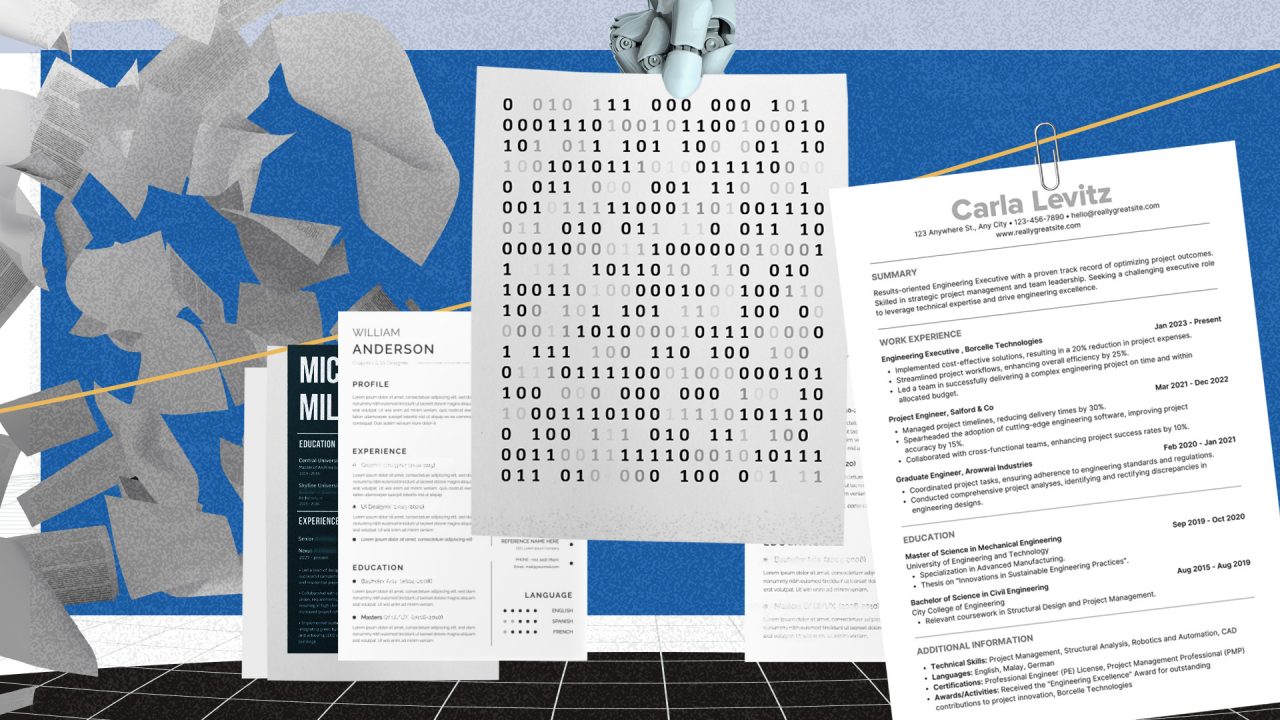
AI is reshaping hiring, but not always for the better. Employers and job seekers are caught in an automation standoff that’s eroding trust, fairness, and human connection.
Enjoy on Your Favorite App
More AI Headlines from SHRM

Learn how AI can audit employee goals, identify common weaknesses, assess alignment with organizational priorities, and uncover conflicting goals.

Learn how AI can analyze engagement survey comments to identify key themes, compare feedback with survey scores, and uncover workplace concerns.

Learn how AI can analyze exit surveys and interviews to identify turnover trends, uncover workplace issues, and highlight opportunities for improvement.