EXECUTIVE SUMMARY
In 2021, SHRM, in collaboration with the SHRM Foundation and Walmart, conducted a study on the state of skilled credentials in the workplace. The resulting reports, The Rise of Skilled Credentials in Hiring and Making Skilled Credentials Work, provided critical insights into how organizations and HR professionals were beginning to recognize and integrate nondegree credentials into their talent strategies. The findings highlighted an emerging shift away from traditional educational requirements toward a more inclusive approach that focused on skilled credentials.
The landscape of talent acquisition and retention has evolved significantly since then. The concept of skilled credentials has broadened into a more comprehensive strategy known as skills-first talent management. This new approach prioritizes candidates’ abilities and competencies, regardless of where these skills were acquired, fundamentally reshaping how organizations attract, develop, and retain talent. It also outlines strategies for using a skills-first mindset not only in recruitment and hiring, but also in onboarding, career pathing, day-to-day management, and even succession planning.
Given this evolution, SHRM and the SHRM Foundation, with funding from Walmart, conducted a follow-up study in 2025 to understand the current state of skills-first practices.1 The purpose of this new research is to measure the progress made, identify persistent challenges, and equip HR professionals with the data-driven insights needed to champion skills-first hiring within their organizations. This report draws comparisons to the 2021 benchmarking data where possible, but much of the 2025 research presents new findings, offering fresh insights into how the world of work is evolving toward a skills-based future.
OUR PERSPECTIVES
Key Findings
Relevant Skills and Work Experience Lead Hiring Decisions
HR professionals and supervisors ranked relevant work experience and demonstrated skills and competencies as the top factors when deciding who to hire, ahead of other considerations such as educational background and interview performance.
Skills-First Hiring Is Gaining Momentum
Over one-third of organizations (34%) reported often or almost always using skills-first strategies in their hiring processes. Among those who never or rarely use them, more than half (55%) expressed interest in adopting these strategies.
AI is Reshaping Skills Demands
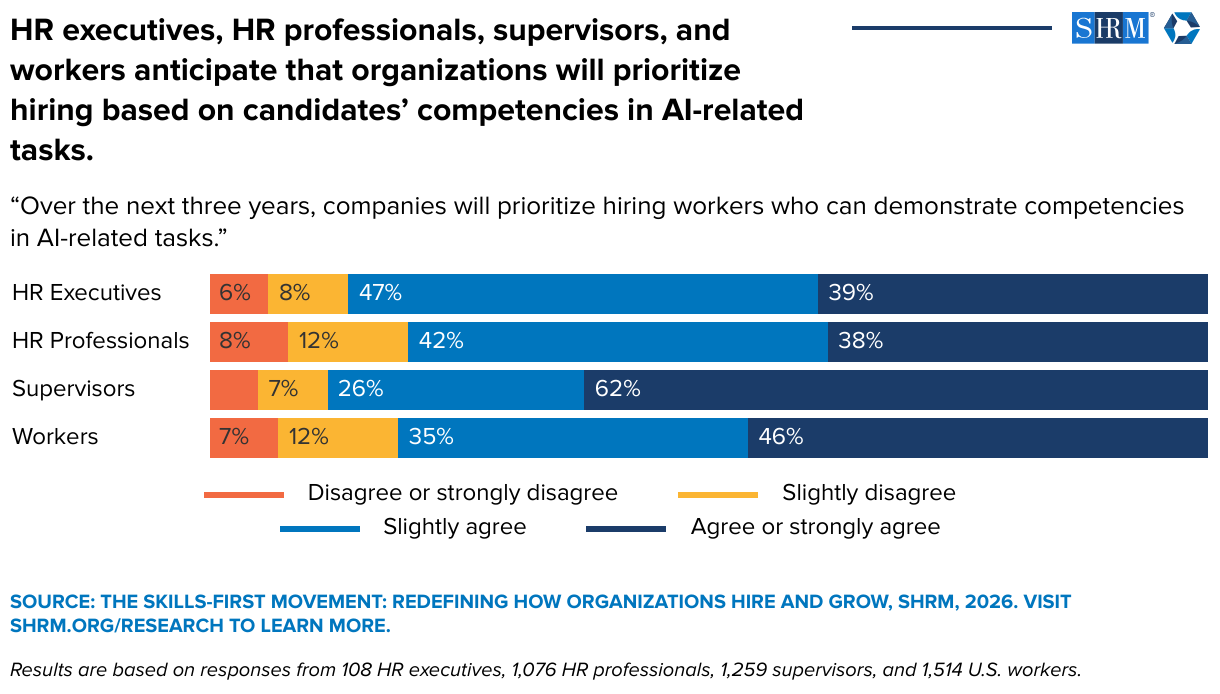
Over 80% of HR professionals, HR executives, supervisors, and workers agreed that artificial intelligence will change which skills are valued, and 80% of HR professionals said they expect companies to prioritize hiring workers with AI-related competencies in the next three years.
Technical and Power Skills Remain Vital
As the demand for AI-related competencies rises, many HR professionals said they believe this will only create a greater need for proficiency in technical (75%) and power skills (84%).2
Skills-First Hiring Delivers Positive Business Outcomes
Organizations that often or always use skills-first strategies were more likely than organizations that do not use these strategies to exceed financial objectives (35% versus 27%) and report positive company culture (86% versus 78%).
Upskilling Drives Better Employee Experience
Workers who said their organizations promote upskilling opportunities throughout the year were significantly more likely than workers who said their organizations do not promote such opportunities to feel engaged at work (59% versus 31%), satisfied with their jobs (59% versus 37%), and committed to their organizations (61% versus 47%).
The Skills Transition From 2021 to 2025
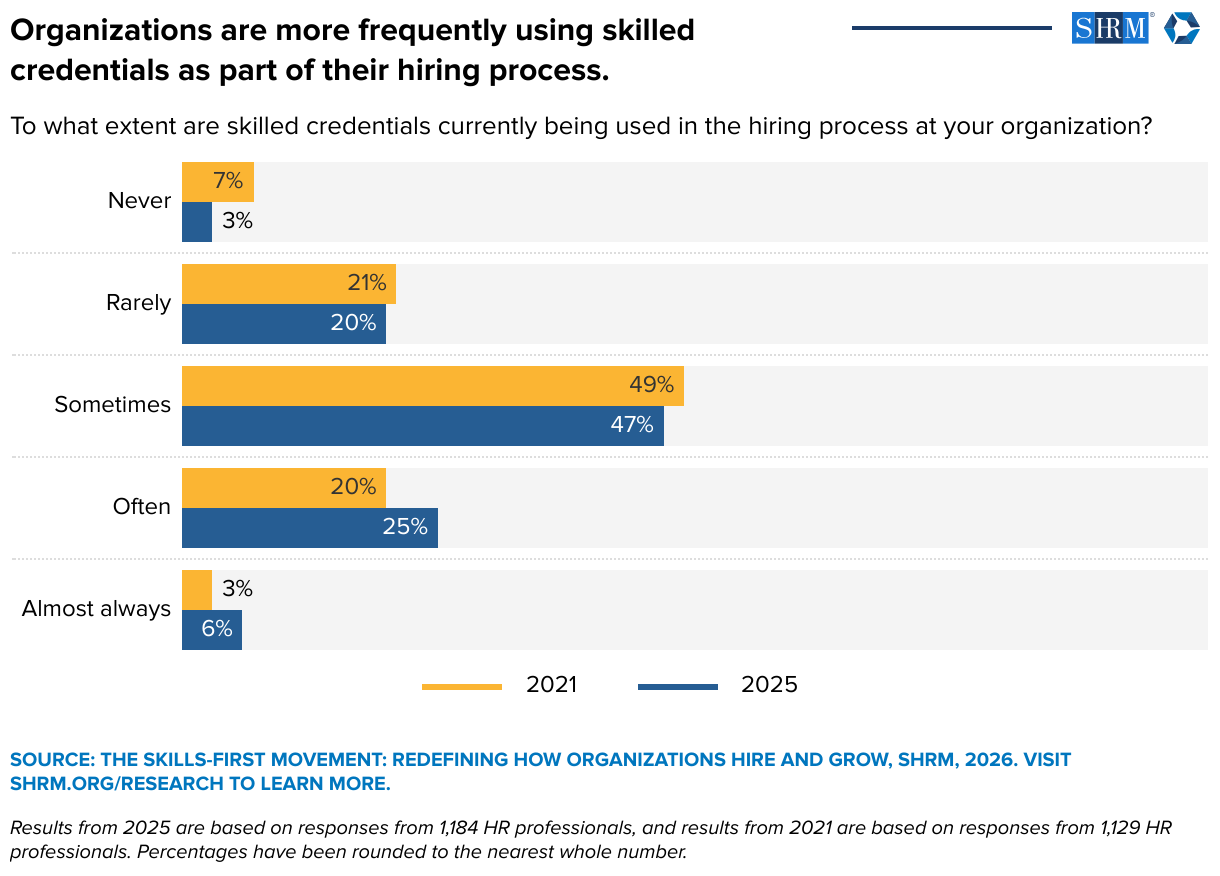
Since 2021, the workplace has experienced notable changes in how skilled, or nondegree, credentials are viewed. Earlier data from 2021 indicated that organizations were just beginning to recognize the value of these credentials. According to Strada Education Network, in 2021, 2 in 5 working-age adults (40%) had a nondegree credential and 1 in 5 (20%) reported it to be their highest level of education. By 2025, a clear shift emerged: Skilled credentials are not only recognized but are increasingly used in hiring decisions. In 2025, over 3 in 4 HR professionals (78%) reported that skilled credentials are used sometimes, often, or almost always in their hiring processes, up from 72% in 2021. This indicates a growing integration of these qualifications into standard hiring practices.
What Are Skilled Credentials?
Skilled credentials, sometimes referred to as alternative or nondegree credentials, can be defined as any micro-credential, industry or professional certification, acknowledgment of apprenticeship (registered or nonregistered), or badging that indicates one’s competencies and skills within a particular field. Skilled credentials do not include traditional academic degrees or required occupational licensures (e.g., medical licenses or law licenses).
As organizations increasingly integrate skilled credentials into their hiring practices, job applicants are, in parallel, keeping pace by presenting these credentials more frequently. In 2025, 87% of HR professionals reported encountering applicants with skilled credentials sometimes, often, or almost always, a 10-percentage-point increase from 2021 (77%). This growth highlights a mutual shift toward skilled credentials, underscoring the growing prevalence of skills as an important consideration in the current hiring landscape.

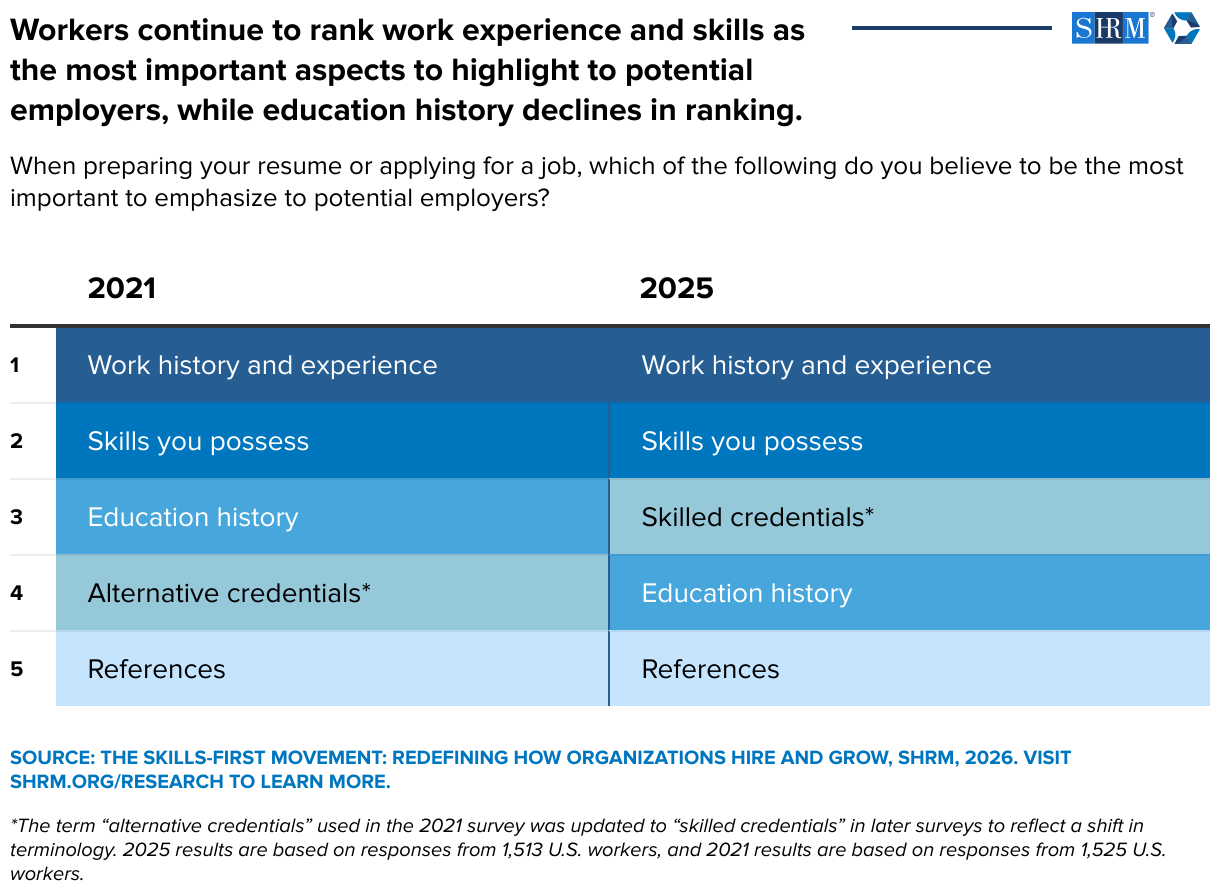
What’s more, the factors that previously defined the selection process are being re-evaluated. This shift is clearly reflected in the hiring priorities of both HR professionals and supervisors when comparing data from 2021 to 2025. This change marks a move away from traditional credentials and highlights an emerging emphasis on skills and relevant experience as the primary drivers in hiring decisions. When making hiring decisions, both HR professionals and supervisors said their organizations now place the highest value on candidates’ relevant skills and practical experience.

At the same time, the weight once given to educational background has also declined in importance from four years ago:
- For HR professionals: In 2021, educational background was the fourth most important factor in hiring. By 2025, it dropped to sixth.
- For supervisors: College degrees fell from the third most important factor in 2021 to sixth place in 2025.
- For workers: Workers echoed this sentiment in 2025, ranking educational background as only the fourth most important factor to emphasize to potential employers, a decrease from its No. 3 spot in 2021.
The Challenge of Validating Skills Through Credentials
The number of unique credentials in the U.S. has grown dramatically in recent years. In 2018, there were 334,114 distinct credentials, and, by 2020, that figure had nearly tripled to 967,734. As of 2025, this number had grown to over 1.85 million unique credentials, signaling their enduring popularity among workers who wanted to hone their skills and become more marketable in a challenging labor market amid the COVID-19 pandemic. This surge in credential types also introduced complexity for employers: They were often unsure how to evaluate their quality, a challenge that remains today. In 2025, nearly 1 in 4 HR professionals (24%) and HR executives (26%) as well as 1 in 3 (33%) supervisors reported that it is too difficult to determine the quality of skills received from skilled credentials. This is a significant hurdle because the ability to determine a credential’s quality heavily influences its use in hiring. In fact, 65% of HR professionals and 90% of supervisors stated that the ability to verify a credential’s quality has a moderate to very high impact on their decision to consider it in hiring decisions.
This uncertainty persists even as the number of workers reporting that they hold at least one skilled credential has grown over the last four years, from 45% in 2021 to 70% today. Yet, the gap between recognizing the value of credentials and confidently using them as a standard for hiring continues to slow the adoption of a skills-first approach and add complexity to talent decisions. In addition, beyond the evaluation process, candidates encounter their own set of barriers when pursuing skilled credentials.
The Barriers to Obtaining Skilled Credentials
Organizations continue to recognize the value of skilled credentials and encourage their workforces to pursue them but are not necessarily investing time or money in directly reducing barriers and increasing uptake of such credentials. Despite a slight decrease from 78% in 2021, 73% of organizations continue to promote the attainment of skilled credentials among their employees. In many cases, however, employers do not value the attainment of skilled credentials enough to subsidize it; among workers who hold a skilled credential, only 36% reported that their employers helped them pay for it, either fully (29%) or partially (7%).
Among workers who currently do not hold a skilled credential, the leading reasons fall into two broad categories: limitations in resources and perceptions of relevance. Resource constraints are common barriers, with cost cited by 34% of respondents, followed by the time required to prepare for and complete a credential (20%) as well as competing work responsibilities (17%). Perceived relevance also plays a large role: 1 in 4 workers said they have never considered obtaining a credential (26%), while 1 in 4 believe it is not necessary for their current job (25%) or not relevant to their career goals (23%). Together, these findings highlight that both practical challenges and questions about value continue to slow credential attainment and adoption.

This runs counter to employers’ perceptions of such credentials. Among supervisors and HR professionals, demonstrable and relevant skills and competencies were the top considerations in hiring decisions in 2025, and employers are placing greater value on demonstrated abilities than they did four years ago, making skills even more central to hiring and advancement decisions.
In the 2021 study, a worker was defined as an employee without direct reports. For the purpose of making year-after-year comparisons, this current study uses the following definitions to align with the previous study:
Worker: An individual contributor without direct reports.
Supervisor or manager: An employee with at least one direct report.
HR professional: A human resources professional at the individual contributor, manager, or director level.
HR executive: A human resources professional at the vice president, C-suite officer, or CEO level.
The Skills-First Hiring Landscape in 2025
What Is Skills-First Talent Management?
Skills-first talent management is an approach that focuses on people’s skills and competencies throughout the talent life cycle, regardless of how or where those skills were acquired. For example, organizations that use skills-first strategies have moved beyond specific degree requirements in hiring and promotion decisions and, instead, evaluate candidates based on the skills they have, whether those skills were acquired from past jobs, volunteer opportunities, life experiences, or their own personal upskilling.
The placement of increased value on demonstrable skills and abilities has accelerated employers’ shift toward skills-first hiring, an approach in which candidates are evaluated primarily on their competencies and skills, regardless of how the skills were acquired. This change is especially critical as organizations face an acceleration of evolving job requirements and persistent talent shortages. SHRM’s 2025 Talent Trends report revealed that over 1 in 4 organizations said the full-time roles they’ve hired for in the last year have required new skills, and more than three-quarters of these organizations reported difficulty finding qualified individuals for those roles.
In response to these challenges, organizations are increasingly turning to skills-first strategies. In fact, over 1 in 3 organizations (34%) said they often or almost always use skills-first methods in their hiring processes. Of those who said that skills-first strategies are never or rarely used at their organizations (25%), more than half are interested in implementing skills-first hiring as a part of their process.

What Skills Do Employers Consider Most Acceptable to Acquire Through Skills Pathways?
Organizations increasingly recognize that many critical competencies can be developed through nondegree pathways such as work experience, volunteering, and personal learning. Understanding which skills employers most commonly accept as valid through these pathways provides clarity on where flexibility exists in talent evaluation, allowing organizations to broaden their approach to identifying qualified candidates. The lists below show which skills HR professionals most commonly accept as valid to acquire through these pathways for hiring decisions, helping employers understand where skills-first evaluation can replace or supplement more traditional methods of demonstrating competencies.3
Basic Skills
Basic skills lay the foundation for learning and adapting in any role. They represent core abilities that make it easier to absorb new information and apply knowledge effectively across different contexts. These skills are often transferable and are commonly developed through practical experience. Among them, critical thinking is the most accepted skill in this category, with 82% of HR professionals saying they would find it acceptable for this skill to be attained through nondegree pathways.
- Critical thinking (82%).
- Active listening (80%).
- Speaking (73%).
- Active learning (73%).
- Writing (58%).
- Learning strategies (57%).
- Reading comprehension (53%).
- Monitoring (38%).
- Mathematics (27%).
- Science (19%).
- None of the above (3%).
Complex Problem-Solving and Resource Management Skills
Employees’ abilities to navigate complexity and manage resources are vital for the organization’s success. Employers acknowledge that these skills are frequently demonstrated and acquired through real-world application. Time management ranks highest in this category, with 87% of HR professionals saying they would find it acceptable for this skill to be attained through nondegree pathways.
- Time management (87%).
- Complex problem-solving (74%).
- Management of personnel resources (62%).
- Management of material resources (62%).
- Management of financial resources (50%).
- None of the above (3%).
Social Skills
Social and interpersonal skills are the foundations of a collaborative and productive work environment. These skills shape how individuals interact with colleagues, clients, and stakeholders, directly influencing team dynamics. Coordination is the leading social skill, with 72% of HR professionals agreeing it is acceptable to develop and strengthen through nondegree pathways. Other social skills, including service orientation and negotiation, are also frequently recognized as attainable under this approach.
- Coordination (72%).
- Service orientation (71%).
- Negotiation (70%).
- Social perceptiveness (69%).
- Persuasion (62%).
- Instructing (60%).
- None of the above (5%).
Systems Skills
Systems skills involve the ability to understand and manage the interactions between processes and systems, ensuring they operate effectively to achieve organizational goals. These skills involve analyzing how various components work together, monitoring performance, anticipating the impact of changes, and making informed decisions to optimize organizational performance. Judgment and decision-making is ranked as the most commonly accepted systems skill, with 84% of HR professionals saying they would find it acceptable for this skill to be acquired through nondegree pathways.
- Judgment and decision-making (84%).
- Systems evaluation (54%).
- Systems analysis (52%).
- None of the above (8%).
Technical Skills
Technical skills refer to the practical knowledge required to work effectively with tools, equipment, and technology. These skills enable employees to set up and operate systems, maintain functionality, resolve issues to keep processes running smoothly, and maintain quality standards in evolving work environments. Troubleshooting is viewed as the most commonly accepted skill in this category, with 76% of HR professionals saying they would find it acceptable for it to be acquired through nondegree pathways.
- Troubleshooting (76%).
- Equipment maintenance (62%).
- Repairing (61%).
- Installation (54%).
- Equipment selection (52%).
- Operations monitoring (52%).
- Operation and control (49%).
- Quality control analysis (49%).
- Operations analysis (43%).
- Programming (42%).
- Technology design (38%).
- None of the above (10%).
These findings highlight the breadth of skills that employers are willing to accept through nondegree pathways. By examining both the most and least commonly accepted competencies through skills-first learning methods, organizations gain valuable insight into where they can adopt skills-first strategies and where more-traditional approaches may still be needed.
Where Can Skills Be Attained?
Both HR professionals and workers show alignment on the importance of practical experience as the most widely recognized method of gaining skills, with on-the-job work experience and hands-on training programs and apprenticeships ranking at the top of their list. However, some variance emerged in how these groups perceive other skill-building pathways. For example, HR professionals were 1.5 times more likely to recognize mentorship or coaching programs as a relevant way to develop skills compared to workers. This emphasis on practical application, including mentorship and coaching, reinforces the value of these pathways because they allow workers to build skills through real-world experience and collaboration with peers and mentors.

Benefits of Skills-First Hiring
Skills-First Hiring Widens the Talent Pool
Although implementing skills-first hiring presents challenges, the advantages that organizations stand to gain make it an important consideration for workforce planning. One of the greatest benefits of a skills-first approach is its ability to widen talent pools and allow organizations to attract a more diverse and qualified group of applicants. Two in three HR professionals (67%) and HR executives (66%) and over 3 in 4 supervisors (76%) said they agree or strongly agree that listing the specific skills and competencies required for a job instead of only a degree encourages more qualified applicants to apply.
For candidates, this approach is also highly appealing. Nearly 3 in 5 workers (58%) said they would prefer to apply to an organization that emphasizes skills-first hiring over one that does not, which can be beneficial for organizations looking to gain a competitive edge in recruitment.
Skills-First Hiring Attracts Quality Talent
In addition to expanding and revealing a fuller talent pool, almost as many HR professionals said both educational requirements and a skills-first hiring approach have proven effective in identifying successful hires. Sixty-seven percent said that educational requirements have enabled their organizations to find successful hires, while 62% have seen similar success by prioritizing candidates’ skills. Supervisors share this sentiment, with 86% reporting that educational requirements have been effective and 84% saying the same of skills-first strategies.

These perspectives underscore that organizations can achieve similar success in identifying strong hires without relying on traditional education requirements. This parity is important because it demonstrates that skills-first strategies are not risky or experimental, but a proven approach that works and delivers positive hiring outcomes on par with degree-based approaches without relying on rigid educational requirements.
Skills-First Strategies Are Good for Business
A skills-first hiring strategy offers more than an alternative to traditional hiring methods. It is also tied to higher key performance indicators (KPIs) related to an organization’s financial performance and company culture.
Organizations that reported often or almost always using a skills-first strategy in their hiring processes were significantly more likely to exceed financial objectives (35%) compared to organizations that never, rarely, or only sometimes used such a strategy (27%). Additionally, organizations stand to gain positive returns in nontangible ways, too. Organizations that reported often or almost always using a skills-first strategy in their hiring processes were significantly more likely to report positive company culture (86%) compared to organizations that never, rarely, or only sometimes used such a strategy (78%).
A Skills-First Hiring Future: The Volunteers of America Story
In Sheridan, Wyoming, Chandra Cody and Traci Christensen discovered how embracing a skills-first approach transformed hiring and spurred growth at Volunteers of America Northern Rockies. By valuing capabilities over credentials, they unlocked talent and created new opportunities.
Explore the SHRM Foundation’s Center for a Skills First Future, which offers practical tools and resources to help you implement skills-first practices that drive results in your organization.
Beyond Hiring: the Role of Upskilling
What Is Upskilling?
Upskilling refers to employee training that builds on existing skills. An example of this would be intermediate and advanced training for a particular skill, such as coding, programming, project management, or public speaking. Unlike general training or personal development, which may introduce new skills or focus on broader growth, upskilling is specifically designed to enhance and expand an employee’s current skill set to meet evolving job demands.
Beyond hiring, HR professionals and supervisors generally agreed that upskilling is critical for organizations to remain competitive and crucial for employees’ career advancement. A majority of both HR professionals and supervisors agreed that upskilling is essential for career advancement now (87% and 90%, respectively) and will be essential in the next three years (85% and 90%, respectively). Nearly all HR professionals (97%) and supervisors (94%) recognized that upskilling is valuable for employee development, and 87% of HR professionals and 93% of supervisors reported that their organizations encourage upskilling among employees. Upskilling complements skills-first hiring, ensuring employees remain competitive as job requirements evolve and throughout the employee life cycle.
This emphasis on continuous learning is equally important to workers. More than 3 in 4 (78%) said they would prefer to apply to an organization that encourages upskilling over one that does not, and over half of workers (55%) said that it is “very” or “extremely important” to them that their organization provides them with resources related to upskilling or learning new skills. In fact, 2 in 3 workers (67%) said they would be interested in engaging in upskilling initiatives if offered by their organization, underscoring the strong demand for development opportunities.
The weight placed on upskilling by current and prospective workers does not align with the amount of effort some employers are placing on making sure their upskilling efforts are promoted and visible to talent. Despite the vast majority of HR professionals and supervisors reporting that their organizations encourage upskilling, over 1 in 4 workers (28%) said their organizations do not promote upskilling opportunities to its employees throughout the year, and nearly 1 in 5 (19%) said they were unsure, highlighting a gap between what employees want and what employers are providing.
This finding carries important implications for talent retention because workers who said their organizations do not promote upskilling opportunities throughout the year were also significantly more likely to say they are actively searching for a new job (35%) compared to those whose organizations regularly promote these opportunities (25%). Regularly highlighting and encouraging participation in upskilling programs not only demonstrates an organization’s commitment to employee growth but can also foster a sense of value and engagement among workers.
Upskilling Opportunity Boost Positive Job Attitudes
Workers who said their organizations promote upskilling opportunities throughout the year were significantly more likely than workers who said their organizations do not promote such opportunities to feel engaged at work (59% versus 31%), satisfied with their jobs (59% versus 37%), and deeply committed to their organization (61% versus 47%).
Toward a Skills-First Future
Skills in the Next Three Years
As the world of work continues to evolve, 70% of HR professionals said that skills-first practices will play a larger role in hiring decisions in their organizations over the next three years. As a result, it is essential for organizations to be able to anticipate which skills, as well as which skills validation methods, will be most needed and accepted for building a future-ready workforce.
Two in three HR professionals said they anticipate that on-the-job training (65%) and industry or professional certifications (64%) will remain valuable over the next three years, a sentiment echoed by HR executives and supervisors. This reflects a growing understanding that skills needs are changing at an accelerating pace. Employers are particularly interested in methods that allow for ongoing skilling methods that may not be as readily accessible in the traditional education space.

Industry Perspectives on Future Skills Trends
Different industries hold varying beliefs about which learning mechanisms will retain their value over the next three years. HR professionals in the physical sector were more likely than those in other sectors to believe that on-the-job training (69% versus 63%) and apprenticeships (51% versus 33%) will remain valuable over the next three years. In the knowledge sector, HR professionals were significantly more likely to report stronger confidence in the lasting value of technology-specific credentials (48% versus 38%). Similarly, HR professionals in the service sector were significantly more likely to anticipate that AI-specific credentials will hold their value (40% versus 32%).
Skills in the Age of AI
As automation and AI-driven tools become embedded in business processes, adaptability and technological fluency are emerging as critical competencies for both organizations and workers. This shift is widely recognized across job levels, with over 4 in 5 HR executives (84%), HR professionals (82%), supervisors (88%), and workers (84%) agreeing or strongly agreeing that AI will change which skills are considered valuable in the workforce. Respondents said they expect that AI integration will redefine hiring priorities, signaling the need for organizations to anticipate evolving role requirements and incorporate AI-related competencies into workforce planning.

Additionally, over 4 in 5 HR executives (86%) and HR professionals (80%) said they agree that, over the next three years, companies will prioritize hiring workers who can demonstrate competencies in AI-related tasks.
Organizations may anticipate an increased prevalence in the demand for AI-specific competencies, but these do not replace the foundational skills that enable employees to succeed in the workplace. Technical skills, such as troubleshooting, systems evaluations, and decision-making, continue to be critical for operational success.

At the same time, power skills such as critical thinking, active listening, and social perceptiveness remain indispensable. These competencies provide the adaptability and judgment needed to integrate AI tools effectively.
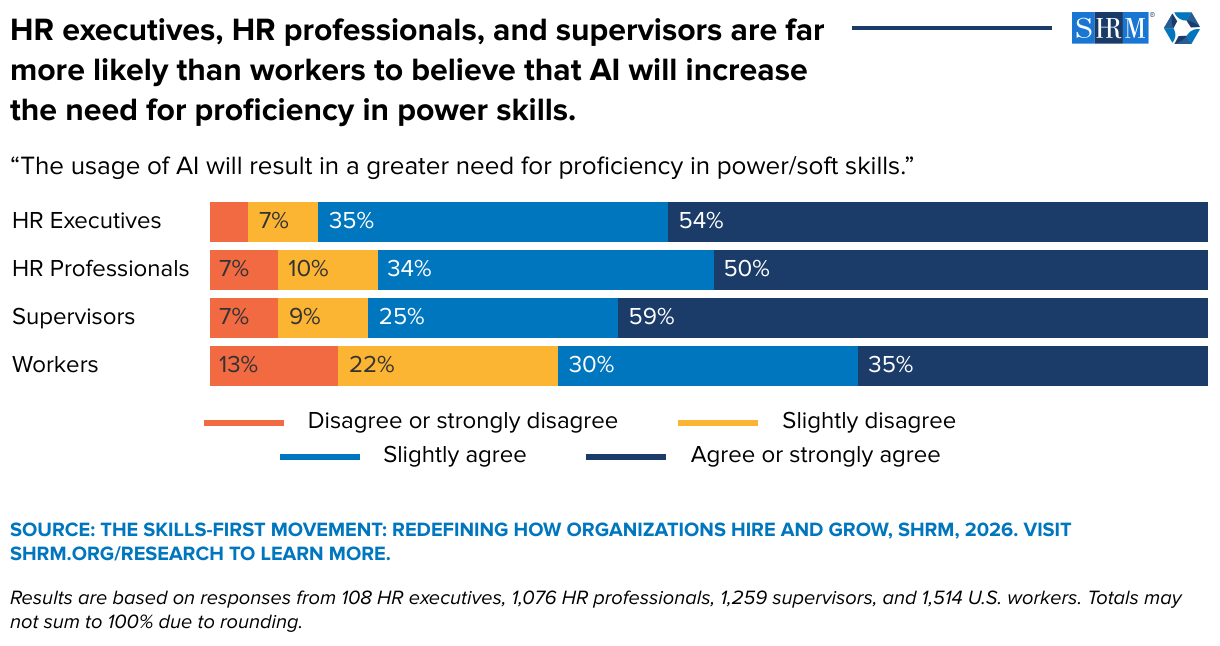
Workers were less likely than HR executives, HR professionals, and supervisors to agree that the usage of AI in the workplace will increase the need for proficiency in power skills such as critical thinking and communication (65%, 84%, 84%, and 89%, respectively), and this gap has important implications. This difference in perspective may result in misaligned training investments as employers aim to build their workforces’ power skills while employees prioritize other competencies. In an AI-driven workplace, such disconnect may hinder the development of these critical skills, leaving organizations vulnerable to future integration challenges.
Implementing Skills-First Strategies
Implementing a skills-first approach begins with rethinking how organizations define talent. Skills-first hiring focuses on demonstrable competencies and what people can do, rather than where or how they attained those skills. This shift requires intentional practices, such as crafting job descriptions that emphasize capabilities and using interviews as a tool to evaluate the real-world application of skills.
Behavioral interviewing is one of the most common skills-first methods that employers have used in their hiring processes, allowing candidates to share examples of how they’ve applied their skills in past roles. In fact, more than 4 in 5 organizations (86%) have used this technique. Other widely adopted practices include defining clear skills and competencies for each role (76%) and creating job descriptions that prioritize skills over degrees or years of experience (66%). Together, these steps create a consistent framework that not only improves hiring decisions but also sets the stage for broader adoption across the various stages of the employee life cycle.

Project-based assessments and mock sessions rank among the least utilized skills-first hiring strategies, yet both are linked to better organizational outcomes. Organizations that conduct project-based assessments during hiring were significantly more likely to report low or very low turnover compared to organizations that don’t utilize this strategy (46% versus 34%). Despite this, over half of HR professionals (53%) reported that they have not yet adopted or considered this strategy, highlighting an underutilized opportunity to enhance employee retention. Similarly, organizations that conduct mock sessions, such as sales calls or training exercises, during hiring were significantly more likely to exceed their financial objectives compared to organizations that do not utilize this strategy (37% versus 28%). With 59% of HR professionals reporting that they have not utilized or considered this approach, this finding represents another opportunity to strengthen organizational outcomes.
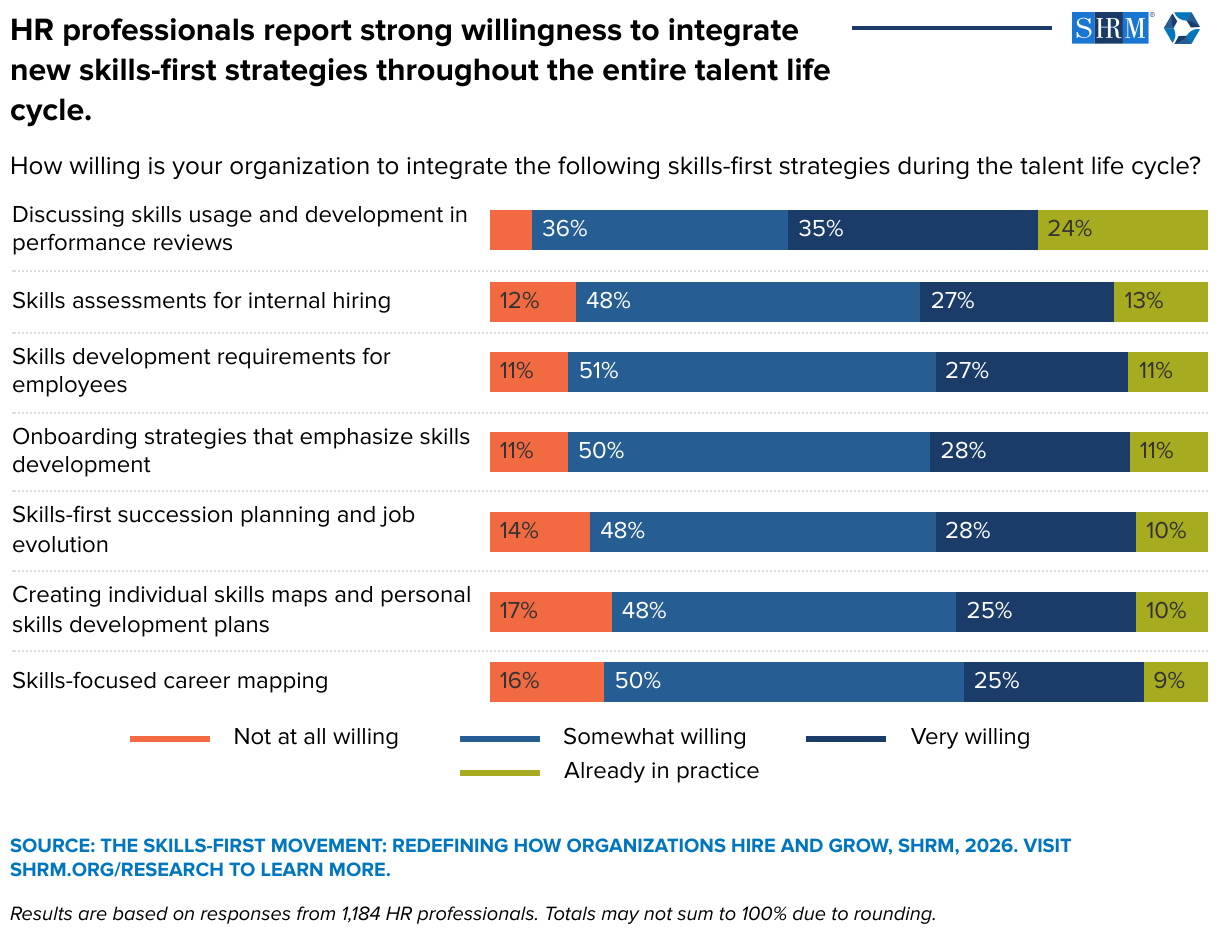
By starting with these foundational practices, organizations can build confidence in skills-first strategies and gradually scale them to influence the later stages of the talent life cycle, including onboarding, performance reviews, and career development. Skills-first frameworks can inform onboarding by mapping new hires’ existing competencies to role expectations, guide performance reviews by focusing on demonstrated skills and areas of potential growth, and shape career development through targeted upskilling plans. Embedding these strategies throughout the employee life cycle creates a culture of continuous growth, improves internal mobility, and nurtures employee engagement.
Recommendations and Resources
Organizations often struggle to evaluate demonstrable skills consistently and effectively, which can slow the adoption of skills-first hiring. Using structured methods such as behavioral interviews, project-based assessments, and live task demonstrations allows organizations to measure candidates’ competencies with greater confidence. These tools help reduce reliance on traditional educational qualifications and create consistency across hiring teams, ensuring that skills-first strategies are applied effectively.

SHRM Foundation’s Center for a Skills-First Future

Transform Your Talent Acquisition Strategy with Skills-First Hiring

How to Conduct a Skills Gap Analysis

How Skills-First Talent Management Can Transform Your Organization
Job descriptions that focus on specific skills and competencies attract a more diverse and qualified talent pool. This approach encourages candidates from nontraditional backgrounds to apply, widening the talent pool and aligning with the growing preference for skills-first hiring. HR professionals can start by piloting skills-focused job descriptions in one department or role to refine the process before scaling it across the organization.

Skills-First Job Description Template

Skills-First Growth Model

Credential Engine

Credential Finder
Upskilling initiatives are essential for both employee development and organizational success. Upskilling should be integrated into career development plans and communicated consistently throughout the year. Providing accessible resources, such as workshops, online courses, and mentorship programs, helps employees enhance their technical skills, power skills, and AI-related skills. Organizations that prioritize continuous learning stand to gain a more skilled workforce, benefiting both the organization and its employees.

Identify Upskilling Opportunities Through Training Needs Assessments

Upskill, Reskill, and Retain — How to Future-Proof Your Workforce

Retain and Grow — How Upskilling Builds Loyalty and Strengthens Leadership

Upskilling and Reskilling — Training Today for a Future-Forward Tomorrow
As AI processes become more commonplace in organizational workflows, successful integration depends on employees who can pair AI fluency with the enduring value of human capabilities. By prioritizing both technical expertise and interpersonal competencies, organizations ensure they are building teams that can leverage AI effectively while maintaining the human judgment and adaptability that drive successful integration. HR professionals can address this shift by incorporating AI-related skills into training programs and emphasizing their importance in hiring and development strategies.

AI in the Workplace

Skilled Credentials Action Planner

Employers Train Employees to Close the AI Skills Gap

How to Prepare Employees for AI-Enhanced Roles and Responsibilities
Organizations that have implemented skills-first strategies should establish and maintain a systematic process for measuring the return on investment (ROI) of these initiatives. Tracking ROI is critical to demonstrate business impact, identify areas for optimization, and help build the case for expansion. Defining clear KPIs — such as time-to-hire, retention rate, and financial performance — can help make the case to organizational leadership to maintain momentum and secure buy-in for scaling.

Skilled Credentials Action Planner

Measuring the ROI of Your Training Initiatives

Skills First Specialty Credential

SHRM Foundation Resource Library
CONCLUSION
The evolution from credential-based hiring to a skills-first approach reflects a fundamental shift in how organizations define talent. As the findings show, employers are increasingly prioritizing demonstrable skills and competencies, widening talent pools and creating opportunities for candidates from a variety of backgrounds. This transition is not only a response to changing workforce expectations but also a strategic move that fosters future-ready workforces. Skills-first hiring has been proven to deliver tangible benefits, including improved financial performance and stronger workplace culture, making it a critical component of organizational success.
Methodology
HR professionals: A sample of 1,184 U.S.-based HR professionals (including 108 HR executives) were surveyed Oct. 13-27, 2025, using the SHRM Voice of Work Research Panel. Participants were employed in organizations across multiple types of industries, sizes, and locations. See appendix for full demographic breakdown.
Supervisors: A sample of 1,259 supervisors were surveyed Oct. 13-24, 2025, using a third-party panel vendor. For the purposes of this study, participants were required to be supervisors to one or more employees and employed part time or full time by an organization. Those who were self-employed or retired did not qualify. Participants were employed in organizations across multiple types of industries, sizes, and locations. See appendix for full demographic breakdown.
U.S. workers: A sample of 1,513 U.S. workers were surveyed Oct. 13-25, 2025, using a third-party panel vendor. For the purposes of this study, participants were required to be individual contributors and employed part time or full time by an organization. Those who were self-employed or retired did not qualify. Participants were employed in organizations across multiple types of industries, sizes, and locations. See appendix for full demographic breakdown.
How to cite the research: The Skills-First Movement: Redefining How Organizations Hire and Grow, SHRM, 2026.
1. A total of 1,184 HR professionals (including 108 HR executives), 1,512 U.S. workers, and 1,259 supervisors were surveyed in 2025.
2. Power skills are interpersonal, nontechnical skills such as respectful communication and critical thinking. They are also known as soft skills, durable skills, and essential skills.
3. Skills categories adopted from O*NET OnLine.
Glossary of Terms
- Behavioral interviewing: A candidate describing past experiences to show how they’ve used their skills in real-world situations.
- Live task demonstrations: A candidate performing a task or skill live during an interview or assessment, such as coding a program.
- Mock sessions: A candidate conducting mock sales calls or training sessions to reflect job-specific skills, such as client interaction.
- Power skills: Interpersonal, nontechnical skills such as respectful communication and critical thinking. They are also known as soft skills, durable skills, and essential skills.
- Project-based assessments: A candidate completing a preassigned project or challenge provided by an employer to demonstrate their approach and skills in action.
- Skills assessments: A candidate completing standardized tests or hands-on challenges designed to evaluate technical or job-specific skills.
- Skilled credentials: Any micro-credential, industry or professional certification, acknowledgment of apprenticeship (registered or nonregistered), or badging that indicates a person’s competencies and skills within a particular field. Skilled credentials do not include traditional academic degrees or required occupational licensures.
- Skills-first hiring: A recruitment strategy that encompasses hiring based on skills obtained by any means and not just skilled credentials or formal education. Organizations that use skills-first hiring have moved beyond specific degree requirements and, instead, evaluate candidates based on the skills they have, regardless of where the skills were acquired. This can be from past jobs, volunteer opportunities, life experiences, or their own personal upskilling.
- Tool or technology demos: A candidate showcasing proficiency with specific industry tools or platforms by demonstrating their application to solve problems.
- Upskilling: Employee training that builds on existing skills. Unlike general training or personal development, which may introduce new skills or focus on broader growth, upskilling is specifically designed to enhance and expand an employee's current skill set to meet evolving job demands.
Appendix


Survey Respondent Demographics


