  • Personal
  • Business
  • Foundation
    Close
  • Select Region
    • Global
    • India
    • MENA
  • mySHRM Login
  • MySHRM
    • Dashboard
    • Account
    • Logout
SHRM
  • Membership
    • Membership

      As a SHRM Member®, you’ll pave the path of your success with invaluable resources, world-class educational opportunities and premier events.

      Membership Tiers
      • Professional
      • Student
      • Global
      • Executive
      • Business
      Membership Benefits
  • Learning
    • Learning

      Build capability, credibility, and confidence to influence strategy, shape culture, and drive measurable business impact.

      SHRM Certification

      Demonstrate your ability to apply HR principles to real-life situations.

      • Choosing Your Certification
      • SHRM-CP
      • SHRM-SCP
      • How to Get Certified
      • Prepare for the Exam
      • Recertification
      Seminars

      Stand out from among your HR peers with the skills obtained from a SHRM Seminar.

      Specialty Credentials

      Demonstrate targeted competence and enhance your HR credibility.

      Educational Programs

      Designed and delivered by HR experts to empower you with the knowledge and tools you need to drive lasting change in the workplace.

      • Essentials of HR
      • eLearning
      Qualifications

      Gain a deeper understanding and develop critical skills.

  • Attend
    • Events

      Demonstrate your ability to apply HR principles to real-life situations.

      • SHRM26 Annual Conference & Expo
      • The AI+HI Project 2026
      • Talent 2026
      • Linkage Institute 2026
      • BLUEPRINT 2025
      State Conferences

      Attend a SHRM state event to network with other HR professionals and learn more about the future of work.

      Seminars

      Stand out from among your HR peers with the skills obtained from a SHRM Seminar.

      Webinars

      Learn live and on demand. Earn PDCs and gain immediate insights into the latest HR trends.

  • Resources
    • Resources

      Stay up to date with news and leverage our vast library of resources.

      • Flagships
      • HR Research
      • Legal & Compliance
      • Latest News & Trends
      • Tools & Guides
      • Webinars
      HR Topics
      • AI in the Workplace
      • Civility at Work
      • Compensation & Benefits
      • Inclusion & Diversity
      • Talent Acquisition
      • HR Technology
      • Workplace Violence Prevention
      Educational Programs

      Designed and delivered by HR experts to empower you with the knowledge and tools you need to drive lasting change in the workplace.

  • Community
    • Find a SHRM Chapter

      Easily find a local professional or student chapter in your area.

      • SHRM Northern California
      SHRM Connect

      Post polls, get crowdsourced answers to your questions and network with other HR professionals online.

      Membership Councils

      Learn about SHRM's five regional councils and the Membership Advisory Council (MAC).

      Volunteers

      Learn about volunteer opportunities with SHRM.

  • Shop
    • SHRM Store

      Shop for HR certifications, credentials, learning, events, merchandise and more.

      Workplace Essentials
      • SHRM Memberships
      • SHRM Certification
      • Specialty Credentials
      • HR Tools & Tech
      Education
      • Seminars
      • eLearning
      • Books
      Merchandise
      • Accessories
      • Apparel
      • Office & Home
Become a Member
Renew
Rejoin Now
Renew
Ask an HR Advisor
Close
  • Personal
  • Business
  • Foundation
  • Membership
    back
    Membership
    • Membership

      As a SHRM Member®, you’ll pave the path of your success with invaluable resources, world-class educational opportunities and premier events.

      Membership Tiers
      • Professional
      • Student
      • Global
      • Executive
      • Business
      Membership Benefits
  • Learning
    back
    Learning
    • Learning

      Build capability, credibility, and confidence to influence strategy, shape culture, and drive measurable business impact.

      SHRM Certification

      Demonstrate your ability to apply HR principles to real-life situations.

      • Choosing Your Certification
      • SHRM-CP
      • SHRM-SCP
      • How to Get Certified
      • Prepare for the Exam
      • Recertification
      Seminars

      Stand out from among your HR peers with the skills obtained from a SHRM Seminar.

      Specialty Credentials

      Demonstrate targeted competence and enhance your HR credibility.

      Educational Programs

      Designed and delivered by HR experts to empower you with the knowledge and tools you need to drive lasting change in the workplace.

      • Essentials of HR
      • eLearning
      Qualifications

      Gain a deeper understanding and develop critical skills.

  • Attend
    back
    Attend
    • Events

      Demonstrate your ability to apply HR principles to real-life situations.

      • SHRM26 Annual Conference & Expo
      • The AI+HI Project 2026
      • Talent 2026
      • Linkage Institute 2026
      • BLUEPRINT 2025
      State Conferences

      Attend a SHRM state event to network with other HR professionals and learn more about the future of work.

      Seminars

      Stand out from among your HR peers with the skills obtained from a SHRM Seminar.

      Webinars

      Learn live and on demand. Earn PDCs and gain immediate insights into the latest HR trends.

  • Resources
    back
    Resources
    • Resources

      Stay up to date with news and leverage our vast library of resources.

      • Flagships
      • HR Research
      • Legal & Compliance
      • Latest News & Trends
      • Tools & Guides
      • Webinars
      HR Topics
      • AI in the Workplace
      • Civility at Work
      • Compensation & Benefits
      • Inclusion & Diversity
      • Talent Acquisition
      • HR Technology
      • Workplace Violence Prevention
      Educational Programs

      Designed and delivered by HR experts to empower you with the knowledge and tools you need to drive lasting change in the workplace.

  • Community
    back
    Community
    • Find a SHRM Chapter

      Easily find a local professional or student chapter in your area.

      • SHRM Northern California
      SHRM Connect

      Post polls, get crowdsourced answers to your questions and network with other HR professionals online.

      Membership Councils

      Learn about SHRM's five regional councils and the Membership Advisory Council (MAC).

      Volunteers

      Learn about volunteer opportunities with SHRM.

  • Shop
    back
    Shop
    • SHRM Store

      Shop for HR certifications, credentials, learning, events, merchandise and more.

      Workplace Essentials
      • SHRM Memberships
      • SHRM Certification
      • Specialty Credentials
      • HR Tools & Tech
      Education
      • Seminars
      • eLearning
      • Books
      Merchandise
      • Accessories
      • Apparel
      • Office & Home
Become a Member
Renew
Rejoin Now
Renew
Ask an HR Advisor
  • Select Region
    • Global
    • India
    • MENA
SHRM
mySHRM Login
  • MySHRM
    • Dashboard
    • Account
    • Logout
Close

  1. Topics & Tools
  2. Workplace News & Trends
  3. Compensation & Benefits
  4. America's Pay Gap Is Widening
Share
  • Linked In
  • Facebook
  • Twitter
  • Email

Lorem ipsum dolor sit amet, consectetur adipiscing elit. Vivamus convallis sem tellus, vitae egestas felis vestibule ut.


Error message details.

Copy button
Reuse Permissions

Request permission to republish or redistribute SHRM content and materials.


Learn More
News

America's Pay Gap Is Widening

HR is challenged by pay inequality despite a booming economy

September 10, 2018 | Dana Wilkie


Mind the Gap

The Death of the Pay Raise
Part 1 of a four-part series.

In 1979, nearly four decades ago, the typical low-income worker—perhaps a waitress or a cashier—earned about $9.42 an hour when adjusted to today's dollars.

In 2016, the person working in that same job earned about $9.33 an hour—0.98 percent less than what his or her counterpart was making almost 40 years ago.

That, even though 2016 marked seven years since the end of the country's Great Recession.

Today, in 2018, the economy is strong, unemployment is at an all-time low, many businesses are turning healthy profits and the financial markets have surged. Yet those developments have not translated into robust wage growth for many U.S. workers, even though basic economic theory holds that this should have happened. Instead, wages for many low- and middle-income workers have remained relatively stagnant, in some cases barely keeping pace with the yearly rise in the cost of living and in other cases not keeping pace at all.

Why is that? And what should business leaders—and the HR professionals who advise them—be doing about it?

The theories abound as to why wages have stagnated:

  • Automation and global outsourcing have started to replace many U.S. workers, especially lower-skilled ones, reducing the demand for these employees and thus the pressure to increase their pay.
  • A four-year college degree no longer promises the financial bargaining power it once did.
  • The decline in labor unions has made it more difficult for low-wage workers to negotiate higher pay.
  • The minimum wage, although it has risen incrementally at the federal level and is higher in many states, doesn't afford the buying power it did decades ago.
  • Companies, their boards and their shareholders grew gun-shy following the recession and prefer to keep labor costs low in case another economic downturn is on the horizon.

"We think that companies are trying to protect themselves from the next [recession], investing in their physical and technological infrastructures, and [are] not willing to increase wages as fast as the HR profession was expecting coming out of the [last] recession," said Bruce and Blair Johanson, principal partners at DBSquared, a compensation software firm based in Fayetteville, Ark., in a joint comment. "We see wage budget [increases] in state and local governments and in the nonprofit sector in the range of 4 to 8 percentage [points] per year as they are trying hard to be competitive again, but public and private companies are still holding the line to around 3 percent per year."

[SHRM members-only resource: Salary Survey Directory]

Increase in Wage Inequality

There has been wage growth for some workers, but much of it has been concentrated among upper-middle- and top-income earners, according to a 2017 analysis of the Bureau of Labor Statistics' Current Population Survey conducted by the Brookings Institution's The Hamilton Project. That would be workers earning more than $27 an hour. Those considered "upper-middle" earners saw nearly 12 percent growth in wages from 1979 to 2016, when adjusted for today's dollars. Top earners enjoyed an increase of more than 27 percent.

At the lower end, wages decreased by 0.98 percent for those making less than $10 an hour, increased less than 1 percent (0.77 percent) for those earning about $14 an hour and increased by 3.4 percent for those earning about $19 an hour, according to The Hamilton Project.

Meanwhile, the cost of living rose an average of 1.5 percent per year since 2011, according to the Social Security Administration, meaning the wages for those in the bottom two categories of earnings did not keep pace.


Real Wages by Wage Quintile, 1979-2016

Much of the growth in wages has been concentrated among top earners, with wages in the top quintile growing to $48 per hour in 2016 from $38 per hour in 1979—a 27 percent increase. Wages in the upper-middle quintile increased by about 12 percent, from $24 per hour to $27 per hour. In the bottom fifth, real wages fell slightly over the same period.
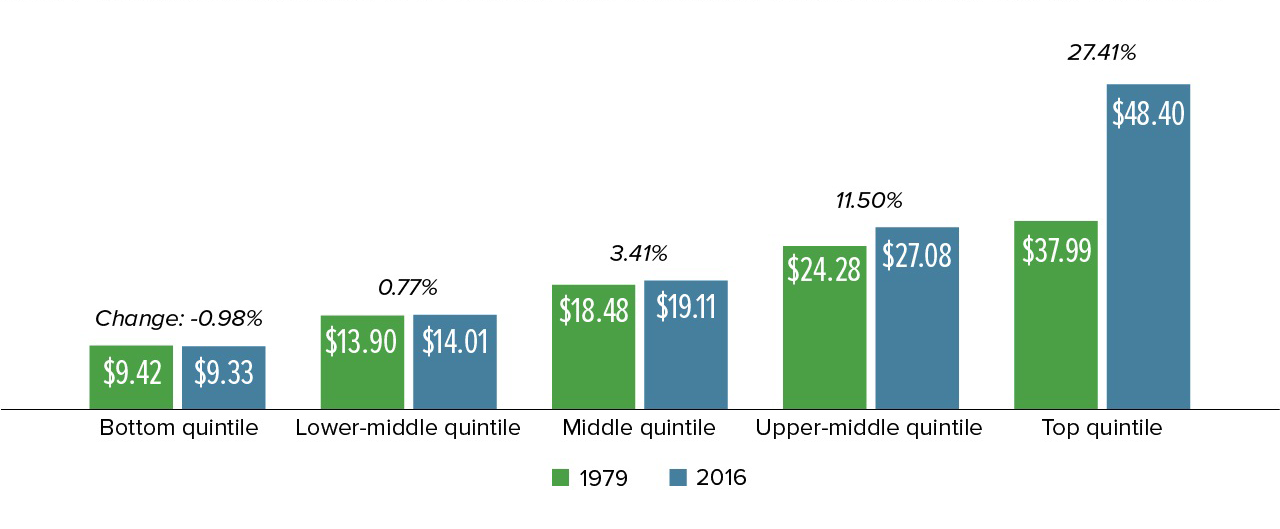
Real Wages by Wage Quintile, 1979-2016

Note: Wages are expressed in 2016 dollars. Sample restricted to workers ages 25-54. Growth rates are cumulative. Source: Current Population Survey, Bureau of Labor Statistics (1979-2016); authors' calculations. 


"There's been a decline in the share of economic output going to workers," said The Hamilton Project Policy Director Ryan Nunn, co-author of a report based on the group's analysis. "They have been doing a little worse over time. The biggest part of the story is the increase in inequality. Workers at the top are getting wage growth, while others have not."

And while workers considered "middle income"—those earning about $19 an hour—saw wage increases that outpaced the average rise in the cost of living over those years, their wage increases have remained "relatively low," said Pete Sanborn, Atlanta-based managing director for human capital advisory at consultancy Aon Hewitt.

Middle managers, for instance, tend to lack the "hot" skills that drive wages higher in today's economy—for instance, skills in technology, communications and health care.

"There has not been much pressure to increase pay for these roles, as turnover for most companies has not been a significant risk and there is typically a supply of people to fill these roles when people leave or retire," Sanborn said. "In many companies, the most significant increase in total compensation for middle-management roles has been through variable pay driven by strong company financial performance and individual performance."

Families Are Struggling

The United Way's ALICE (Asset Limited, Income Constrained, Employed) Project sought to find out how low- and middle-income workers were faring. In a study published in May, the project reported that 43 percent of U.S. households don't earn enough to afford basic living expenses such as housing, food, child care, health care and transportation.

The figure includes 16.1 million households living in poverty, as well as 34.7 million families that the project has dubbed "Asset Limited, Income Constrained and Employed." This group of workers earns what the project considers less than what's needed to survive in the modern economy.

"Many of these folks are the nation's child care workers, home health aides, office assistants and store clerks, who work low-paying jobs and have little savings," the study authors wrote. "Some 66 percent of jobs in the U.S. pay less than $20 an hour."


Snapshot: One State's Low- to Low-Middle-Wage Jobs

In Louisiana, some of the most common occupations are low- to low-middle-income jobs, characterized by unpredictable hours and the classification of workers as "independent contractors" rather than "employees" who are offered health care and other benefits.

It costs about $46,240 a year—or $3,853 a month—for a family of two adults, one infant and one preschooler to cover the basics of living in Louisiana, including housing, child care, food, transportation and health care. This family would need to earn at least $23.12 an hour to cover the cost of maintaining the household.
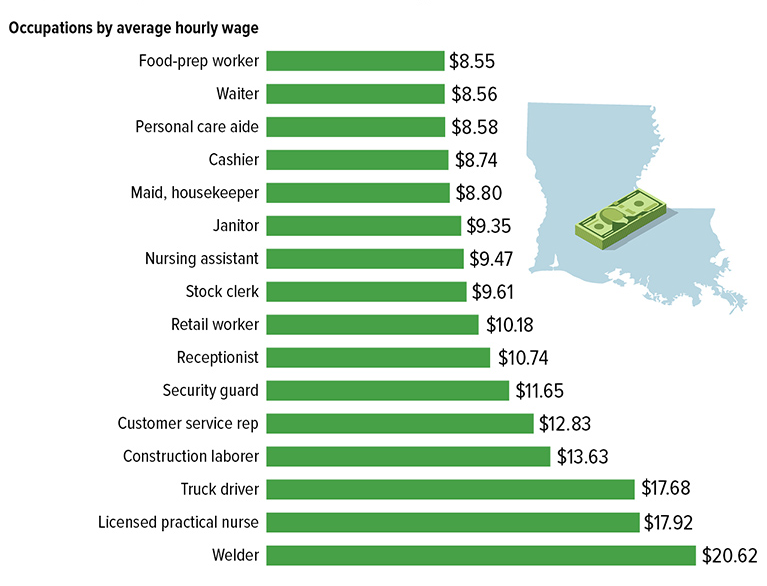

Source: The National Employment Law Project (NELP) and the Louisiana Association of United Ways.


So what is the role of business leaders? What is the role of HR, which is charged with keeping employees happy and engaged so as not to lose talented contributors and with luring strong job candidates? Do business leaders and HR professionals recognize the disparity between a strong economy and stalled or sluggish wage increases for workers?

"I'm not sure all do," said Tim Low, senior vice president for marketing at PayScale, a compensation data and software firm. "It's important for all leaders to pull their heads up once in a while to put [things] into perspective. This current economy does present some challenges for HR in trying to foster a productive relationship between employees and employers."

Next: Part 2
Why Have Some Wages Stopped Growing?
Many workers have noticed a disconnect between good economic news and what they see in their paychecks.

Compensation Management
Pay Equity

Was this resource helpful?

Leave Feedback

Related Articles

(opens in a new tab)
News
How One Company Uses Digital Tools to Boost Employee Well-Being

Learn how Marsh McLennan successfully boosts staff well-being with digital tools, improving productivity and work satisfaction for more than 20,000 employees.

(opens in a new tab)
News
A 4-Day Workweek? AI-Fueled Efficiencies Could Make It Happen

The proliferation of artificial intelligence in the workplace, and the ensuing expected increase in productivity and efficiency, could help usher in the four-day workweek, some experts predict.

(opens in a new tab)
News
Rising Demand for Workforce AI Skills Leads to Calls for Upskilling

As artificial intelligence technology continues to develop, the demand for workers with the ability to work alongside and manage AI systems will increase. This means that workers who are not able to adapt and learn these new skills will be left behind in the job market.

HR Daily Newsletter

Stay up to date with the latest HR news, trends, and expert advice each business day.

Success title

Success caption

Manage Subscriptions
Our Brands

SHRM Foundation Logo
SHRM Executive Network Logo
CEO Circle Logo
SHRM Business Logo
SHRM Linkage Logo
SHRM Labs
Overview

  • About SHRM
  • Careers at SHRM
  • Press Room
  • Contact SHRM
  • Post an HR Job
SHRM Named to Newsweek's 2026 America's Top Online Learning Provider List
Advocacy

  • SHRM Advocacy
  • Federal Policies
  • State Affairs
  • Global Policy
  • Take Action
  • SHRM E2 Initiative
Brand Partnership

  • Partnership Opportunities
  • Advertise with Us
  • Exhibit & Sponsorship
  • Recertification Providers
  • Book a Speaker
Member Resources

  • Ask an HR Advisor
  • SHRM Newsletters
  • SHRM Flagships
  • Topics & Tools
  • Find an HR Job
  • Vendor Directory

© 2026 SHRM. All Rights Reserved
SHRM provides content as a service to its readers and members. It does not offer legal advice, and cannot guarantee the accuracy or suitability of its content for a particular purpose. Disclaimer

Follow Us

  • LinkedIn
  • Facebook
  • Twitter
  • Instagram
  • YouTube
Feedback

  1. Your Privacy Choices

  2. Terms of Use

  3. Accessibility

Join SHRM for Exclusive Access to Professional Content

SHRM Members enjoy unlimited access to articles and exclusive professional content resources.

Already a member? Login
Free Article

Login to unlock unlimited access or join SHRM today to get unlimited access to articles and member-exclusive resources.

Already a member? Login
Limit Reached

You've reached the limit of 1 free article this month. Join to access unlimited articles and member-only resources.

Already a member? Login
Free Article

Login to unlock unlimited access or join SHRM today to get unlimited access articles and member-exclusive resources.

Already a member? Login
Limit Reached

You've reached the limit of 1 free article this month. Join the Executive Network and enjoy unlimited content.

Already a member? Login
Unlock Your Career with SHRM Membership

Please enjoy this free resource! Join SHRM for unlimited access to exclusive articles and tools.

Already a member? Login
Join SHRM for Exclusive Access to Professional Premium Content

SHRM Members enjoy unlimited access to articles and exclusive professional premium resources.

Already a member? Login
Join SHRM for Exclusive Access to Student Content

SHRM Members enjoy unlimited access to articles and exclusive member resources.

Already a member? Login
Join SHRM for Exclusive Access to Executive Network Content

SHRM member enjoys unlimited access to articles and exclusive executive member resources.

Already a member? Login

Your membership is almost expired! Renew today for unlimited access to member content.

Renew now

Your membership has expired. Renew today for unlimited access to member content.

Renew Now

Your Executive Network membership is nearing its expiration. Renew now to maintain access.

Renew Now

Your membership has expired. Renew your Executive Network benefits today.

Renew Now
