
Much of the federal government shut down at 12:01 a.m. ET Oct. 1, meaning federal agencies have stopped all but their most essential functions.
Depending on its duration, the shutdown will be disruptive not only for the federal workforce but also employers and workers seeking to interact with the government or use the federal government's resources.
Many agencies will stop processing charges and investigations, hearings will be canceled, public-information offices will be closed, and new rules, guidance, or regulations will be delayed.
Employers can and should expect delays in everything from case processing to business travel, said James A. Paretti, an attorney in the Washington, D.C., office of Littler. "It is unclear whether the White House will carry out its threat not merely to furlough nonessential personnel — meaning they would return to work when the government ultimately reopens — but instead fire them permanently," he said. "It is also unclear whether such an effort would be upheld by the courts."
Over 1 in 3 (37%) of the non-U.S. Postal Service federal workforce — up to 860,000 federal employees — could be affected by a government shutdown and furloughed, according to a SHRM data analysis.
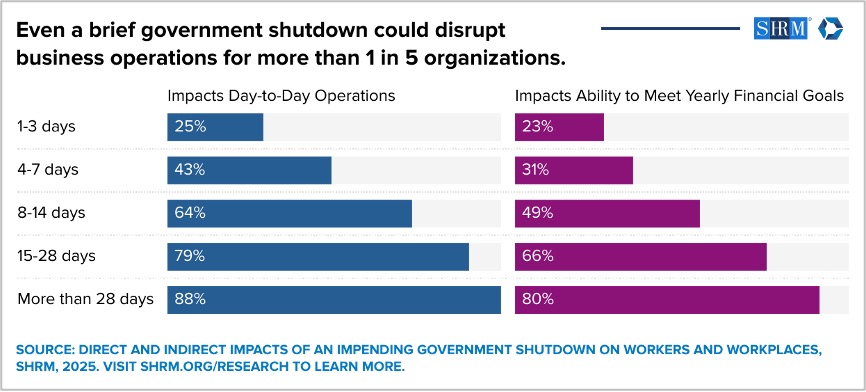
SHRM researchers found that a government shutdown lasting just 1-3 days could disrupt the day-to-day operations of 25% of organizations and hinder the ability to meet yearly financial goals for 23% of organizations. A government shutdown lasting more than a week significantly increases the impact, affecting 64% of organizations' day-to-day operations and 49% of organizations' abilities to meet yearly financial goals.
The most recent Department of Labor (DOL) contingency plan noted that the agency will scale back its enforcement and regulatory efforts, including technical assistance and compliance audits. The DOL will not process foreign labor certifications, labor condition applications, and prevailing wage determinations used in immigration processing. The Occupational Safety and Health Administration will suspend most workplace inspections. The Bureau of Labor Statistics will suspend operations, including the issuance of the eagerly awaited monthly Employment Situation report scheduled for Oct. 3.
"The absence of a jobs report on Friday is likely to compound uncertainties about the health of the labor market, which means businesses will remain entrenched in a 'wait-and-see' position until they can receive additional clarity," said Noah Yosif, chief economist at the American Staffing Association. "Much of that clarity will come from the Federal Reserve through further interest rate cuts, which could be disrupted if the committee cannot accurately assess the cadence of cooling in the labor market."
Regulatory efforts will also be paused, including a proposed rule to repeal a 2024 regulation changing the Fair Labor Standard Act's (FLSA's) definition of independent contractor; a proposed heat standard; and proposed rules to address the definition of joint employer under the FLSA.
The Equal Employment Opportunity Commission's (EEOC's) most recent contingency plan indicated that the agency will cease all nonessential operations. Claimants can still file a timely charge of discrimination or request an appeal or reconsideration. Litigation will continue in cases where the court has not granted an extension. Otherwise, the EEOC will not start new investigations, hold hearings or mediations, investigate nonessential charges, hold outreach programs, or respond to questions about pending cases.
The National Labor Relations Board will also cease all nonessential activities, including processing new representation petitions and unfair labor practice charges, administrative litigation and hearings.
U.S. Citizenship and Immigration Services is primarily funded by user fees and is expected to continue to accept and process petitions and applications for immigration benefits. During prior government shutdowns, employers couldn't enroll in E-Verify, initiate queries, access cases or resolve tentative nonconfirmations with affected workers. All employers remain subject to Form I-9 obligations, however.
Immigration and Customs Enforcement officers are generally considered to be essential personnel, and most are expected to be working during the government shutdown.
Federal Workers
The Trump administration has threatened mass layoffs during the shutdown, but also signaled those plans may be revised once Congress restores funding.
The White House's Office of Management and Budget issued guidance instructing agencies to consider issuing reductions in force (RIF) notices to all employees whose work is funded by regular appropriations and does not align with President Trump's priorities. The Office of Personnel Management (OPM) told agencies that it can tweak those RIF plans once the government reopens.
"Once fiscal year 2026 appropriations are enacted, agencies may consider revising their RIFs as needed to retain the minimal number of employees necessary to carry out statutory functions," OPM said.
Furloughed federal employees who are deemed essential and continue to work are not paid during a shutdown. But they are paid for their work after the government reopens. In addition, federal employees will continue to have health care coverage during the government shutdown.
Businesses that contract with the federal government will be especially impacted, as thousands of stop-work orders for contracts were issued during previous shutdowns.
Previous Shutdowns
There have been a few government shutdowns in the recent past, most of which were partial, as some of the departmental appropriations bills had already been enacted. These shutdowns lasted:
- 21 days, beginning Dec. 16, 1995.
- 16 days, from Oct. 1, 2013.
- 2 days, from Jan. 19, 2018.
- 34 days, starting Dec. 21, 2018.
Was this resource helpful?

Validate your HR expertise
Earning your SHRM-CP credential makes you a recognized expert and leader in the HR field.
Related Content

Transform HR with mobile technology to streamline workflows, enhance communication, and boost employee engagement across distributed teams.

A new study found that talent development practitioners believe performance-based assessments are more effective at measuring employee learning outcomes than knowledge tests.

As AI makes deeper inroads into organizations, employee concerns about the technology continue to grow. Here's how HR leaders can address the fear of AI among their own staff, as well as in the wider organization.