  • Personal
  • Business
  • Foundation
    Close
  • Select Region
    • Global
    • India
    • MENA
  • mySHRM Login
  • MySHRM
    • Dashboard
    • Account
    • Logout
SHRM
  • Membership
    • Membership

      As a SHRM Member®, you’ll pave the path of your success with invaluable resources, world-class educational opportunities and premier events.

      Membership Tiers
      • Professional
      • Student
      • Global
      • Executive
      • Business
      Membership Benefits
  • Learning
    • Learning

      Build capability, credibility, and confidence to influence strategy, shape culture, and drive measurable business impact.

      SHRM Certification

      Demonstrate your ability to apply HR principles to real-life situations.

      • Choosing Your Certification
      • SHRM-CP
      • SHRM-SCP
      • How to Get Certified
      • Prepare for the Exam
      • Recertification
      Seminars

      Stand out from among your HR peers with the skills obtained from a SHRM Seminar.

      Specialty Credentials

      Demonstrate targeted competence and enhance your HR credibility.

      Educational Programs

      Designed and delivered by HR experts to empower you with the knowledge and tools you need to drive lasting change in the workplace.

      • Essentials of HR
      • eLearning
      Qualifications

      Gain a deeper understanding and develop critical skills.

  • Attend
    • Events

      Demonstrate your ability to apply HR principles to real-life situations.

      • SHRM26 Annual Conference & Expo
      • The AI+HI Project 2026
      • Talent 2026
      • Linkage Institute 2026
      • BLUEPRINT 2025
      State Conferences

      Attend a SHRM state event to network with other HR professionals and learn more about the future of work.

      Seminars

      Stand out from among your HR peers with the skills obtained from a SHRM Seminar.

      Webinars

      Learn live and on demand. Earn PDCs and gain immediate insights into the latest HR trends.

  • Resources
    • Resources

      Stay up to date with news and leverage our vast library of resources.

      • Flagships
      • HR Research
      • Legal & Compliance
      • Latest News & Trends
      • Tools & Guides
      • Webinars
      HR Topics
      • AI in the Workplace
      • Civility at Work
      • Compensation & Benefits
      • Inclusion & Diversity
      • Talent Acquisition
      • HR Technology
      • Workplace Violence Prevention
      Educational Programs

      Designed and delivered by HR experts to empower you with the knowledge and tools you need to drive lasting change in the workplace.

  • Community
    • Find a SHRM Chapter

      Easily find a local professional or student chapter in your area.

      • SHRM Northern California
      SHRM Connect

      Post polls, get crowdsourced answers to your questions and network with other HR professionals online.

      Membership Councils

      Learn about SHRM's five regional councils and the Membership Advisory Council (MAC).

      Volunteers

      Learn about volunteer opportunities with SHRM.

  • Shop
    • SHRM Store

      Shop for HR certifications, credentials, learning, events, merchandise and more.

      Workplace Essentials
      • SHRM Memberships
      • SHRM Certification
      • Specialty Credentials
      • HR Tools & Tech
      Education
      • Seminars
      • eLearning
      • Books
      Merchandise
      • Accessories
      • Apparel
      • Office & Home
Become a Member
Renew
Rejoin Now
Renew
Ask an HR Advisor
Close
  • Personal
  • Business
  • Foundation
  • Membership
    back
    Membership
    • Membership

      As a SHRM Member®, you’ll pave the path of your success with invaluable resources, world-class educational opportunities and premier events.

      Membership Tiers
      • Professional
      • Student
      • Global
      • Executive
      • Business
      Membership Benefits
  • Learning
    back
    Learning
    • Learning

      Build capability, credibility, and confidence to influence strategy, shape culture, and drive measurable business impact.

      SHRM Certification

      Demonstrate your ability to apply HR principles to real-life situations.

      • Choosing Your Certification
      • SHRM-CP
      • SHRM-SCP
      • How to Get Certified
      • Prepare for the Exam
      • Recertification
      Seminars

      Stand out from among your HR peers with the skills obtained from a SHRM Seminar.

      Specialty Credentials

      Demonstrate targeted competence and enhance your HR credibility.

      Educational Programs

      Designed and delivered by HR experts to empower you with the knowledge and tools you need to drive lasting change in the workplace.

      • Essentials of HR
      • eLearning
      Qualifications

      Gain a deeper understanding and develop critical skills.

  • Attend
    back
    Attend
    • Events

      Demonstrate your ability to apply HR principles to real-life situations.

      • SHRM26 Annual Conference & Expo
      • The AI+HI Project 2026
      • Talent 2026
      • Linkage Institute 2026
      • BLUEPRINT 2025
      State Conferences

      Attend a SHRM state event to network with other HR professionals and learn more about the future of work.

      Seminars

      Stand out from among your HR peers with the skills obtained from a SHRM Seminar.

      Webinars

      Learn live and on demand. Earn PDCs and gain immediate insights into the latest HR trends.

  • Resources
    back
    Resources
    • Resources

      Stay up to date with news and leverage our vast library of resources.

      • Flagships
      • HR Research
      • Legal & Compliance
      • Latest News & Trends
      • Tools & Guides
      • Webinars
      HR Topics
      • AI in the Workplace
      • Civility at Work
      • Compensation & Benefits
      • Inclusion & Diversity
      • Talent Acquisition
      • HR Technology
      • Workplace Violence Prevention
      Educational Programs

      Designed and delivered by HR experts to empower you with the knowledge and tools you need to drive lasting change in the workplace.

  • Community
    back
    Community
    • Find a SHRM Chapter

      Easily find a local professional or student chapter in your area.

      • SHRM Northern California
      SHRM Connect

      Post polls, get crowdsourced answers to your questions and network with other HR professionals online.

      Membership Councils

      Learn about SHRM's five regional councils and the Membership Advisory Council (MAC).

      Volunteers

      Learn about volunteer opportunities with SHRM.

  • Shop
    back
    Shop
    • SHRM Store

      Shop for HR certifications, credentials, learning, events, merchandise and more.

      Workplace Essentials
      • SHRM Memberships
      • SHRM Certification
      • Specialty Credentials
      • HR Tools & Tech
      Education
      • Seminars
      • eLearning
      • Books
      Merchandise
      • Accessories
      • Apparel
      • Office & Home
Become a Member
Renew
Rejoin Now
Renew
Ask an HR Advisor
  • Select Region
    • Global
    • India
    • MENA
SHRM
mySHRM Login
  • MySHRM
    • Dashboard
    • Account
    • Logout
Close

  1. Topics & Tools
  2. Workplace News & Trends
  3. How Does Your Workplace Handle Crying at Work?
Share
  • Linked In
  • Facebook
  • Twitter
  • Email

Lorem ipsum dolor sit amet, consectetur adipiscing elit. Vivamus convallis sem tellus, vitae egestas felis vestibule ut.


Error message details.

Copy button
Reuse Permissions

Request permission to republish or redistribute SHRM content and materials.


Learn More
News

How Does Your Workplace Handle Crying at Work?

December 12, 2018

Two women sitting in an office talking to each other.


Crying at Work

Rhonda Moret remembers breaking down in tears during a heated debate in a meeting with her boss and co-workers. She was in her 20s and had worked for most of her career in marketing at high-profile brands in the golfing industry.

"I loved my job and approached my work with real passion," she said. "I believed the only way to propel my career to the C-suite was to be like one of the guys." 

And then she cried at work. It was her worst nightmare come to life.

"As the only female at the table I was humiliated at the manifestation of this very real human emotion," she said. "But more stunning than my tears, I was shocked by my co-workers' reactions. 

"The more I cried, the more the team outwardly ignored me. Eventually, I walked out of the conference room and shortly thereafter I permanently walked out of that organization."

If her boss had valued empathy as a necessary business skill, she said, he could have stopped the meeting and addressed why she was distraught. It would have kept her from leaving. 

While no one wants weeping at work, "managers cannot expect employees to be robots," said Brenda Della Casa, digital content director at BDC Digital Media in the United Kingdom.

"The question I would like to pose is: Why are we talking about crying more than yelling, passive aggression and bullying in the same way?" 

The Breaking Point

Often when someone tears up, it's from a culmination of frustrations, said Kim Dawson, director of employee experience at YouEarnedIt/HighGround, an employee-experience software provider in Austin, Texas.

"The issue that set them off is not the real issue; it's just the breaking point. Any time employees show emotion at work that is outside their norm, it should not be taken lightly by management or the organization at large. … The organization needs to take a step back and look at the response from all angles to understand the situation and how to move forward." 

The person may be dealing with deeply troubling personal news, such as a terminal diagnosis, a financial challenge, divorce or a death.

[SHRM members-only resources and tools: Managing Emotional Reactions]

Caitlin Fisher, content manager for Green Circle Growers in Oberlin, Ohio, recalled meeting with her boss to discuss the status of a project ahead of what was to be a vacation with her husband.

Once alone with her boss, Fisher broke into tears as she explained she had decided to initiate a divorce and would be using her vacation to find a new apartment.

"She was so unbelievably kind about it," Fisher said of her boss, "and told me to take all the time I needed."

Be aware, though, if tears are an employee's modus operandi, warned Holly Caplan, medical device sales manager and workplace writer at Holly Caplan Books in the Dallas/Fort Worth area.

Caplan worked with a woman who periodically teared up to get attention.

"She would call you into her office in the middle of the workday and want you to listen to her issues as she cried. ... This became toxic for us as co-workers because we did not want to be aligned with her behavior." 

The Bathroom Club

Crying in the bathroom was common at the large New York City law firm where Diane Rosen—today an attorney at Ortoli Rosenstadt in New York City and co-founder of Compass Consultants—worked years ago.

"We worked long hours and sadly, many of the partners and senior associates were quite abusive, yelling and ranting," she said. As a young lawyer, Rosen recalled feeling intimidated and worried whether she and her peers measured up.

"The bathroom club became a safe space for us to cry and complain. We would go in with our makeup bags, have a good cry, clean up and go back to work." 

Years later, when her daughter called her late at night, distraught over her harsh supervisors, Rosen advised her to have a good cry then go back to work.

"I told her that up and down Wall Street, women—and men, too—were crying in the bathroom."

Rosen thinks crying is appropriate in the face of loss, tragedy or celebration, but "maintaining equanimity is critical, and we must all learn to manage ourselves, to keep tears in check when we want to cry in anger or frustration."

Address the Real Causes

The problem with trying to contain emotions is they manifest themselves in other ways, said Taira Adair, owner of Adair Artistry in Jacksonville, Fla.

"Of all the ways to release emotions, crying shouldn't be an issue," she said. "[It's] way better than promoting passive-aggressiveness or yelling or storming out in the middle of the day."

If your sadness is rooted in a serious or chronic issue such as depression, anxiety or any type of workplace harassment, ask HR, a friend or family member for help, advised Wendy Toth, editor-in-chief of the career blog PowerSuiting. 

"It's fine to cry," Toth said, "but you don't have to do it alone." 

Jerry Colonna has seen what happens in cultures where workers are expected to leave their emotions at the door. He's founder, CEO and an executive coach at Reboot IO, a coaching company in Boulder, Colo. 

His firm was called in to help a large software company because mental health claims among employee family members had skyrocketed.

"When we laid bare the issues, it was clear that the culture had fostered a 'false positivity' in which no one was allowed to admit struggles. … The implicit ban on true feelings, feelings of sadness or pain, had not only impacted the employees but their children as well."

He remembers being a rising executive at JP Morgan 20 years ago and having to hide his tears as well as the depression that was wrecking his life.

"It simply wasn't acceptable to show any authentic vulnerability," he said. "The result was nearly deadly, as it exacerbated the pain."

Same Emotion, Different Outcome

Some think crying is a career killer.

"As a woman, tears can be seen as proof of weakness and hypersensitivity, whereas if a man screams or yells, it is seen as powerful or letting off steam," said Della Casa.

crying2.jpg

Men cry, too, though.

Twenty-five percent of men of all ages—and 18 percent of women—have cried because of a performance review, according to a 2016 Adobe survey of 1,500 U.S. office workers.

There's a disconnect between what is acceptable in theory and what happens in reality. A 2018 Civic Science survey found 51 percent of 16,211 U.S. adults said crying at work is unacceptable, but 57 percent of 33,747 adults said they had done so.
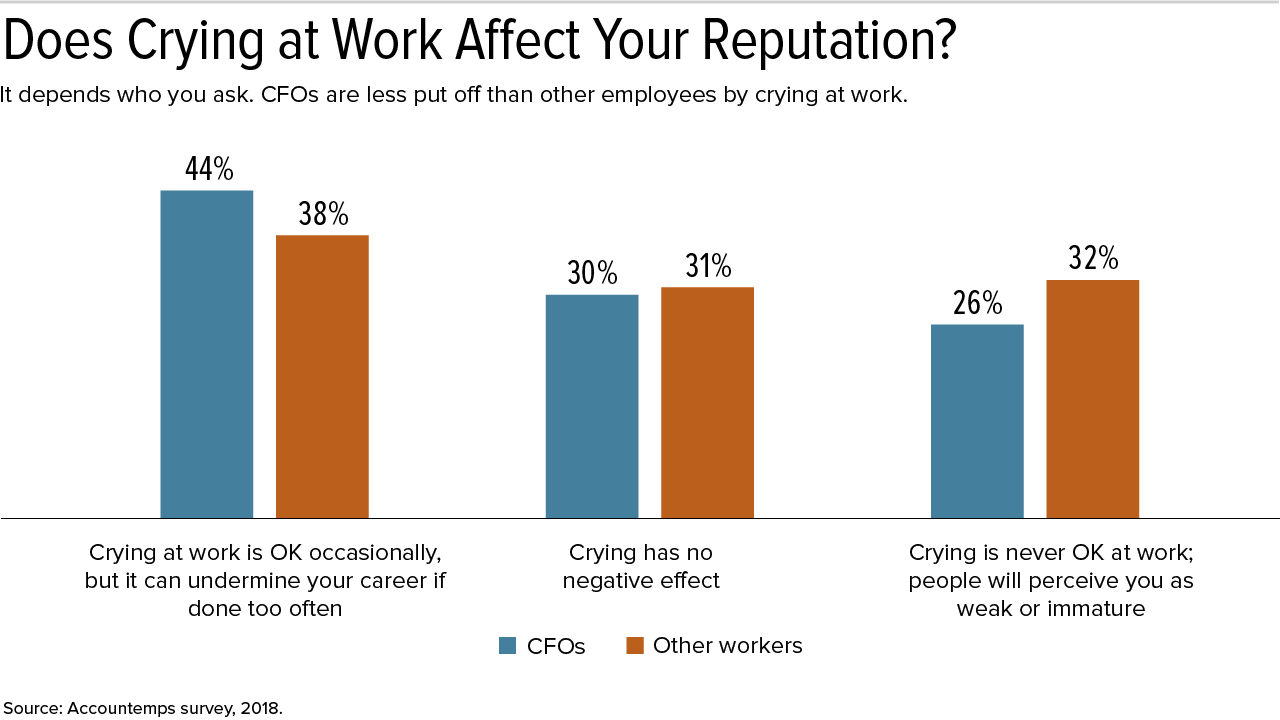
crying graphic.png

Negative Feedback, Job Loss

Shedding tears was a good outlet for an employee who learned her father had cancer and later as his health deteriorated from the terminal disease, said Miki Feldman-Simon. She is the founder of IamBackatWork, a Lexington, Mass., company aimed at women who are re-entering the workforce.

Getting weepy over work, though, is a different matter, she said. 

"An employee often crying over work-related matters is usually a sign of a poor fit with the role. Work itself should not make one cry."

But sometimes it does. In addition to performance reviews, layoffs can result in an emotional breakdown. That includes workers who kept their jobs.

Crying is common among layoff "survivors" who feel badly for former colleagues, experience survivor guilt and fear for their future at the company, said Susan Hosage, SHRM-SCP. She is a senior consultant and executive coach at OneSource HR Solutions in Wilkes Barre, Pa. HR professionals aren't spared either, she added, because "they have had to silently carry the burden for weeks or even months" before downsizing.

Jeffrey Naftal, SHRM-SCP, keeps a box of tissues on his desk. As HR director at Prince George's County Memorial Library System in Largo, Md., he sometimes breaks bad news or disciplines employees.

"I have never had a problem with employees crying at work. For some people, crying is the way they can release their tension or be able to cope with bad experiences."

For employees who routinely cry when receiving negative feedback, leaders should stay calm and give them a chance to compose themselves, suggest Karin Hurt and David Dye. They are trainers and authors of Winning Well: A Manager's Guide to Getting Results Without Losing Your Soul (Amacom, 2016) and suggest the following:

  • Tell the employee you've noticed that he or she gets emotional when participating in a feedback discussion.

  • Provide an example: "In our last one-on-one you cried and now you're getting upset again."

  • Ask the employee what he or she could do to have more productive discussions. 

Think before acting when faced with a tearful employee or co-worker, advised Michael Steinitz, executive director of Accountemps.

"Professionals spend many hours at work so many people are bound to shed tears at some point," he said. "A siege of emotions can be work related, such as receiving bad personal news or making a big mistake, but how you move past the situation shows your professionalism.

"For both employees and managers, it's important to practice emotional intelligence. Try not to overreact to a colleague who is crying, as it may be a way that person deals with pressure." 

In a world where personal and work lives are so intertwined, people should not be self-conscious about reacting to distress, said Natalie Leigh. She is owner and CEO of Natalie Ihde in Glendale Heights, Ill., a company that creates resources for working mothers. 

"We spend a minimum of 40 hours per week with people at work, and they become a part of our extended family. If we can't be ourselves from time to time with these people, then is it really a good environment to work in?" 

Labor & Employee Relations

Was this resource helpful?

Leave Feedback

SHRM-CP Promo Image
Validate your HR expertise

Earning your SHRM-CP credential makes you a recognized expert and leader in the HR field.

Get Certified


Related Content

(opens in a new tab)
News
How One Company Uses Digital Tools to Boost Employee Well-Being

Learn how Marsh McLennan successfully boosts staff well-being with digital tools, improving productivity and work satisfaction for more than 20,000 employees.

(opens in a new tab)
News
A 4-Day Workweek? AI-Fueled Efficiencies Could Make It Happen

The proliferation of artificial intelligence in the workplace, and the ensuing expected increase in productivity and efficiency, could help usher in the four-day workweek, some experts predict.

(opens in a new tab)
News
Rising Demand for Workforce AI Skills Leads to Calls for Upskilling

As artificial intelligence technology continues to develop, the demand for workers with the ability to work alongside and manage AI systems will increase. This means that workers who are not able to adapt and learn these new skills will be left behind in the job market.

HR Daily Newsletter

Stay up to date with the latest HR news, trends, and expert advice each business day.

Success title

Success caption

Manage Subscriptions
Our Brands

SHRM Foundation Logo
SHRM Executive Network Logo
CEO Circle Logo
SHRM Business Logo
SHRM Linkage Logo
SHRM Labs
Overview

  • About SHRM
  • Careers at SHRM
  • Press Room
  • Contact SHRM
  • Post an HR Job
SHRM Named to Newsweek's 2026 America's Top Online Learning Provider List
Advocacy

  • SHRM Advocacy
  • Federal Policies
  • State Affairs
  • Global Policy
  • Take Action
  • SHRM E2 Initiative
Brand Partnership

  • Partnership Opportunities
  • Advertise with Us
  • Exhibit & Sponsorship
  • Recertification Providers
  • Book a Speaker
Member Resources

  • Ask an HR Advisor
  • SHRM Newsletters
  • SHRM Flagships
  • Topics & Tools
  • Find an HR Job
  • Vendor Directory

© 2026 SHRM. All Rights Reserved
SHRM provides content as a service to its readers and members. It does not offer legal advice, and cannot guarantee the accuracy or suitability of its content for a particular purpose. Disclaimer

Follow Us

  • LinkedIn
  • Facebook
  • Twitter
  • Instagram
  • YouTube
Feedback

  1. Your Privacy Choices

  2. Terms of Use

  3. Accessibility

Join SHRM for Exclusive Access to Professional Content

SHRM Members enjoy unlimited access to articles and exclusive professional content resources.

Already a member? Login
Free Article

Login to unlock unlimited access or join SHRM today to get unlimited access to articles and member-exclusive resources.

Already a member? Login
Limit Reached

You've reached the limit of 1 free article this month. Join to access unlimited articles and member-only resources.

Already a member? Login
Free Article

Login to unlock unlimited access or join SHRM today to get unlimited access articles and member-exclusive resources.

Already a member? Login
Limit Reached

You've reached the limit of 1 free article this month. Join the Executive Network and enjoy unlimited content.

Already a member? Login
Unlock Your Career with SHRM Membership

Please enjoy this free resource! Join SHRM for unlimited access to exclusive articles and tools.

Already a member? Login
Join SHRM for Exclusive Access to Professional Premium Content

SHRM Members enjoy unlimited access to articles and exclusive professional premium resources.

Already a member? Login
Join SHRM for Exclusive Access to Student Content

SHRM Members enjoy unlimited access to articles and exclusive member resources.

Already a member? Login
Join SHRM for Exclusive Access to Executive Network Content

SHRM member enjoys unlimited access to articles and exclusive executive member resources.

Already a member? Login

Your membership is almost expired! Renew today for unlimited access to member content.

Renew now

Your membership has expired. Renew today for unlimited access to member content.

Renew Now

Your Executive Network membership is nearing its expiration. Renew now to maintain access.

Renew Now

Your membership has expired. Renew your Executive Network benefits today.

Renew Now
