
It's been three years since bystander footage went viral of a white Minneapolis police officer kneeling on a Black man's neck for more than nine minutes. The ensuing outrage and empathy surrounding George Floyd's death brought issues of systemic oppression and discrimination to the forefront of public consciousness, sparking conversations and debates regarding diversity, equity and inclusion (DE&I) in society and the workplace.
"George Floyd's murder ushered in an era of awareness," says Theresa M. Robinson, a Houston-based author and DE&I coach. "More people now know what they had not known previously."
Police brutality, workplace discrimination and other offenses against historically marginalized communities have buoyed social movements—including Black Lives Matter and #MeToo—and have given rise to the concept of "wokeness," a slang term that has become a staple in the political lexicon.
‘The concept of “woke” is not a monolithic or static one; It is constantly evolving and adapting to new cultural, political and social contexts.’ - Paul Wolfe
For years, the Black community ascribed the word "woke" to those alert to racism. In the three years since Floyd's death, it has become an umbrella term encompassing awareness of many aspects of DE&I—particularly systemic issues related to race, gender and sexuality.
"The concept of 'woke' is not a monolithic or static one," says Paul Wolfe, a workplace expert and former HR executive at Indeed, Condé Nast and Match.com. "It is constantly evolving and adapting to new cultural, political and social contexts."
The killings of unarmed Black individuals, deterioration of LGBTQ+ rights and the 2022 reversal of Roe v. Wade have created a groundswell of "wokeism" that has resulted in many employers taking steps to address societal ills. JPMorgan Chase allocated $30 billion in housing and business loans to people of color, while companies such as Microsoft and Starbucks announced that they would cover travel expenses for employees seeking out-of-state abortion care.
In recent years, many organizations have implemented recruiting and hiring practices that prioritize diversity, launched employee resource groups (ERGs) to promote cultural inclusion, invested in mental wellness programs, and created unconscious bias training for managers and employees. To sustain these strategies, organizations have created specific positions to promote diversity, equity and inclusion. DE&I-related job openings rose by 55 percent in the weeks following Floyd's murder, according to data from employment site Glassdoor. Many employers vowed to hire chief diversity officers and promised a renewed focus on addressing discrimination in their workplaces.
However, three years later, many businesses are walking back their commitments to DE&I. While some cite budget constraints as the main factor preventing further investment in DE&I programs, others harbor fears of public backlash, employee alienation and being perceived as "too woke." And the recent Supreme Court ruling that rolls back affirmative action efforts for college admissions only adds more anxiety to the question of how companies should address so-called "woke" programs.
How ‘Woke’ Became a Divisive Term
Opponents of social movements have begun to use the term "woke" mockingly, suggesting it is an insincere form of activism. Many critics now associate the word with what they perceive as political correctness, cancel culture and left-leaning bias.
"The term 'woke' is often used in a pejorative or dismissive way by those who are critical of social justice movements," Wolfe explains. "Some argue that this is because the term has been co-opted by mainstream culture and stripped of its original meaning and power."
Some companies have fallen victim to this backlash. Anheuser-Busch became embroiled in controversy after the company partnered with transgender activist Dylan Mulvaney for a campaign to promote Bud Light in March 2023. Customers boycotted Anheuser-Busch products in response, resulting in dwindling sales and downgraded stock shares in the weeks that followed, according to data from Bump Williams Consulting. Michel Doukeris, a top executive at Anheuser-Busch, released a statement a month later downplaying the brand's collaboration with Mulvaney.
"Bud Light's problem wasn't that they partnered with Dylan—an extremely famous social media influencer and excellent way to reach millions of consumers—it was that when the backlash started, they let [Dylan] take the fall and chose to walk their support back," says Ben Greene, a St. Louis-based public speaker, consultant and LGBTQ-rights activist.
Greene, a transgender man, says he bought several Bud Light products upon learning of the company's partnership with Mulvaney as a way to "send a signal to them that consumers were happy they were making a small show of support for the trans community in a time of immense national hatred and discrimination." But as the backlash swelled and Anheuser-Busch failed to defend or support Mulvaney, Greene became disappointed in the company.
‘I don't think the “woke” movement is losing steam; what is losing steam is performative activism.’ - Ben Greene
"Seeing them walk back their statement meant that we were no longer excited about showing our support to them," he explains. "We knew there wasn't true allyship coming from them."
The Walt Disney Company has also been under fire for its support of DE&I issues. In 2021, reports emerged that Disney World planned to implement a new anti-racism training course for its park employees to teach them about systemic racism and microaggressions. Internal company documents leaked to social media revealed that the company's training included a how-to guide called "75 Things White People Can Do for Racial Justice," although the program was reportedly canceled after the revelation came to light.
Disney's perceived missteps with "wokeness" apparently haven't hurt its bottom line, though. Despite being flippantly branded as "The Wokest Place on Earth" by many Twitter users, the company announced annual revenue of $82.7 billion in 2022—a $15 billion increase from 2021.
The Debate Over Critical Race Theory
Several politicians have vowed to keep the "woke movement" from a specific type of workplace: classrooms.
Notably, Florida Gov. Ron DeSantis signed into law the Stop Wrongs to Our Kids and Employees (WOKE) Act in April 2022. The legislation regulates how race and other DE&I topics can be discussed in schools, colleges and workplaces, to avoid what DeSantis has called "woke indoctrination," particularly regarding the concept of critical race theory (CRT).
Developed in law schools in the 1970s, CRT holds that racism is ingrained in the country's legal, financial and education system. Although the concept is seldom taught in grade schools, many conservative legislators have openly condemned CRT in education. Some states, including Pennsylvania and Wyoming, have banned books about people of color and LGBTQ+ issues.
Lauran Star, an adjunct professor at Merrimack College in North Andover, Mass., and the University of New Hampshire in Durham, says she has encountered instructors who are hesitant to discuss DE&I or social injustices with their students due to a potential backlash. But Star says she's confused by what being "too woke" means.
"Education is built on knowledge, not rhetoric," she says. "If discussing injustices with the goal to find solutions is considered being 'too woke,' then why have higher education? Why have education at all?"
Ella Washington, a professor of practice at the McDonough School of Business at Georgetown University in Washington, D.C., says she doesn't believe that universities are "too woke." She notes that history books are missing information about groups from many ethnic backgrounds, explaining that "creating room for more learning is never a bad thing."
"I ground my work in research, and I believe that people should have access to all the information and decide for themselves on what they will believe," Washington says. "The role of higher education is to enlighten minds. The institutions that do this best are those that welcome all perspectives and create space for meaningful learning and dialogue across differences."
Why DE&I Still Matters
The recent rise in anti-woke rhetoric has coincided with a palpable decline in DE&I efforts across organizations. A 2023 report by LinkedIn that assessed more than 500,000 C-suite hirings between 2019 and 2022 indicated that, after significantly growing in 2020 and 2021, the number of chief diversity officers (CDOs) hired declined in 2022. CDOs were the only C-suite position to experience a reduction in hiring in 2022.
‘The principles of DE&I never go out of style. A company doesn't have to worry as much about doing the “right thing” when the “right thing” is who they are.’
Theresa M. Robinson
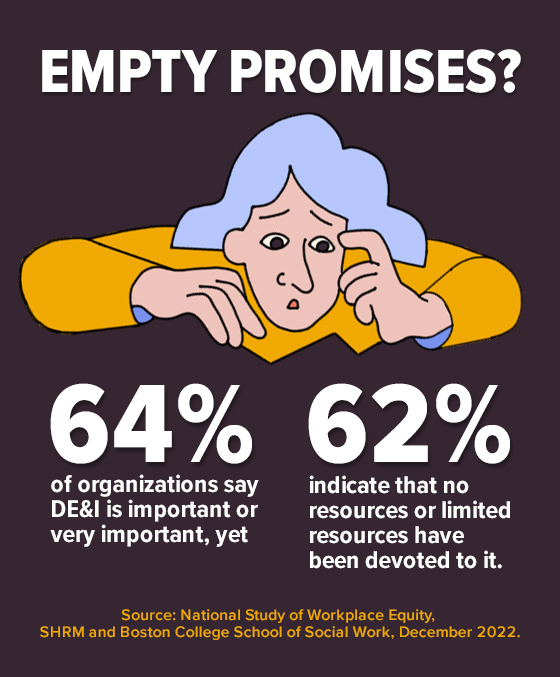
Additional data released in 2023 by SHRM reveals that more than one-third of employers have not invested resources in DE&I efforts in the past year, half citing a lack of prioritization among senior leaders as the reason. SHRM Research also found that larger companies are more likely than smaller ones to have invested resources in DE&I efforts this past year.
However, Greene says that representation still matters. Historically marginalized communities, including people of color and women, still face barriers to leadership. The unemployment rate for people with disabilities has shrunk since the rise of remote work, but it remains significantly higher than that for the general population. Additional reports suggest that workplaces continue to discriminate against workers due to their religious affiliations.
"I don't think the 'woke' movement is losing steam; what is losing steam is performative activism," Greene says. "Trying to do something tiny to win diversity points but not taking any strong stand for your employees or for a community is taken note of by consumers."
Benevity, a Calgary-based company that provides charitable grant-management platforms, found that 95 percent of about 1,000 surveyed employees consider a prospective employer's DE&I efforts when choosing among job offers with similar salaries and benefits.
Generation Z is closely monitoring organizational DE&I efforts. A 2022 report by recruiting technology provider iCIMS indicated that this group cares deeply about workplace issues such as equal pay and diversity. They frequently challenge and encourage corporations to have robust social responsibility programs.
But what if fostering a DE&I-focused workplace alienates employees, consumers and stakeholders?
"Losing a customer is preferable to a company losing its soul," Robinson says. "The principles of DE&I never go out of style. A company doesn't have to worry as much about doing the 'right thing' when the 'right thing' is who they are."
Wolfe offers tips for CEOs looking to remain committed to DE&I without experiencing public or consumer backlash:
Exercise transparency. Be direct about your DE&I initiatives and goals, and communicate them clearly to your employees, customers and stakeholders to build trust and credibility. Transparency can demonstrate a genuine commitment to creating positive change.
Educate and involve employees. Provide opportunities for education and training to build a more inclusive workplace culture and encourage employees to take ownership of the DE&I process.
Be authentic. Avoid tokenism or performative activism. This means ensuring that your DE&I initiatives and goals align with your company's values and culture and are not simply designed to appeal to a particular audience or trend.
Seek feedback. Solicit the opinions of your employees, customers and stakeholders about your DE&I efforts. Use this input to make improvements and adjustments as necessary to ensure your initiatives are meaningful.
Take a long-term approach. Recognize that meaningful change takes time. Set realistic goals and expectations. Be committed to ongoing learning and improvement.
"'Wokeness' is not a fixed or static concept, but is constantly evolving and adapting to new cultural and political contexts," Wolfe says. "As such, it's important to engage in ongoing dialogue and reflection about what it means to be 'woke' and how to create positive change in the world."
The Pros and Cons of 'Wokeness'
According to Paul Wolfe, there are both pros and cons for businesses who embrace the ideals sometimes labeled as "woke."
Pros:
- Greater awareness of social injustices. Being "woke" can boost awareness of social injustices and their impact on individuals and communities. This can lead to more empathetic and compassionate workplace cultures and a greater appreciation of different perspectives and experiences.
- Improved DE&I. A "woke" approach can result in more inclusive workplaces where individuals feel valued and included regardless of their race, gender, sexual orientation or other identity markers. Committing to DE&I can create a diverse workforce and improve collaboration and innovation.
- Enhanced social responsibility. Being "woke" can promote a sense of social responsibility and a commitment to creating positive social and environmental change. This gives way to increased community engagement and positive brand reputation, which can benefit companies' bottom line.
Cons:
- Polarization and divisiveness. Being "woke" can lead to polarization and divisiveness, particularly if employees have different views on social justice issues. This can create tension and conflict in the workplace, which can be detrimental to productivity and morale, especially during an election year, when stress is already high among employees with opposing viewpoints.
- Perceived tokenism. DE&I initiatives may be viewed as tokenistic or performative rather than genuine efforts to promote equity and inclusion. Programs perceived as disingenuous can compromise employee trust and credibility. It can also undermine the effectiveness of such initiatives.
- Over-reliance on buzzwords. In some cases, the terminology associated with "wokeness" can be overused or misused, leading to confusion and misunderstanding and contributing to a sense of "us versus them," which can create a hostile or unwelcoming workplace culture.
Related Articles

Transform HR with mobile technology to streamline workflows, enhance communication, and boost employee engagement across distributed teams.

A new study found that talent development practitioners believe performance-based assessments are more effective at measuring employee learning outcomes than knowledge tests.

As AI makes deeper inroads into organizations, employee concerns about the technology continue to grow. Here's how HR leaders can address the fear of AI among their own staff, as well as in the wider organization.