GenAI Will Bring Unprecedented Workforce Disruption
Generative AI will transform roles and lead to widespread displacement of workers. How should business leaders respond?

Adapting to emerging technologies isn’t a new challenge for corporate executives. Whether it’s cloud computing, smart phones and 5G, the Internet of Things, or 3D printing, new innovation has often forced the C-suite to refashion business strategy to account for the effects of automation introduced throughout the enterprise.
But experts say the arrival of the latest next-generation technology poses unique and unprecedented challenges that will test the ability of even the most seasoned CEOs to respond in a way that maximizes the technology’s benefits and limits its risks.
Unlike other forms of automation, generative artificial intelligence (GenAI) won’t just impact blue-collar and entry-level jobs. It will redefine many highly skilled professional jobs in disciplines across organizations.
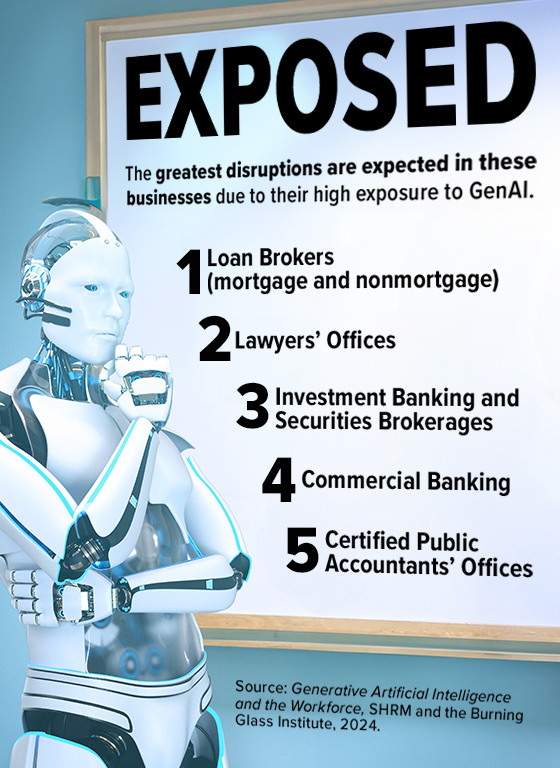
A newly released report from SHRM and the Burning Glass Institute, titled Generative Artificial Intelligence and the Workforce, found that the accelerating adoption of GenAI will cause the broad transformation of roles such as financial analysts, lawyers, software developers, marketers and human resource professionals. While few of those jobs will be fully replaced by GenAI, many will be augmented and fundamentally reshaped by the rapidly evolving technology.
Top executives will be faced with difficult decisions as GenAI becomes a mainstay in their organizations’ technology platforms. For example, the SHRM and Burning Glass Institute report found that the surge in productivity and output GenAI will create over time is unlikely to meet a corresponding growth in demand for goods and services. This will lead to overstaffing in many industries. Senior leaders will need to craft mitigation strategies, such as hiring freezes, to minimize the disruption.
CEOs will need to work more closely with their CHROs, chief technology officers (CTOs), chief information security officers (CISOs) and legal counsel on GenAI-related issues, the SHRM/Burning Glass report found. They will need to design talent management, governance, legal and cybersecurity strategies to capitalize on the vast productivity and efficiency benefits created by GenAI. At the same time, they will need to overcome its still-significant risks.
Impact on Business Strategy
Technology analysts believe that in 2024 organizations will increasingly adopt GenAI, including OpenAI’s ChatGPT and DALL-E, Google’s Bard, and Microsoft Copilot, as corporate leaders install more rigorous governance plans. Additionally, the still-high costs of the technology will fall and the results of GenAI proof-of-concept projects will encourage broader enterprise rollouts.
Analysts also expect that GenAI tools will become a standard feature of vendor technology platforms used in HR, customer service, marketing, cybersecurity, supply chain management and more. Walmart is one of the latest organizations to double down on its investment in GenAI. The retailer recently announced it was expanding access to the company’s proprietary GenAI platform, My Assistant, to 25,000 additional employees in 10 more countries this year.
Barriers to adoption of the technology will remain, including the risks posed by use of public large language models (LLMs) such as ChatGPT. These risks include violating copyright laws or basing decisions on inaccurate outputs. Still, CEOs need to find ways to capitalize on GenAI or risk falling behind competitors.
A 2023 global study by IBM’s Institute for Business Value found that 75 percent of CEOs believe the organizations with the most advanced forms of generative AI will have a competitive advantage. Half of those CEOs also said they’ve already integrated GenAI into products and services, with 43 percent reporting they’re using GenAI to inform their strategic decisions.
This current generation of tools are not cheap. GenAI is by no means a free replacement of labor."
Bryan Ackermann
The ubiquitous nature of the technology will impact leadership decisions on multiple levels. “It’s affecting everything from establishing governance strategies that ensure control but don’t deter innovation to employee value propositions to how an organization trains its workforce to use the technology effectively and responsibly,” says Bryan Ackermann, head of AI strategy and transformation in Scottsdale, Ariz., for consulting firm Korn Ferry. “We’ve rarely seen a technology evolve this quickly and become ubiquitous in its first year of introduction.”
But investing in the technology doesn’t come without caution flags. For one thing, executives need to weigh the considerable costs to develop, deploy and maintain the software. These include expenses tied to using application programming interfaces (APIs) to connect to GenAI tools from the likes of OpenAI or Google.
“This current generation of tools are not cheap,” Ackermann says. “GenAI is by no means a free replacement of labor. As enterprise vendors have released more GenAI products and a plethora of startups have done the same, these tools all remain reasonably expensive because of the costs of the underlying computing power.”
Small and midsize organizations aren’t without hope in this environment. Analysts say they can start to get in the GenAI game by using new tools such as artificial-intelligence-as-a-service (AIaaS) platforms, which are technologies that allow organizations to license GenAI software without prohibitive upfront capital or labor costs.
GenAI’s Impact on Jobs
The SHRM/Burning Glass Institute report found that the use of GenAI is more likely to augment than replace most existing jobs in the short term. But job roles with high exposure to GenAI will remain vulnerable to being automated in the future. While workforce reductions resulting from the use of AI could become widespread over the coming decade, many of those cuts may be driven less by machines replacing humans than by economic growth lagging behind significant leaps in worker productivity.
“Despite the best efforts of savvy HR leaders, workforce reductions will become increasingly pressing as GenAI transforms the macroeconomic landscape,” the SHRM/Burning Glass report says.
Gad Levanon, chief economist with the Burning Glass Institute in New York City, offered an example of how the growing use of GenAI in software engineering jobs could impact organizations in the future.
“Ten software developers in a company might now be able to do the work of 15, for example, because of the increased efficiency introduced by GenAI,” Levanon says. “But the demand for goods and services of the organization employing those developers may only increase by 10 percent in a certain time frame, not 50 percent. So that organization may become overstaffed because it doesn’t need as many developers.”
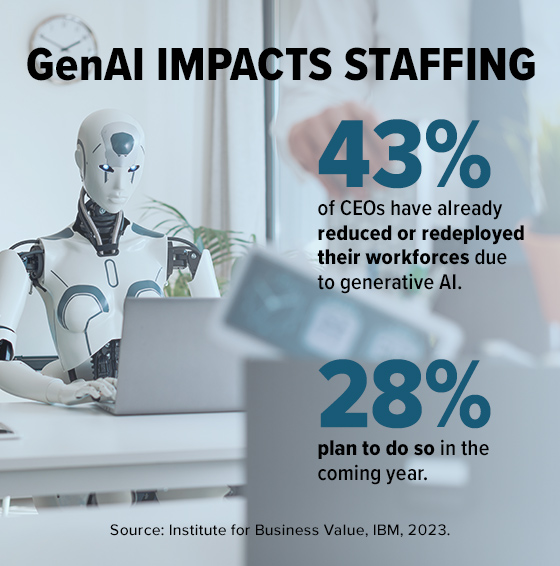
The IBM study found that 43 percent of responding CEOs said they’ve already reduced or redeployed their workforces due to generative AI, with another 28 percent saying they planned to do so in the coming year.
While disruptions caused by GenAI will in some cases carry human costs, the SHRM/Burning Glass report found those costs may be short-lived.
“Corporate profits will increase as firms benefit from decreased payroll costs,” the report says. “In a competitive market, we expect price decreases to follow. Finally, price cuts and new jobs created by GenAI will drive increased demand and employment will rebound, at least somewhat.”
Despite the best efforts of savvy HR leaders, workforce reductions will become increasingly pressing as GenAI transforms the macroeconomic landscape."
Generative Artificial Intelligence and the Workforce, SHRM and the Burning Glass Institute
The report also found that in the long term, research and development (R&D) will accelerate as GenAI enables researchers to process more data and achieve new discoveries more quickly.
In their 2024 workplace predictions, analysts in the HR practice at consulting company Gartner said AI will likely create and not diminish workforce opportunities.
“Despite anxiety and significant discussion around how GenAI will impact jobs, in the short to medium term GenAI will fully replace few jobs,” Gartner analysts wrote in their report. “GenAI will lower the level of technical skills needed for many roles, widely increasing the roles for which candidates can qualify. Many jobs heavily impacted by GenAI will be redesigned and will have new responsibilities that include interacting with GenAI tools.”
Some experts believe GenAI will lead to more hiring and not less, as the technology unleashes more creativity and innovation per employee. The IBM study, for example, found that 46 percent of CEOs have already hired additional workers because of GenAI, with 26 percent saying they have plans for more hiring ahead.
Talent Management Implications
Jill Goldstein, global managing partner for talent transformation at IBM Consulting, says it will fall primarily to CHROs, working together with other HR leaders and line managers, to help identify which tasks within specific job roles can be automated or augmented by GenAI.
“People tend to talk in extremes about GenAI’s impact, such as employees losing jobs or jobs being completely redesigned,” Goldstein says. “But in more cases than not, it will only be the transactional or rote tasks within existing jobs that will be automated through use of either traditional AI or GenAI.”
Accountants, for example, will likely continue to focus on their core tasks including revenue recognition and risk mitigation, but will use their new “digital buddies”—GenAI tools—to handle more of the transactional tasks in their jobs, Goldstein says. “And by applying AI to the job, you may be able to release 25 to 40 percent of the capacity of those accountants.”
CHROs should be in the driver’s seat of rethinking and redesigning job roles that will be impacted by GenAI."
Jill Goldstein
The SHRM/Burning Glass report found the occupations with the highest exposure to GenAI will include these roles:
- Financial analysts, actuaries and accountants who spend much of their time crunching numbers—a task that GenAI can help streamline.
- Auditors, compliance officers and lawyers involved in regulatory compliance. The use of GenAI can facilitate quicker compliance checks in these roles.
- Software developers, whose routine tasks such as creating code and monitoring systems can be augmented or entirely managed by next-generation AI.
- Administrative roles that involve structured, routine tasks such as data entry and appointment scheduling that are conducive to AI-based replacement.
Correspondingly, the industries with the greatest exposure to GenAI will include financial services, law, marketing research and business services/consulting, the SHRM/Burning Glass report found. Service, manual and other occupations that require in-person work and that have been experiencing staffing shortages, such as nursing, are unlikely to be impacted as much by GenAI, the report found.
These profound impacts on talent management strategy will require CEOs to work more closely with their CHROs to help build both recruiting and workforce reskilling plans that ensure the organization is equipped with the right people and skills to get strong returns from GenAI technology investments. One oft-overlooked factor is that GenAI will likely have as big an impact on nontechnical job roles as on technical ones, experts say.
“The notion that generative AI is only information-technology-centric isn’t the case,” says Annemarie Schaefer, vice president of research for SHRM, who oversaw the report. “It will impact entire organizations, and as such requires that CEOs and executive teams set clear GenAI-related business strategies. It’s up to CEOs to understand how GenAI can and should impact strategy, and then pass the torch to their CTOs, CIOs and CHROs to help manage technology deployment, talent acquisition, skill development and more.”
Experts say CHROs will need to oversee a granular review of all job roles to determine which tasks within those roles might be automated or augmented through use of GenAI.
“CHROs should be in the driver’s seat of rethinking and redesigning job roles that will be impacted by GenAI,” Goldstein says. “It will be increasingly important to conduct a job task analysis to understand which tasks within jobs exposed to GenAI can be automated or augmented, and then create a GenAI skills road map to reskill or recruit to those needs.”
Ackermann says such an analysis also should include planning for what to do with work capacity “unleashed” by GenAI as well as additional time needed for quality control of GenAI’s outputs. For example, 2023 research from Accenture found that GenAI may eventually free up 40 percent of working hours across organizations.
Additional time will be required for due diligence, however. “You also need to understand how much time will be added back into the work environment in terms of checks and balances and quality assurance needed after receiving a first draft of GenAI’s output, for example,” Ackermann says.
Goldstein says the arrival of GenAI should increase leaders’ recognition of the need to invest more in the overall technical acumen of the workforce. “This isn’t just in the IT group or only specific to GenAI,” she says, “but rather to ensure the entire workforce has a base level of technical acumen to be able to understand and use all of the new technologies recently introduced and to come.”
 |
Despite the promise of GenAI, concerns about the revolutionary technology keep many CEOs up at night. These worries include still-unsettled legal issues around copyright infringement when using the public large language models (LLMs) that are fundamental to GenAI and the dangers of inaccurate or biased GenAI outputs influencing weighty business decisions. Additionally, new laws will likely be enacted around the world regulating AI use. In an example of the unsettled landscape, late last year The New York Times sued OpenAI, the maker of ChatGPT, as well as its investor Microsoft for alleged copyright violations for using the newspaper’s content to train ChatGPT’s public GenAI models. OpenAI has responded by saying the lawsuit is “without merit.” Despite such concerns, experts say there are proven steps executives can take to protect against the risks of using GenAI in the enterprise. Creating more rigorous governance strategies and clearly-defined policies about GenAI use are two such steps to safeguard against potential problems. “Executives first need to decide what needs to be governed from the center to protect against potential issues around bias, accuracy of the technology and data security,” says Bryan Ackermann, head of AI strategy and transformation for consulting firm Korn Ferry. “You don’t want use of GenAI to evolve haphazardly in a decentralized fashion, but you also don’t want to stifle innovation in the organization,” Ackermann says. “That’s a difficult balancing act, even for organizations experienced in using more traditional forms of AI.” Heavy-handed oversight of GenAI use can have adverse impacts, experts say, triggering a rise in the “shadow” use of the technology in organizations. “The decision an organization makes to allow GenAI use or not has to be done with recognition that it may chase use of the technology underground,” Ackermann says. “That is where you see GenAI tools being used on employees’ phones without others in the organization knowing.” CEOs also need to consult with legal counsel when creating GenAI policy. Consulting company Gartner recommends that legal leaders guide discussions with senior management on “must-avoid” outcomes with GenAI. One example of such an outcome could be major reputational harm from GenAI use that causes permanent brand damage, says Laura Cohn, a senior principal and legal expert at Gartner. “For example, if a generative AI-powered application of a consumer products company gives legal, financially or morally-unsound advice to consumers, the consumers could lose trust in the brand,” Cohn says. Gartner suggests compiling a list of ways AI might be applied in an organization and sorting them according to perceived risk—both the likelihood and severity of the risk. Higher-risk scenarios might require stricter controls, such as requiring approval from a manager or GenAI committee to use the technology, for example. Jill Goldstein, global managing partner for talent transformation at IBM Consulting, says CEOs shouldn’t let the risks of using GenAI paralyze them into inaction. “While it’s important to be cautious and create a clear GenAI strategy before moving forward, the best way to learn is by doing,” Goldstein says. “We recommend CEOs and other leaders start with pilots and proof of concept in a contained fashion, using things like private large language models instead of public ones to reduce risks of problems like exposing confidential data or of copyright violations.” Jason Averbook, senior partner and leader of digital HR strategy for consulting firm Mercer, says CEOs would be wise to view effective governance and regulation as a force multiplier of GenAI rather than as an onerous part of the equation. “If organizations are using GenAI as an amplifier of employee capability—as a second brain instead of a first brain—and are keeping humans in the loop to evaluate GenAI outputs, their risks diminish,” Averbook says. “Like any other emerging technology, if you put the proper guardrails in place, the rewards will likely be exponentially higher than your risks. Governance is what will give GenAI its powerhouse capabilities. Those rules of engagement make the technology safer and more trustworthy over the long term.” —D.Z. |
Dave Zielinski is a freelance business journalist in Minneapolis.
Explore Further
SHRM provides resources to help business leaders capitalize on the benefits promised by GenAI.
Generative Artificial Intelligence and the Workforce
This research report from SHRM and the Burning Glass Institute provides information for organizations on how to anticipate and develop workforce strategies as GenAI disrupts work.
How to Move Forward with Generative AI, LLMs
To embrace new technologies safely, employers must develop policies for the use of these tools and educate workers on these guidelines and best practices.
Microsoft and AFL-CIO Partner on Developing AI
A historic tech-labor partnership will involve union members in AI development, train workers on AI and advocate pro-worker policies.
HR Implications of President Biden’s AI Executive Order
Human resource professionals searching for guidance on managing artificial intelligence should pay attention to the Biden administration’s October 2023 executive order that seeks to manage the risks of AI and reap its benefits.
EU Reaches Deal on Regulation of AI
European Union policymakers reached a deal late last year on the proposed AI Act, which includes steep penalties for violations.
SHRM Resource Hub Page: Artificial Intelligence in the Workplace
Insightful content and expert perspectives for organizations to leverage the potential of AI.

Related Articles

Transform HR with mobile technology to streamline workflows, enhance communication, and boost employee engagement across distributed teams.

A new study found that talent development practitioners believe performance-based assessments are more effective at measuring employee learning outcomes than knowledge tests.

As AI makes deeper inroads into organizations, employee concerns about the technology continue to grow. Here's how HR leaders can address the fear of AI among their own staff, as well as in the wider organization.