What Is Workforce Pell?
Workforce Pell Grants extend traditional federal Pell Grant eligibility beyond degree programs to include short-term workforce training programs that prepare students for immediate employment or career advancement.
Enacted under the Reconciliation package, signed July 4, 2025, this policy allows eligible students to use federal financial aid for career-focused credentials typically completed in 8-15 weeks.
The goal is to support adult learners, working professionals, and nontraditional students seeking faster, more affordable pathways into the workforce.
Eligible programs generally:
- Last 8-15 weeks (150–599 clock hours)
- Lead to a recognized postsecondary credential
- Align with high-skill, high-wage, or in-demand occupations
- Support stackable and portable credentials
- Provide pathways that connect to academic credit or degree programs where applicable

SHRM Feature: Workforce Pell Puts Employers at the Center of Skills-Based Training
Expanded Pell Grant eligibility for short-term workforce training could help employers address skills shortages while accelerating workers’ credential attainment. Employers should engage with state workforce systems as states determine qualifying high-skill, high-wage, and in-demand occupations. Because programs must meet specific requirements and demonstrate outcomes, employers should focus on quality training, not funding eligibility alone.
How Workforce Pell Works
Workforce Pell implementation is a shared federal-state responsibility, with distinct roles for the U.S. Department of Education (DOE) and state governments.

Federal Responsibilities
The DOE is responsible for ensuring programs meet baseline eligibility and accountability standards, including:
- Programs must have been in existence for at least one year
- Programs must demonstrate completion rates of at least 70%
- Programs must demonstrate job placement rates of at least 70%
- Tuition must be below graduates’ median value-added earnings, defined as income exceeding 150% of the federal poverty line three years after completion
- Institutions must meet federal Title IV eligibility requirements
These standards are intended to ensure programs deliver measurable labor market value and student outcomes.

State Responsibilities
State governors, in coordination with State Workforce Development Boards, are responsible for ensuring programs align with local labor market needs. States must confirm that eligible programs:
- Prepare students for high-skill, high-wage, or in-demand occupations
- Lead to recognized postsecondary credentials
- Support stackable and portable credentials across employers, unless the credential applies to a single recognized occupation
- Align with broader state workforce development strategies
States play a central role in determining which programs are approved for participation in Workforce Pell funding.
Under the Workforce Innovation and Opportunity Act (WIOA), training funds are specifically directed toward careers that are high-skill, high-wage, and high-demand. State and regional workforce boards maintain specific Target/Demand Occupations Lists.
WIOA State Plans outline what your state or territory is doing to help Americans, including youth and those with significant barriers to employment, into high-quality jobs and careers, and help employers hire and retain skilled workers.
Learn more at the WIOA State Plan Website
Program Design and Key Features
Workforce Pell represents a structural shift in how federal education funding supports workforce development. By expanding access to short-term training while increasing accountability for outcomes, the program aims to better align education pathways with labor market demand.
To qualify, programs must:
- Connect to recognized credentials
- Offer pathways that can stack toward additional credentials or degrees
- Demonstrate alignment with employer demand and workforce needs
How Programs Are Approved
Workforce Pell approval of programs generally follows this process:
1
Be approved by the institution's accrediting agency or be included in the institution's grant of accreditation by its accreditor
2
Be approved by the State Governor
3
Be approved by the DOE
What Does this Mean?
In practical terms, Workforce Pell means that federal financial aid will now help pay for short-term job training programs — not just traditional college degrees. This is a significant expansion of how the federal student aid system supports education, workers, and workforce readiness.
Most programs that will qualify are offered by existing higher education and training institutions that already participate in federal financial aid programs under Title IV of the Higher Education Act. This includes community colleges, technical colleges, and other accredited postsecondary institutions that already operate within the federal student aid system.
Students
For students, this change lowers the cost barrier to enrolling in fast, career-focused training programs that can lead directly to employment or advancement in fields like healthcare, IT, manufacturing, transportation, and skilled trades.
Employers
For employers and the broader workforce system, it means a larger pipeline of candidates who have completed short, structured programs that are designed around specific job skills and validated labor market needs.

SHRM's Education-to-Employment (E²) Initiative
SHRM's Education-to-Employment (E²) Initiative is focused on strengthening the connection between education and work. By addressing challenges across K-12 education, higher education, and untapped talent, E² brings together employers, educators, policymakers, and workforce leaders to build stronger pathways to opportunity.
Because people do not live, learn, or work in silos, workforce solutions cannot either.
Press Release: U.S. Department of Education Approves Nation's First Workforce Pell Grant Program at Iowa Central Community College
On August 4, 2026, the U.S. Department of Education approved the nation’s first Workforce Pell Grant program. Eligible students at Iowa Central Community College can now use federal Pell Grant dollars to enroll in the Emergency Medical Technician program, a 14-week program that prepares students for key public safety jobs.

Registered Apprenticeships and Workforce Pell
Under Workforce Pell, the related technical instruction (RTI) component of a Registered Apprenticeship may qualify for funding if it meets all applicable eligibility requirements. This creates an opportunity to expand access to the classroom and technical training portion of apprenticeship programs while maintaining the core apprenticeship model that combines instruction with paid, on-the-job learning.
Key Benefits for Registered Apprenticeships
Eligible workforce programs that serve as the related instruction component of a Registered Apprenticeship receive certain advantages:
- They are automatically considered to meet state requirements related to preparing students for high-skill, high-wage, or in-demand occupations.
- They are automatically considered to satisfy employer hiring demand requirements for those occupations.
- They may enter into written arrangements with outside entities to provide up to 49.9% of the instructional program.
Important Considerations
While Registered Apprenticeships receive certain flexibilities, the related technical instruction component must still independently satisfy Workforce Pell requirements. This means the instructional portion must:
1
Meet applicable requirements related to program length and instructional hours
2
Demonstrate required completion and employment outcomes
3
Lead to a recognized postsecondary credential
4
Provide academic credit that can be applied toward a related certificate or degree program
Importantly, Workforce Pell funding applies only to the instructional portion of a Registered Apprenticeship — not the paid on-the-job training component. This approach allows apprenticeship programs to benefit from expanded financial aid opportunities while maintaining the accountability and quality standards required of all Workforce Pell-eligible programs.
For employers, this creates another avenue to support workforce development by connecting apprenticeship pathways with federal financial aid and recognized credentials, helping strengthen talent pipelines in high-demand industries.
SHRM’s 2026 Talent Trends research shows:
- 84% of HR professionals whose organizations offer or partner with apprenticeship programs reported that those programs were somewhat effective or very effective at addressing talent shortages.
- 59% of HR professionals agree that apprenticeship programs can be used to develop skills where talent is needed.
Apprenticeship models already span a wide range of industries and occupations. Talent Trends found that the top reported occupation groups with apprenticeships were installation, maintenance, and repair (25%), construction and extraction (19%), and production (15%).
State-Level Engagement
SHRM members are on the frontlines of hiring, workforce planning, and talent development, giving them a unique perspective on the skills and credentials employers need. Because Workforce Pell implementation is largely driven at the state level, employer input will be critical to ensuring approved programs align with labor market demand and lead to meaningful employment opportunities.
For SHRM and its state councils and affiliate network, this presents an opportunity to engage early with governors, State Workforce Development Boards, and education providers. Employer engagement can help shape program approval decisions, identify in-demand occupations, and ensure training programs are responsive to workforce needs.

State Implementation Landscape
While federal law establishes baseline requirements, states have significant discretion in determining how Workforce Pell operates. Governors, in consultation with State Workforce Development Boards, must establish and publish the policies and processes used to evaluate and approve eligible workforce programs.
States are actively developing implementation frameworks, including:
- Establishing advisory or governance structures to guide program approval
- Issuing implementation guidance for institutions and providers
- Identifying high-skill, high-wage, and in-demand occupations
- Defining state-level approval processes for eligible programs
These decisions will directly influence which programs are approved, which credentials are prioritized, and how effectively training aligns with workforce needs. As a result, Workforce Pell is unlikely to be implemented uniformly across the country. For SHRM members and state affiliates, this creates a valuable opportunity to provide employer insight and help shape a system that better connects education, skills development, and employment.
States must publish:
- A methodology for identifying high-skill, high-wage, and in-demand sectors and occupations
- A policy for determining whether a program meets employer hiring needs in those sectors and occupations
- A policy for determining whether a credential is stackable and portable
- A process for demonstrating that program credits can be applied toward a certificate or degree program at an eligible institution
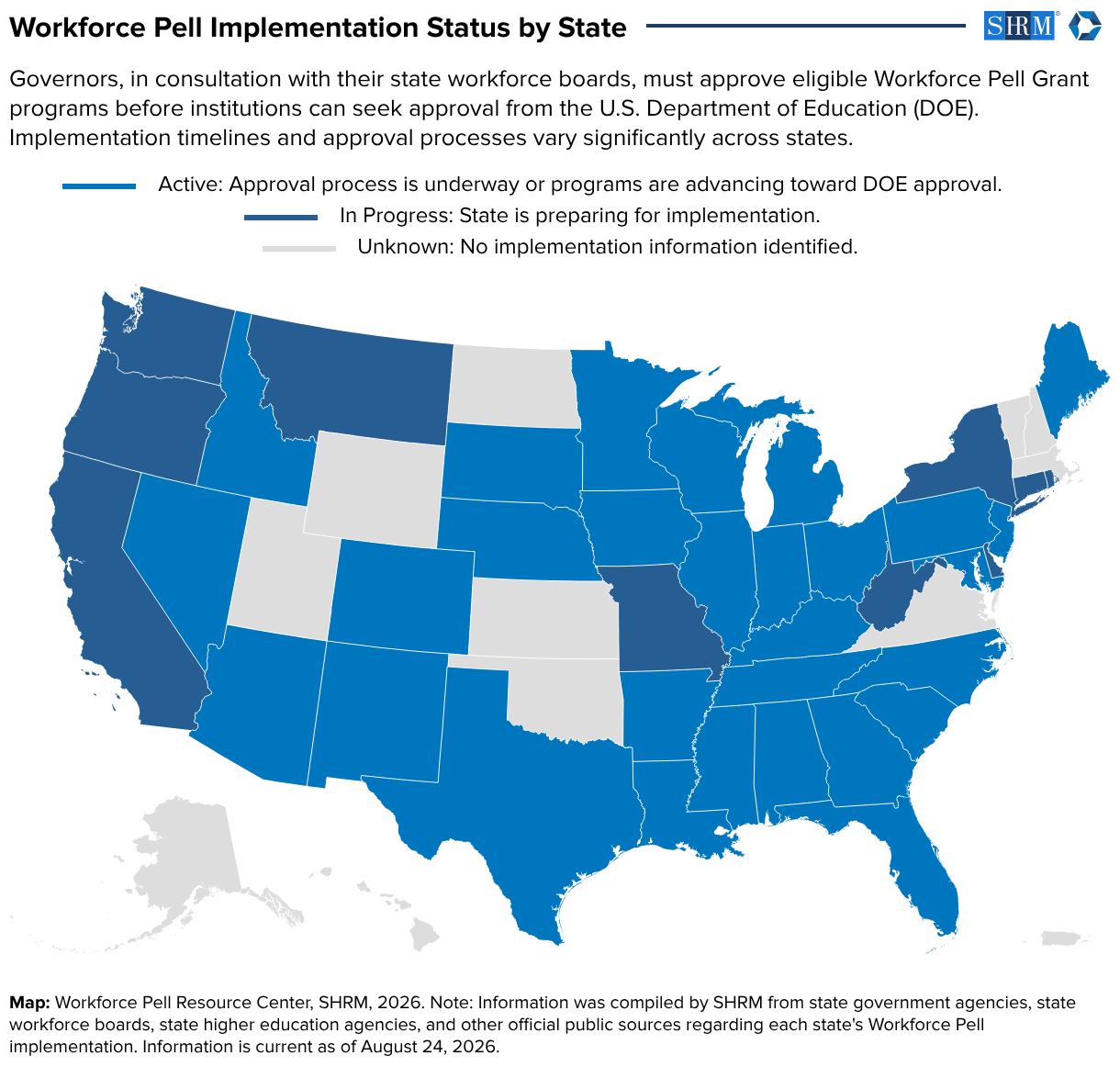
Workforce Pell Implementation Status by State
Eligible workforce programs became eligible July 1, 2026. Implementation now sits with each state: governors, in consultation with their state workforce boards, must approve eligible programs before institutions can seek approval from the US Department of Education. Implementation timelines and approval processes vary significantly across states.
Want to be involved in your community but do not know where to start?
Have you considered joining a Workforce Development Board (WDB)? WDBs are local and state bodies that help shape how workforce training and employment services are delivered in communities. These bodies create strategic workforce plans, direct federal workforce funds, and guide local training programs based on real-time labor market data. They partner with employers to ensure talent pipelines are aligned with business needs, especially in high-demand industries.
Steps to get involved:
- Download a quick FAQ for more information.
- Find WDBs in your area.
- Have you previously served on a WDB and would like to share your experience? Tell us about it! Email us at Govermentaffairs@SHRM.org.
Frequently Asked Questions (FAQs)
Workforce Pell funding is expected to begin in July 2026.
Low-income students enrolled in approved short-term workforce training programs.
Programs lasting 8-15 weeks that lead to recognized credentials and align with in-demand occupations.
Approval is shared between the U.S. Department of Education and state governments.
Employers help validate labor market demand and ensure programs reflect real workforce needs.
Programs are encouraged to offer stackable and portable credentials, and in some cases academic credit toward degrees.
Key Government Resources
Federal Student Aid (FSA)
Access training materials, courses, and resources to better understand federal student aid programs and requirements.
FSA Knowledge Center
Explore official guidance, announcements, and reference materials related to federal student aid administration.
FSA Partner Connect Help Center
Find answers to common questions and access support resources for institutions participating in federal student aid programs.
E-App and Third-Party Servicer Updates
Learn about recent updates to institutional application processes and third-party servicer reporting requirements.
Title IV Application (E-App) Home Page
Access the Electronic Application (E-App) portal and related resources for Title IV program participation and updates.
Contact SHRM Government Affairs
We are committed to responding to your inquiries promptly and look forward to connecting with you. Thank you for your interest in our work and your support in shaping the future of work, workers and the workplace.
General Inquiries, Public Policy and Collaboration Opportunities
For general questions, public policy-related inquiries, information about our advocacy efforts, or collaboration opportunities, please contact our team at: governmentaffairs@shrm.org.
Media Inquiries
For members of the media seeking information, interviews or press-related inquiries, please reach out to our media relations team at press@shrm.org.